Warm up

 Classroom clean up. Your tasks are written on your
  tables.
 Create a Venn Diagram on your own sheet of
  scratch paper. Compare and contrast similarities
  between mitosis and meiosis. Use your notes to help
  you.


 FYI: I‟m still getting my voice back. 
Nature of Science

We will now start our section on evolution. Before we
do, we need to understand how science works (nature
of science).

What would your definition of science be. Think about it
for a minute and then share with your neighbor. Be
ready to share out with the class.

Hopefully by the end we will talk about all of your
definitions.
Nature of Science

Complete the Nature of Science Survey in the Before
column.
Nature of Science

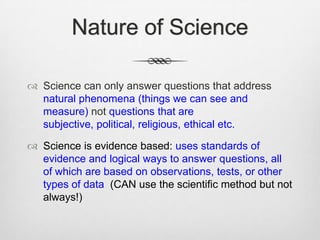
 Science can only answer questions that address
  natural phenomena (things we can see and
  measure) not questions that are
  subjective, political, religious, ethical etc.

 Science is evidence based: uses standards of
  evidence and logical ways to answer questions, all
  of which are based on observations, tests, or other
  types of data (CAN use the scientific method but not
  always!)
Nature of Science

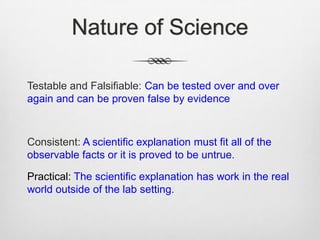
Testable and Falsifiable: Can be tested over and over
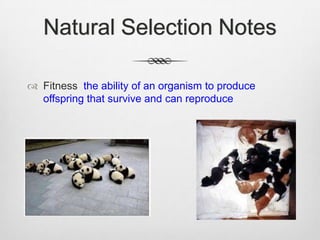
again and can be proven false by evidence


Consistent: A scientific explanation must fit all of the
observable facts or it is proved to be untrue.

Practical: The scientific explanation has work in the real
world outside of the lab setting.
Nature of Science

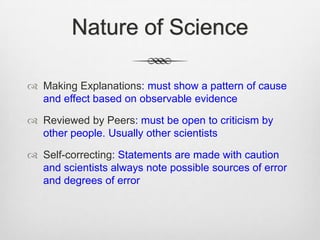
 Making Explanations: must show a pattern of cause
  and effect based on observable evidence

 Reviewed by Peers: must be open to criticism by
  other people. Usually other scientists

 Self-correcting: Statements are made with caution
  and scientists always note possible sources of error
  and degrees of error
Nature of Science

Limitations of Science
Science is not absolute truth: scientific statements are
best approximations based on available evidence
 Note!: This doesn‟t mean it‟s not reliable. Take
  gravity for example.
Science is not Democratic: you cannot vote on science.
Science policy and laws may be voted on but science is
based only on evidence.
Nature of Science

Limitations of Science:

Confirmation Bias: bad science starts with a belief and
then looks for evidence to confirm that belief. Science
should start with facts and the beliefs follow after.
Nature of Science

A video: A video of a physics teacher explaining the
nature of science. He will probably make more sense
than all these notes….

Terms used to Describe Nature of Science

 Fact: an observation that has been repeatedly
  confirmed and for all practical purposes assumed to
  be true. (Ex: Right now we can see the sun If we
  walk outside)
Do you feel like your perception
of science is changing? How so?
Nature of Science
Terms used to Describe Nature of Science
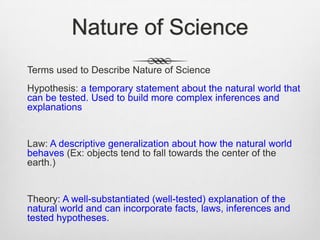
Hypothesis: a temporary statement about the natural world that
can be tested. Used to build more complex inferences and
explanations


Law: A descriptive generalization about how the natural world
behaves (Ex: objects tend to fall towards the center of the
earth.)


Theory: A well-substantiated (well-tested) explanation of the
natural world and can incorporate facts, laws, inferences and
tested hypotheses.
Nature of Science

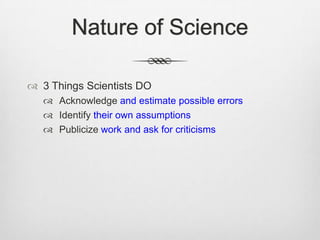
 3 Things Scientists DO
    Acknowledge and estimate possible errors
    Identify their own assumptions
    Publicize work and ask for criticisms
Nature of Science

 It sometimes can be difficult determining what is a
  scientific claim and what is not. Let‟s have a little
  practice by taking this survey.
Nature of Science

 The Nature of Science – You can’t handle the truth!
 Directions: Work in groups of 2-3 Go to the class
  website (hthbio2012.weebly.com) Under Assignments is
  a Nature of Science Assignment Page. Pick 5 of the sites
  and determine whether the sites are stating true facts or
  not. Find at least one site that is stating true data. After
  you determine whether the sites are true or not support
  your statement with 3 different reasons. List 1 to 2
  reasons why this site can be deceptive or make a reader
  uncertain if the content in the website is true or not.
Discussion Rules
As we get into evolution, we might be getting into some sensitive
subjects. In order to maintain a safe class environment, we will all abide
by the following rules:

 Listen and give your full attention to the person who is speaking

 Only one person speaks at a time

 Raise your hand to be recognized if you want to say something

 When you disagree with someone, make sure that you make a
  difference between criticizing someone‟s ideas and the person
  themselves

 Be respectful of everyone in the classroom

 Encourage everyone to participate

 Any other rules we decide at agree on
Natural
Selection/Evolution Survey
Complete the evolution survey
Nature of Science

“Everything you‟ve learned in school as „obvious‟ becomes
less and less obvious as you begin to study the universe. For
example, there are no solids in the universe. There‟s not
even a suggestion of a solid. There are no absolute
continuums. There are no surfaces. There are no straight
lines”

-   R. Buckminster Fuller (1895-1983)

“The truth can sometimes be deceptive.”

-   - Galileo
Warm Up

Finish the Nature of Science website activity.

When you are done, browse through the other website
you haven‟t visited yet. We will also go over those
websites later.

Honors: Take out SAT Book Page 224-245/Video Notes

Nature of Science

Let‟s go over the Nature of Science Survey Again. (After
column)
Natural Selection

 Natural Selection is theory that explains how
  evolution works. Rather than take notes on natural
  selection, we are going to do an activity and you will
  try to come up with a theory for natural selection.

 Take out Your Lab Notebooks
    Title: Modeling Natural Selection
    Purpose: To model and define how natural selection
     works
Natural Selection

Popcorn Reading: As a field scientist…
Procedure: Popcorn Reading
-   Cut and Paste the front page into Lab Notebook as
    the procedure.
-   Practice using your feeding apparatus. Create a
    section called pre-lab questions and answer the
    questions on page 2 of your modeling natural
    selection handout in your lab notebook.
Warm-UP

 Clear the tables of everything except a writing
  utensil and your lab notebook or data sheet.

 Practice using your feeding apparatus. Answer the
  questions on page 2 of your modeling natural
  selection handout in your lab notebook.
Results

Create a graph of your data that best shows which type
of pretendie was best suited for the environment over
time.
Conclusion

Answer the post-lab questions as your conclusion.
Warm Up

Take out your annotations and PD

Discuss the evolution reading packet and take the
evolution survey. Use the survey as points of
discussion. Be ready to share out.

Turn in the list of things you did for engineering in the
inbox
Back to Natural Selection

Create a Graph in your lab notebook that shows how
the number of different pretendies changed over time.
Then answer the post lab questions. Be ready to
discuss answers.
Natural Selection Notes

Take out a sheet of paper.

Natural Selection: The gradual process where biological traits become more or
less common.


Facts:

1.   Overproduction and competition: the population of species has to produce
     lots of offspring. Offspring compete with each other for food
     1.   Fitness: How many babies you can have that can have babies

2.   Individual Variation: Individuals in a population vary (Ex: People look
     different)
Warm-Up

How would you define fitness? In other words, when
you think of someone who is fit, what comes to mind?

Any questions about evolution?

If evolution is about survival of the fittest, do you think
there can ever really be true altruism?
Natural Selection Notes

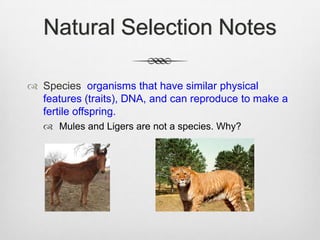
 Species organisms that have similar physical
  features (traits), DNA, and can reproduce to make a
  fertile offspring.
    Mules and Ligers are not a species. Why?
Natural Selection Notes

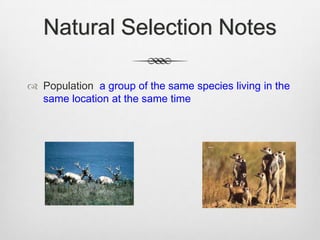
 Population a group of the same species living in the
  same location at the same time
Natural Selection Notes

 Fitness the ability of an organism to produce
  offspring that survive and can reproduce
What is Evolution

 Evolution is a change in population overtime and a
  change in gene pool in a population over
  generations

 Gene pool: all the genes/DNA in the population
Natural Selection Notes

 Darwin made two points in the Origin of Species

 1 found evidence that new species had evolved from
  ancestral populations


 2 Natural Selection – explains how evolution works
Natural Selection Notes

 Darwin‟s Theory of Natural Selection
    1 Overproduction: organisms produce more offspring
     than are able to survive

    2 there are difference in appearance of traits found in
     individuals of the species or organisms of the same
     species look different from each other

    3 Natural Selection is the mechanism for how
     evolution works.
Natural Selection Notes

 Darwin‟s Theory of Natural Selection
    4 In a specific environment, some traits will help with
     survival and reproduction (fitness) more than others

    5 Over generations, the population will change to
     have more traits that help survival and reproduction
Natural Selection Notes
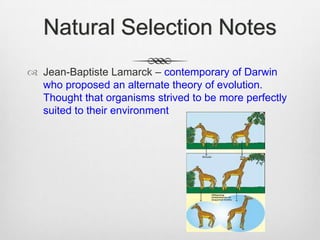
 Jean-Baptiste Lamarck – contemporary of Darwin
  who proposed an alternate theory of evolution.
  Thought that organisms strived to be more perfectly
  suited to their environment
Natural Selection Notes

Remember (aka Key Points)
 A population is the smallest unit that can evolve.
  Individuals CAN NOT evolve


 Natural Selection diminishes (decreases) or amplifies
  (increases) existing traits


 Natural Selection depends on environment
Natural Selection Notes

Why is diversity important in a population?

Increases the likelihood of a species surviving during
environmental changes.
Natural Selection

 Darwin‟s experiment on Natural Selection with
  Asparagus
Natural Selection

Complete the worksheet to practice explaining how
natural selection works in each situation
Warm up

Turn in Introduction to inbox or email the assignment to
me. If you already turned it in, that‟s fine. 

Take out a sheet of paper and title it evidence for
evolution. This will be your notes for evidence for
evolution.

ANNOUNCEMENT: Treekiller ran out of toner. Please
print out work on Chainsaw
Evolution Choice

 Evidence for Evolution
    Watch Darwin‟s Dangerous Idea Video: List the
     evidence he provides for evolution.
Lab
 You can work alone or in groups of 2-3
 Finding Homologous Structures Lab
    Title: Homologous Structures Lab
    Purpose: To find homologous structures in the same
     phylum
    Method: Compare 2 organisms from the same phylum.
     Sketch the organisms you are comparing. Label the
     phylum and the name of the organisms. Look for
     homologous structures and different structure and list
     them. (You only need to compare organisms from 6
     phylums out of the 9)
    Results
    Conclusion: Are organism in the same phylum more similar
     that those from a different phylum? Why or why not?

Nature of science and evolution

  • 2.
    Warm up  Classroomclean up. Your tasks are written on your tables.  Create a Venn Diagram on your own sheet of scratch paper. Compare and contrast similarities between mitosis and meiosis. Use your notes to help you.  FYI: I‟m still getting my voice back. 
  • 3.
    Nature of Science Wewill now start our section on evolution. Before we do, we need to understand how science works (nature of science). What would your definition of science be. Think about it for a minute and then share with your neighbor. Be ready to share out with the class. Hopefully by the end we will talk about all of your definitions.
  • 4.
    Nature of Science Completethe Nature of Science Survey in the Before column.
  • 5.
    Nature of Science Science can only answer questions that address natural phenomena (things we can see and measure) not questions that are subjective, political, religious, ethical etc.  Science is evidence based: uses standards of evidence and logical ways to answer questions, all of which are based on observations, tests, or other types of data (CAN use the scientific method but not always!)
  • 6.
    Nature of Science Testableand Falsifiable: Can be tested over and over again and can be proven false by evidence Consistent: A scientific explanation must fit all of the observable facts or it is proved to be untrue. Practical: The scientific explanation has work in the real world outside of the lab setting.
  • 7.
    Nature of Science Making Explanations: must show a pattern of cause and effect based on observable evidence  Reviewed by Peers: must be open to criticism by other people. Usually other scientists  Self-correcting: Statements are made with caution and scientists always note possible sources of error and degrees of error
  • 8.
    Nature of Science Limitationsof Science Science is not absolute truth: scientific statements are best approximations based on available evidence  Note!: This doesn‟t mean it‟s not reliable. Take gravity for example. Science is not Democratic: you cannot vote on science. Science policy and laws may be voted on but science is based only on evidence.
  • 9.
    Nature of Science Limitationsof Science: Confirmation Bias: bad science starts with a belief and then looks for evidence to confirm that belief. Science should start with facts and the beliefs follow after.
  • 10.
    Nature of Science Avideo: A video of a physics teacher explaining the nature of science. He will probably make more sense than all these notes…. Terms used to Describe Nature of Science  Fact: an observation that has been repeatedly confirmed and for all practical purposes assumed to be true. (Ex: Right now we can see the sun If we walk outside)
  • 11.
    Do you feellike your perception of science is changing? How so?
  • 12.
    Nature of Science Termsused to Describe Nature of Science Hypothesis: a temporary statement about the natural world that can be tested. Used to build more complex inferences and explanations Law: A descriptive generalization about how the natural world behaves (Ex: objects tend to fall towards the center of the earth.) Theory: A well-substantiated (well-tested) explanation of the natural world and can incorporate facts, laws, inferences and tested hypotheses.
  • 13.
    Nature of Science 3 Things Scientists DO  Acknowledge and estimate possible errors  Identify their own assumptions  Publicize work and ask for criticisms
  • 14.
    Nature of Science It sometimes can be difficult determining what is a scientific claim and what is not. Let‟s have a little practice by taking this survey.
  • 15.
    Nature of Science The Nature of Science – You can’t handle the truth!  Directions: Work in groups of 2-3 Go to the class website (hthbio2012.weebly.com) Under Assignments is a Nature of Science Assignment Page. Pick 5 of the sites and determine whether the sites are stating true facts or not. Find at least one site that is stating true data. After you determine whether the sites are true or not support your statement with 3 different reasons. List 1 to 2 reasons why this site can be deceptive or make a reader uncertain if the content in the website is true or not.
  • 16.
    Discussion Rules As weget into evolution, we might be getting into some sensitive subjects. In order to maintain a safe class environment, we will all abide by the following rules:  Listen and give your full attention to the person who is speaking  Only one person speaks at a time  Raise your hand to be recognized if you want to say something  When you disagree with someone, make sure that you make a difference between criticizing someone‟s ideas and the person themselves  Be respectful of everyone in the classroom  Encourage everyone to participate  Any other rules we decide at agree on
  • 17.
  • 18.
    Nature of Science “Everythingyou‟ve learned in school as „obvious‟ becomes less and less obvious as you begin to study the universe. For example, there are no solids in the universe. There‟s not even a suggestion of a solid. There are no absolute continuums. There are no surfaces. There are no straight lines” - R. Buckminster Fuller (1895-1983) “The truth can sometimes be deceptive.” - - Galileo
  • 19.
    Warm Up Finish theNature of Science website activity. When you are done, browse through the other website you haven‟t visited yet. We will also go over those websites later. Honors: Take out SAT Book Page 224-245/Video Notes 
  • 20.
    Nature of Science Let‟sgo over the Nature of Science Survey Again. (After column)
  • 21.
    Natural Selection  NaturalSelection is theory that explains how evolution works. Rather than take notes on natural selection, we are going to do an activity and you will try to come up with a theory for natural selection.  Take out Your Lab Notebooks  Title: Modeling Natural Selection  Purpose: To model and define how natural selection works
  • 22.
    Natural Selection Popcorn Reading:As a field scientist… Procedure: Popcorn Reading - Cut and Paste the front page into Lab Notebook as the procedure. - Practice using your feeding apparatus. Create a section called pre-lab questions and answer the questions on page 2 of your modeling natural selection handout in your lab notebook.
  • 23.
    Warm-UP  Clear thetables of everything except a writing utensil and your lab notebook or data sheet.  Practice using your feeding apparatus. Answer the questions on page 2 of your modeling natural selection handout in your lab notebook.
  • 24.
    Results Create a graphof your data that best shows which type of pretendie was best suited for the environment over time.
  • 25.
    Conclusion Answer the post-labquestions as your conclusion.
  • 26.
    Warm Up Take outyour annotations and PD Discuss the evolution reading packet and take the evolution survey. Use the survey as points of discussion. Be ready to share out. Turn in the list of things you did for engineering in the inbox
  • 27.
    Back to NaturalSelection Create a Graph in your lab notebook that shows how the number of different pretendies changed over time. Then answer the post lab questions. Be ready to discuss answers.
  • 28.
    Natural Selection Notes Takeout a sheet of paper. Natural Selection: The gradual process where biological traits become more or less common. Facts: 1. Overproduction and competition: the population of species has to produce lots of offspring. Offspring compete with each other for food 1. Fitness: How many babies you can have that can have babies 2. Individual Variation: Individuals in a population vary (Ex: People look different)
  • 29.
    Warm-Up How would youdefine fitness? In other words, when you think of someone who is fit, what comes to mind? Any questions about evolution? If evolution is about survival of the fittest, do you think there can ever really be true altruism?
  • 30.
    Natural Selection Notes Species organisms that have similar physical features (traits), DNA, and can reproduce to make a fertile offspring.  Mules and Ligers are not a species. Why?
  • 31.
    Natural Selection Notes Population a group of the same species living in the same location at the same time
  • 32.
    Natural Selection Notes Fitness the ability of an organism to produce offspring that survive and can reproduce
  • 33.
    What is Evolution Evolution is a change in population overtime and a change in gene pool in a population over generations  Gene pool: all the genes/DNA in the population
  • 34.
    Natural Selection Notes Darwin made two points in the Origin of Species  1 found evidence that new species had evolved from ancestral populations  2 Natural Selection – explains how evolution works
  • 35.
    Natural Selection Notes Darwin‟s Theory of Natural Selection  1 Overproduction: organisms produce more offspring than are able to survive  2 there are difference in appearance of traits found in individuals of the species or organisms of the same species look different from each other  3 Natural Selection is the mechanism for how evolution works.
  • 36.
    Natural Selection Notes Darwin‟s Theory of Natural Selection  4 In a specific environment, some traits will help with survival and reproduction (fitness) more than others  5 Over generations, the population will change to have more traits that help survival and reproduction
  • 37.
    Natural Selection Notes Jean-Baptiste Lamarck – contemporary of Darwin who proposed an alternate theory of evolution. Thought that organisms strived to be more perfectly suited to their environment
  • 38.
    Natural Selection Notes Remember(aka Key Points)  A population is the smallest unit that can evolve. Individuals CAN NOT evolve  Natural Selection diminishes (decreases) or amplifies (increases) existing traits  Natural Selection depends on environment
  • 39.
    Natural Selection Notes Whyis diversity important in a population? Increases the likelihood of a species surviving during environmental changes.
  • 40.
    Natural Selection  Darwin‟sexperiment on Natural Selection with Asparagus
  • 41.
    Natural Selection Complete theworksheet to practice explaining how natural selection works in each situation
  • 42.
    Warm up Turn inIntroduction to inbox or email the assignment to me. If you already turned it in, that‟s fine.  Take out a sheet of paper and title it evidence for evolution. This will be your notes for evidence for evolution. ANNOUNCEMENT: Treekiller ran out of toner. Please print out work on Chainsaw
  • 43.
    Evolution Choice  Evidencefor Evolution  Watch Darwin‟s Dangerous Idea Video: List the evidence he provides for evolution.
  • 44.
    Lab  You canwork alone or in groups of 2-3  Finding Homologous Structures Lab  Title: Homologous Structures Lab  Purpose: To find homologous structures in the same phylum  Method: Compare 2 organisms from the same phylum. Sketch the organisms you are comparing. Label the phylum and the name of the organisms. Look for homologous structures and different structure and list them. (You only need to compare organisms from 6 phylums out of the 9)  Results  Conclusion: Are organism in the same phylum more similar that those from a different phylum? Why or why not?