Populations
Warm up
Warm-up:
What are the 4 major macromolecules and their monomers?
Define the central dogma of molecular biology
What are the steps of photosynthesis and where do they occur in
the cell?

Announcement:
Guest Speaker – May 3rd Thursday. Donate Life
Open Notes Exam on May 8th

Agenda:
- Daphnia Project Set Up
- STAR Testing Practice and Review Old Material
- Populations if we have time
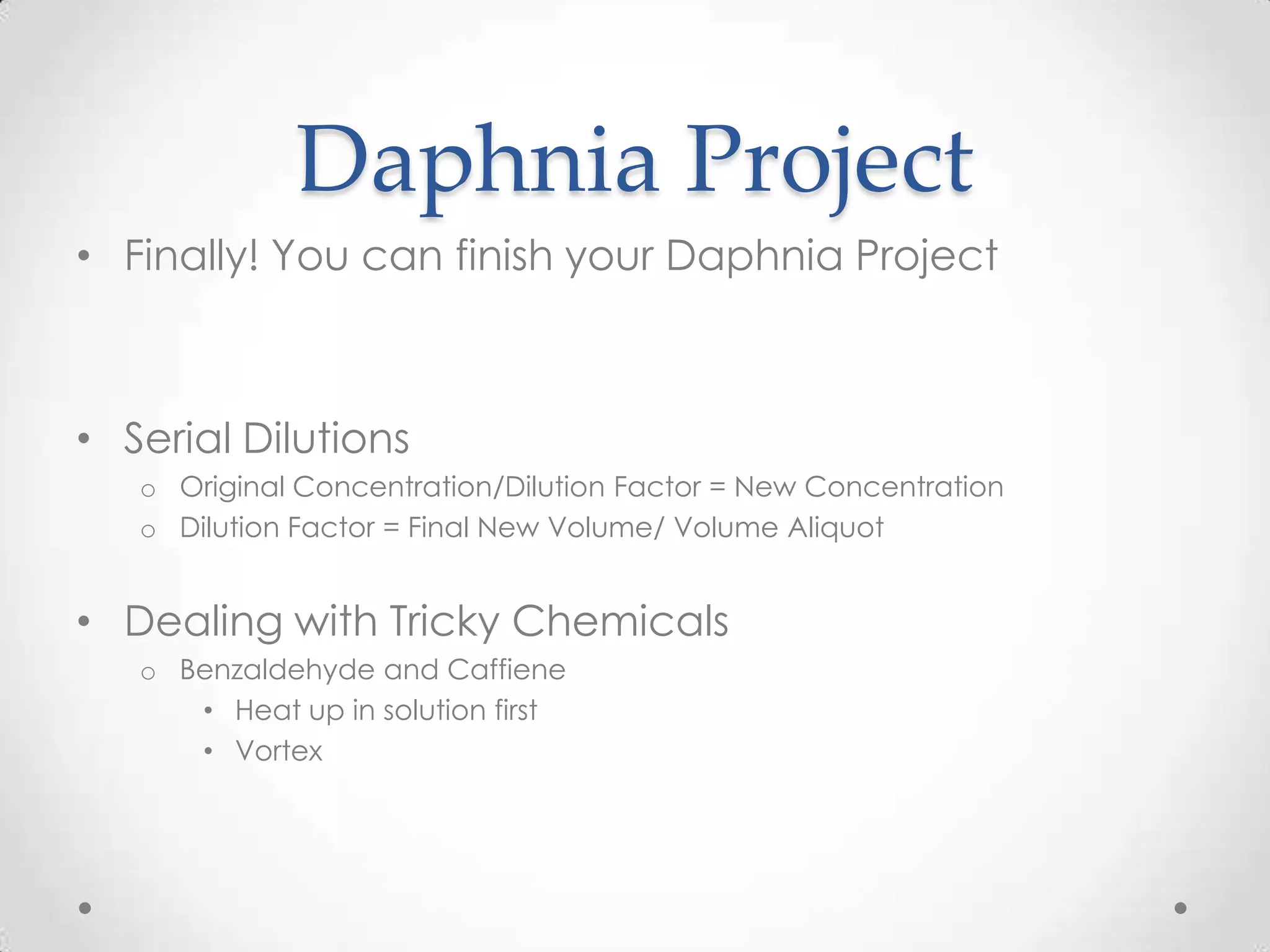
Daphnia Project
• Finally! You can finish your Daphnia Project


• Serial Dilutions
   o Original Concentration/Dilution Factor = New Concentration
   o Dilution Factor = Final New Volume/ Volume Aliquot


• Dealing with Tricky Chemicals
   o Benzaldehyde and Caffiene
      • Heat up in solution first
      • Vortex
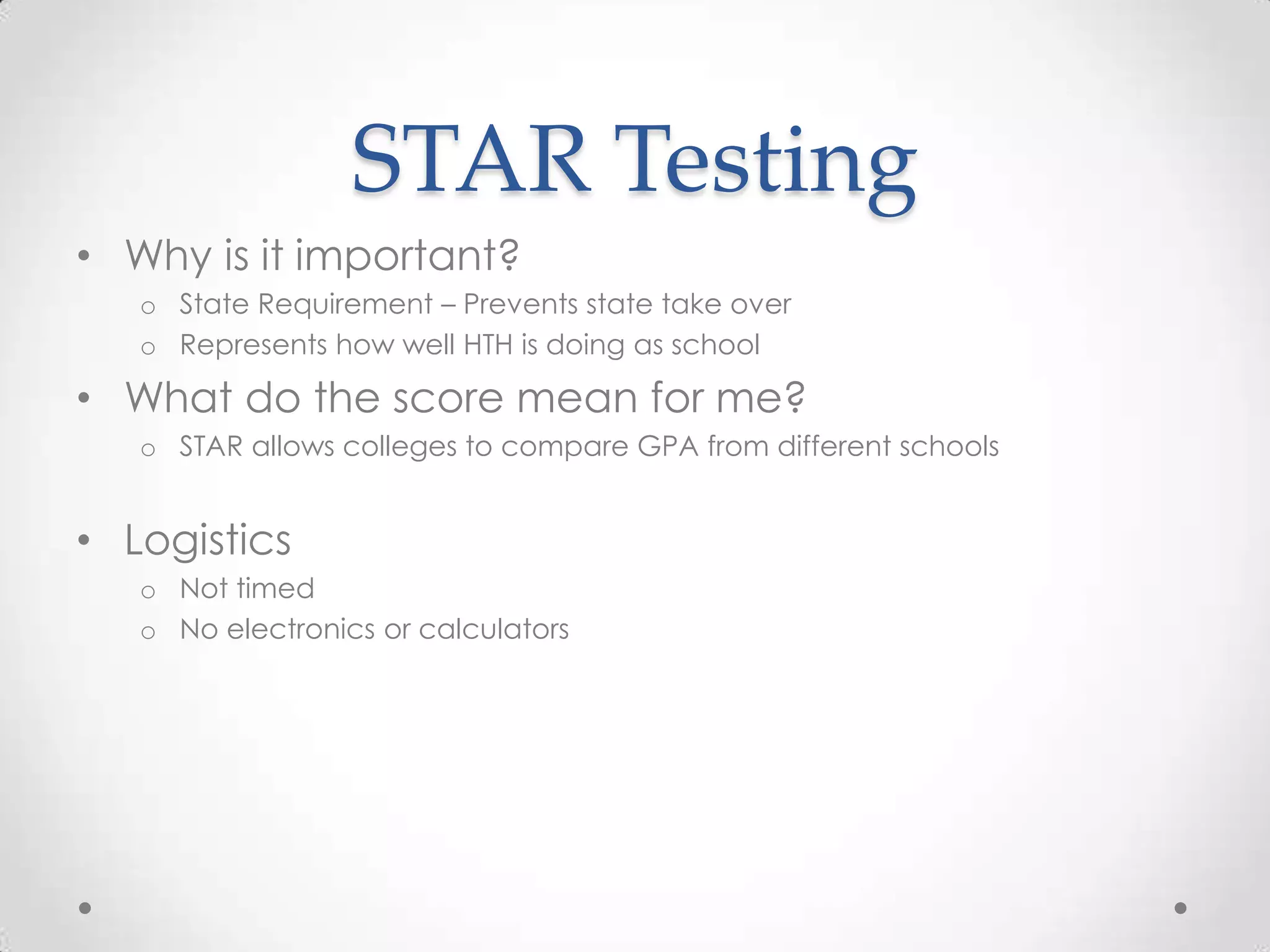
STAR Testing
• Why is it important?
   o State Requirement – Prevents state take over
   o Represents how well HTH is doing as school

• What do the score mean for me?
   o STAR allows colleges to compare GPA from different schools


• Logistics
   o Not timed
   o No electronics or calculators
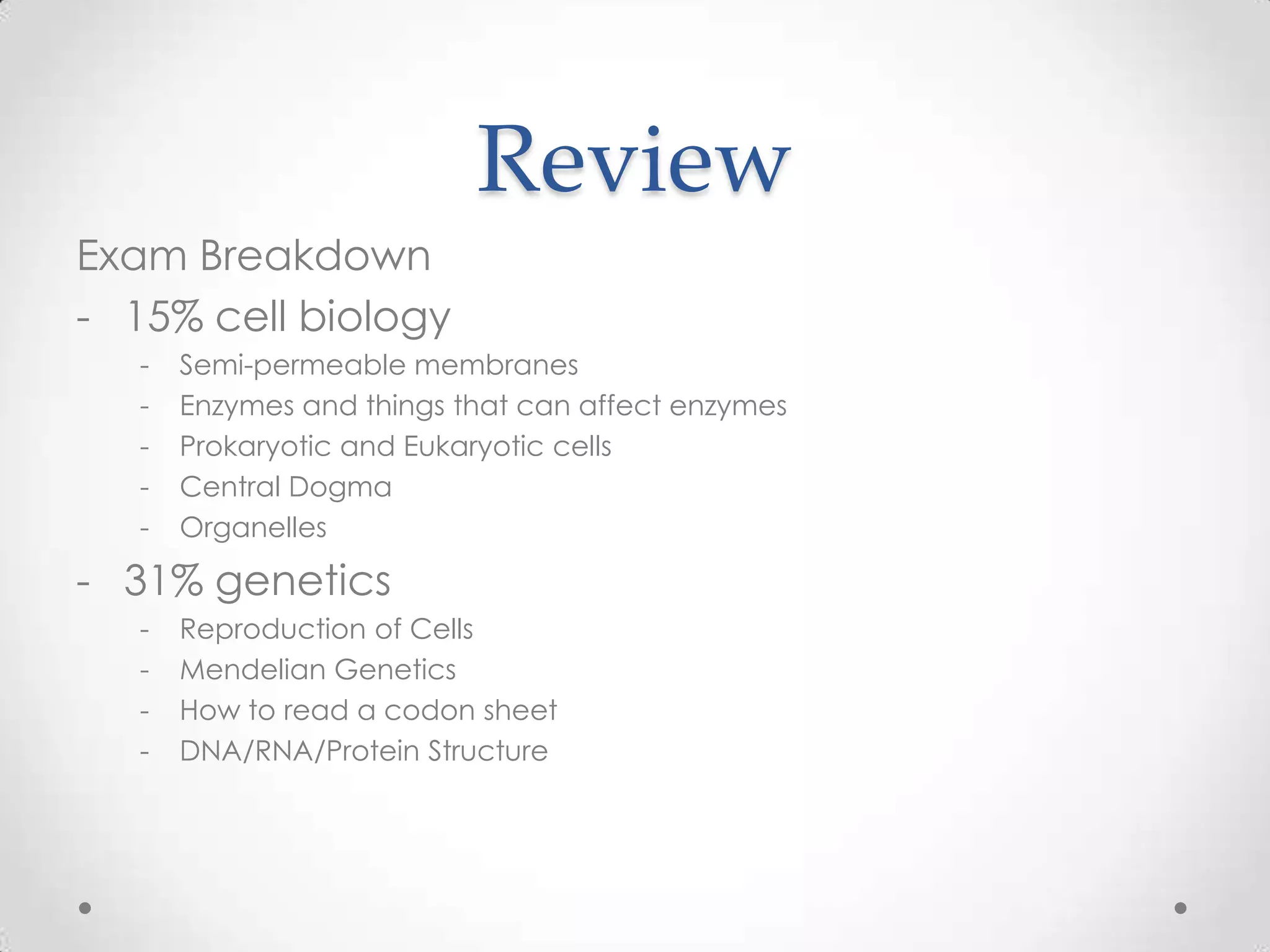
Review
Exam Breakdown
- 15% cell biology
   -   Semi-permeable membranes
   -   Enzymes and things that can affect enzymes
   -   Prokaryotic and Eukaryotic cells
   -   Central Dogma
   -   Organelles

- 31% genetics
   -   Reproduction of Cells
   -   Mendelian Genetics
   -   How to read a codon sheet
   -   DNA/RNA/Protein Structure
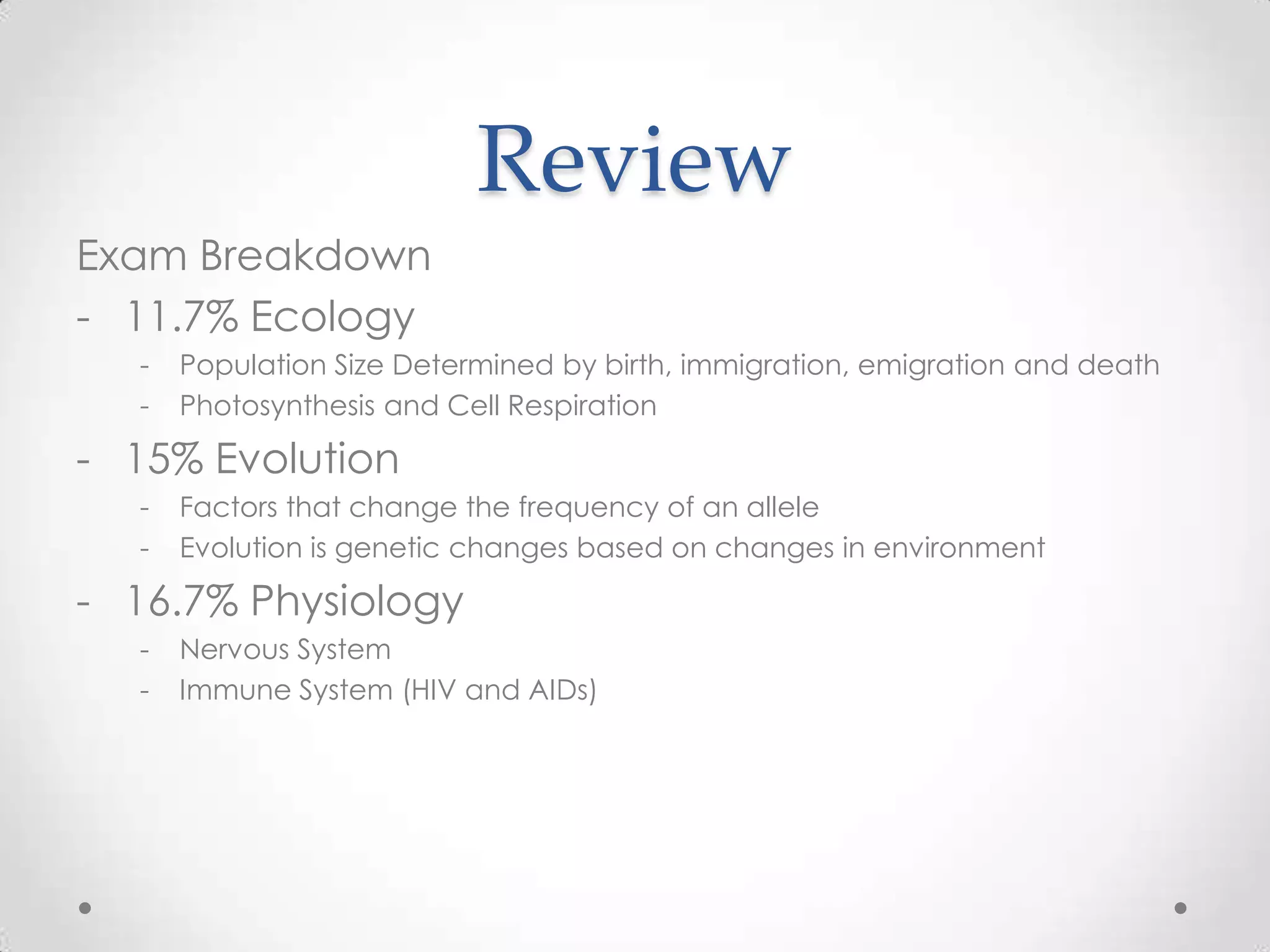
Review
Exam Breakdown
- 11.7% Ecology
  -   Population Size Determined by birth, immigration, emigration and death
  -   Photosynthesis and Cell Respiration

- 15% Evolution
  -   Factors that change the frequency of an allele
  -   Evolution is genetic changes based on changes in environment

- 16.7% Physiology
  -   Nervous System
  -   Immune System (HIV and AIDs)
Side Note for SAT II Test
-   60 minutes
-   80 question
-   ¼ off for every wrong answer
-   Leave blank -0
-   Pick a score to aim for
    -   http://www.sparknotes.com/testprep/books/sat2/biology/chapter2sectio
        n6.rhtml
Strategies
• Keep Calm and Carry On
• Scan exam
• Answer what you know first, then go back to ones
  you are unsure of
• Make sure you mark on the correct grid
• Start getting a good night sleep and eating
  breakfast at least 2 days before.
• Plan to be at least 15 min early.
• Read all options before answering
• Guess: 2 wrong and 2 right…
  o Be careful with words such as always, sometimes, never
Warm Up
WARM UP: Take out your lab notebook and record how
many daphnia are still alive in each jar for your results. Write
observations of how the remaining alive daphnia are
behaving.
When finished, finish your star testing packet. They are on
the table next to the door.

HONORS: Take out your SAT Book.

ANNOUNCEMENTS:
Guest speaker(s) from Donate Life Thursday
SAT Info
•   Reading 800
•   Math 800
•   Writing 800
•   1 raw score for correct answer and -.25 for every
    wrong answer.
    o Therefore, if you can eliminate 1 answer out of the 5 answers then guess.
    o http://www.sparknotes.com/testprep/books/newsat/chapter3section4.rht
      ml

• Pacing – Practice taking it and time yourself
FAFSA
Grant = Free Money, Loans = Must Pay Back
• Federal Pell Grant- From Federal Gov. based on
  financial need (5.550 max- changes each school
  yr.)
FAFSA
• Cal Grant – Only if you’re going to a California
  School and you are a resident (GPA-3.0 from HS
  and GPA 2.4 from college)
• Different types of Cal Grants:
   o Cal Grant A: for undergrads resident (GPA-3.0 from HS and GPA 2.4 from
     college)
       • Going to a public school: $5,472 and $12,192
       • Going to a private school: $9,708
   o Cal Grant B: For low income students (GPA -2.0)
       • $1,551 for housing and books
   o Cal Grant C: For trade and occupational schools
       • $576 max for books
       • $2,592 for tuition
   o Cal Grant A and B competitive: If you don’t go to college right after high
     school. Doesn’t really concern you but usually need higher GPA
FAFSA
Loans

- Subsidized: no interest when in school, 6 months
  after graduating, and during deferment
- Unsubsidized: interest all the time
- PLUS Loan: Unsubsidized loan your parents can take
  out
FAFSA
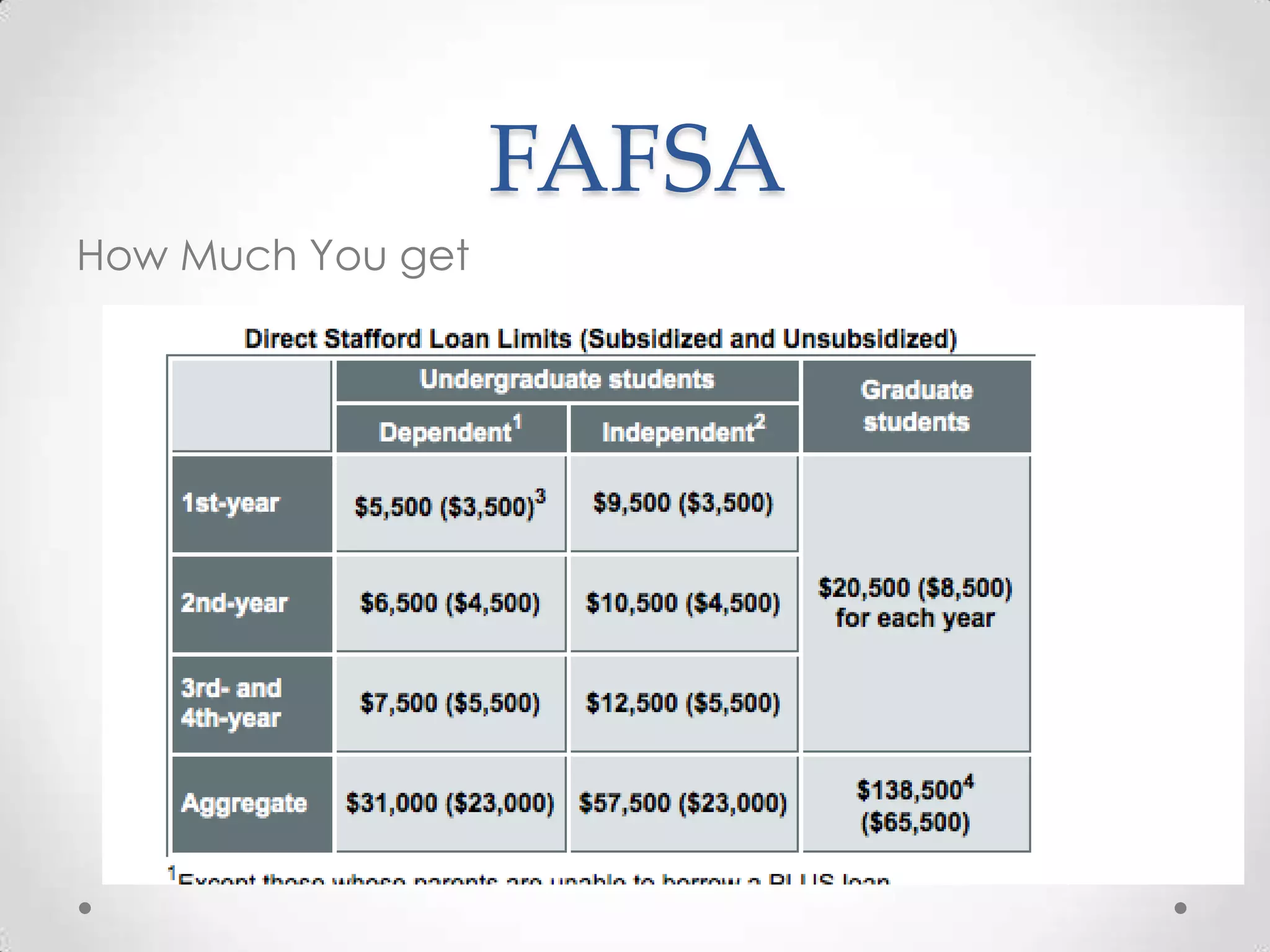
How Much You get
FAFSA
• How much to Borrow?
     Depends…Try to borrow as little as possible

• Options to Repay Loans:
   o Standard Repayment: 50$ a month min and have 10 years to pay back
     (least interest)
   o Extended Repayment: Must have over S30,000 in loans. 25 yrs to pay off
       • 2 options: Fixed and Graduated
             o Fixed: pay same amount as standard plan for 25 yrs
             o Graduated: pay less at first and payment increases every 2 years.
               (max increase is 3x) May end up paying more interest
FAFSA
o Income contingent Repayment
    • 2 options and will pay whichever cost less
        o the amount you would pay if you repaid your loan in 12
          years multiplied by an income percentage factor that
          varies with your annual income, or
        o 20% of your monthly discretionary income*.
o Income Based Repayment
    • Under financial hardship you can pay a percentage of your
      income per month.
    • After 25 years can be forgiven for rest of loans if meet certain
      requirements
        o Public service worker – 10 years of payments forgiven
        o Dangers: High interest. May not qualify
College App Screening
          Process
• Round 1: Eliminate obvious candidates that don’t
  make the cut
  o Based on GPA, SAT, Sloppy Essay

• Round 2: Regional admission staff debate why
  candidates are worthy
  o Where your essay matters
  o Pick a theme: Perseverance, Innovative, etc. Then show how you
    represent that theme.
Things to Look for in a
           College
•   Accreditation: http://ope.ed.gov/accreditation/Search.aspx
•   High Graduation Rate:
•   Low Student – Faculty Ratio
•   Financial Aid Assistance
•   Internship options while you’re an undergrad (preferably paid)
•   Paid Travel opportunities
•   Engaging classes ()
•   School activities match your interest
•   Health and Wellness facilities
•   Campus Safety and Comfort
•   Academic Support Services
•   Career Services and Leadership opportunity
•   Strong Computing Infrastructure
•   Strong Alumni Network
Populations
Population: organisms in the same species and live in the
same geographical area (close enough to interbreed)

Some factors that ecologists consider when they study
populations:
      Geographical range: the size of the area the
population lives in
      Density: how close together organisms in a
population live together
      Age Structure: The percentage of people in different
age groups
      Growth rate: how fast or slow is the population size
increasing
Food for Thought
On the issue of human overpopulation…

Do you think everyone should have the right to
reproduce? Even if they don’t have the financial,
physical, or social ability to provide for their offspring?

What if this reproduction rights had an effect on how
much taxes you have to pay? Etc. Should everyone
still have the right to reproduce?
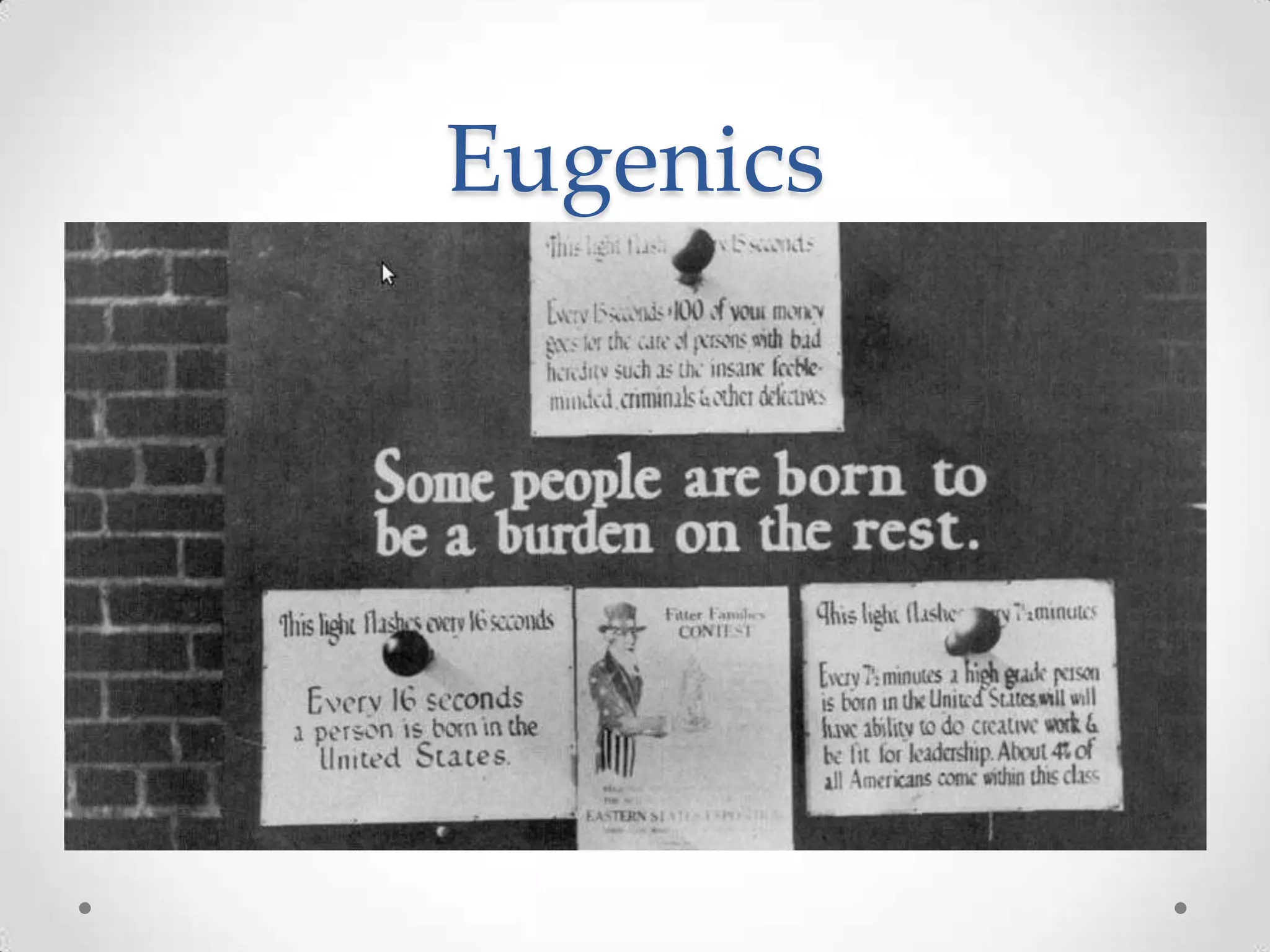
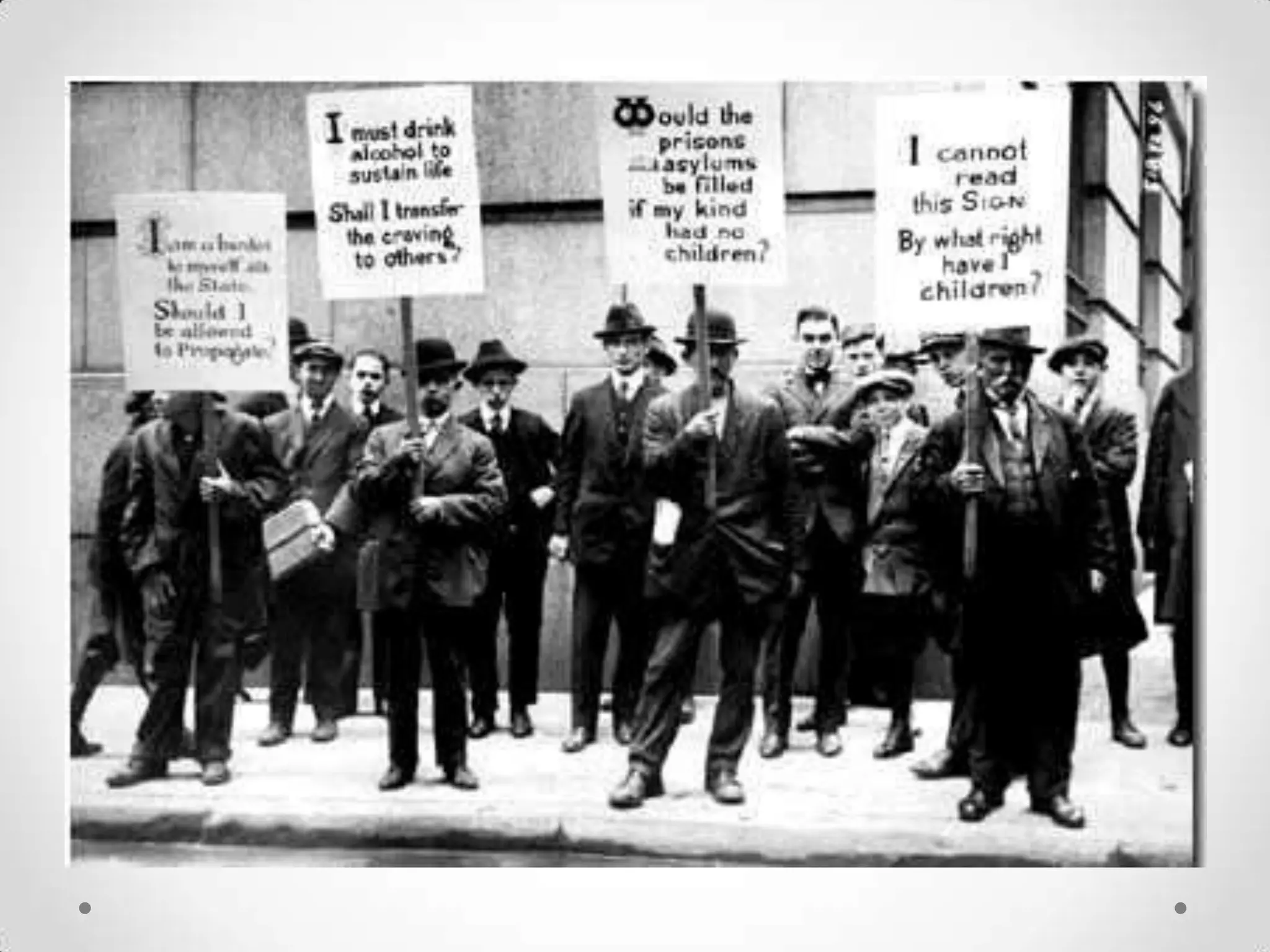
Eugenics
Eugenics
• the social movement claiming to improve the
  genetic features of human populations through
  selective breeding and sterilization
Eugenics in US Law
• Indiana became the first state to enact sterilization
  legislation in 1907, followed closely by Washington and
  California in 1909.
• 1927 Supreme Court case Buck v. Bell which legitimized
  the forced sterilization of patients at a Virginia home for
  the mentally retarded.
• An IQ of 70 or lower meant sterilization was appropriate
  in North Carolina.
• The American Breeder’s Association was the first eugenic
  body in the U.S. The ABA was formed to “investigate and
  report on heredity in the human race, and emphasize
  the value of superior blood and the menace to society
  of inferior blood.” Membership included Alexander
  Graham Bell, Stanford president David Starr Jordan and
  Luther Burbank.
Eugenics in US Politics
• Margret Sanger founder of planned parenthood:
  Margaret Sanger saw birth control as a means to
  prevent unwanted children from being born into a
  disadvantaged life, and incorporated the
  language of eugenics to advance the movement
Eugenics in California
• The state of California was at the vanguard of the
  American eugenics movement, performing about
  20,000 sterilizations or one third of the 60,000
  nationwide from 1909 up until the 1960s.

• Almost 19 million people attended the Panama-
  Pacific International Exposition in San Francisco.
   o Conference for 10 months to address stopping disease and inferior
     characteristics through eugenics
Why and Who to Sterilize
• Men and women were compulsorily sterilized for
  different reasons. Men were sterilized to treat their
  aggression and to eliminate their criminal behavior,
  while women were sterilized to control the results of
  their sexuality (prostitution)
How to Sterilize and
         Euthanize
• A mental institution in Lincoln, Illinois fed its incoming
  patients milk infected with tuberculosis (reasoning
  that genetically fit individuals would be resistant),
  resulting in 30-40% annual death rates.
• Unknown “Cure”
• Medical Neglect
Eugenics Cali to Germany
• California eugenicists began producing literature
  promoting eugenics and sterilization and sending it
  overseas to German scientists and medical
  professionals. By 1933, California had subjected
  more people to forceful sterilization than all other
  U.S. states combined. The forced sterilization
  program engineered by the Nazis was partly
  inspired by California's
We Do Not
Stand
Alone
Eugenics Cali to Germany
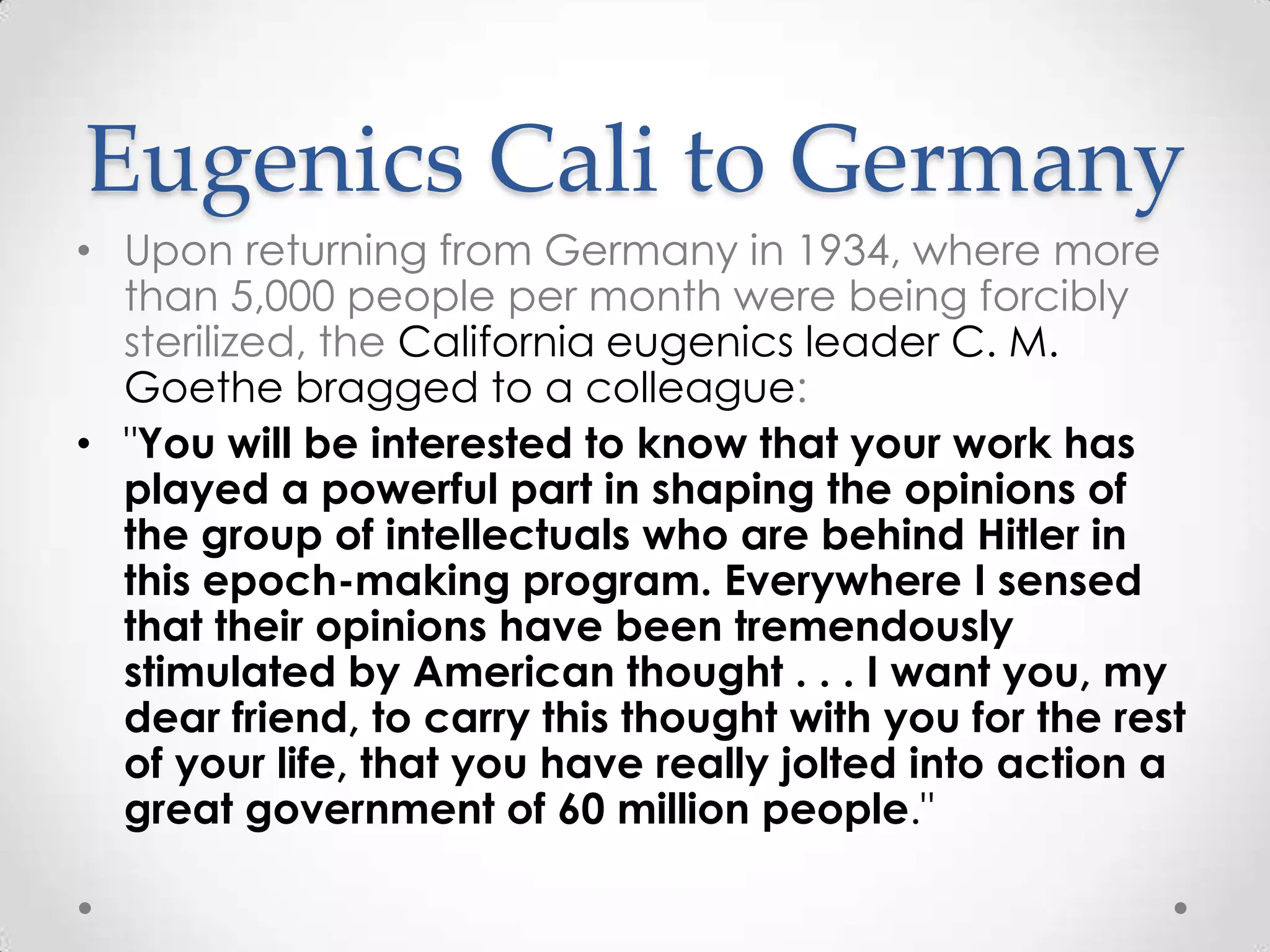
• Upon returning from Germany in 1934, where more
  than 5,000 people per month were being forcibly
  sterilized, the California eugenics leader C. M.
  Goethe bragged to a colleague:
• "You will be interested to know that your work has
  played a powerful part in shaping the opinions of
  the group of intellectuals who are behind Hitler in
  this epoch-making program. Everywhere I sensed
  that their opinions have been tremendously
  stimulated by American thought . . . I want you, my
  dear friend, to carry this thought with you for the rest
  of your life, that you have really jolted into action a
  great government of 60 million people."
End-ish of Eugenics
A few years after end of WWII and Nazi Germany
1968-1969 (End of WWII - 1945)
      - Feminist Movement
Good Afternoon!
Warm up:
1. Warm up questions
How engaged did you feel yesterday? Why?
On a scale of 0-100. (0 being unproductive and 100 being
highly productive) What would you rate yourself?
2. Turn in your STAR Packet. Make a neat pile on the table
in front of the fridge.

Agenda:
P1 – Sex in a Cup (HIV/AIDs Transmission)
P2 – Guest Speaker
P3 – Guest Speaker
P4 – Sex in a Cup (HIV/AIDs Transmission)
HIV/AIDs Activity
Title: HIV/AIDs – Sex in a Cup

Purpose: To demonstrate how HIV can spread and
how pathologists locate patient zero (the patient that
first contracted the disease)

Method:
1. Get a cup filled with fluids and the post-it attached
   to it. (Do not sniff or drink your fluid cup. If fluids get
   in contact with skin, rinse immediately with cold
   water)
HIV/AIDs Activity
Method:
2. Read the post-it privately to yourself. The post-it will
determine your behavior in trial 1. Keep it a secret.
3. When you exchange body fluids, pour your fluids in their
cup and take back and equal amount of fluid you gave
away to your partner.
4. You must ask permission to exchange fluids and you may
not tell the person your role.
5. Keep track of who you exchanged body fluids with in the
results table
6. Only exchange fluids if you role allows you too.
7. After exchanging fluids for 5 times you will be
administered an AIDs test
Daphnia project, college info and STAR review, Eugenics

  • 1.
  • 2.
    Warm up Warm-up: What arethe 4 major macromolecules and their monomers? Define the central dogma of molecular biology What are the steps of photosynthesis and where do they occur in the cell? Announcement: Guest Speaker – May 3rd Thursday. Donate Life Open Notes Exam on May 8th Agenda: - Daphnia Project Set Up - STAR Testing Practice and Review Old Material - Populations if we have time
  • 3.
    Daphnia Project • Finally!You can finish your Daphnia Project • Serial Dilutions o Original Concentration/Dilution Factor = New Concentration o Dilution Factor = Final New Volume/ Volume Aliquot • Dealing with Tricky Chemicals o Benzaldehyde and Caffiene • Heat up in solution first • Vortex
  • 4.
    STAR Testing • Whyis it important? o State Requirement – Prevents state take over o Represents how well HTH is doing as school • What do the score mean for me? o STAR allows colleges to compare GPA from different schools • Logistics o Not timed o No electronics or calculators
  • 5.
    Review Exam Breakdown - 15%cell biology - Semi-permeable membranes - Enzymes and things that can affect enzymes - Prokaryotic and Eukaryotic cells - Central Dogma - Organelles - 31% genetics - Reproduction of Cells - Mendelian Genetics - How to read a codon sheet - DNA/RNA/Protein Structure
  • 6.
    Review Exam Breakdown - 11.7%Ecology - Population Size Determined by birth, immigration, emigration and death - Photosynthesis and Cell Respiration - 15% Evolution - Factors that change the frequency of an allele - Evolution is genetic changes based on changes in environment - 16.7% Physiology - Nervous System - Immune System (HIV and AIDs)
  • 7.
    Side Note forSAT II Test - 60 minutes - 80 question - ¼ off for every wrong answer - Leave blank -0 - Pick a score to aim for - http://www.sparknotes.com/testprep/books/sat2/biology/chapter2sectio n6.rhtml
  • 8.
    Strategies • Keep Calmand Carry On • Scan exam • Answer what you know first, then go back to ones you are unsure of • Make sure you mark on the correct grid • Start getting a good night sleep and eating breakfast at least 2 days before. • Plan to be at least 15 min early. • Read all options before answering • Guess: 2 wrong and 2 right… o Be careful with words such as always, sometimes, never
  • 9.
    Warm Up WARM UP:Take out your lab notebook and record how many daphnia are still alive in each jar for your results. Write observations of how the remaining alive daphnia are behaving. When finished, finish your star testing packet. They are on the table next to the door. HONORS: Take out your SAT Book. ANNOUNCEMENTS: Guest speaker(s) from Donate Life Thursday
  • 10.
    SAT Info • Reading 800 • Math 800 • Writing 800 • 1 raw score for correct answer and -.25 for every wrong answer. o Therefore, if you can eliminate 1 answer out of the 5 answers then guess. o http://www.sparknotes.com/testprep/books/newsat/chapter3section4.rht ml • Pacing – Practice taking it and time yourself
  • 11.
    FAFSA Grant = FreeMoney, Loans = Must Pay Back • Federal Pell Grant- From Federal Gov. based on financial need (5.550 max- changes each school yr.)
  • 12.
    FAFSA • Cal Grant– Only if you’re going to a California School and you are a resident (GPA-3.0 from HS and GPA 2.4 from college) • Different types of Cal Grants: o Cal Grant A: for undergrads resident (GPA-3.0 from HS and GPA 2.4 from college) • Going to a public school: $5,472 and $12,192 • Going to a private school: $9,708 o Cal Grant B: For low income students (GPA -2.0) • $1,551 for housing and books o Cal Grant C: For trade and occupational schools • $576 max for books • $2,592 for tuition o Cal Grant A and B competitive: If you don’t go to college right after high school. Doesn’t really concern you but usually need higher GPA
  • 13.
    FAFSA Loans - Subsidized: nointerest when in school, 6 months after graduating, and during deferment - Unsubsidized: interest all the time - PLUS Loan: Unsubsidized loan your parents can take out
  • 14.
  • 15.
    FAFSA • How muchto Borrow? Depends…Try to borrow as little as possible • Options to Repay Loans: o Standard Repayment: 50$ a month min and have 10 years to pay back (least interest) o Extended Repayment: Must have over S30,000 in loans. 25 yrs to pay off • 2 options: Fixed and Graduated o Fixed: pay same amount as standard plan for 25 yrs o Graduated: pay less at first and payment increases every 2 years. (max increase is 3x) May end up paying more interest
  • 16.
    FAFSA o Income contingentRepayment • 2 options and will pay whichever cost less o the amount you would pay if you repaid your loan in 12 years multiplied by an income percentage factor that varies with your annual income, or o 20% of your monthly discretionary income*. o Income Based Repayment • Under financial hardship you can pay a percentage of your income per month. • After 25 years can be forgiven for rest of loans if meet certain requirements o Public service worker – 10 years of payments forgiven o Dangers: High interest. May not qualify
  • 17.
    College App Screening Process • Round 1: Eliminate obvious candidates that don’t make the cut o Based on GPA, SAT, Sloppy Essay • Round 2: Regional admission staff debate why candidates are worthy o Where your essay matters o Pick a theme: Perseverance, Innovative, etc. Then show how you represent that theme.
  • 18.
    Things to Lookfor in a College • Accreditation: http://ope.ed.gov/accreditation/Search.aspx • High Graduation Rate: • Low Student – Faculty Ratio • Financial Aid Assistance • Internship options while you’re an undergrad (preferably paid) • Paid Travel opportunities • Engaging classes () • School activities match your interest • Health and Wellness facilities • Campus Safety and Comfort • Academic Support Services • Career Services and Leadership opportunity • Strong Computing Infrastructure • Strong Alumni Network
  • 19.
    Populations Population: organisms inthe same species and live in the same geographical area (close enough to interbreed) Some factors that ecologists consider when they study populations: Geographical range: the size of the area the population lives in Density: how close together organisms in a population live together Age Structure: The percentage of people in different age groups Growth rate: how fast or slow is the population size increasing
  • 20.
    Food for Thought Onthe issue of human overpopulation… Do you think everyone should have the right to reproduce? Even if they don’t have the financial, physical, or social ability to provide for their offspring? What if this reproduction rights had an effect on how much taxes you have to pay? Etc. Should everyone still have the right to reproduce?
  • 21.
  • 22.
    Eugenics • the socialmovement claiming to improve the genetic features of human populations through selective breeding and sterilization
  • 24.
    Eugenics in USLaw • Indiana became the first state to enact sterilization legislation in 1907, followed closely by Washington and California in 1909. • 1927 Supreme Court case Buck v. Bell which legitimized the forced sterilization of patients at a Virginia home for the mentally retarded. • An IQ of 70 or lower meant sterilization was appropriate in North Carolina. • The American Breeder’s Association was the first eugenic body in the U.S. The ABA was formed to “investigate and report on heredity in the human race, and emphasize the value of superior blood and the menace to society of inferior blood.” Membership included Alexander Graham Bell, Stanford president David Starr Jordan and Luther Burbank.
  • 25.
    Eugenics in USPolitics • Margret Sanger founder of planned parenthood: Margaret Sanger saw birth control as a means to prevent unwanted children from being born into a disadvantaged life, and incorporated the language of eugenics to advance the movement
  • 26.
    Eugenics in California •The state of California was at the vanguard of the American eugenics movement, performing about 20,000 sterilizations or one third of the 60,000 nationwide from 1909 up until the 1960s. • Almost 19 million people attended the Panama- Pacific International Exposition in San Francisco. o Conference for 10 months to address stopping disease and inferior characteristics through eugenics
  • 27.
    Why and Whoto Sterilize • Men and women were compulsorily sterilized for different reasons. Men were sterilized to treat their aggression and to eliminate their criminal behavior, while women were sterilized to control the results of their sexuality (prostitution)
  • 28.
    How to Sterilizeand Euthanize • A mental institution in Lincoln, Illinois fed its incoming patients milk infected with tuberculosis (reasoning that genetically fit individuals would be resistant), resulting in 30-40% annual death rates. • Unknown “Cure” • Medical Neglect
  • 29.
    Eugenics Cali toGermany • California eugenicists began producing literature promoting eugenics and sterilization and sending it overseas to German scientists and medical professionals. By 1933, California had subjected more people to forceful sterilization than all other U.S. states combined. The forced sterilization program engineered by the Nazis was partly inspired by California's
  • 30.
  • 31.
    Eugenics Cali toGermany • Upon returning from Germany in 1934, where more than 5,000 people per month were being forcibly sterilized, the California eugenics leader C. M. Goethe bragged to a colleague: • "You will be interested to know that your work has played a powerful part in shaping the opinions of the group of intellectuals who are behind Hitler in this epoch-making program. Everywhere I sensed that their opinions have been tremendously stimulated by American thought . . . I want you, my dear friend, to carry this thought with you for the rest of your life, that you have really jolted into action a great government of 60 million people."
  • 32.
    End-ish of Eugenics Afew years after end of WWII and Nazi Germany 1968-1969 (End of WWII - 1945) - Feminist Movement
  • 33.
    Good Afternoon! Warm up: 1.Warm up questions How engaged did you feel yesterday? Why? On a scale of 0-100. (0 being unproductive and 100 being highly productive) What would you rate yourself? 2. Turn in your STAR Packet. Make a neat pile on the table in front of the fridge. Agenda: P1 – Sex in a Cup (HIV/AIDs Transmission) P2 – Guest Speaker P3 – Guest Speaker P4 – Sex in a Cup (HIV/AIDs Transmission)
  • 34.
    HIV/AIDs Activity Title: HIV/AIDs– Sex in a Cup Purpose: To demonstrate how HIV can spread and how pathologists locate patient zero (the patient that first contracted the disease) Method: 1. Get a cup filled with fluids and the post-it attached to it. (Do not sniff or drink your fluid cup. If fluids get in contact with skin, rinse immediately with cold water)
  • 35.
    HIV/AIDs Activity Method: 2. Readthe post-it privately to yourself. The post-it will determine your behavior in trial 1. Keep it a secret. 3. When you exchange body fluids, pour your fluids in their cup and take back and equal amount of fluid you gave away to your partner. 4. You must ask permission to exchange fluids and you may not tell the person your role. 5. Keep track of who you exchanged body fluids with in the results table 6. Only exchange fluids if you role allows you too. 7. After exchanging fluids for 5 times you will be administered an AIDs test