Warm up!
 Sit next to your lab partner from yesterday
 Put on a lab coat and gloves. Take out your lab notebook.
   Title: Bacterial Transformation
   Purpose: To change the phenotype (physical traits) of e.coli by
    changing the geneotype (DNA or genes)
   Method: See ScienceBridge Protocol
   Results: “Wait for Quanina to explain”
 Take a look at your results. Did you see what you expected?
Results
 Number of fluorescent colonies counted:


Conclusion
 If you saw colonies growing that were not fluorescent, explain
  how this could have happened?
 If you saw no colonies growing, how could this have
  happened?
 If your results were unexpected, explain how this could have
  happened.
Protein Purification
Student Training
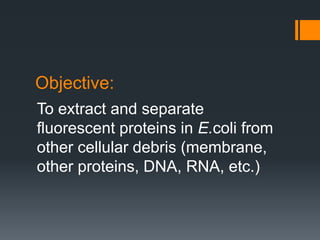
Objective:
To extract and separate
fluorescent proteins in E.coli from
other cellular debris (membrane,
other proteins, DNA, RNA, etc.)
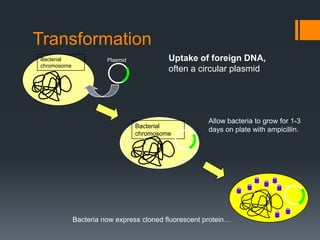
Transformation
Bacterial              Plasmid            Uptake of foreign DNA,
chromosome
                                          often a circular plasmid


                                                      Allow bacteria to grow for 1-3
                                 Bacterial
                                                      days on plate with ampicillin.
                                 chromosome


             Bacteria now express cloned fluorescent protein…
Warm-up
 Sit next to your lab partner from yesterday.
 Take out your PD and reading packet annotations. Swap PDs
  and annotate. Repeat until 3 people have read and
  annotated your PD.
   Do this without talking
SLCs Yay!
 Take out a sheet of paper.

 Write down 3 things you are proud that you have
  accomplished this semester.
 Write down 2 things you want to improve on this
  semester.
    You can talk about any class you are taking this
     semester or you can talk about the semester
     overall.
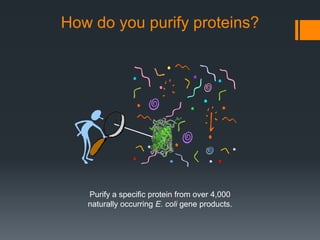
How do you purify proteins?


   Purify a specific protein from over 4,000
   naturally occurring E. coli gene products.
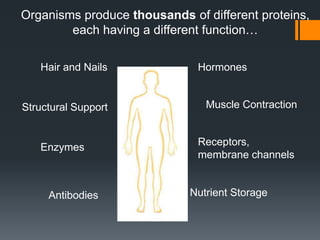
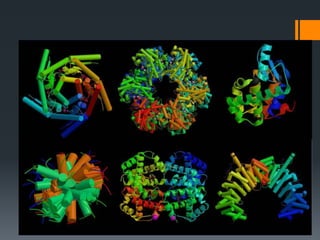
Organisms produce thousands of different proteins,
        each having a different function…

   Hair and Nails             Hormones


Structural Support              Muscle Contraction


                              Receptors,
   Enzymes
                              membrane channels


     Antibodies              Nutrient Storage
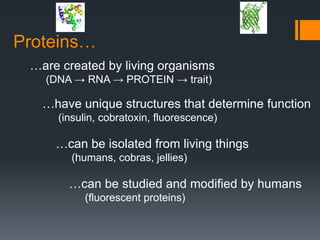
Proteins…
 …are created by living organisms
   (DNA → RNA → PROTEIN → trait)

   …have unique structures that determine function
     (insulin, cobratoxin, fluorescence)

     …can be isolated from living things
        (humans, cobras, jellies)

       …can be studied and modified by humans
          (fluorescent proteins)
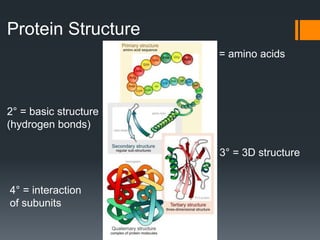
Protein Structure
Protein Structure
                       1° = amino acids


2° = basic structure
(hydrogen bonds)

                         3° = 3D structure


4° = interaction
of subunits
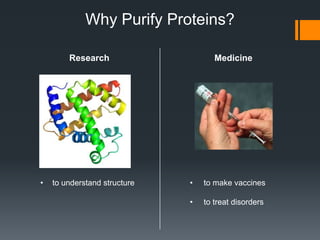
Why Purify Proteins?

        Research                     Medicine


•   to understand structure   •   to make vaccines

                              •   to treat disorders
Why Purify Proteins?
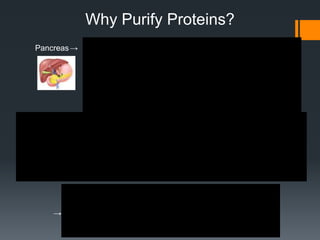
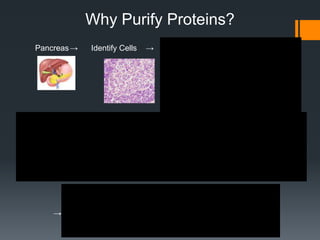
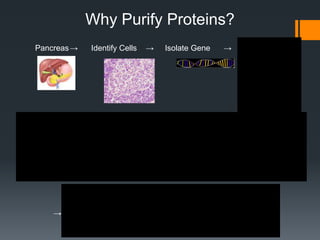
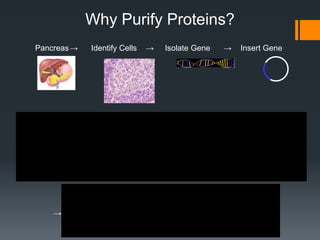
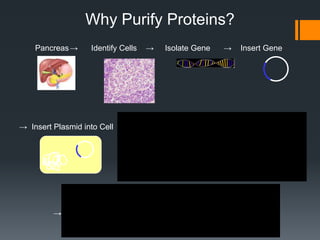
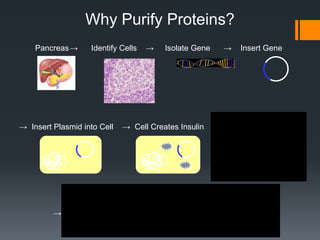
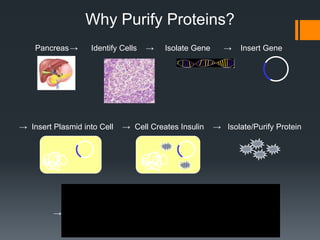
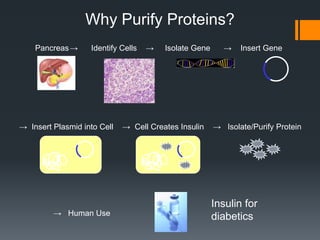
    Pancreas →     Identify Cells   →   Isolate Gene     →    Insert Gene


→ Insert Plasmid into Cell   → Cell Creates Insulin    → Isolate/Purify Protein


                                                       Insulin for
         → Human Use                                   diabetics
Why Purify Proteins?
    Pancreas →     Identify Cells   →   Isolate Gene     →    Insert Gene


→ Insert Plasmid into Cell   → Cell Creates Insulin    → Isolate/Purify Protein


                                                       Insulin for
         → Human Use                                   diabetics
Why Purify Proteins?
    Pancreas →     Identify Cells   →   Isolate Gene     →    Insert Gene


→ Insert Plasmid into Cell   → Cell Creates Insulin    → Isolate/Purify Protein


                                                       Insulin for
         → Human Use                                   diabetics
Why Purify Proteins?
    Pancreas →     Identify Cells   →   Isolate Gene     →    Insert Gene


→ Insert Plasmid into Cell   → Cell Creates Insulin    → Isolate/Purify Protein


                                                       Insulin for
         → Human Use                                   diabetics
Why Purify Proteins?
    Pancreas →     Identify Cells   →   Isolate Gene     →    Insert Gene


→ Insert Plasmid into Cell   → Cell Creates Insulin    → Isolate/Purify Protein


                                                       Insulin for
         → Human Use                                   diabetics
Why Purify Proteins?
    Pancreas →     Identify Cells   →   Isolate Gene     →    Insert Gene


→ Insert Plasmid into Cell   → Cell Creates Insulin    → Isolate/Purify Protein


                                                       Insulin for
         → Human Use                                   diabetics
Why Purify Proteins?
    Pancreas →     Identify Cells   →   Isolate Gene     →    Insert Gene


→ Insert Plasmid into Cell   → Cell Creates Insulin    → Isolate/Purify Protein


                                                       Insulin for
         → Human Use                                   diabetics
Why Purify Proteins?
    Pancreas →     Identify Cells   →   Isolate Gene     →    Insert Gene


→ Insert Plasmid into Cell   → Cell Creates Insulin    → Isolate/Purify Protein


                                                       Insulin for
         → Human Use                                   diabetics
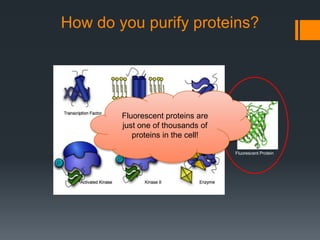
How do you purify proteins?


        Fluorescent proteins are
        just one of thousands of
           proteins in the cell!

                                   Fluorescent Protein
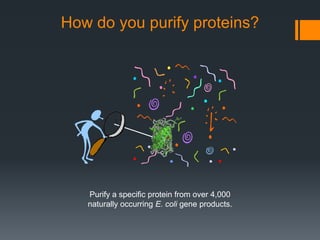
How do you purify proteins?


   Purify a specific protein from over 4,000
   naturally occurring E. coli gene products.
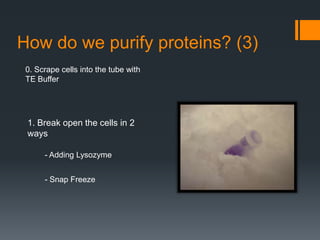
How do we purify proteins? (3)
 0. Scrape cells into the tube with
 TE Buffer


 1. Break open the cells in 2
 ways

      - Adding Lysozyme


      - Snap Freeze
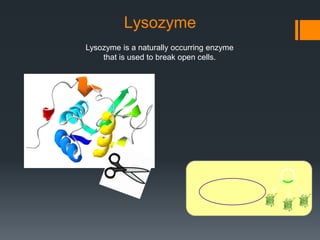
Lysozyme
Lysozyme is a naturally occurring enzyme
    that is used to break open cells.
How do we purify proteins? (3)
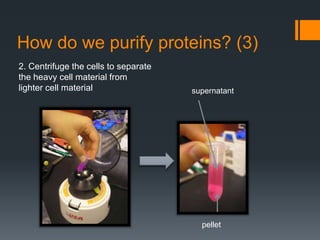
2. Centrifuge the cells to separate
the heavy cell material from
lighter cell material                 supernatant


                                        pellet
How do we purify proteins? (3)
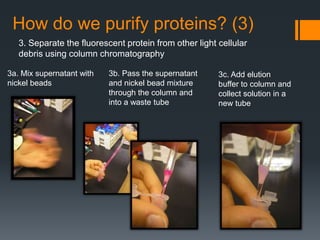
   3. Separate the fluorescent protein from other light cellular
   debris using column chromatography

3a. Mix supernatant with   3b. Pass the supernatant     3c. Add elution
nickel beads               and nickel bead mixture      buffer to column and
                           through the column and       collect solution in a
                           into a waste tube            new tube
How do the nickel beads work?


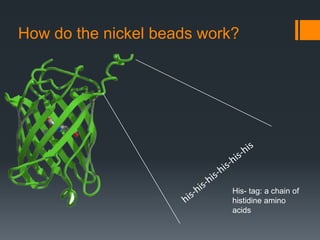
                            His- tag: a chain of
                            histidine amino
                            acids
How do the nickel beads work?
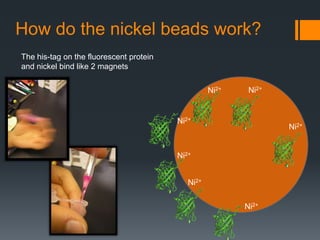
The his-tag on the fluorescent protein
and nickel bind like 2 magnets

                                                   Ni2+    Ni2+


                                         Ni2+
                                                                  Ni2+


                                         Ni2+


                                            Ni2+


                                                          Ni2+
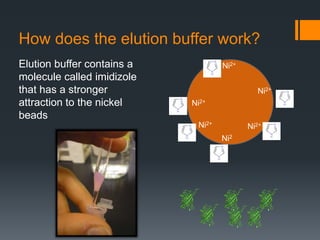
How does the elution buffer work?
Elution buffer contains a           Ni2+
molecule called imidizole
that has a stronger                          Ni2+
attraction to the nickel    Ni2+
beads
                             Ni2+          Ni2+
                                    Ni2
                                    +
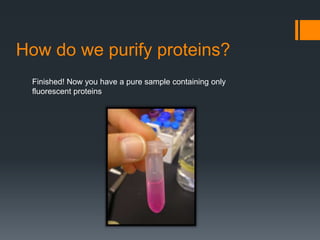
How do we purify proteins?
 Finished! Now you have a pure sample containing only
 fluorescent proteins
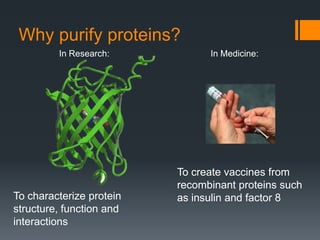
Why purify proteins?
         In Research:           In Medicine:


                          To create vaccines from
                          recombinant proteins such
To characterize protein   as insulin and factor 8
structure, function and
interactions
Tricky Parts of Lab
 Scraping cells into tube

 Using the correct buffer solution

Protein Purification Slides

  • 1.
    Warm up!  Sitnext to your lab partner from yesterday  Put on a lab coat and gloves. Take out your lab notebook.  Title: Bacterial Transformation  Purpose: To change the phenotype (physical traits) of e.coli by changing the geneotype (DNA or genes)  Method: See ScienceBridge Protocol  Results: “Wait for Quanina to explain”  Take a look at your results. Did you see what you expected?
  • 2.
    Results  Number offluorescent colonies counted: Conclusion  If you saw colonies growing that were not fluorescent, explain how this could have happened?  If you saw no colonies growing, how could this have happened?  If your results were unexpected, explain how this could have happened.
  • 3.
  • 4.
    Objective: To extract andseparate fluorescent proteins in E.coli from other cellular debris (membrane, other proteins, DNA, RNA, etc.)
  • 5.
    Transformation Bacterial Plasmid Uptake of foreign DNA, chromosome often a circular plasmid Allow bacteria to grow for 1-3 Bacterial days on plate with ampicillin. chromosome Bacteria now express cloned fluorescent protein…
  • 6.
    Warm-up  Sit nextto your lab partner from yesterday.  Take out your PD and reading packet annotations. Swap PDs and annotate. Repeat until 3 people have read and annotated your PD.  Do this without talking
  • 7.
    SLCs Yay!  Takeout a sheet of paper.  Write down 3 things you are proud that you have accomplished this semester.  Write down 2 things you want to improve on this semester.  You can talk about any class you are taking this semester or you can talk about the semester overall.
  • 8.
    How do youpurify proteins? Purify a specific protein from over 4,000 naturally occurring E. coli gene products.
  • 9.
    Organisms produce thousandsof different proteins, each having a different function… Hair and Nails Hormones Structural Support Muscle Contraction Receptors, Enzymes membrane channels Antibodies Nutrient Storage
  • 10.
    Proteins… …are createdby living organisms (DNA → RNA → PROTEIN → trait) …have unique structures that determine function (insulin, cobratoxin, fluorescence) …can be isolated from living things (humans, cobras, jellies) …can be studied and modified by humans (fluorescent proteins)
  • 11.
  • 12.
    Protein Structure 1° = amino acids 2° = basic structure (hydrogen bonds) 3° = 3D structure 4° = interaction of subunits
  • 13.
    Why Purify Proteins? Research Medicine • to understand structure • to make vaccines • to treat disorders
  • 14.
    Why Purify Proteins? Pancreas → Identify Cells → Isolate Gene → Insert Gene → Insert Plasmid into Cell → Cell Creates Insulin → Isolate/Purify Protein Insulin for → Human Use diabetics
  • 15.
    Why Purify Proteins? Pancreas → Identify Cells → Isolate Gene → Insert Gene → Insert Plasmid into Cell → Cell Creates Insulin → Isolate/Purify Protein Insulin for → Human Use diabetics
  • 16.
    Why Purify Proteins? Pancreas → Identify Cells → Isolate Gene → Insert Gene → Insert Plasmid into Cell → Cell Creates Insulin → Isolate/Purify Protein Insulin for → Human Use diabetics
  • 17.
    Why Purify Proteins? Pancreas → Identify Cells → Isolate Gene → Insert Gene → Insert Plasmid into Cell → Cell Creates Insulin → Isolate/Purify Protein Insulin for → Human Use diabetics
  • 18.
    Why Purify Proteins? Pancreas → Identify Cells → Isolate Gene → Insert Gene → Insert Plasmid into Cell → Cell Creates Insulin → Isolate/Purify Protein Insulin for → Human Use diabetics
  • 19.
    Why Purify Proteins? Pancreas → Identify Cells → Isolate Gene → Insert Gene → Insert Plasmid into Cell → Cell Creates Insulin → Isolate/Purify Protein Insulin for → Human Use diabetics
  • 20.
    Why Purify Proteins? Pancreas → Identify Cells → Isolate Gene → Insert Gene → Insert Plasmid into Cell → Cell Creates Insulin → Isolate/Purify Protein Insulin for → Human Use diabetics
  • 21.
    Why Purify Proteins? Pancreas → Identify Cells → Isolate Gene → Insert Gene → Insert Plasmid into Cell → Cell Creates Insulin → Isolate/Purify Protein Insulin for → Human Use diabetics
  • 22.
    How do youpurify proteins? Fluorescent proteins are just one of thousands of proteins in the cell! Fluorescent Protein
  • 23.
    How do youpurify proteins? Purify a specific protein from over 4,000 naturally occurring E. coli gene products.
  • 24.
    How do wepurify proteins? (3) 0. Scrape cells into the tube with TE Buffer 1. Break open the cells in 2 ways - Adding Lysozyme - Snap Freeze
  • 25.
    Lysozyme Lysozyme is anaturally occurring enzyme that is used to break open cells.
  • 26.
    How do wepurify proteins? (3) 2. Centrifuge the cells to separate the heavy cell material from lighter cell material supernatant pellet
  • 27.
    How do wepurify proteins? (3) 3. Separate the fluorescent protein from other light cellular debris using column chromatography 3a. Mix supernatant with 3b. Pass the supernatant 3c. Add elution nickel beads and nickel bead mixture buffer to column and through the column and collect solution in a into a waste tube new tube
  • 28.
    How do thenickel beads work? His- tag: a chain of histidine amino acids
  • 29.
    How do thenickel beads work? The his-tag on the fluorescent protein and nickel bind like 2 magnets Ni2+ Ni2+ Ni2+ Ni2+ Ni2+ Ni2+ Ni2+
  • 30.
    How does theelution buffer work? Elution buffer contains a Ni2+ molecule called imidizole that has a stronger Ni2+ attraction to the nickel Ni2+ beads Ni2+ Ni2+ Ni2 +
  • 31.
    How do wepurify proteins? Finished! Now you have a pure sample containing only fluorescent proteins
  • 32.
    Why purify proteins? In Research: In Medicine: To create vaccines from recombinant proteins such To characterize protein as insulin and factor 8 structure, function and interactions
  • 33.
    Tricky Parts ofLab  Scraping cells into tube  Using the correct buffer solution

Editor's Notes

  • #9 Like your body, the E. coli bacterial cells that we will be using have many different proteins. From the over 4,000 proteins on an E. coli cell, we will be separating out just the specific protein that we are interested in looking at. The protein we will be purifying is the fluorescent protein.A bacterial cell is full of stuff. This includes DNA, RNA, lipids, and many different types of proteins. If we only want to separate out the fluorescent protein, how are we going to do that?
  • #14 Recombinant vaccines expressed in bacteria or yeast to produce large quantities of a single viral or bacterial protein. -purified protein injected into the patient -patient's immune system makes antibodies to the disease agent's protein, -patient protected from natural disease. Advantages of the recombinant vaccine technology are that there is virtually no chance of the host becoming ill from the agent, since it is just a single protein, not the organism itself.
  • #24 Like your body, the E. coli bacterial cells that we will be using have many different proteins. From the over 4,000 proteins on an E. coli cell, we will be separating out just the specific protein that we are interested in looking at. The protein we will be purifying is the fluorescent protein.A bacterial cell is full of stuff. This includes DNA, RNA, lipids, and many different types of proteins. If we only want to separate out the fluorescent protein, how are we going to do that?
  • #25 LysozymeIn our saliva, tears, spleen, lung, kidney High concentration in chicken egg-white (our source of lysozyme).Lysozyme was discovered accidentally in 1922 by Alexander Fleming by accident. Nasal drippings in the petri dish with bacterial culture, killing the bacterial cells. Viruses uselysozymeto break into the host bacterial cell allowing it to inject its DNA. SNAP FREEZEThis technique involves freezing and then thawing the material.Causes cells to swell and ultimately break as ice crystals form during the freezing process and then contract during thawing.