Introduction
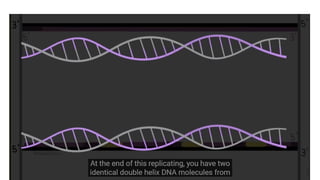
• DNA replicationis the process of producing two identical copies from one
original DNA molecules.
• It is the basis of inheritance and therefore it occurs in all living organisms.
• Fundamental mechanism of DNA replication is same, however there are
some variation due to difference in molecular properties.
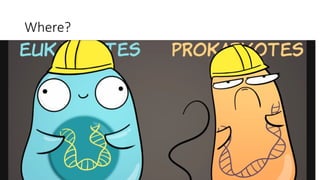
• DNA replication in eukaryotes is more complex than the DNA replication in
prokaryotes.
• DNA in eukaryotes are highly condensed nucleosomal structure which
needs to be unwound before replication.
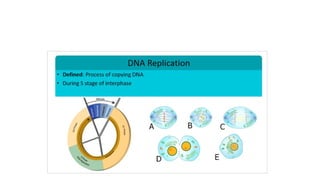
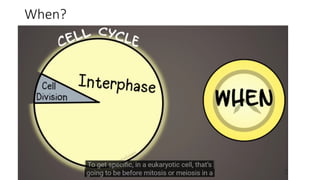
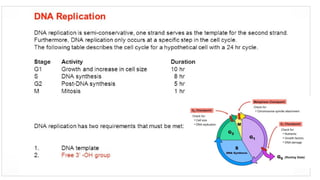
• Majority of DNA replication (synthesis) occurs during S phase of the cell
cycle (telomere is synthesized in late S phase).
• Replication is bidirectional as in the prokaryotes.
7.
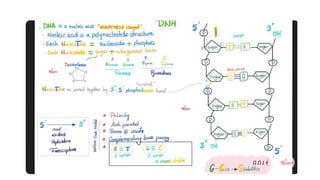
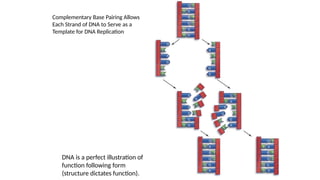
Complementary Base PairingAllows
Each Strand of DNA to Serve as a
Template for DNA Replication
DNA is a perfect illustration of
function following form
(structure dictates function).
8.
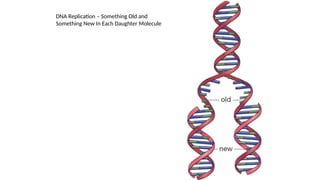
DNA Replication –Something Old and
Something New In Each Daughter Molecule
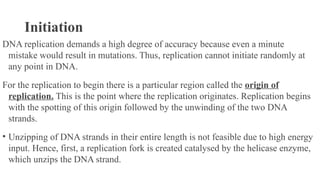
Initiation
DNA replication demandsa high degree of accuracy because even a minute
mistake would result in mutations. Thus, replication cannot initiate randomly at
any point in DNA.
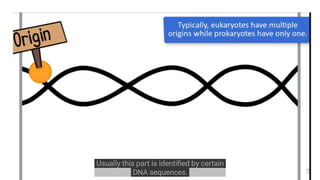
For the replication to begin there is a particular region called the origin of
replication. This is the point where the replication originates. Replication begins
with the spotting of this origin followed by the unwinding of the two DNA
strands.
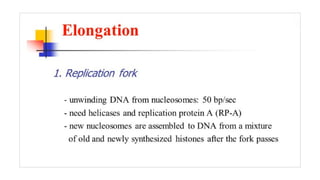
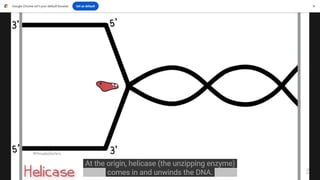
• Unzipping of DNA strands in their entire length is not feasible due to high energy
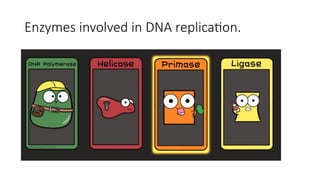
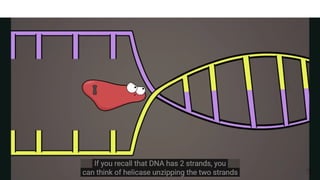
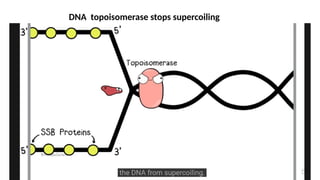
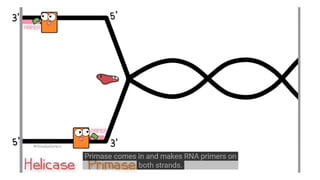
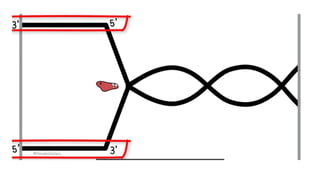
input. Hence, first, a replication fork is created catalysed by the helicase enzyme,
which unzips the DNA strand.
25.
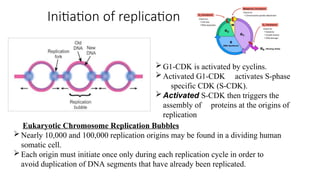
Initiation of replication
EukaryoticChromosome Replication Bubbles
Nearly 10,000 and 100,000 replication origins may be found in a dividing human
somatic cell.
Each origin must initiate once only during each replication cycle in order to
avoid duplication of DNA segments that have already been replicated.
G1-CDK is activated by cyclins.
Activated G1-CDK activates S-phase
specific CDK (S-CDK).
Activated S-CDK then triggers the
assembly of proteins at the origins of
replication
27.
Initiation of replication
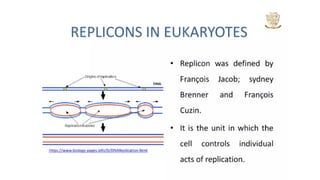
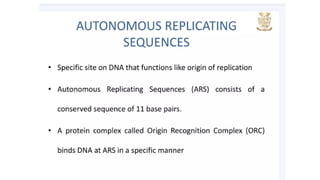
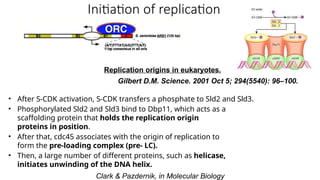
Replicationorigins in eukaryotes.
Gilbert D.M. Science. 2001 Oct 5; 294(5540): 96–100.
• After S-CDK activation, S-CDK transfers a phosphate to Sld2 and Sld3.
• Phosphorylated Sld2 and Sld3 bind to Dbp11, which acts as a
scaffolding protein that holds the replication origin
proteins in position.
• After that, cdc45 associates with the origin of replication to
form the pre-loading complex (pre- LC).
• Then, a large number of different proteins, such as helicase,
initiates unwinding of the DNA helix.
Clark & Pazdernik, in Molecular Biology
28.
Initiation of replication
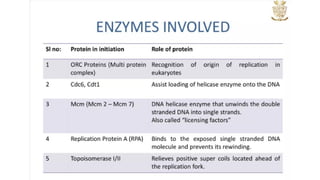
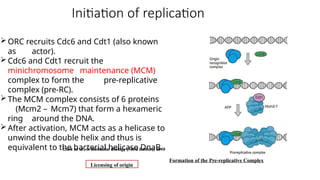
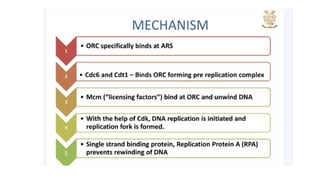
ORCrecruits Cdc6 and Cdt1 (also known
as actor).
Cdc6 and Cdt1 recruit the
minichromosome maintenance (MCM)
complex to form the pre-replicative
complex (pre-RC).
The MCM complex consists of 6 proteins
(Mcm2 – Mcm7) that form a hexameric
ring around the DNA.
After activation, MCM acts as a helicase to
unwind the double helix and thus is
equivalent to the bacterial helicase DnaB.
Licensing of origin
Clark et. al., in Molecular Biology (Third Edition), 2019
Formation of the Pre-replicative Complex
31.
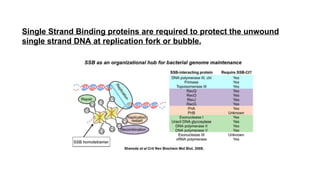
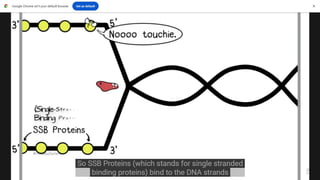
Single Strand Bindingproteins are required to protect the unwound
single strand DNA at replication fork or bubble.
32.
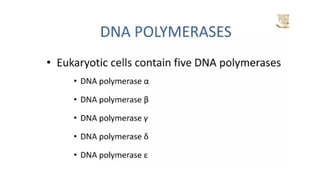
Eukaryotes also containmultiple DNA polymerases
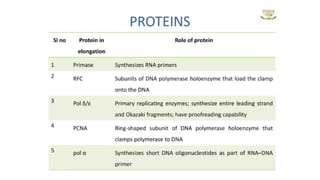
DNA pol α DNA pol β DNA pol γ DNA pol δ DNA pol ε
3´ exonucease No No Yes Yes Yes
Fidelity 10-4- 10-5 5 × 10 4
−
10-5 10-5- 10-6 10-6- 10-7
Processivity Moderate Low High High High
Role Lagging
strand
primer
synthesis
DNA repair Mitochodria I
DNA
replication
Lagging
strand
replicatio
n
Leading
strand
replicatio
n
35.
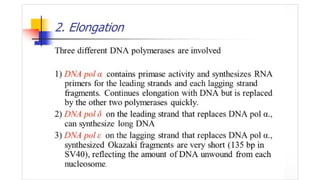
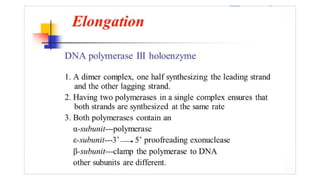
Elongation
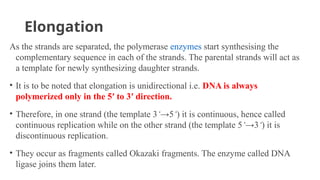
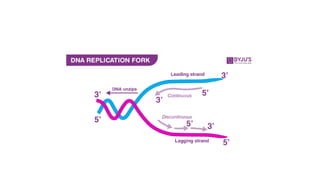
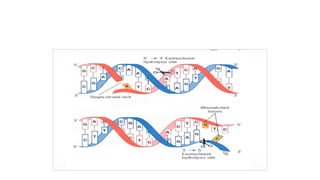
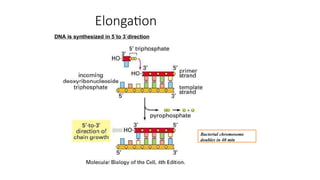
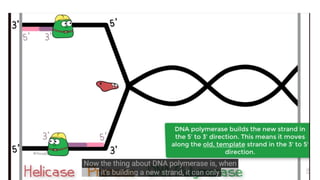
As the strandsare separated, the polymerase enzymes start synthesising the
complementary sequence in each of the strands. The parental strands will act as
a template for newly synthesizing daughter strands.
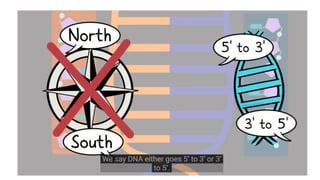
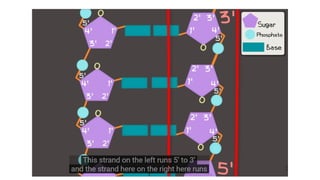
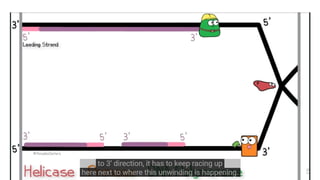
• It is to be noted that elongation is unidirectional i.e. DNA is always
polymerized only in the 5′ to 3′ direction.
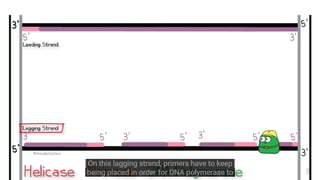
• Therefore, in one strand (the template 3‘→5‘) it is continuous, hence called
continuous replication while on the other strand (the template 5‘→3‘) it is
discontinuous replication.
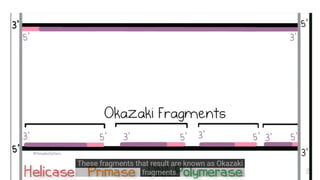
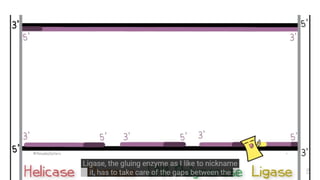
• They occur as fragments called Okazaki fragments. The enzyme called DNA
ligase joins them later.
42.
Elongation
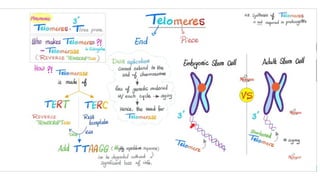
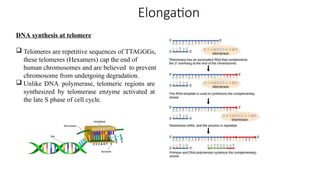
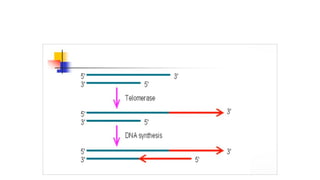
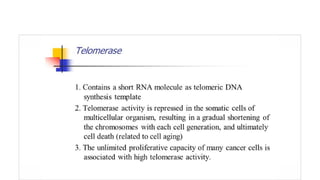
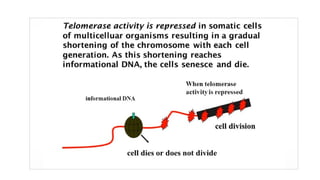
DNA synthesis attelomere
Telomeres are repetitive sequences of TTAGGGs,
these telomeres (Hexamers) cap the end of
human chromosomes and are believed to prevent
chromosome from undergoing degradation.
Unlike DNA polymerase, telomeric regions are
synthesized by telomerase enzyme activated at
the late S phase of cell cycle.
44.
Termination
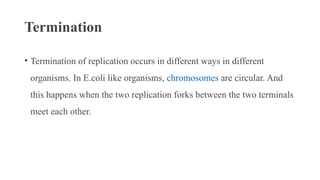
• Termination ofreplication occurs in different ways in different
organisms. In E.coli like organisms, chromosomes are circular. And
this happens when the two replication forks between the two terminals
meet each other.
46.
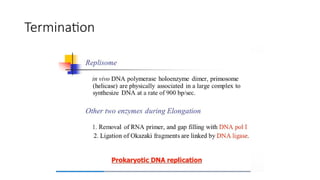
Termination
• Is achievedby convergence of
advancing replication fork or
bubble
• Catenation is removed by helicase,
i.e., Plf1/Rm3 helicase
• Gap is filled by DNA ligase
Molecular Cell 2019; 74(2): 231-244.e9
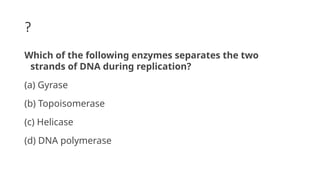
?
Which of thefollowing enzymes separates the two
strands of DNA during replication?
(a) Gyrase
(b) Topoisomerase
(c) Helicase
(d) DNA polymerase
98.
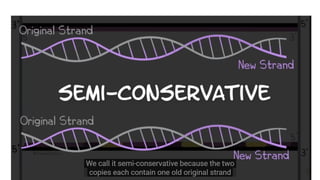
DNA replication is
(a)conservative
(b) conservative and discontinuous
(c) semi-conservative and discontinuous
(d) semi-conservative and semi-discontinuous
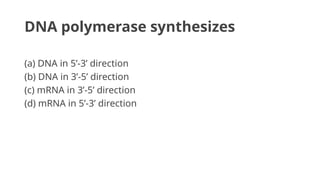
99.
DNA polymerase synthesizes
(a)DNA in 5’-3’ direction
(b) DNA in 3’-5’ direction
(c) mRNA in 3’-5’ direction
(d) mRNA in 5’-3’ direction





























![PERI-PROSTHETIC FRACTURE NAIL-PLATE CONSTRUCT [NPC].pptx](https://cdn.slidesharecdn.com/ss_thumbnails/drarunkumardrmohamedashrafperiprostheticfrasturenail-plateconstructnpc-260209164459-7e9d15a1-thumbnail.jpg?width=640&height=640&fit=bounds)


![ONFH[AVN HIP] -TRIPLE REGIME -A NOVAL SURGICAL CONCEPT .pptx](https://cdn.slidesharecdn.com/ss_thumbnails/onfhavnhip2026koaconcalicutdrgokuldevdrmashraf-260210064517-213ec005-thumbnail.jpg?width=640&height=640&fit=bounds)


