DNA replication in
eukaryotes
Presented by;
Name; Sadia Abid
Roll Number; 855
. It occurs in nucleus.
. Synthesis occurs in 5__3 direction.
Enzymes of DNA Replication;
Helicase;
Opens up the DNA helix.
RF_A or replication factor A;
Held two strands separately.
Topoisomerase 1 and 2;
Relax supercoiling in the DNA a
head of replication fork.
PCNA;
Isa DNA clamp that act as a procesdivety
factor for DNA polymerase.
Replication factor C or RF_C;
Load PCNA on DNA.
Primase;
Form RNA primer.
DNA pol epsilon;
Synthesis of leading strand.
DNA pol delta;
Synthesis of lagging strand.
RNAse H;
Remove primers.
Lygase;
Nick is sealed and formation of phosphodiester
bond.
Steps of eukaryotic replication;
It has 3 steps.
1. Initiation.
2. Elongation.
3. Termination.
Initiation;
It inovlves the identification of origin sites which
are usually rich in adenine and thymine.
. Eukayotic cells have mutiple origin sites which are present
on special sequence of DNA known as autonomously
replicating sequence.
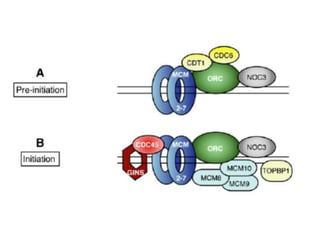
. At the origin site of replication, a pre replication complex
is made by the combination of many initiation proteins .This
pre replicating complex is then converted into initiation
complex.
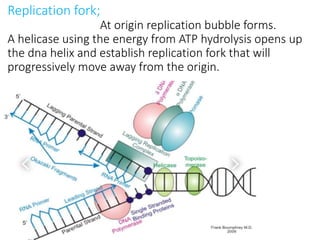
Replication fork;
At origin replication bubble forms.
A helicase using the energy from ATP hydrolysis opens up
the dna helix and establish replication fork that will
progressively move away from the origin.
Rf A bind to unwound singal stranded DNA.
The opening of double helix causes supercoiling in
the DNA ahead of replication fork . These are
resolved with the action of topoisomerases.
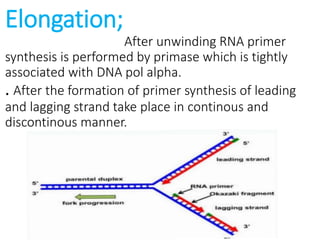
Elongation;
After unwinding RNA primer
synthesis is performed by primase which is tightly
associated with DNA pol alpha.
. After the formation of primer synthesis of leading
and lagging strand take place in continous and
discontinous manner.
Leading strand synthesis;
DNA pol epsilon synthesize nucleotides on leading
strand.
. It will continously add nucleotides leading to
continous process of replication in 5_3 direction. Thus
it will require only a single RNA primer.
. Finally the primers are removed by RNAse H and the
gap is filled by DNA pol.
. Nick is sealed by DNA ligase.
Significance of eukaryotic replication;
Replication is a fundamental process which is essential
for cell growth and division.
.DNA replication involves the generation of new
molecule of DNA which is crucial for life.
. It conserves the all genome for next generation.
Dna replication in eukaryotes

Dna replication in eukaryotes

  • 1.
    DNA replication in eukaryotes Presentedby; Name; Sadia Abid Roll Number; 855
  • 3.
    . It occursin nucleus. . Synthesis occurs in 5__3 direction. Enzymes of DNA Replication; Helicase; Opens up the DNA helix. RF_A or replication factor A; Held two strands separately. Topoisomerase 1 and 2; Relax supercoiling in the DNA a head of replication fork. PCNA; Isa DNA clamp that act as a procesdivety factor for DNA polymerase.
  • 4.
    Replication factor Cor RF_C; Load PCNA on DNA. Primase; Form RNA primer. DNA pol epsilon; Synthesis of leading strand. DNA pol delta; Synthesis of lagging strand. RNAse H; Remove primers. Lygase; Nick is sealed and formation of phosphodiester bond.
  • 5.
    Steps of eukaryoticreplication; It has 3 steps. 1. Initiation. 2. Elongation. 3. Termination. Initiation; It inovlves the identification of origin sites which are usually rich in adenine and thymine. . Eukayotic cells have mutiple origin sites which are present on special sequence of DNA known as autonomously replicating sequence. . At the origin site of replication, a pre replication complex is made by the combination of many initiation proteins .This pre replicating complex is then converted into initiation complex.
  • 7.
    Replication fork; At originreplication bubble forms. A helicase using the energy from ATP hydrolysis opens up the dna helix and establish replication fork that will progressively move away from the origin.
  • 8.
    Rf A bindto unwound singal stranded DNA. The opening of double helix causes supercoiling in the DNA ahead of replication fork . These are resolved with the action of topoisomerases.
  • 9.
    Elongation; After unwinding RNAprimer synthesis is performed by primase which is tightly associated with DNA pol alpha. . After the formation of primer synthesis of leading and lagging strand take place in continous and discontinous manner.
  • 11.
    Leading strand synthesis; DNApol epsilon synthesize nucleotides on leading strand. . It will continously add nucleotides leading to continous process of replication in 5_3 direction. Thus it will require only a single RNA primer. . Finally the primers are removed by RNAse H and the gap is filled by DNA pol. . Nick is sealed by DNA ligase.
  • 12.
    Significance of eukaryoticreplication; Replication is a fundamental process which is essential for cell growth and division. .DNA replication involves the generation of new molecule of DNA which is crucial for life. . It conserves the all genome for next generation.