Advanced Level Teacher’s
     Seminar-2006


 DNA Finger printing and
  Related techniques
     S.Santharooban
                           1
DNA Fingerprinting or DNA
            Typing
• Method to identify the DNA of an individual
• DNA is unique to a person, no two individuals
  have identical DNA except identical twins or
  clones
• All the cells of a person has same DNA
• A specimen for DNA fingerprinting can be any
  type of cell
        – Blood, saliva, sperm, muscle, teeth, bones or any DNA bearing
          cell


                                                                      2
Importance of VNTRs
• DNA contain exons and introns.
    • Exons that contain genetic information.
    • Introns supply no relevant genetic information at all
• Introns contain repeated sequences of
  base pairs.
• These sequences is called Variable
  Number Tandem Repeats (VNTR).


                                                          3
• VNTRs contain anywhere from 20 to 100 base
  pairs.
• Every human being has some VNTRs.
• To determine if a person has a particular VNTR,
  a Southern Blot is performed.
• In this technique, VNTRs is probed, through a
  hybridization reaction, with a radioactive
  version of the VNTR in question.
• The pattern which results from this process is
  often referred to as a DNA fingerprint.
                                                    4
Southern Blot technique
involves…
     Invented by Prof. Ed. Southern.

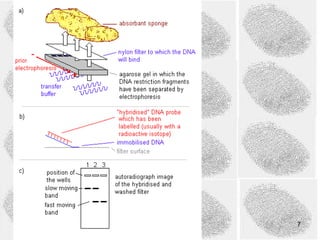
•     Extract DNA from the sample of an individual
•     Digest into small fragments using restriction enzyme
•     Separate DNA fragments by gel electrophoresis.
•     Denature the DNA,
              •   the entire DNA is changed as single-stranded.
5.    Apply a sheet of nitrocellulose paper to the gel
      (containing DNA).
6.    Make to permanently attach the DNA to the sheet.
7.    The Southern Blot is now ready to be analyzed.

                                                                  5
•   Apply a radioactive genetic probe/ a
    radioactive version of the VNTR to
    nitrocellulose filter paper.
•   Radioactive probe bind to target
    sequence/VNTRs.
•   Washed out excess probe.
•   Determine the position of the bounded probe
    by autoradiography.
           »   By an X-ray filming
           »   areas where the radioactive probe binds will show up on
               the film.

                                                                         6
7
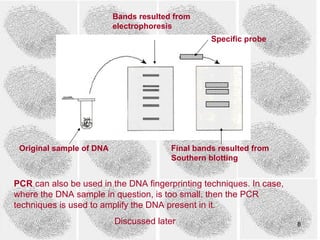
Bands resulted from
                          electrophoresis
                                                  Specific probe


 Original sample of DNA                 Final bands resulted from
                                        Southern blotting


PCR can also be used in the DNA fingerprinting techniques. In case,
where the DNA sample in question, is too small, then the PCR
techniques is used to amplify the DNA present in it.
                          Discussed later                             8
Use of DNA fingerprinting
• Criminal Identification and Forensics.
          » used in forensic medicine-confirm the suspect

• Determine family relationships
          » paternity confirmation, family diseases

• Applicable to both plants and animals


                                                            9
Polymerase Chain Reaction
             (PCR)
• Invented by Kary. B. Mullis.
• used to amplify specific regions of a DNA strand.
• sample is crushed and added different buffers
  solution and primers.
• Then it is put into Thermocycler to amplify the
  DNA strands using appropriate temperature.
• The following reaction take place in the
  amplification.


                                                 10
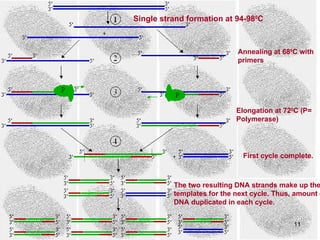
Single strand formation at 94-980C


                            Annealing at 680C with
                            primers


                            Elongation at 720C (P=
                            Polymerase)


                              First cycle complete.


          The two resulting DNA strands make up the
          templates for the next cycle. Thus, amount o
          DNA duplicated in each cycle.


                                             11
What will happen to double stranded DNA if
 the temperature is raised to 900C????


                                         12
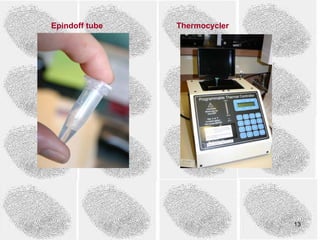
Epindoff tube   Thermocycler


                               13
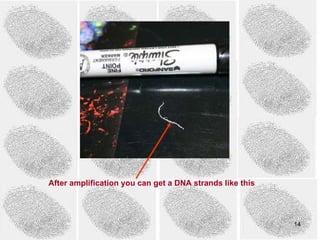
After amplification you can get a DNA strands like this


                                                          14
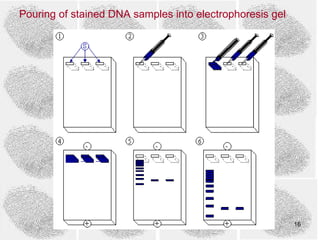
•   Then Ethidium bromide is added to stain the DNA.
•   poured onto the electrophoresis gel.
•   allowed to run nearly for 1 hrs.
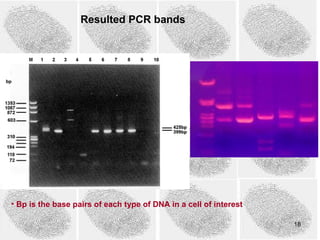
•   It results in series of bands.
        • Bands are laid down based on the base pairs of each type of DNA.
        • Bands present in the distal end of application consist the DNA of
          less base pairs.
        • Bands present in the proximal end of application consist the DNA of
          higher base pairs.
        • In between are moderate base pairs.
• Obtained bands will be compared to references banding
  pattern.

                                                                           15
Pouring of stained DNA samples into electrophoresis gel


                                                          16
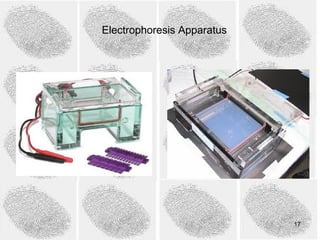
Electrophoresis Apparatus


                            17
Resulted PCR bands


• Bp is the base pairs of each type of DNA in a cell of interest

                                                                   18
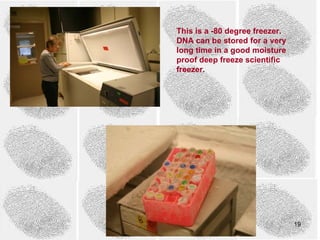
This is a -80 degree freezer.
DNA can be stored for a very
long time in a good moisture
proof deep freeze scientific
freezer.


                                19
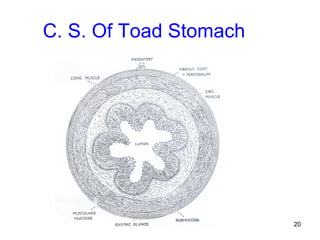
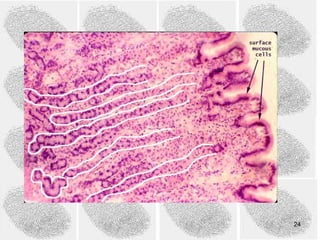
C. S. Of Toad Stomach


                        20
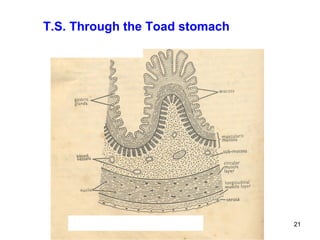
T.S. Through the Toad stomach


                                21
22
23
24

DNA fingerprinting

  • 1.
    Advanced Level Teacher’s Seminar-2006 DNA Finger printing and Related techniques S.Santharooban 1
  • 2.
    DNA Fingerprinting orDNA Typing • Method to identify the DNA of an individual • DNA is unique to a person, no two individuals have identical DNA except identical twins or clones • All the cells of a person has same DNA • A specimen for DNA fingerprinting can be any type of cell – Blood, saliva, sperm, muscle, teeth, bones or any DNA bearing cell 2
  • 3.
    Importance of VNTRs •DNA contain exons and introns. • Exons that contain genetic information. • Introns supply no relevant genetic information at all • Introns contain repeated sequences of base pairs. • These sequences is called Variable Number Tandem Repeats (VNTR). 3
  • 4.
    • VNTRs containanywhere from 20 to 100 base pairs. • Every human being has some VNTRs. • To determine if a person has a particular VNTR, a Southern Blot is performed. • In this technique, VNTRs is probed, through a hybridization reaction, with a radioactive version of the VNTR in question. • The pattern which results from this process is often referred to as a DNA fingerprint. 4
  • 5.
    Southern Blot technique involves… Invented by Prof. Ed. Southern. • Extract DNA from the sample of an individual • Digest into small fragments using restriction enzyme • Separate DNA fragments by gel electrophoresis. • Denature the DNA, • the entire DNA is changed as single-stranded. 5. Apply a sheet of nitrocellulose paper to the gel (containing DNA). 6. Make to permanently attach the DNA to the sheet. 7. The Southern Blot is now ready to be analyzed. 5
  • 6.
    Apply a radioactive genetic probe/ a radioactive version of the VNTR to nitrocellulose filter paper. • Radioactive probe bind to target sequence/VNTRs. • Washed out excess probe. • Determine the position of the bounded probe by autoradiography. » By an X-ray filming » areas where the radioactive probe binds will show up on the film. 6
  • 7.
  • 8.
    Bands resulted from electrophoresis Specific probe Original sample of DNA Final bands resulted from Southern blotting PCR can also be used in the DNA fingerprinting techniques. In case, where the DNA sample in question, is too small, then the PCR techniques is used to amplify the DNA present in it. Discussed later 8
  • 9.
    Use of DNAfingerprinting • Criminal Identification and Forensics. » used in forensic medicine-confirm the suspect • Determine family relationships » paternity confirmation, family diseases • Applicable to both plants and animals 9
  • 10.
    Polymerase Chain Reaction (PCR) • Invented by Kary. B. Mullis. • used to amplify specific regions of a DNA strand. • sample is crushed and added different buffers solution and primers. • Then it is put into Thermocycler to amplify the DNA strands using appropriate temperature. • The following reaction take place in the amplification. 10
  • 11.
    Single strand formationat 94-980C Annealing at 680C with primers Elongation at 720C (P= Polymerase) First cycle complete. The two resulting DNA strands make up the templates for the next cycle. Thus, amount o DNA duplicated in each cycle. 11
  • 12.
    What will happento double stranded DNA if the temperature is raised to 900C???? 12
  • 13.
    Epindoff tube Thermocycler 13
  • 14.
    After amplification youcan get a DNA strands like this 14
  • 15.
    Then Ethidium bromide is added to stain the DNA. • poured onto the electrophoresis gel. • allowed to run nearly for 1 hrs. • It results in series of bands. • Bands are laid down based on the base pairs of each type of DNA. • Bands present in the distal end of application consist the DNA of less base pairs. • Bands present in the proximal end of application consist the DNA of higher base pairs. • In between are moderate base pairs. • Obtained bands will be compared to references banding pattern. 15
  • 16.
    Pouring of stainedDNA samples into electrophoresis gel 16
  • 17.
  • 18.
    Resulted PCR bands •Bp is the base pairs of each type of DNA in a cell of interest 18
  • 19.
    This is a-80 degree freezer. DNA can be stored for a very long time in a good moisture proof deep freeze scientific freezer. 19
  • 20.
    C. S. OfToad Stomach 20
  • 21.
    T.S. Through theToad stomach 21
  • 22.
  • 23.
  • 24.