DNA
FINGERPRINTING
Group 8
Michila Fernando
and
Sureshni Fernando
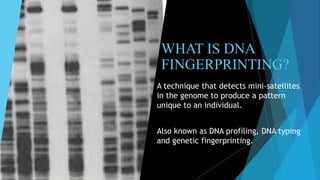
A technique that detects mini-satellites
in the genome to produce a pattern
unique to an individual.
Also known as DNA profiling, DNA typing
and genetic fingerprinting.
WHAT IS DNA
FINGERPRINTING?
HISTORY
Science of fingerprinting was 1st
used by Sir William Herschel as a
method of identification in 1858
and in 1897 in India.
The DNA fingerprinting technique
was invented by Alec Jeffreys
(1984) at Leicester University,
United Kingdom.
PRINCIPLE
Human genome consists of non coding proteins
which make up 95% of DNA known as junk DNA.
They can be separated as satellites by density
centrifugation.
In satellites, repetition of bases is in tandem.
According to the length, base composition and
numbers of tandemly repetitive units, it is
divided as micro-satellites and mini-satellites.
At specific loci on the chromosome, the number
of tandem repeats varies between individuals.
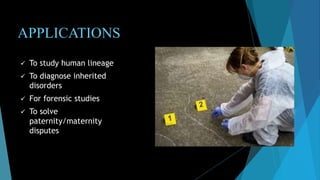
APPLICATIONS
 To study human lineage
 To diagnose inherited
disorders
 For forensic studies
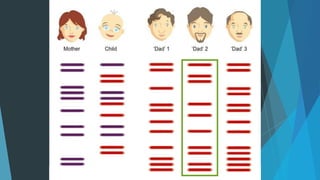
 To solve
paternity/maternity
disputes
TECHNIQUE
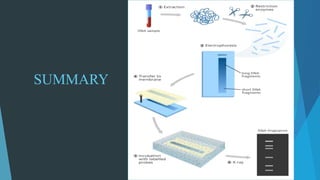
1. Extraction of DNA
- from blood, saliva, semen, hair roots by salting
out proteins.
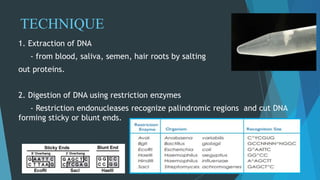
2. Digestion of DNA using restriction enzymes
- Restriction endonucleases recognize palindromic regions and cut DNA
forming sticky or blunt ends.
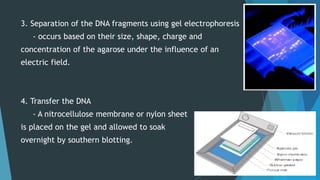
3. Separation of the DNA fragments using gel electrophoresis
- occurs based on their size, shape, charge and
concentration of the agarose under the influence of an
electric field.
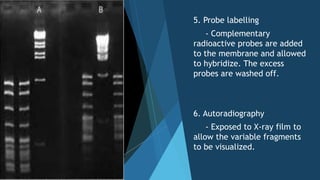
4. Transfer the DNA
- A nitrocellulose membrane or nylon sheet
is placed on the gel and allowed to soak
overnight by southern blotting.
5. Probe labelling
- Complementary
radioactive probes are added
to the membrane and allowed
to hybridize. The excess
probes are washed off.
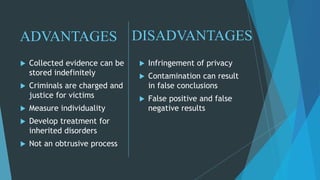
6. Autoradiography
- Exposed to X-ray film to
allow the variable fragments
to be visualized.
DISADVANTAGES
 Collected evidence can be
stored indefinitely
 Criminals are charged and
justice for victims
 Measure individuality
 Develop treatment for
inherited disorders
 Not an obtrusive process
 Infringement of privacy
 Contamination can result
in false conclusions
 False positive and false
negative results
ADVANTAGES
SUMMARY
REFERENCES
Barh, D. and Azevedo, V. (2017) Omics Technologies and Bio-Engineering, pp. 591-625.
Bioscience Times (2018) DNA Fingerprinting- Principle, Methods, Applications [Online]. Available at:
https://www.biosciencetimes.com/molecular-biology/dna-fingerprinting/276/ (Accessed: 28 August
2019).
Kofanova, O. A., Mathieson, W., Thomas, G. A. and Betsou F. (2014) ‘DNA Fingerprinting: A Quality
Control Case Study for Human Biospecimen Authentication’, Biopreservation and Biobank, 12(2), pp.
151–153 [Online]. Available at: https://www.ncbi.nlm.nih.gov/pmc/articles/PMC3995361/ (Accessed:
27 August 2019).
Roewer, L., (2013) ‘DNA fingerprinting in forensics: past, present, future’, Investigative Genetics, 4(22)
[Online]. Available at: https://www.ncbi.nlm.nih.gov/pmc/articles/PMC3831584/ (Accessed: 28 August
2019).
Sciencing (2019) What are Specific Biotechnology Applications for DNA Fingerprinting? [Online].
Available at: https://sciencing.com/specific-biotechnology-applications-dna-fingerprinting-23975.html
(Accessed: 28 August 2019).
Your Article Library (2019) DNA Fingerprinting: Principles and Techniques of DNA Fingerprinting
[Online]. Available at: http://www.yourarticlelibrary.com/dna/dna-fingerprinting-principles-and-
techniques-of-dna-fingerprinting/12211 (Accessed: 28 August 2019).
Yourgenome.org. (2016) What is a DNA fingerprint? [Online] Available at:
THANK YOU!

DNA fingerprinting

  • 1.
  • 2.
    A technique thatdetects mini-satellites in the genome to produce a pattern unique to an individual. Also known as DNA profiling, DNA typing and genetic fingerprinting. WHAT IS DNA FINGERPRINTING?
  • 3.
    HISTORY Science of fingerprintingwas 1st used by Sir William Herschel as a method of identification in 1858 and in 1897 in India. The DNA fingerprinting technique was invented by Alec Jeffreys (1984) at Leicester University, United Kingdom.
  • 4.
    PRINCIPLE Human genome consistsof non coding proteins which make up 95% of DNA known as junk DNA. They can be separated as satellites by density centrifugation. In satellites, repetition of bases is in tandem. According to the length, base composition and numbers of tandemly repetitive units, it is divided as micro-satellites and mini-satellites. At specific loci on the chromosome, the number of tandem repeats varies between individuals.
  • 5.
    APPLICATIONS  To studyhuman lineage  To diagnose inherited disorders  For forensic studies  To solve paternity/maternity disputes
  • 7.
    TECHNIQUE 1. Extraction ofDNA - from blood, saliva, semen, hair roots by salting out proteins. 2. Digestion of DNA using restriction enzymes - Restriction endonucleases recognize palindromic regions and cut DNA forming sticky or blunt ends.
  • 8.
    3. Separation ofthe DNA fragments using gel electrophoresis - occurs based on their size, shape, charge and concentration of the agarose under the influence of an electric field. 4. Transfer the DNA - A nitrocellulose membrane or nylon sheet is placed on the gel and allowed to soak overnight by southern blotting.
  • 9.
    5. Probe labelling -Complementary radioactive probes are added to the membrane and allowed to hybridize. The excess probes are washed off. 6. Autoradiography - Exposed to X-ray film to allow the variable fragments to be visualized.
  • 10.
    DISADVANTAGES  Collected evidencecan be stored indefinitely  Criminals are charged and justice for victims  Measure individuality  Develop treatment for inherited disorders  Not an obtrusive process  Infringement of privacy  Contamination can result in false conclusions  False positive and false negative results ADVANTAGES
  • 11.
  • 12.
    REFERENCES Barh, D. andAzevedo, V. (2017) Omics Technologies and Bio-Engineering, pp. 591-625. Bioscience Times (2018) DNA Fingerprinting- Principle, Methods, Applications [Online]. Available at: https://www.biosciencetimes.com/molecular-biology/dna-fingerprinting/276/ (Accessed: 28 August 2019). Kofanova, O. A., Mathieson, W., Thomas, G. A. and Betsou F. (2014) ‘DNA Fingerprinting: A Quality Control Case Study for Human Biospecimen Authentication’, Biopreservation and Biobank, 12(2), pp. 151–153 [Online]. Available at: https://www.ncbi.nlm.nih.gov/pmc/articles/PMC3995361/ (Accessed: 27 August 2019). Roewer, L., (2013) ‘DNA fingerprinting in forensics: past, present, future’, Investigative Genetics, 4(22) [Online]. Available at: https://www.ncbi.nlm.nih.gov/pmc/articles/PMC3831584/ (Accessed: 28 August 2019). Sciencing (2019) What are Specific Biotechnology Applications for DNA Fingerprinting? [Online]. Available at: https://sciencing.com/specific-biotechnology-applications-dna-fingerprinting-23975.html (Accessed: 28 August 2019). Your Article Library (2019) DNA Fingerprinting: Principles and Techniques of DNA Fingerprinting [Online]. Available at: http://www.yourarticlelibrary.com/dna/dna-fingerprinting-principles-and- techniques-of-dna-fingerprinting/12211 (Accessed: 28 August 2019). Yourgenome.org. (2016) What is a DNA fingerprint? [Online] Available at:
  • 13.

Editor's Notes

  • #4 This was discovered by chance during a murder investigation in Jalpaiguri.
  • #5 A child receives 50% of the DNA from its father and the other 50% from his mother, so the number of VNTRs at a particular locus of the child will be different may be due to insertion, deletion or mutation in the base pairs. In which every individual has a distinct composition of VNTRs and this is the main principle of DNA fingerprinting.