DNA FINGERPRINTINGBy:-Parth ShahPrinalKhimasiaShrey ShahVikashMakadyaM. PHARM ( Pharmacology)NMIMS UNIVERSITY, MUMBAI.
How do you figure out that someone’s DNA is more similar to another’s?The primary method of assessing similarities is by use of DNA fingerprinting or DNA restriction analysis.This process makes use of special proteins called restriction enzymes and sections of the chromosome called tandem repeats

DefinitionTechnology using tandem repeats of individuals to identify individuals is known as DNA fingerprinting
DNA Fingerprinting is a method where:a person’s genetic traits, genes, are used to make specific strings of DNA letters that are cut into patterns of shorter strings separated by length these banding patterns can identify a unique human being!Basis of genetic fingerprinting:Most of our DNA is identical to each other, however, there are inherited regions of our DNA that can vary from person to person (such variations are termed as polymorphisms). One such class of polymorphisms is known as tandem repeats,  which vary within the individual of the species. This forms the basis of genetic fingerprinting.
Tandem repeatsIn a Eukaryotic genome, Tandem repeats are an array of consecutive repeats, known as satellites.     They are of three types based on migration when centrifuged in CsCl density gradient.Satellites.Minisatellites.Microsatellites.
Satellite DNAIllustration of satellite bands.  By using buoyant density gradient centrifugation, DNA fragments with significantly different base compositions may be separated, and then monitored by the absorption spectra of ultraviolet light.  The main band represents the bulk DNA, and the "satellite" bands originate from tandem repeats.
SATELLITESThe size of a satellite DNA ranges from 100 kb to over 1 Mb. Other satellites have a shorter repeat unit.  Most satellites in humans or in other organisms are located at the centromere.
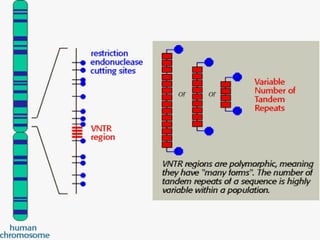
MinisatellitesThe size of a minisatellite ranges from 1 kb to 20 kb.  One type of minisatellites is called variable number of tandem repeats (VNTR).  Its repeat unit ranges from  9 bp - 80 bp.  They are located in non-coding regions.  The number of repeats for a given minisatellite differs between individuals.  This feature is the basis of DNA fingerprinting.
MicrosatellitesMicrosatellites are also known as short tandem repeats (STR), because a repeat unit consists of only 1-6 bp and the whole repetitive region spans less than 150 bp.  Similar to minisatellites, the number of repeats for a given microsatellite may differ between individuals.  Therefore, microsatellites can also be used for DNA fingerprinting.
Variable Number of Tandem Repeats (VNTR): repeats of 9 to 80 base pairs (bp), total length is 500 to 23,000 bp, very specific due to length and repeats, testing is expensive and time-consuming, degrade in older DNA samples due to random breaking of DNA strandsAmplified Fragment Length Polymorphisms (AmpFLP):repeats of 8 to 16 bp, total length 100 to 1300 bp, shorter and less susceptible to degradation, first loci to be used in forensic analysis
Short Tandem Repeats:repeats of 2 to 7 bases, total length 100 to 400 bp, shorter yet thereby less susceptible to breakage, these loci are the current standard in forensic laboratory analysis, ideal size for PCR amplificationSingle Nucleotide Polymorphisms (SNP):   a single base change as a result of mutation, not commonly useful to forensic investigators, can be potentially used to distinguish identical twins
Restriction Fragment Length Polymorphisms (RFLP)The term Restriction Fragment Length Polymorphism, or RFLP refers to a difference between two or more samples of homologous DNA molecules arising from differing locations of restriction sites, and to a related laboratory technique by which these segments can be distinguished. .
Commonly pronounced “rif-lip”.
Its analysis was the first DNA profiling technique cheap enough to see widespread application.
It is  an important tool in genome mapping.
Localization of genes for genetic disorders.
Determination of risk for disease, and paternity testingA restriction enzyme cuts the DNA molecules at every occurrence of  a particular sequence, called restriction site.
For example, HindII enzyme cuts at GTGCAC or GTTAAC.
If we apply a restriction enzyme on DNA, it is cut at every occurrence of the restriction site into a million restriction fragments each a few thousands nucleotides long.
Any mutation of a single nucleotide may destroy or create the site(CTGCAC or CTTAAC for HindII) and alter the length of the corresponding fragment.
The term polymorphism refers to the slight differences between individuals, in base pair sequences of common genes. RFLP ANALYSIS TECHNIQUE:RFLP analysis is the detection of the change in the length of the restriction fragments.
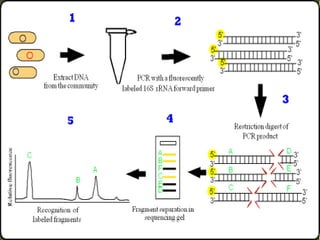
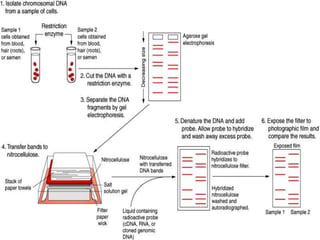
The basic technique for detecting RFLPs involves fragmenting a sample of DNA by a restriction enzyme, which can recognize and cut DNA wherever a specific short sequence occurs, in a process known as a restriction digestion.
The resulting DNA fragments are then separated by length through a process known as agarose gel electrophoresis.
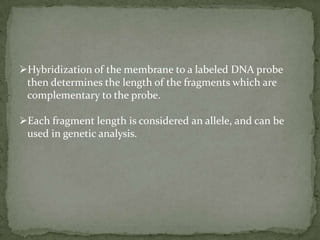
Then transferred to a membrane via the Southern blot procedure Hybridization of the membrane to a labeled DNA probe then determines the length of the fragments which are complementary to the probe.
Each fragment length is considered an allele, and can be used in genetic analysis.
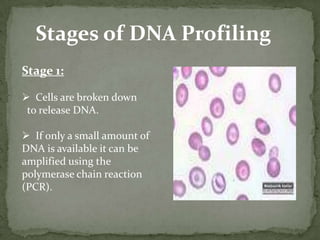
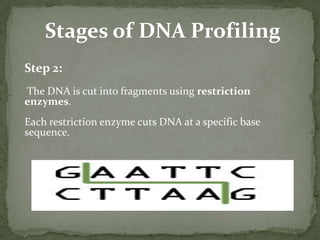
Stages of DNA ProfilingStage 1:  Cells are broken down  to release DNA.  If only a small amount of DNA is available it can be amplified using the polymerase chain reaction (PCR).Stages of DNA Profiling Step 2: The DNA is cut into fragments using restriction enzymes.Each restriction enzyme cuts DNA at a specific base sequence.
Stages of DNA Profiling The sections of DNA that are cut out are called restriction fragments. This yields thousands of restriction fragments of all different sizes because the base sequences being cut may be far apart (long fragment) or close together (short fragment).
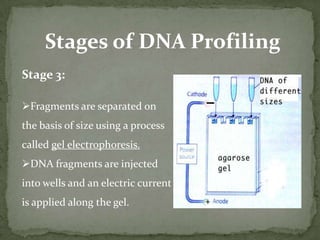
Stages of DNA Profiling Stage 3:Fragments are separated on the basis of size using a process called gel electrophoresis.
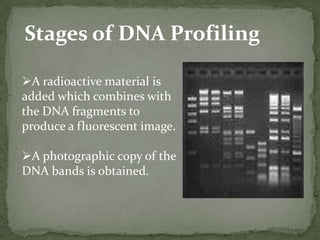
DNA fragments are injected into wells and an electric current is applied along the gel. Stages of DNA ProfilingA radioactive material is added which combines with the DNA fragments to produce a fluorescent image.
A photographic copy of the DNA bands is obtained.Stages of DNA ProfilingStage 4:The pattern of fragment distribution is then analysed.
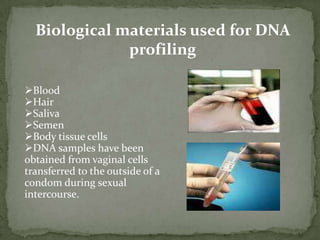
Biological materials used for DNA profilingBlood
Hair
Saliva
Semen

DNA FINGERPRINTING

  • 1.
    DNA FINGERPRINTINGBy:-Parth ShahPrinalKhimasiaShreyShahVikashMakadyaM. PHARM ( Pharmacology)NMIMS UNIVERSITY, MUMBAI.
  • 2.
    How do youfigure out that someone’s DNA is more similar to another’s?The primary method of assessing similarities is by use of DNA fingerprinting or DNA restriction analysis.This process makes use of special proteins called restriction enzymes and sections of the chromosome called tandem repeats
  • 3.
    DefinitionTechnology using tandemrepeats of individuals to identify individuals is known as DNA fingerprinting
  • 4.
    DNA Fingerprinting isa method where:a person’s genetic traits, genes, are used to make specific strings of DNA letters that are cut into patterns of shorter strings separated by length these banding patterns can identify a unique human being!Basis of genetic fingerprinting:Most of our DNA is identical to each other, however, there are inherited regions of our DNA that can vary from person to person (such variations are termed as polymorphisms). One such class of polymorphisms is known as tandem repeats, which vary within the individual of the species. This forms the basis of genetic fingerprinting.
  • 5.
    Tandem repeatsIn aEukaryotic genome, Tandem repeats are an array of consecutive repeats, known as satellites. They are of three types based on migration when centrifuged in CsCl density gradient.Satellites.Minisatellites.Microsatellites.
  • 6.
    Satellite DNAIllustration ofsatellite bands.  By using buoyant density gradient centrifugation, DNA fragments with significantly different base compositions may be separated, and then monitored by the absorption spectra of ultraviolet light.  The main band represents the bulk DNA, and the "satellite" bands originate from tandem repeats.
  • 7.
    SATELLITESThe size ofa satellite DNA ranges from 100 kb to over 1 Mb. Other satellites have a shorter repeat unit.  Most satellites in humans or in other organisms are located at the centromere.
  • 8.
    MinisatellitesThe size ofa minisatellite ranges from 1 kb to 20 kb.  One type of minisatellites is called variable number of tandem repeats (VNTR).  Its repeat unit ranges from  9 bp - 80 bp.  They are located in non-coding regions.  The number of repeats for a given minisatellite differs between individuals.  This feature is the basis of DNA fingerprinting.
  • 9.
    MicrosatellitesMicrosatellites are alsoknown as short tandem repeats (STR), because a repeat unit consists of only 1-6 bp and the whole repetitive region spans less than 150 bp.  Similar to minisatellites, the number of repeats for a given microsatellite may differ between individuals.  Therefore, microsatellites can also be used for DNA fingerprinting.
  • 10.
    Variable Number ofTandem Repeats (VNTR): repeats of 9 to 80 base pairs (bp), total length is 500 to 23,000 bp, very specific due to length and repeats, testing is expensive and time-consuming, degrade in older DNA samples due to random breaking of DNA strandsAmplified Fragment Length Polymorphisms (AmpFLP):repeats of 8 to 16 bp, total length 100 to 1300 bp, shorter and less susceptible to degradation, first loci to be used in forensic analysis
  • 11.
    Short Tandem Repeats:repeatsof 2 to 7 bases, total length 100 to 400 bp, shorter yet thereby less susceptible to breakage, these loci are the current standard in forensic laboratory analysis, ideal size for PCR amplificationSingle Nucleotide Polymorphisms (SNP): a single base change as a result of mutation, not commonly useful to forensic investigators, can be potentially used to distinguish identical twins
  • 13.
    Restriction Fragment LengthPolymorphisms (RFLP)The term Restriction Fragment Length Polymorphism, or RFLP refers to a difference between two or more samples of homologous DNA molecules arising from differing locations of restriction sites, and to a related laboratory technique by which these segments can be distinguished. .
  • 14.
  • 15.
    Its analysis wasthe first DNA profiling technique cheap enough to see widespread application.
  • 16.
    It is an important tool in genome mapping.
  • 17.
    Localization of genesfor genetic disorders.
  • 18.
    Determination of riskfor disease, and paternity testingA restriction enzyme cuts the DNA molecules at every occurrence of a particular sequence, called restriction site.
  • 19.
    For example, HindIIenzyme cuts at GTGCAC or GTTAAC.
  • 20.
    If we applya restriction enzyme on DNA, it is cut at every occurrence of the restriction site into a million restriction fragments each a few thousands nucleotides long.
  • 21.
    Any mutation ofa single nucleotide may destroy or create the site(CTGCAC or CTTAAC for HindII) and alter the length of the corresponding fragment.
  • 22.
    The term polymorphismrefers to the slight differences between individuals, in base pair sequences of common genes. RFLP ANALYSIS TECHNIQUE:RFLP analysis is the detection of the change in the length of the restriction fragments.
  • 23.
    The basic techniquefor detecting RFLPs involves fragmenting a sample of DNA by a restriction enzyme, which can recognize and cut DNA wherever a specific short sequence occurs, in a process known as a restriction digestion.
  • 24.
    The resulting DNAfragments are then separated by length through a process known as agarose gel electrophoresis.
  • 25.
    Then transferred toa membrane via the Southern blot procedure Hybridization of the membrane to a labeled DNA probe then determines the length of the fragments which are complementary to the probe.
  • 26.
    Each fragment lengthis considered an allele, and can be used in genetic analysis.
  • 27.
    Stages of DNAProfilingStage 1: Cells are broken down to release DNA. If only a small amount of DNA is available it can be amplified using the polymerase chain reaction (PCR).Stages of DNA Profiling Step 2: The DNA is cut into fragments using restriction enzymes.Each restriction enzyme cuts DNA at a specific base sequence.
  • 28.
    Stages of DNAProfiling The sections of DNA that are cut out are called restriction fragments. This yields thousands of restriction fragments of all different sizes because the base sequences being cut may be far apart (long fragment) or close together (short fragment).
  • 29.
    Stages of DNAProfiling Stage 3:Fragments are separated on the basis of size using a process called gel electrophoresis.
  • 30.
    DNA fragments areinjected into wells and an electric current is applied along the gel. Stages of DNA ProfilingA radioactive material is added which combines with the DNA fragments to produce a fluorescent image.
  • 31.
    A photographic copyof the DNA bands is obtained.Stages of DNA ProfilingStage 4:The pattern of fragment distribution is then analysed.
  • 33.
    Biological materials usedfor DNA profilingBlood
  • 34.
  • 35.
  • 36.