@ujjwalsirohi
PhD scholar
content
 Sanger sequencing
 Maxam Gilbert Sequencing
Sanger sequencing
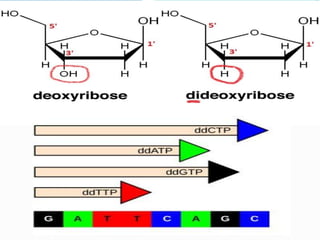
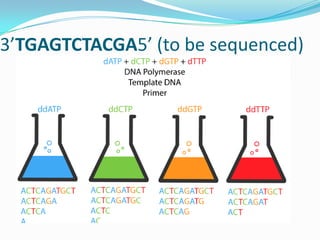
 Based on the selective incorporation of chain terminating
dideoxynucleotides by DNA polymerase during in
vitro DNA replication.
 Developed by Frederick Sanger and colleagues in 1977.
 99.9% accuracy.
 Cost: $1,000 per million bp.
 In 1990 ~450bp (blotting system)
 In 2017 ~1100bp can be sequenced (ABI 3730)
Method
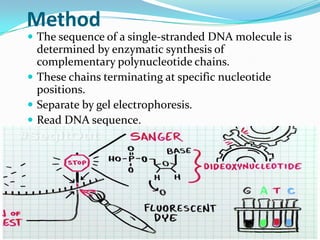
 The sequence of a single-stranded DNA molecule is
determined by enzymatic synthesis of
complementary polynucleotide chains.
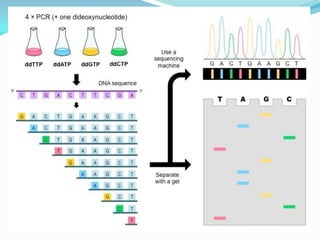
 These chains terminating at specific nucleotide
positions.
 Separate by gel electrophoresis.
 Read DNA sequence.
3’TGAGTCTACGA5’ (to be sequenced)
Maxam–Gilbert sequencing
 Developed by Allan Maxam and Walter
Gilbert in 1976–1977.
 This method is based on nucleobase-specific
partial chemical modification of DNA and
subsequent cleavage of the DNA backbone at sites
adjacent to the modified nucleotides.
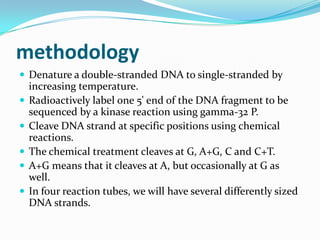
methodology
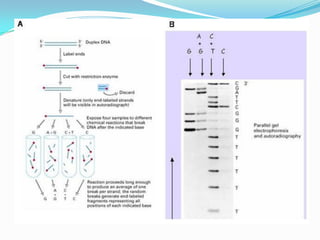
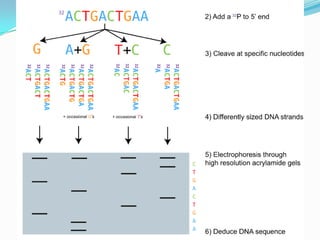
 Denature a double-stranded DNA to single-stranded by
increasing temperature.
 Radioactively label one 5' end of the DNA fragment to be
sequenced by a kinase reaction using gamma-32 P.
 Cleave DNA strand at specific positions using chemical
reactions.
 The chemical treatment cleaves at G, A+G, C and C+T.
 A+G means that it cleaves at A, but occasionally at G as
well.
 In four reaction tubes, we will have several differently sized
DNA strands.
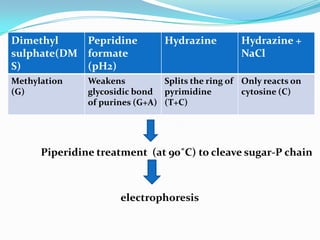
Dimethyl
sulphate(DM
S)
Pepridine
formate
(pH2)
Hydrazine Hydrazine +
NaCl
Methylation
(G)
Weakens
glycosidic bond
of purines (G+A)
Splits the ring of
pyrimidine
(T+C)
Only reacts on
cytosine (C)
Piperidine treatment (at 90˚C) to cleave sugar-P chain
electrophoresis
Sanger & maxam gilbert sequencing @ujjwalsirohi