INTRODUCTION
 Northern blotting was developed by
Alwine in 1977. It a laboratory
technique used to study gene
expression by detection of RNA in a
sample.
 Northern blotting is based on the
Hybridization principle
MAJOR STEPS INVOLVED
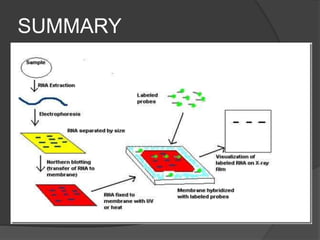
 RNA isolation
 Separation of RNA using Gel
Electrophoresis
 Blotting
 Hybridization and Washing of excess
probes
 visualization
RNA ISOLATION
 The RNA is isolated from the cell.
SEPARATION OF RNA
 Formaldehyde agarose gel
electrophoresis is normally used in the
separation of RNA as formaldehyde
agarose gel prevent RNA from folding
on itself.
 On electrophoresis RNA molecules
moves towards positive pole as RNA is
negatively charged.
BLOTTING
 Simply blotting is process of transferring the RNA
molecules to the nitrocellulose membrane or nylon
membrane:
Nitrocellulose typically has a binding capacity of
about 100µg/cm, while nylon has a binding
capacity of about 500 µg/cm. Many scientists
feel nylon is better since it binds more and is
less fragile.
Once the RNA has been transferred to the
membrane, it is immobilized through covalent
linkage to the membrane by UV light or heat.
UV cross linking is more effective in binding
RNA to the membrane.
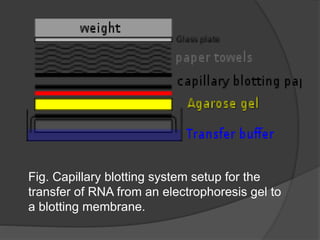
Fig. Capillary blotting system setup for the
transfer of RNA from an electrophoresis gel to
a blotting membrane.
HYBRIDIZATON AND
WASHING OF EXCESS
PROBS
 Probes for northern blotting are composed of
nucleic acids with a complementary sequence to
all or part of the RNA of interest, they can be DNA,
RNA, or oligonucleotides with a minimum of 25
complementary bases to the target sequence.
 The probes must be labelled either with
radioactive isotopes (32P) or
with chemiluminescence.
 Hybridization between probes and the target RNA
 Washing of excess probes
VISUALIZATION
Autoradiography:
Place membrane over X-ray film.
X-ray film darkens where the
fragments are complementary to the
radioactive probes.
SUMMARY
NORTHEN BLOT
APPLICATION Northern blots are particularly useful for
determining the conditions under which
specific genes are being expressed, including
which tissues in a complex organism express
which of its genes at the mRNA level.
 For instance: When trying to learn about the
function of a certain protein, it is sometimes
useful to purify mRNA from many different
tissues or cell types and then prepare a
Northern blot of those mRNAs, using a cDNA
clone of the protein of interest as the probe.
Only mRNA from the cell types that are
synthesizing the protein will hybridize to the
probe.
 Northern blotting allows one to observe a
particular gene's expression pattern between
tissues, organs, developmental stages,
pathogen infection, and over the course of
treatment
 The technique has been used to show
overexpression of oncogenes and
downregulation of tumor-suppressor genes in
cancerous cells when compared to 'normal'
tissue, as well as the gene expression in the
rejection of transplanted organ.
references
 www.weikepedia.com
 http://homepage.smc.edu/colavito_mary/biology22/2
 www.colorado.edu/MCDB/MCDB2150Fall/notes99/99L17.html
 www.uwp.edu/~higgs/Lect12mb.html
 THANKYOU

Northen blotting

  • 2.
    INTRODUCTION  Northern blottingwas developed by Alwine in 1977. It a laboratory technique used to study gene expression by detection of RNA in a sample.  Northern blotting is based on the Hybridization principle
  • 3.
    MAJOR STEPS INVOLVED RNA isolation  Separation of RNA using Gel Electrophoresis  Blotting  Hybridization and Washing of excess probes  visualization
  • 4.
    RNA ISOLATION  TheRNA is isolated from the cell.
  • 5.
    SEPARATION OF RNA Formaldehyde agarose gel electrophoresis is normally used in the separation of RNA as formaldehyde agarose gel prevent RNA from folding on itself.  On electrophoresis RNA molecules moves towards positive pole as RNA is negatively charged.
  • 6.
    BLOTTING  Simply blottingis process of transferring the RNA molecules to the nitrocellulose membrane or nylon membrane: Nitrocellulose typically has a binding capacity of about 100µg/cm, while nylon has a binding capacity of about 500 µg/cm. Many scientists feel nylon is better since it binds more and is less fragile. Once the RNA has been transferred to the membrane, it is immobilized through covalent linkage to the membrane by UV light or heat. UV cross linking is more effective in binding RNA to the membrane.
  • 7.
    Fig. Capillary blottingsystem setup for the transfer of RNA from an electrophoresis gel to a blotting membrane.
  • 8.
    HYBRIDIZATON AND WASHING OFEXCESS PROBS  Probes for northern blotting are composed of nucleic acids with a complementary sequence to all or part of the RNA of interest, they can be DNA, RNA, or oligonucleotides with a minimum of 25 complementary bases to the target sequence.  The probes must be labelled either with radioactive isotopes (32P) or with chemiluminescence.  Hybridization between probes and the target RNA  Washing of excess probes
  • 9.
    VISUALIZATION Autoradiography: Place membrane overX-ray film. X-ray film darkens where the fragments are complementary to the radioactive probes.
  • 10.
  • 11.
    NORTHEN BLOT APPLICATION Northernblots are particularly useful for determining the conditions under which specific genes are being expressed, including which tissues in a complex organism express which of its genes at the mRNA level.  For instance: When trying to learn about the function of a certain protein, it is sometimes useful to purify mRNA from many different tissues or cell types and then prepare a Northern blot of those mRNAs, using a cDNA clone of the protein of interest as the probe. Only mRNA from the cell types that are synthesizing the protein will hybridize to the probe.
  • 12.
     Northern blottingallows one to observe a particular gene's expression pattern between tissues, organs, developmental stages, pathogen infection, and over the course of treatment  The technique has been used to show overexpression of oncogenes and downregulation of tumor-suppressor genes in cancerous cells when compared to 'normal' tissue, as well as the gene expression in the rejection of transplanted organ.
  • 13.
    references  www.weikepedia.com  http://homepage.smc.edu/colavito_mary/biology22/2 www.colorado.edu/MCDB/MCDB2150Fall/notes99/99L17.html  www.uwp.edu/~higgs/Lect12mb.html  THANKYOU