DNA Extraction from Human
Blood
Rizwan Abbas
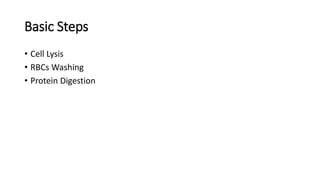
Basic Steps
• Cell Lysis
• RBCs Washing
• Protein Digestion
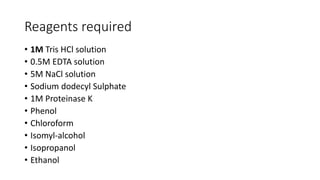
Reagents required
• 1M Tris HCl solution
• 0.5M EDTA solution
• 5M NaCl solution
• Sodium dodecyl Sulphate
• 1M Proteinase K
• Phenol
• Chloroform
• Isomyl-alcohol
• Isopropanol
• Ethanol
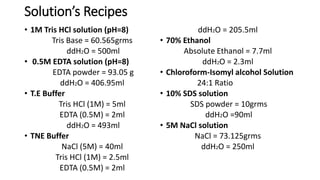
Solution’s Recipes
• 1M Tris HCl solution (pH=8)
Tris Base = 60.565grms
ddH2O = 500ml
• 0.5M EDTA solution (pH=8)
EDTA powder = 93.05 g
ddH2O = 406.95ml
• T.E Buffer
Tris HCl (1M) = 5ml
EDTA (0.5M) = 2ml
ddH2O = 493ml
• TNE Buffer
NaCl (5M) = 40ml
Tris HCl (1M) = 2.5ml
EDTA (0.5M) = 2ml
ddH2O = 205.5ml
• 70% Ethanol
Absolute Ethanol = 7.7ml
ddH2O = 2.3ml
• Chloroform-Isomyl alcohol Solution
24:1 Ratio
• 10% SDS solution
SDS powder = 10grms
ddH2O =90ml
• 5M NaCl solution
NaCl = 73.125grms
ddH2O = 250ml
Tris HCl- EDTA Buffer
• TE buffer is a commonly used buffer solution in molecular biology,
especially in procedures involving DNA, cDNA or RNA. "TE" is derived
from its components: Tris, a common pH buffer, and EDTA, a molecule
that chelates cations like Mg2+. The purpose of TE buffer is to
solubilize DNA or RNA, while protecting it from degradation.
• the pH is usually adjusted to 7.5 for RNA and 8.0 for DNA
• The respective DNA and RNA nucleases are supposed to be less active
at these pH values, but pH 8.0 can safely be used for storage of both
DNA and RNA
EDTA
• EDTA stands for ethylene diamine tetraacetic acid.
• It is a polyamino carboxylic acid.
• It is extensively used in molecular biology experiments as a chelating agent.
It sequesters metal ions such as Ca2+ and Fe3+.
• After being bound by EDTA, metal ions remain in solution but exhibit
diminished reactivity.
• Metal ions are necessary for the action of many enzymes including DNases.
• EDTA is commercially available as several forms. Disodium salt of EDTA is
most commonly used in molecular biology.
• 0.5 M EDTA solution is used for the preparation of many solutions including
TAE, TBE, DNA loading dye, resuspension buffer (isolation of plasmid), Tris-
EDTA, Trypsin-EDTA, etc.
Role of Buffers and other Reagents
• cell lysis buffer TNE to lyse blood cells as salt buffer
• Proteinase K is a commonly used enzyme used in various protocols to
cleave glycoproteins and inactivate RNases and DNases.
• 10% SDS to inactivate and remove contaminants
• Excess salt can be removed by adding 70% ethanol, and the sample is
then centrifuged to collect the DNA pellet, which can be resuspended
in sterile distilled water or TE buffer.
• DNA is recovered by alcohol precipitation and rehydrated using a Tris
or Tris-EDTA buffer solution. Isolated DNA is stable at 4°C and -20°C
for 10+ years.
Chloroform
• Chloroform mixed with phenol is more efficient at denaturing proteins than
either reagent is alone.
• Chloroform ensures phase separation of the two liquids because
chloroform is miscible with phenol and it has a higher density (1.47 g/cm3)
than phenol; it forces a sharper separation of the organic and aqueous
phases thereby assisting in the removal of the aqueous phase with minimal
cross contamination from the organic phase.
• chloroform is a dense organic solvent. The non-aqueous parts of the cell
(lipids, some proteins, etc) will be disolved in this this hydrophobic liquid
while the DNA stays immersed in an aqueous layer.
• Chloroform’s density pulls it to the bottom of the tube, leaving the
aqueous layer on top ready for removal by a pipette to separate it from the
organic layer.
Phenol
• Phenol is a carbolic acid that denatures proteins quickly, but it is highly
corrosive, toxic, and flammable. This organic solvent is usually added to the
sample and then, using centrifugal force, a biphasic emulsion is obtained.
• phenol is to ensure a clear separation between the aqueous and organic
phases.
• Two “phases” form when phenol is added to the solution and centrifuged.
There is an aqueous, polar phase at the top of the solution containing
nucleic acids and water, and an organic phase containing denatured
proteins and other cell components at the bottom of the solution. The
aqueous phase is always on top of the organic because, as mentioned
above, phenol is denser than water
Purpose of Reagents Use
• DNA precipitation is achieved by adding high concentrations of salt to
DNA-containing solutions, as cations from salts such as ammonium/
sodium acetate counteract repulsion caused by the negative charge of
the phosphate backbone.
• A mixture of DNA and salts in the presence of solvents like ethanol
(final concentrations of 70%–80%) or isopropanol (final
concentrations of 40%–50%) causes nucleic acids to precipitate.
DNA Extraction Protocol
• Genomic DNA will be extracted from respective blood samples
following inorganic and organic DNA extraction Protocol (Grimberg et
al.1989)
• 5ml of venous blood samples will be collecting in 15ml falcon tubes
containing 400 µl of 0.5 M EDTA.
• Till the commencement of DNA extraction, blood samples will be
keep frozen either at -70°C for 20-30 min or at -20°C for long term
storage.
DNA Extraction Steps
Digestion
• Digestion of proteins in the pellets of WBC will be carried out by
adding 20 µl of proteinase K
• 200 µl of 10% SDS
• 6 ml TNE buffer (10 mM Tris HCl, 2 mM EDTA, 400 mM NaCl)
• Samples will be left overnight in an incubating shaker at a
temperature of 37ºC and a speed of 250 rpm.
DNA Extraction Steps
Washing
• Blood samples will be thawed for the red blood cells (RBC) lyses.
• 7ml of TE buffer (10 mM Tris HCl, 2 mM EDTA, pH 8.0) will be added
for washing of blood samples.
• Samples will be centrifuged at 3000 rpm for 30 min and supernatant
will be discarded to wash out the lysed RBC.
• Washing will be repeat for three to four times till the WBC pellet is
free of hemoglobin.
DNA Extraction Steps
DAY-II Procedure
Precipitation of Proteins
• Proteins will be precipitated by adding 3ml of Phenol, followed by vigorous
shaking and chilling on ice for 10 min before centrifugation at 2400 rpm for
15 minutes.
• Supernatant will be shifted to another Sterilin® falcon tube and equal
volume of Chloroform-Isomyl alcohol in 24:1 Ratio will be added and
centrifuge for 15 minutes at 2400RPM.
 Precipitation of DNA (Threads like Structure: Visible)
• Supernatant will be shifted to another Sterilin® falcon tube and DNA will
be extracted from the supernatant by adding equal volume of Chilled
Isopropanol and centrifuge for 20 minutes at 2400RPM
DNA Extraction Steps
Salt and Other organic Compounds Removal
• After washing the DNA pellet with 70% ethanol
• DNA will be dissolved in 250ul of 1X TE buffer (10 mM Tris HCl, 0.2
mM EDTA)
• heated at 70ºC in a water bath for 1 hour to inactivate any remaining
nucleases.
• Further the DNA will be kept at -20°C for long storage.
References
• http://www.scilifelab.com/protocols/preparation-of-0-5-m-edta-
solution/
• DNA extraction Protocol (Grimberg et al.1989)

Dna extraction from human blood

  • 1.
    DNA Extraction fromHuman Blood Rizwan Abbas
  • 3.
    Basic Steps • CellLysis • RBCs Washing • Protein Digestion
  • 4.
    Reagents required • 1MTris HCl solution • 0.5M EDTA solution • 5M NaCl solution • Sodium dodecyl Sulphate • 1M Proteinase K • Phenol • Chloroform • Isomyl-alcohol • Isopropanol • Ethanol
  • 5.
    Solution’s Recipes • 1MTris HCl solution (pH=8) Tris Base = 60.565grms ddH2O = 500ml • 0.5M EDTA solution (pH=8) EDTA powder = 93.05 g ddH2O = 406.95ml • T.E Buffer Tris HCl (1M) = 5ml EDTA (0.5M) = 2ml ddH2O = 493ml • TNE Buffer NaCl (5M) = 40ml Tris HCl (1M) = 2.5ml EDTA (0.5M) = 2ml ddH2O = 205.5ml • 70% Ethanol Absolute Ethanol = 7.7ml ddH2O = 2.3ml • Chloroform-Isomyl alcohol Solution 24:1 Ratio • 10% SDS solution SDS powder = 10grms ddH2O =90ml • 5M NaCl solution NaCl = 73.125grms ddH2O = 250ml
  • 6.
    Tris HCl- EDTABuffer • TE buffer is a commonly used buffer solution in molecular biology, especially in procedures involving DNA, cDNA or RNA. "TE" is derived from its components: Tris, a common pH buffer, and EDTA, a molecule that chelates cations like Mg2+. The purpose of TE buffer is to solubilize DNA or RNA, while protecting it from degradation. • the pH is usually adjusted to 7.5 for RNA and 8.0 for DNA • The respective DNA and RNA nucleases are supposed to be less active at these pH values, but pH 8.0 can safely be used for storage of both DNA and RNA
  • 7.
    EDTA • EDTA standsfor ethylene diamine tetraacetic acid. • It is a polyamino carboxylic acid. • It is extensively used in molecular biology experiments as a chelating agent. It sequesters metal ions such as Ca2+ and Fe3+. • After being bound by EDTA, metal ions remain in solution but exhibit diminished reactivity. • Metal ions are necessary for the action of many enzymes including DNases. • EDTA is commercially available as several forms. Disodium salt of EDTA is most commonly used in molecular biology. • 0.5 M EDTA solution is used for the preparation of many solutions including TAE, TBE, DNA loading dye, resuspension buffer (isolation of plasmid), Tris- EDTA, Trypsin-EDTA, etc.
  • 8.
    Role of Buffersand other Reagents • cell lysis buffer TNE to lyse blood cells as salt buffer • Proteinase K is a commonly used enzyme used in various protocols to cleave glycoproteins and inactivate RNases and DNases. • 10% SDS to inactivate and remove contaminants • Excess salt can be removed by adding 70% ethanol, and the sample is then centrifuged to collect the DNA pellet, which can be resuspended in sterile distilled water or TE buffer. • DNA is recovered by alcohol precipitation and rehydrated using a Tris or Tris-EDTA buffer solution. Isolated DNA is stable at 4°C and -20°C for 10+ years.
  • 9.
    Chloroform • Chloroform mixedwith phenol is more efficient at denaturing proteins than either reagent is alone. • Chloroform ensures phase separation of the two liquids because chloroform is miscible with phenol and it has a higher density (1.47 g/cm3) than phenol; it forces a sharper separation of the organic and aqueous phases thereby assisting in the removal of the aqueous phase with minimal cross contamination from the organic phase. • chloroform is a dense organic solvent. The non-aqueous parts of the cell (lipids, some proteins, etc) will be disolved in this this hydrophobic liquid while the DNA stays immersed in an aqueous layer. • Chloroform’s density pulls it to the bottom of the tube, leaving the aqueous layer on top ready for removal by a pipette to separate it from the organic layer.
  • 10.
    Phenol • Phenol isa carbolic acid that denatures proteins quickly, but it is highly corrosive, toxic, and flammable. This organic solvent is usually added to the sample and then, using centrifugal force, a biphasic emulsion is obtained. • phenol is to ensure a clear separation between the aqueous and organic phases. • Two “phases” form when phenol is added to the solution and centrifuged. There is an aqueous, polar phase at the top of the solution containing nucleic acids and water, and an organic phase containing denatured proteins and other cell components at the bottom of the solution. The aqueous phase is always on top of the organic because, as mentioned above, phenol is denser than water
  • 11.
    Purpose of ReagentsUse • DNA precipitation is achieved by adding high concentrations of salt to DNA-containing solutions, as cations from salts such as ammonium/ sodium acetate counteract repulsion caused by the negative charge of the phosphate backbone. • A mixture of DNA and salts in the presence of solvents like ethanol (final concentrations of 70%–80%) or isopropanol (final concentrations of 40%–50%) causes nucleic acids to precipitate.
  • 12.
    DNA Extraction Protocol •Genomic DNA will be extracted from respective blood samples following inorganic and organic DNA extraction Protocol (Grimberg et al.1989) • 5ml of venous blood samples will be collecting in 15ml falcon tubes containing 400 µl of 0.5 M EDTA. • Till the commencement of DNA extraction, blood samples will be keep frozen either at -70°C for 20-30 min or at -20°C for long term storage.
  • 13.
    DNA Extraction Steps Digestion •Digestion of proteins in the pellets of WBC will be carried out by adding 20 µl of proteinase K • 200 µl of 10% SDS • 6 ml TNE buffer (10 mM Tris HCl, 2 mM EDTA, 400 mM NaCl) • Samples will be left overnight in an incubating shaker at a temperature of 37ºC and a speed of 250 rpm.
  • 14.
    DNA Extraction Steps Washing •Blood samples will be thawed for the red blood cells (RBC) lyses. • 7ml of TE buffer (10 mM Tris HCl, 2 mM EDTA, pH 8.0) will be added for washing of blood samples. • Samples will be centrifuged at 3000 rpm for 30 min and supernatant will be discarded to wash out the lysed RBC. • Washing will be repeat for three to four times till the WBC pellet is free of hemoglobin.
  • 15.
    DNA Extraction Steps DAY-IIProcedure Precipitation of Proteins • Proteins will be precipitated by adding 3ml of Phenol, followed by vigorous shaking and chilling on ice for 10 min before centrifugation at 2400 rpm for 15 minutes. • Supernatant will be shifted to another Sterilin® falcon tube and equal volume of Chloroform-Isomyl alcohol in 24:1 Ratio will be added and centrifuge for 15 minutes at 2400RPM.  Precipitation of DNA (Threads like Structure: Visible) • Supernatant will be shifted to another Sterilin® falcon tube and DNA will be extracted from the supernatant by adding equal volume of Chilled Isopropanol and centrifuge for 20 minutes at 2400RPM
  • 16.
    DNA Extraction Steps Saltand Other organic Compounds Removal • After washing the DNA pellet with 70% ethanol • DNA will be dissolved in 250ul of 1X TE buffer (10 mM Tris HCl, 0.2 mM EDTA) • heated at 70ºC in a water bath for 1 hour to inactivate any remaining nucleases. • Further the DNA will be kept at -20°C for long storage.
  • 17.