ABO BLOOD GROUPABO BLOOD GROUP
SYSTEMSYSTEM
ABO BLOOD GROUP SYSTEMABO BLOOD GROUP SYSTEM
The ABO blood group system is the most 
important blood group system in human blood 
transfusion.
 Found on platelets, epithelium and cells other 
than erythrocytes, AB antigens can also cause an 
adverse immune response to organ transplantation. The 
associated anti-A and anti-B antibodies are 
usually IgM antibodies, which are produced in the first 
years of life by sensitization to environmental 
substances, such as food, bacteria, and viruses.
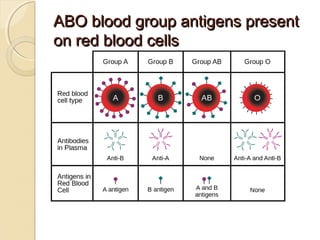
ABO blood group antigens presentABO blood group antigens present
on red blood cellson red blood cells
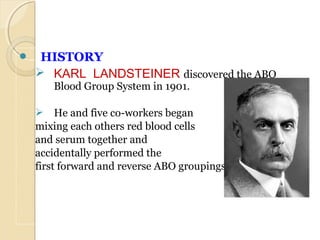
 HISTORY
 KARL LANDSTEINER discovered the ABO 
Blood Group System in 1901.
 He and five co-workers began 
mixing each others red blood cells 
and serum together and 
accidentally performed the 
first forward and reverse ABO groupings.
LANDSTEINER’S LAWLANDSTEINER’S LAW
a) If an agglutinogen is present on red blood 
cell membrane, the  corresponding 
agglutinin must be absent in the plasma.
b) If an agglutinogen is absent on red blood 
cell membrane, then the corresponding 
agglutinin must be present in the plasma.
IMPORTANCE OF ABOIMPORTANCE OF ABO
There are two principles-
1) Almost all normal healthy individuals above 3-6 months of 
age have “ naturally occurring Abs” to the ABO Ags that 
they lack.
    These Abs termed naturally occurring  because they  
were thought to arise without antigenic stimulation.
2) These “naturally occurring” Abs are mostly IgM  
class.  That means that, they are antibodies capable 
of agglutinating saline/ low protein suspended red 
cell without enhancement and may activate 
complement cascade.
*___________________*
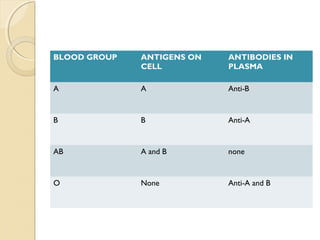
BLOOD GROUP ANTIGENS ON
CELL
ANTIBODIES IN
PLASMA
A A Anti-B
B B Anti-A
AB A and B none
O None Anti-A and B
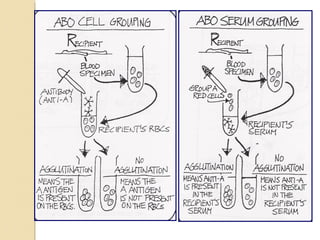
ABO TYPINGABO TYPING
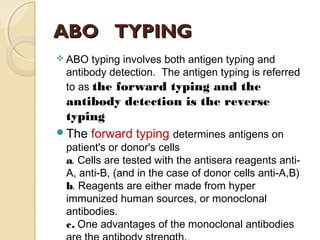
 ABO typing involves both antigen typing and
antibody detection.  The antigen typing is referred
to as the forward typing and the
antibody detection is the reverse
typing
The forward typing determines antigens on
patient's or donor's cells 
a. Cells are tested with the antisera reagents anti-
A, anti-B, (and in the case of donor cells anti-A,B) 
b. Reagents are either made from hyper
immunized human sources, or monoclonal
antibodies.  
c. One advantages of the monoclonal antibodies
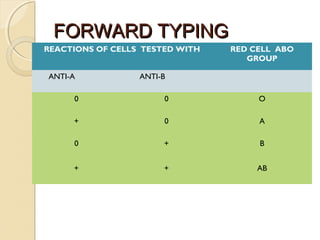
FORWARD TYPINGFORWARD TYPING
REACTIONS OF CELLS TESTED WITH RED CELL ABO
GROUP
ANTI-A ANTI-B
0 0 O
+ 0 A
0 + B
+ + AB
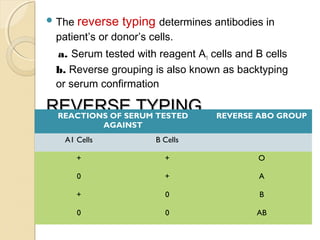
 The reverse typing determines antibodies in
patient’s or donor’s cells.
a. Serum tested with reagent A1 cells and B cells 
b. Reverse grouping is also known as backtyping
or serum confirmation
REVERSE TYPINGREVERSE TYPINGREACTIONS OF SERUM TESTED
AGAINST
REVERSE ABO GROUP
A1 Cells B Cells
+ + O
0 + A
+ 0 B
0 0 AB
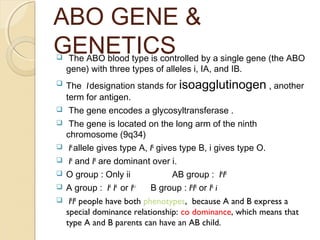
ABO GENE &
GENETICS  The ABO blood type is controlled by a single gene (the ABO
gene) with three types of alleles i, IA, and IB.
 The  Idesignation stands for isoagglutinogen ,, another
term for antigen.
 The gene encodes a glycosyltransferase .
 The gene is located on the long arm of the ninth
chromosome (9q34)
  IA
allele gives type A, IB
gives type B, i gives type O.
  IA
and IB
are dominant over i.
 O group : Only ii AB group :  IA
IB
 A group :  IA
 IA
or IA i
B group : IB
IB
or IB
i
  IA
IB
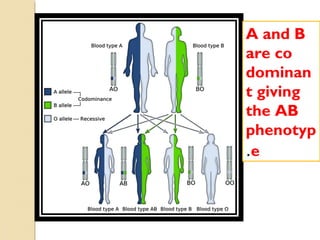
 people have both phenotypes, because A and B express a
special dominance relationship: co dominance, which means that
type A and B parents can have an AB child.
A and B
are co
dominan
t giving
the AB
phenotyp
e.
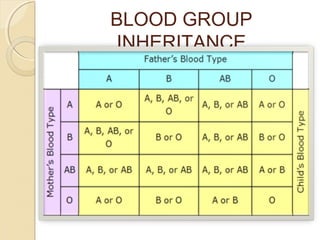
BLOOD GROUP
INHERITANCE
ABO ANITGEN GENETICSABO ANITGEN GENETICS
The presence or absence of the ABH
antigens on the red blood cell
membrane is controlled by the H gene
• The presence or absence of the
ABH antigens in secretions is
indirectly controlled by the Se gene
• H gene – H and h alleles (h is an
amorph)
 • Se gene – Se and se alleles (se is
an amorph)
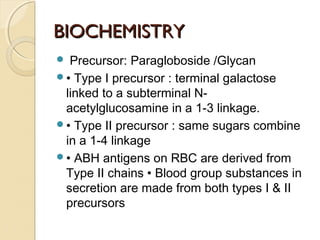
BIOCHEMISTRYBIOCHEMISTRY
 Precursor: Paragloboside /Glycan
• Type I precursor : terminal galactose
linked to a subterminal N-
acetylglucosamine in a 1-3 linkage.
• Type II precursor : same sugars combine
in a 1-4 linkage
• ABH antigens on RBC are derived from
Type II chains • Blood group substances in
secretion are made from both types I & II
precursors
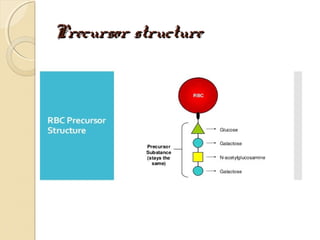
Precursor structurePrecursor structure
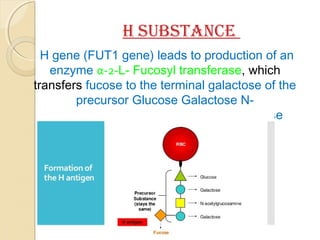
H SUBSTANCE
  H gene (FUT1 gene) leads to production of an
enzyme α-2-L- Fucosyl transferase, which
transfers fucose to the terminal galactose of the
precursor Glucose Galactose N-
acetylglucosamine Galactose RBC Fucose
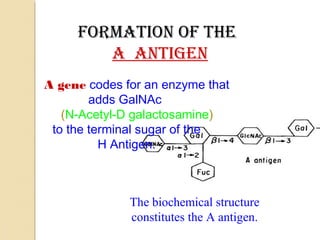
FormATioN oF THE
A ANTigEN
A gene codes for an enzyme that
adds GalNAc
(N-Acetyl-D galactosamine)
to the terminal sugar of the
H Antigen.
The biochemical structure
constitutes the A antigen.
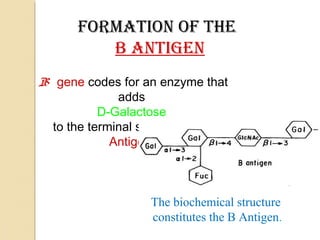
FormATioN oF THE
B ANTigEN
B gene codes for an enzyme that
adds
D-Galactose
to the terminal sugar of the H
Antigen.
The biochemical structure
constitutes the B Antigen.
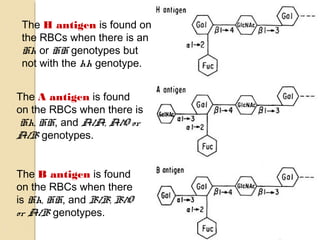
The H antigen is found on
the RBCs when there is an
Hh or HH genotypes but
not with the hh genotype.
The A antigen is found
on the RBCs when there is
Hh, HH, and A/A, A/O or
A/B genotypes.
The B antigen is found
on the RBCs when there
is Hh, HH, and B/B, B/O
or A/B genotypes.
BOMBAY GROUPBOMBAY GROUP
The h/h blood group, also known as Oh[
 or
the Bombay blood group, is a rare blood
type. This blood [phenotype] was first
discovered in Bombay, now known
as Mumbai, in India, by Dr. Y.M.Bhende in
1952.
The Hh blood group contains one antigen,
the H antigen, which is found on virtually all
RBCs and is the building block for the
production of the antigens within the ABO
blood group.
H antigen deficiency is known as the
"Bombay phenotype" (h/h, also known as
Oh) and is found in 1 of 10,000 individuals
in India and 1 in a million people in Europe.
There is no ill effect with being H deficient,
but if a blood transfusion is ever needed,
people with this blood type can receive
blood only from other donors who are also
H deficient. (A transfusion of "normal" group
O blood can trigger a severe transfusion
reaction.)
The peculiarity is that they do not express
the H antigen. As a result they cannot form
A antigens or B antigens on their red blood
ABO ANTIGEN IN TRANSFUSIONABO ANTIGEN IN TRANSFUSION
For a blood donor and recipient to be ABO-
compatible for a transfusion, the recipient
must not have Anti-A or Anti-B antibodies
that correspond to the A or B antigens on
the surface of the donor's red blood
cells (since the red blood cells are isolated
from whole blood before transfusion, it is
unimportant whether the donor blood has
antibodies in its plasma). If the antibodies of
the recipient's blood and the antigens on
the donor's red blood cells do correspond,
the donor blood is rejected. On rejection,
the recipient may experience Acute
RH BLOOD GROUP SYSTEMRH BLOOD GROUP SYSTEM
oThe Rh blood group system (including
the Rh factor) is one of thirty-five
current human blood group systems. It is
the second most important blood group
system, after ABO.
o Rh derives from rhesus and the terms
 rhe sus blo o d g ro up syste m , rhe sus
facto r, rhe sus po sitive  and rhe sus
ne g ative  are also used.
o Rh is a blood group system with many
antigens, one of which is D.
RH (D) ANTIGENRH (D) ANTIGEN
Unlike the ABO blood group system,
individuals who lack the D antigen do
not naturally make it.
Production of antibody to D requires
exposure to the antigen.
The D antigen is very immunogenic,
i.e, individuals exposed to it will very
likely make an antibody to it.
For this reason all individuals are
typed for D, if negative must receive
Rh (D) negative blood.
RH (D) ANTIGENRH (D) ANTIGEN
{CONTINUED}{CONTINUED}
The most important patient population
to consider is females of child-bearing
age.
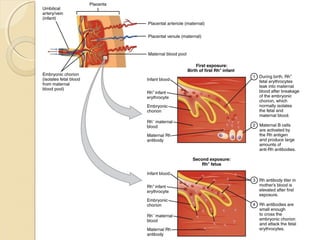
If immunized to Rh (D) antigen the
antibody can cross the placenta and
destroy Rh (D) positive fetal cells
resulting in death.
This is why Rh negative women are
given Rhogam after birth of Rh
positive baby.
ABO Hemolytic disease of theABO Hemolytic disease of the
newbornnewborn
Also known as ERYTHROBLASTOSIS
FETALIS.
It is an allo immune  condition that develops
in a foetus, when the IgG molecules (one of
the five main types of antibodies) produced
by the mother pass through the placenta.
Among these antibodies are some which
attack antigens on the red blood cells in the
foetal circulation taking down and
destroying the cells (hemolysis). The foetus
can develop  reticulocytosis and  anaemia.
THANKYOU.

Abo blood group system

  • 1.
    ABO BLOOD GROUPABOBLOOD GROUP SYSTEMSYSTEM
  • 2.
    ABO BLOOD GROUPSYSTEMABO BLOOD GROUP SYSTEM The ABO blood group system is the most  important blood group system in human blood  transfusion.  Found on platelets, epithelium and cells other  than erythrocytes, AB antigens can also cause an  adverse immune response to organ transplantation. The  associated anti-A and anti-B antibodies are  usually IgM antibodies, which are produced in the first  years of life by sensitization to environmental  substances, such as food, bacteria, and viruses.
  • 3.
    ABO blood groupantigens presentABO blood group antigens present on red blood cellson red blood cells
  • 4.
     HISTORY  KARLLANDSTEINER discovered the ABO  Blood Group System in 1901.  He and five co-workers began  mixing each others red blood cells  and serum together and  accidentally performed the  first forward and reverse ABO groupings.
  • 5.
  • 6.
    IMPORTANCE OF ABOIMPORTANCEOF ABO There are two principles- 1) Almost all normal healthy individuals above 3-6 months of  age have “ naturally occurring Abs” to the ABO Ags that  they lack.     These Abs termed naturally occurring  because they   were thought to arise without antigenic stimulation.
  • 7.
  • 8.
    BLOOD GROUP ANTIGENSON CELL ANTIBODIES IN PLASMA A A Anti-B B B Anti-A AB A and B none O None Anti-A and B
  • 9.
    ABO TYPINGABO TYPING ABO typing involves both antigen typing and antibody detection.  The antigen typing is referred to as the forward typing and the antibody detection is the reverse typing The forward typing determines antigens on patient's or donor's cells  a. Cells are tested with the antisera reagents anti- A, anti-B, (and in the case of donor cells anti-A,B)  b. Reagents are either made from hyper immunized human sources, or monoclonal antibodies.   c. One advantages of the monoclonal antibodies
  • 10.
    FORWARD TYPINGFORWARD TYPING REACTIONSOF CELLS TESTED WITH RED CELL ABO GROUP ANTI-A ANTI-B 0 0 O + 0 A 0 + B + + AB
  • 11.
     The reversetyping determines antibodies in patient’s or donor’s cells. a. Serum tested with reagent A1 cells and B cells  b. Reverse grouping is also known as backtyping or serum confirmation REVERSE TYPINGREVERSE TYPINGREACTIONS OF SERUM TESTED AGAINST REVERSE ABO GROUP A1 Cells B Cells + + O 0 + A + 0 B 0 0 AB
  • 13.
    ABO GENE & GENETICS The ABO blood type is controlled by a single gene (the ABO gene) with three types of alleles i, IA, and IB.  The  Idesignation stands for isoagglutinogen ,, another term for antigen.  The gene encodes a glycosyltransferase .  The gene is located on the long arm of the ninth chromosome (9q34)   IA allele gives type A, IB gives type B, i gives type O.   IA and IB are dominant over i.  O group : Only ii AB group :  IA IB  A group :  IA  IA or IA i B group : IB IB or IB i   IA IB  people have both phenotypes, because A and B express a special dominance relationship: co dominance, which means that type A and B parents can have an AB child.
  • 14.
    A and B areco dominan t giving the AB phenotyp e.
  • 15.
  • 16.
    ABO ANITGEN GENETICSABOANITGEN GENETICS The presence or absence of the ABH antigens on the red blood cell membrane is controlled by the H gene • The presence or absence of the ABH antigens in secretions is indirectly controlled by the Se gene • H gene – H and h alleles (h is an amorph)  • Se gene – Se and se alleles (se is an amorph)
  • 17.
    BIOCHEMISTRYBIOCHEMISTRY  Precursor: Paragloboside /Glycan •Type I precursor : terminal galactose linked to a subterminal N- acetylglucosamine in a 1-3 linkage. • Type II precursor : same sugars combine in a 1-4 linkage • ABH antigens on RBC are derived from Type II chains • Blood group substances in secretion are made from both types I & II precursors
  • 18.
  • 19.
    H SUBSTANCE   Hgene (FUT1 gene) leads to production of an enzyme α-2-L- Fucosyl transferase, which transfers fucose to the terminal galactose of the precursor Glucose Galactose N- acetylglucosamine Galactose RBC Fucose
  • 20.
    FormATioN oF THE AANTigEN A gene codes for an enzyme that adds GalNAc (N-Acetyl-D galactosamine) to the terminal sugar of the H Antigen. The biochemical structure constitutes the A antigen.
  • 21.
    FormATioN oF THE BANTigEN B gene codes for an enzyme that adds D-Galactose to the terminal sugar of the H Antigen. The biochemical structure constitutes the B Antigen.
  • 22.
    The H antigenis found on the RBCs when there is an Hh or HH genotypes but not with the hh genotype. The A antigen is found on the RBCs when there is Hh, HH, and A/A, A/O or A/B genotypes. The B antigen is found on the RBCs when there is Hh, HH, and B/B, B/O or A/B genotypes.
  • 23.
    BOMBAY GROUPBOMBAY GROUP The h/hblood group, also known as Oh[  or the Bombay blood group, is a rare blood type. This blood [phenotype] was first discovered in Bombay, now known as Mumbai, in India, by Dr. Y.M.Bhende in 1952. The Hh blood group contains one antigen, the H antigen, which is found on virtually all RBCs and is the building block for the production of the antigens within the ABO blood group.
  • 24.
    H antigen deficiencyis known as the "Bombay phenotype" (h/h, also known as Oh) and is found in 1 of 10,000 individuals in India and 1 in a million people in Europe. There is no ill effect with being H deficient, but if a blood transfusion is ever needed, people with this blood type can receive blood only from other donors who are also H deficient. (A transfusion of "normal" group O blood can trigger a severe transfusion reaction.) The peculiarity is that they do not express the H antigen. As a result they cannot form A antigens or B antigens on their red blood
  • 25.
    ABO ANTIGEN INTRANSFUSIONABO ANTIGEN IN TRANSFUSION For a blood donor and recipient to be ABO- compatible for a transfusion, the recipient must not have Anti-A or Anti-B antibodies that correspond to the A or B antigens on the surface of the donor's red blood cells (since the red blood cells are isolated from whole blood before transfusion, it is unimportant whether the donor blood has antibodies in its plasma). If the antibodies of the recipient's blood and the antigens on the donor's red blood cells do correspond, the donor blood is rejected. On rejection, the recipient may experience Acute
  • 26.
    RH BLOOD GROUPSYSTEMRH BLOOD GROUP SYSTEM oThe Rh blood group system (including the Rh factor) is one of thirty-five current human blood group systems. It is the second most important blood group system, after ABO. o Rh derives from rhesus and the terms  rhe sus blo o d g ro up syste m , rhe sus facto r, rhe sus po sitive  and rhe sus ne g ative  are also used. o Rh is a blood group system with many antigens, one of which is D.
  • 27.
    RH (D) ANTIGENRH(D) ANTIGEN Unlike the ABO blood group system, individuals who lack the D antigen do not naturally make it. Production of antibody to D requires exposure to the antigen. The D antigen is very immunogenic, i.e, individuals exposed to it will very likely make an antibody to it. For this reason all individuals are typed for D, if negative must receive Rh (D) negative blood.
  • 28.
    RH (D) ANTIGENRH(D) ANTIGEN {CONTINUED}{CONTINUED} The most important patient population to consider is females of child-bearing age. If immunized to Rh (D) antigen the antibody can cross the placenta and destroy Rh (D) positive fetal cells resulting in death. This is why Rh negative women are given Rhogam after birth of Rh positive baby.
  • 29.
    ABO Hemolytic diseaseof theABO Hemolytic disease of the newbornnewborn Also known as ERYTHROBLASTOSIS FETALIS. It is an allo immune  condition that develops in a foetus, when the IgG molecules (one of the five main types of antibodies) produced by the mother pass through the placenta. Among these antibodies are some which attack antigens on the red blood cells in the foetal circulation taking down and destroying the cells (hemolysis). The foetus can develop  reticulocytosis and  anaemia.
  • 31.