Dr Ravi Kant Agrawal, MVSc, PhD
Senior Scientist (Veterinary Microbiology)
Food Microbiology Laboratory
Division of Livestock Products Technology
ICAR-Indian Veterinary Research Institute
Izatnagar 243122 (UP) India
Introduction
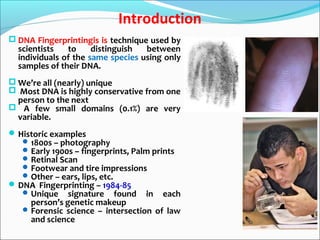
 DNA Fingerprintingis is technique used by
scientists to distinguish between
individuals of the same species using only
samples of their DNA.
 We’re all (nearly) unique
 Most DNA is highly conservative from one
person to the next
 A few small domains (0.1%) are very
variable.
Historic examples
1800s – photography
Early 1900s – fingerprints, Palm prints
Retinal Scan
Footwear and tire impressions
Other – ears, lips, etc.
DNA Fingerprinting – 1984-85
Unique signature found in each
person’s genetic makeup
Forensic science – intersection of law
and science
Why Use DNA Fingerprinting?
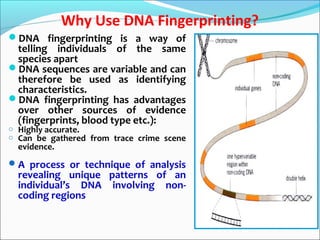
DNA fingerprinting is a way of
telling individuals of the same
species apart
DNA sequences are variable and can
therefore be used as identifying
characteristics.
DNA fingerprinting has advantages
over other sources of evidence
(fingerprints, blood type etc.):
o Highly accurate.
o Can be gathered from trace crime scene
evidence.
A process or technique of analysis
revealing unique patterns of an
individual’s DNA involving non-
coding regions
DNA Fingerprinting/ ProfilingDNA Fingerprinting/ Profiling
 The genome in a particular species is more
of less same in every member of a species.
 Genome contains polymorphisms,
positions were the nucleotide sequences
are not same in every member of the
population.
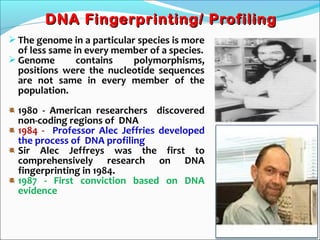
1980 - American researchers discovered
non-coding regions of DNA
1984 - Professor Alec Jeffries developed
the process of DNA profiling
Sir Alec Jeffreys was the first to
comprehensively research on DNA
fingerprinting in 1984.
1987 - First conviction based on DNA
evidence
DNA Fingerprinting/ ProfilingDNA Fingerprinting/ Profiling
 Like several other significant discoveries in biotechnology genetic fingerprinting
was discovered by scientists who were searching for something else.
 Unlike many other advances in modern genetics DNA profiling has already had a
major effect on the lives of thousands of people throughout the world.
 In 1984 Prof Alec Jeffreys of the University of Leicester in England was studying
the gene for myoglobin, a protein that stores oxygen in the muscle. He found that
part of the gene did not carry instructions for the manufacture of myoglobin (non
coding DNA sequence). Instead, this bit of DNA consisted of an unusual sequence
of bases repeated several times.
 Jeffreys realised these aparantly useless & harmless pieces of DNA could act as
genetic markers for the myoglobin gene – helpful in tracking down its location on
a particular chromosome.
 To his surprise Jefferys found that the sequence of non coding DNA from the
myoglobin gene occurred in many different places throughout the human
chromosome.
 Further investigation showed that each of the variable regions shared a common
sequence of about 16 base pairs.
 The number of times this sequence occurred was aparantly unique to each
individual.
 Prof. Jefferys was quick to realise that the technique could be used to establish
with accuracy the identity and relatedness of individuals
 Legal history – made in Nov 1987 when a Bristol man was sentenced to 8 yrs in jail
for rape. First conviction based on evidence using the revolutionary new technique
known as DNA fingerprinting (matched blood with semen stains on the clothes of
his victim)
Restriction Fragment Length Polymorphism (RFLP),
Randomly Amplified Polymorphic DNA (RAPD)
Amplified Fragment length Polymorphism (AFLP)
Variable number tandem repeats (VNTR), particularly short
tandem repeats (STR)s,
Single nucleotide polymorphisms (SNPs)
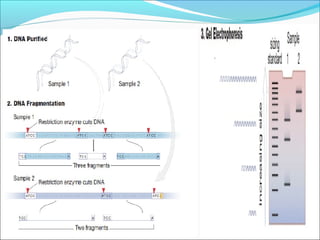
 Restriction Fragment Length Polymorphism (RFLP) is a
difference in homologous DNA sequences that can be detected
by the presence of fragments of different lengths after digestion
of the DNA samples in question with specific restriction
endonucleases.
 The presence or absence of certain recognition sites in a DNA
sample generates variable lengths of DNA fragments, which are
separated using gel electrophoresis.
 RFLP is a technique for analyzing the variable lengths of DNA
fragments that result from digesting a DNA sample with a
restriction endonuclease
If two different samples show VNTRs of different lengths,
the samples could not have come from the same organism.
VNTRs of the same length could have come from the same
organism, or from two individuals who happen to have
VNTRs of the same length at that location.
By comparing enough VNTRs from two individuals,
however, the likelihood of a coincidental match can be
reduced to nearly zero.
It requires relatively large amounts of DNA.
Isolation of sufficient DNA for RFLP analysis is time
consuming and labor intensive.
In addition, samples degraded by environmental factors,
such as dirt or mold, do not work well with RFLP.
The vast majority of RFLP methods are qualitative and
perform best on pure animal tissue since mixtures can
produce complicated fingerprints that are not easily
interpreted.
Also called as PCR-RFLP
PCR can be used to amplify very small amounts of DNA,
usually in 2-3 hours, to the levels required for RFLP analysis.
Therefore, more samples can be analyzed in a shorter time.
Random Amplified Polymorphic DNA (RAPD)
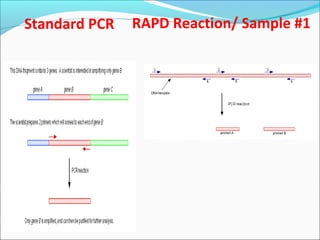
Random amplified polymorphic DNA (RAPD) analysis takes
advantage of short arbitrary PCR primers and produces a range
of amplified products
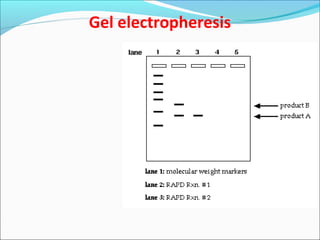
Amplification products are generally separated on agarose gels
and stained with ethidium bromide.
RAPD does not require any specific knowledge of the DNA
sequence of the target organism.
The identical 10-mer primers will or will not amplify a segment
of DNA, depending on positions that are complementary to the
primers sequence.
At an appropriate annealing temperature during the thermal
cycle, oligonucleotide primers of random sequence bind several
priming sites on the complementary sequences in the template
genomic DNA, producing discrete DNA products if these
priming sites are within an amplifiable distance of each other .
Nucleotide variation between different sets of template DNAs
will result in the presence or absence of bands because of
changes in the priming sites.
Standard PCR RAPD Reaction/ Sample #1
Gel electropheresis
Advantages
Little or no information on the DNA sequence is required
RAPD is therefore not only relevant to domestic animals, but
also to rare species
Discrimination between pork, beef, lamb, chicken, and turkey
has been demonstrated in processed food (Saez, Sanz, & Toldra,
2004 )
RAPD is an inexpensive yet powerful typing method for many
bacterial species.
Disadvantages
It is not possible to distinguish whether a DNA segment is
amplified from a locus that is heterozygous (1 copy) or
homozygous (2 copies).
Mismatches between the primer and the template may result in
the total absence of PCR product as well as in a merely
decreased amount of the product. Thus, the RAPD results can be
difficult to interpret
Amplified fragment length polymorphism (AmpFLP)
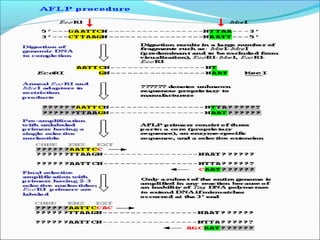
Step 1: Preparing the AFLP Template
Step 2: Ligation Reaction with Restriction Fragments and
Adaptors
Step 3: Selective PCR Amplification
Step 4: Electrophoretic Separation of Amplified DNA Fragments
and Analysis of results
Step 1: Preparing the AFLP Template
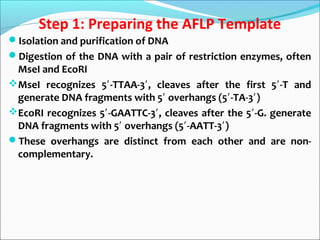
Isolation and purification of DNA
Digestion of the DNA with a pair of restriction enzymes, often
MseI and EcoRI
MseI recognizes 5 -TTAA-3 , cleaves after the first 5 -T and′ ′ ′
generate DNA fragments with 5 overhangs (5 -TA-3 )′ ′ ′
EcoRI recognizes 5 -GAATTC-3 , cleaves after the 5 -G. generate′ ′ ′
DNA fragments with 5 overhangs (5 -AATT-3 )′ ′ ′
These overhangs are distinct from each other and are non-
complementary.
Step 2: Ligation Reaction with Restriction
Fragments and Adaptors
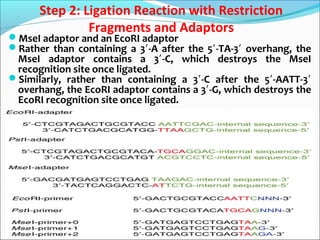
MseI adaptor and an EcoRI adaptor
Rather than containing a 3 -A after the 5 -TA-3 overhang, the′ ′ ′
MseI adaptor contains a 3 -C, which destroys the MseI′
recognition site once ligated.
Similarly, rather than containing a 3 -C after the 5 -AATT-3′ ′ ′
overhang, the EcoRI adaptor contains a 3 -G, which destroys the′
EcoRI recognition site once ligated.
Step 3: Selective PCR Amplification
Each unique genomic DNA fragment is sandwiched between the
MseI adaptor and the EcoRI adaptor and their associated unique
DNA sequences.
Although the MseI and EcoRI adaptor-ligated ends of each DNA
fragment will be identical, the sequences of the genomic DNA
fragments, which begin just after the original MseI and EcoRI
sites, will differ.
If PCR reactions are carried out using primers corresponding to
the MseI and EcoRI adaptor sequences, they would amplify
every single genomic DNA fragment, and therefore
indecipherable set of DNA fragments would be produced.
In order to selectively amplify a smaller number of genomic
DNA fragments, sets of primers are used that are
complementary to the MseI or EcoRI adaptor sequences
starting at their 5 ends but that add up to three unique′
nucleotides following the end of the original MseI or EcoRI
recognition site.
Primer design does not require any previous knowledge of the
genome under study.
Simply PCR reactions are set up using a variety of primer sets,
viz. one MseI-associated primer and one EcoRI-associated
primer.
AFLP-PCR reactions are carried out under stringent conditions,
permitting only the selective amplification of those genomic
DNA fragments that are perfectly complementary to the 3 ends′
of the primer sequences.
The stringent PCR conditions employed in AFLP-PCR reactions
lead to highly reproducible results that are readily comparable
among different samples.
Step 4: Electrophoretic Separation of Amplified
DNA Fragments and Analysis of Results
The band pattern after gel electrophoresis is analyzed to
determine the DNA finger print.
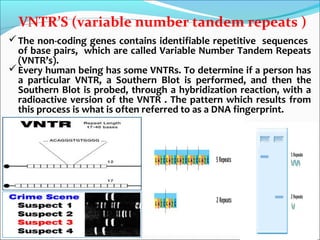
VNTR’S (variable number tandem repeats )
The non-coding genes contains identifiable repetitive sequences
of base pairs, which are called Variable Number Tandem Repeats
(VNTR’s).
Every human being has some VNTRs. To determine if a person has
a particular VNTR, a Southern Blot is performed, and then the
Southern Blot is probed, through a hybridization reaction, with a
radioactive version of the VNTR . The pattern which results from
this process is what is often referred to as a DNA fingerprint.
VNTR
 The introns contain repeated sequences of between 1 and 100 base
pairs
 Called variable number tandem repeats (VNTR’s)
 Some VNTR’s are inherited from mother and some from father
DNA fingerprinting is restricted to the detection of microsatellites
1 to 6 nucleotide repeats dispersed throughout the chromosomes
Probes used to identify the microsatellite surround the specific
microsatellite being analyzed
Also called short tandem repeats (STR)
FBI has chosen 13 unique STRs for testing
 Combined DNA Index System (CODIS)
DNA fingerprinting is a comparative process
Samples from crime scene must be compared to suspect DNA
Best sample from suspect DNA is fresh, whole blood
STR Analysis
o Use primers to amplify STR’s in DNA using PCR
o FBI uses 13 STR regions
o Odds that two individuals will have the same 13-loci DNA profile are
more than one in a billion
 Variable Number Tandem Repeats, VNTRs, are highly polymorphic, multi-allelic
DNA markers that contain tandem repeats of 11 to 60 base pair sequences, but
represent only a single locus.
 The highly polymorphic nature of VNTR loci makes them a useful tool for
human identification.
 VNTR loci are routinely detected by RFLP analysis. Using this technique, the
DNA sample is subjected to restriction enzyme digestion followed by gel
electrophoresis. The separated restriction fragments are then transferred to
a membrane in a Southern blot procedure and VNTR detection is performed
using specific probes that are labeled with radioactive or chemiluminescent
tags.
 VNTR loci are further characterized by length as well as how many times the
sequence is repeated.
 There are three different VNTR structures which are used: Restriction
Fragment Length Polymorphisms (RFLP), Amplification Fragment Length
Polymorphisms (AMP-FLP) and Short Tandem Repeats (STR).
 Note that the longer the repeat, the higher the heterozygosity. As the
heterozygosity increases so does the power of discrimination.
 AMP-FLP and STR analysis are performed using PCR technology.
 Currently STRs are in widespread use.
 Their main advantages is that their small size allows for the use of small
amounts of degraded DNA.
 PCR technology allows use of less than 1ng of DNA for identification.
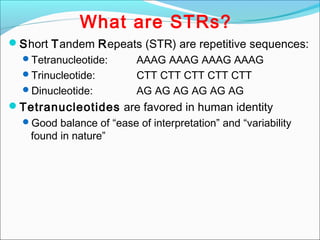
What are STRs?
Short Tandem Repeats (STR) are repetitive sequences:
Tetranucleotide: AAAG AAAG AAAG AAAG
Trinucleotide: CTT CTT CTT CTT CTT
Dinucleotide: AG AG AG AG AG AG
Tetranucleotides are favored in human identity
Good balance of “ease of interpretation” and “variability
found in nature”
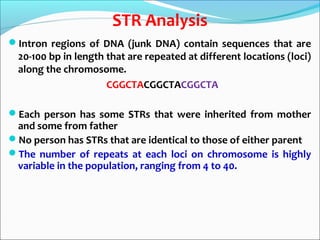
STR Analysis
Intron regions of DNA (junk DNA) contain sequences that are
20-100 bp in length that are repeated at different locations (loci)
along the chromosome.
CGGCTACGGCTACGGCTA
Each person has some STRs that were inherited from mother
and some from father
No person has STRs that are identical to those of either parent
The number of repeats at each loci on chromosome is highly
variable in the population, ranging from 4 to 40.
Interpretation
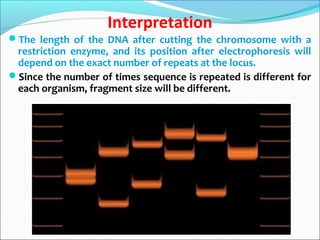
The length of the DNA after cutting the chromosome with a
restriction enzyme, and its position after electrophoresis will
depend on the exact number of repeats at the locus.
Since the number of times sequence is repeated is different for
each organism, fragment size will be different.
Advantage
The odds that two individuals will have the same 13-loci DNA
profile is about one in a billion.
We do not need to sequence the entire DNA to distinguish it
from another sample DNA.
SNP
►A SNP is defined as a single base change in a DNA
sequence that occurs in a significant proportion (more
than 1 percent) of a large population.
In human beings, 99.9 percent bases are same.
Remaining 0.1 percent makes a person unique.
Different attributes / characteristics / traits
 how a person looks,
 diseases he or she develops.
These variations can be:
Harmless (change in phenotype)
Harmful (diabetes, cancer, heart disease, Huntington's disease, and
hemophilia )
Latent (variations found in coding and regulatory regions, are not
harmful on their own, and the change in each gene only becomes
apparent under certain conditions e.g. susceptibility to lung cancer)
►
SNP facts
►SNPs are found in
 coding and (mostly) noncoding
regions.
►Occur with a very high
frequency
 about 1 in 1000 bases to 1 in 100 to
300 bases.
►The abundance of SNPs and the
ease with which they can be
measured make these genetic
variations significant.
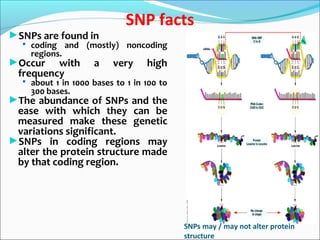
►SNPs in coding regions may
alter the protein structure made
by that coding region.
SNPs may / may not alter protein
structure
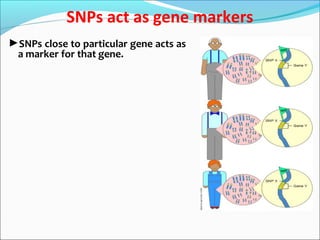
SNPs act as gene markers
►SNPs close to particular gene acts as
a marker for that gene.
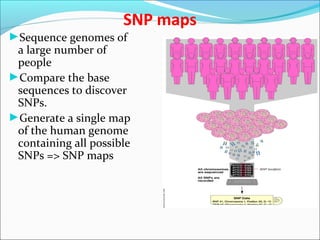
SNP maps
►Sequence genomes of
a large number of
people
►Compare the base
sequences to discover
SNPs.
►Generate a single map
of the human genome
containing all possible
SNPs => SNP maps
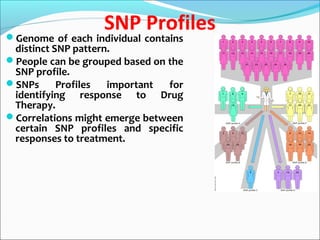
SNP ProfilesGenome of each individual contains
distinct SNP pattern.
People can be grouped based on the
SNP profile.
SNPs Profiles important for
identifying response to Drug
Therapy.
Correlations might emerge between
certain SNP profiles and specific
responses to treatment.
Techniques to detect known Polymorphisms
Hybridization Techniques
Micro arrays
Real time PCR
Enzyme based Techniques
Nucleotide extension
Cleavage
Ligation
Reaction product detection and display
Techniques to detect unknown Polymorphisms
Direct Sequencing
Microarray
Cleavage / Ligation
Electrophoretic mobility assays
Mitochondrial DNA Analysis
mtDNA analysis uses DNA extracted from mitochondrion
All mothers have the same mitochondrial DNA as their offspring
mtDNA profile of unidentified remains with the profile of a
potential maternal relative can be an important technique in
missing-person investigations.
Advantage
mtDNA can be used to examine the DNA from samples that
cannot be analyzed by RFLP or STR
While older biological samples that lack nucleated cellular
material, such as hair, bones, and teeth, cannot be analyzed
with STR and RFLP, they can be analyzed with mtDNA.
In the investigation of cases that have gone unsolved for many
years, mtDNA is extremely valuable.
Disadvantages
Large variations of mitochondria in different tissue.
Not possible to perform a meaningful quantification based
on neither DNA nor meat content (w/w).
PCR Analysis
Polymerase chain reaction (PCR) is used to make millions of
exact copies of DNA from a biological sample.
DNA amplification with PCR allows DNA analysis on biological
samples as small as a few skin cells.
The ability of PCR to amplify such tiny quantities of DNA
enables even highly degraded samples to be analyzed.
Great care, however, must be taken to prevent contamination
with other biological materials during the identifying,
collecting, and preserving of a sample.
Gel electrophoresis has been widely used to separate PCR
amplicons and determine their presence, intensity, size, and
pattern through visualization with different staining dyes.
The PCR technique can, in theory, amplify one copy of target
DNA and the LOD is therefore often lower than observed in
protein based methods.
A low LOD and a large amount of DNA sequence data have
resulted in a shift in species determination from protein to DNA
analysis, and in particular PCR.
Applications
Forensics
 Human forensics
Animal forensics
Solving child disputes
Meat adulteration determination
As an epidemiological tool for determining particular sources
and causative agents of infectious disease
Advantage of Molecular Methods in Epidemiology
Aid in faster diagnosis of diseases.
Increased sensitivity and specificity.
Rapid detection of pathogen than conventional methods.
Identification of epidemiologically important strains.
Decrease the man power need for pathogen detection.
Give rapid answers to treatment options in life threatening
infections.
Adapted to instrumentation.
Uses of DNA Profiling
DNA profiling is used to solve
crimes and medical problems
Crime
Forensic science is the use of scientific knowledge in legal
situations.
The DNA profile of each individual is highly specific.
The chances of two people having exactly the same DNA
profile is 30,000 million to 1 (except for identical twins).
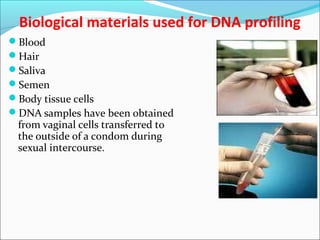
Biological materials used for DNA profiling
Blood
Hair
Saliva
Semen
Body tissue cells
DNA samples have been obtained
from vaginal cells transferred to
the outside of a condom during
sexual intercourse.
DNA Profiling can solve crimes
The pattern of the DNA profile is then compared with those of
the victim and the suspect.
If the profile matches the suspect it provides strong evidence
that the suspect was present at the crime scene (NB:it does not
prove they committed the crime).
If the profile doesn’t match the suspect then that suspect may
be eliminated from the enquiry.
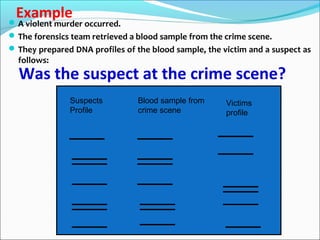
ExampleA violent murder occurred.
The forensics team retrieved a blood sample from the crime scene.
They prepared DNA profiles of the blood sample, the victim and a suspect as
follows:
Suspects
Profile
Blood sample from
crime scene
Victims
profile
Was the suspect at the crime scene?
Solving Medical Problems
DNA profiles can be used to determine whether a particular
person is the parent of a child.
A childs paternity (father) and maternity (mother) can be
determined.
This information can be used in
• Paternity suits
• Inheritance cases
• Immigration cases
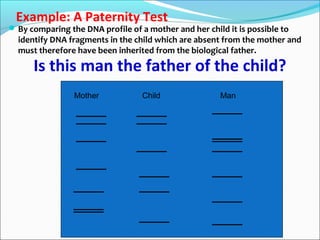
Example: A Paternity Test
By comparing the DNA profile of a mother and her child it is possible to
identify DNA fragments in the child which are absent from the mother and
must therefore have been inherited from the biological father.
Mother Child Man
Is this man the father of the child?
Famous cases
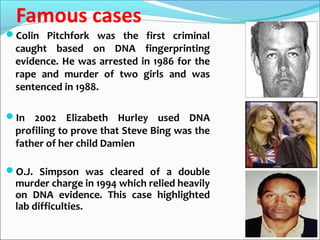
Colin Pitchfork was the first criminal
caught based on DNA fingerprinting
evidence. He was arrested in 1986 for the
rape and murder of two girls and was
sentenced in 1988.
In 2002 Elizabeth Hurley used DNA
profiling to prove that Steve Bing was the
father of her child Damien
O.J. Simpson was cleared of a double
murder charge in 1994 which relied heavily
on DNA evidence. This case highlighted
lab difficulties.
Applications
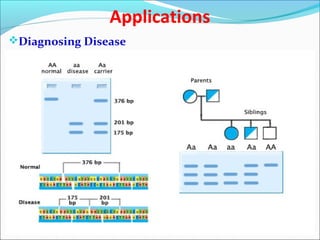
Diagnosing Disease
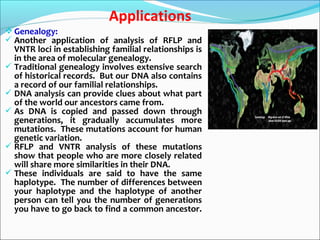
 Genealogy:
 Another application of analysis of RFLP and
VNTR loci in establishing familial relationships is
in the area of molecular genealogy.
 Traditional genealogy involves extensive search
of historical records. But our DNA also contains
a record of our familial relationships.
 DNA analysis can provide clues about what part
of the world our ancestors came from.
 As DNA is copied and passed down through
generations, it gradually accumulates more
mutations. These mutations account for human
genetic variation.
 RFLP and VNTR analysis of these mutations
show that people who are more closely related
will share more similarities in their DNA.
 These individuals are said to have the same
haplotype. The number of differences between
your haplotype and the haplotype of another
person can tell you the number of generations
you have to go back to find a common ancestor.
Applications
Thanks
Acknowledgement: All the material/presentations available online on
the subject are duly acknowledged.
Disclaimer: The author bear no responsibility with regard to the source
and authenticity of the content.
Questions???

DNA fingerprinting

  • 1.
    Dr Ravi KantAgrawal, MVSc, PhD Senior Scientist (Veterinary Microbiology) Food Microbiology Laboratory Division of Livestock Products Technology ICAR-Indian Veterinary Research Institute Izatnagar 243122 (UP) India
  • 2.
    Introduction  DNA Fingerprintingisis technique used by scientists to distinguish between individuals of the same species using only samples of their DNA.  We’re all (nearly) unique  Most DNA is highly conservative from one person to the next  A few small domains (0.1%) are very variable. Historic examples 1800s – photography Early 1900s – fingerprints, Palm prints Retinal Scan Footwear and tire impressions Other – ears, lips, etc. DNA Fingerprinting – 1984-85 Unique signature found in each person’s genetic makeup Forensic science – intersection of law and science
  • 3.
    Why Use DNAFingerprinting? DNA fingerprinting is a way of telling individuals of the same species apart DNA sequences are variable and can therefore be used as identifying characteristics. DNA fingerprinting has advantages over other sources of evidence (fingerprints, blood type etc.): o Highly accurate. o Can be gathered from trace crime scene evidence. A process or technique of analysis revealing unique patterns of an individual’s DNA involving non- coding regions
  • 4.
    DNA Fingerprinting/ ProfilingDNAFingerprinting/ Profiling  The genome in a particular species is more of less same in every member of a species.  Genome contains polymorphisms, positions were the nucleotide sequences are not same in every member of the population. 1980 - American researchers discovered non-coding regions of DNA 1984 - Professor Alec Jeffries developed the process of DNA profiling Sir Alec Jeffreys was the first to comprehensively research on DNA fingerprinting in 1984. 1987 - First conviction based on DNA evidence
  • 5.
    DNA Fingerprinting/ ProfilingDNAFingerprinting/ Profiling  Like several other significant discoveries in biotechnology genetic fingerprinting was discovered by scientists who were searching for something else.  Unlike many other advances in modern genetics DNA profiling has already had a major effect on the lives of thousands of people throughout the world.  In 1984 Prof Alec Jeffreys of the University of Leicester in England was studying the gene for myoglobin, a protein that stores oxygen in the muscle. He found that part of the gene did not carry instructions for the manufacture of myoglobin (non coding DNA sequence). Instead, this bit of DNA consisted of an unusual sequence of bases repeated several times.  Jeffreys realised these aparantly useless & harmless pieces of DNA could act as genetic markers for the myoglobin gene – helpful in tracking down its location on a particular chromosome.  To his surprise Jefferys found that the sequence of non coding DNA from the myoglobin gene occurred in many different places throughout the human chromosome.  Further investigation showed that each of the variable regions shared a common sequence of about 16 base pairs.  The number of times this sequence occurred was aparantly unique to each individual.  Prof. Jefferys was quick to realise that the technique could be used to establish with accuracy the identity and relatedness of individuals  Legal history – made in Nov 1987 when a Bristol man was sentenced to 8 yrs in jail for rape. First conviction based on evidence using the revolutionary new technique known as DNA fingerprinting (matched blood with semen stains on the clothes of his victim)
  • 6.
    Restriction Fragment LengthPolymorphism (RFLP), Randomly Amplified Polymorphic DNA (RAPD) Amplified Fragment length Polymorphism (AFLP) Variable number tandem repeats (VNTR), particularly short tandem repeats (STR)s, Single nucleotide polymorphisms (SNPs)
  • 7.
     Restriction FragmentLength Polymorphism (RFLP) is a difference in homologous DNA sequences that can be detected by the presence of fragments of different lengths after digestion of the DNA samples in question with specific restriction endonucleases.  The presence or absence of certain recognition sites in a DNA sample generates variable lengths of DNA fragments, which are separated using gel electrophoresis.  RFLP is a technique for analyzing the variable lengths of DNA fragments that result from digesting a DNA sample with a restriction endonuclease
  • 8.
    If two differentsamples show VNTRs of different lengths, the samples could not have come from the same organism. VNTRs of the same length could have come from the same organism, or from two individuals who happen to have VNTRs of the same length at that location. By comparing enough VNTRs from two individuals, however, the likelihood of a coincidental match can be reduced to nearly zero.
  • 9.
    It requires relativelylarge amounts of DNA. Isolation of sufficient DNA for RFLP analysis is time consuming and labor intensive. In addition, samples degraded by environmental factors, such as dirt or mold, do not work well with RFLP. The vast majority of RFLP methods are qualitative and perform best on pure animal tissue since mixtures can produce complicated fingerprints that are not easily interpreted.
  • 10.
    Also called asPCR-RFLP PCR can be used to amplify very small amounts of DNA, usually in 2-3 hours, to the levels required for RFLP analysis. Therefore, more samples can be analyzed in a shorter time.
  • 12.
    Random Amplified PolymorphicDNA (RAPD) Random amplified polymorphic DNA (RAPD) analysis takes advantage of short arbitrary PCR primers and produces a range of amplified products Amplification products are generally separated on agarose gels and stained with ethidium bromide. RAPD does not require any specific knowledge of the DNA sequence of the target organism. The identical 10-mer primers will or will not amplify a segment of DNA, depending on positions that are complementary to the primers sequence. At an appropriate annealing temperature during the thermal cycle, oligonucleotide primers of random sequence bind several priming sites on the complementary sequences in the template genomic DNA, producing discrete DNA products if these priming sites are within an amplifiable distance of each other . Nucleotide variation between different sets of template DNAs will result in the presence or absence of bands because of changes in the priming sites.
  • 13.
    Standard PCR RAPDReaction/ Sample #1
  • 14.
  • 15.
    Advantages Little or noinformation on the DNA sequence is required RAPD is therefore not only relevant to domestic animals, but also to rare species Discrimination between pork, beef, lamb, chicken, and turkey has been demonstrated in processed food (Saez, Sanz, & Toldra, 2004 ) RAPD is an inexpensive yet powerful typing method for many bacterial species.
  • 16.
    Disadvantages It is notpossible to distinguish whether a DNA segment is amplified from a locus that is heterozygous (1 copy) or homozygous (2 copies). Mismatches between the primer and the template may result in the total absence of PCR product as well as in a merely decreased amount of the product. Thus, the RAPD results can be difficult to interpret
  • 17.
    Amplified fragment lengthpolymorphism (AmpFLP) Step 1: Preparing the AFLP Template Step 2: Ligation Reaction with Restriction Fragments and Adaptors Step 3: Selective PCR Amplification Step 4: Electrophoretic Separation of Amplified DNA Fragments and Analysis of results
  • 18.
    Step 1: Preparingthe AFLP Template Isolation and purification of DNA Digestion of the DNA with a pair of restriction enzymes, often MseI and EcoRI MseI recognizes 5 -TTAA-3 , cleaves after the first 5 -T and′ ′ ′ generate DNA fragments with 5 overhangs (5 -TA-3 )′ ′ ′ EcoRI recognizes 5 -GAATTC-3 , cleaves after the 5 -G. generate′ ′ ′ DNA fragments with 5 overhangs (5 -AATT-3 )′ ′ ′ These overhangs are distinct from each other and are non- complementary.
  • 19.
    Step 2: LigationReaction with Restriction Fragments and Adaptors MseI adaptor and an EcoRI adaptor Rather than containing a 3 -A after the 5 -TA-3 overhang, the′ ′ ′ MseI adaptor contains a 3 -C, which destroys the MseI′ recognition site once ligated. Similarly, rather than containing a 3 -C after the 5 -AATT-3′ ′ ′ overhang, the EcoRI adaptor contains a 3 -G, which destroys the′ EcoRI recognition site once ligated.
  • 20.
    Step 3: SelectivePCR Amplification Each unique genomic DNA fragment is sandwiched between the MseI adaptor and the EcoRI adaptor and their associated unique DNA sequences. Although the MseI and EcoRI adaptor-ligated ends of each DNA fragment will be identical, the sequences of the genomic DNA fragments, which begin just after the original MseI and EcoRI sites, will differ. If PCR reactions are carried out using primers corresponding to the MseI and EcoRI adaptor sequences, they would amplify every single genomic DNA fragment, and therefore indecipherable set of DNA fragments would be produced. In order to selectively amplify a smaller number of genomic DNA fragments, sets of primers are used that are complementary to the MseI or EcoRI adaptor sequences starting at their 5 ends but that add up to three unique′ nucleotides following the end of the original MseI or EcoRI recognition site.
  • 21.
    Primer design doesnot require any previous knowledge of the genome under study. Simply PCR reactions are set up using a variety of primer sets, viz. one MseI-associated primer and one EcoRI-associated primer. AFLP-PCR reactions are carried out under stringent conditions, permitting only the selective amplification of those genomic DNA fragments that are perfectly complementary to the 3 ends′ of the primer sequences. The stringent PCR conditions employed in AFLP-PCR reactions lead to highly reproducible results that are readily comparable among different samples.
  • 22.
    Step 4: ElectrophoreticSeparation of Amplified DNA Fragments and Analysis of Results The band pattern after gel electrophoresis is analyzed to determine the DNA finger print.
  • 24.
    VNTR’S (variable numbertandem repeats ) The non-coding genes contains identifiable repetitive sequences of base pairs, which are called Variable Number Tandem Repeats (VNTR’s). Every human being has some VNTRs. To determine if a person has a particular VNTR, a Southern Blot is performed, and then the Southern Blot is probed, through a hybridization reaction, with a radioactive version of the VNTR . The pattern which results from this process is what is often referred to as a DNA fingerprint.
  • 25.
    VNTR  The intronscontain repeated sequences of between 1 and 100 base pairs  Called variable number tandem repeats (VNTR’s)  Some VNTR’s are inherited from mother and some from father DNA fingerprinting is restricted to the detection of microsatellites 1 to 6 nucleotide repeats dispersed throughout the chromosomes Probes used to identify the microsatellite surround the specific microsatellite being analyzed Also called short tandem repeats (STR) FBI has chosen 13 unique STRs for testing  Combined DNA Index System (CODIS) DNA fingerprinting is a comparative process Samples from crime scene must be compared to suspect DNA Best sample from suspect DNA is fresh, whole blood STR Analysis o Use primers to amplify STR’s in DNA using PCR o FBI uses 13 STR regions o Odds that two individuals will have the same 13-loci DNA profile are more than one in a billion
  • 26.
     Variable NumberTandem Repeats, VNTRs, are highly polymorphic, multi-allelic DNA markers that contain tandem repeats of 11 to 60 base pair sequences, but represent only a single locus.  The highly polymorphic nature of VNTR loci makes them a useful tool for human identification.  VNTR loci are routinely detected by RFLP analysis. Using this technique, the DNA sample is subjected to restriction enzyme digestion followed by gel electrophoresis. The separated restriction fragments are then transferred to a membrane in a Southern blot procedure and VNTR detection is performed using specific probes that are labeled with radioactive or chemiluminescent tags.  VNTR loci are further characterized by length as well as how many times the sequence is repeated.  There are three different VNTR structures which are used: Restriction Fragment Length Polymorphisms (RFLP), Amplification Fragment Length Polymorphisms (AMP-FLP) and Short Tandem Repeats (STR).  Note that the longer the repeat, the higher the heterozygosity. As the heterozygosity increases so does the power of discrimination.  AMP-FLP and STR analysis are performed using PCR technology.  Currently STRs are in widespread use.  Their main advantages is that their small size allows for the use of small amounts of degraded DNA.  PCR technology allows use of less than 1ng of DNA for identification.
  • 27.
    What are STRs? ShortTandem Repeats (STR) are repetitive sequences: Tetranucleotide: AAAG AAAG AAAG AAAG Trinucleotide: CTT CTT CTT CTT CTT Dinucleotide: AG AG AG AG AG AG Tetranucleotides are favored in human identity Good balance of “ease of interpretation” and “variability found in nature”
  • 28.
    STR Analysis Intron regionsof DNA (junk DNA) contain sequences that are 20-100 bp in length that are repeated at different locations (loci) along the chromosome. CGGCTACGGCTACGGCTA Each person has some STRs that were inherited from mother and some from father No person has STRs that are identical to those of either parent The number of repeats at each loci on chromosome is highly variable in the population, ranging from 4 to 40.
  • 29.
    Interpretation The length ofthe DNA after cutting the chromosome with a restriction enzyme, and its position after electrophoresis will depend on the exact number of repeats at the locus. Since the number of times sequence is repeated is different for each organism, fragment size will be different.
  • 30.
    Advantage The odds thattwo individuals will have the same 13-loci DNA profile is about one in a billion. We do not need to sequence the entire DNA to distinguish it from another sample DNA.
  • 31.
    SNP ►A SNP isdefined as a single base change in a DNA sequence that occurs in a significant proportion (more than 1 percent) of a large population. In human beings, 99.9 percent bases are same. Remaining 0.1 percent makes a person unique. Different attributes / characteristics / traits  how a person looks,  diseases he or she develops. These variations can be: Harmless (change in phenotype) Harmful (diabetes, cancer, heart disease, Huntington's disease, and hemophilia ) Latent (variations found in coding and regulatory regions, are not harmful on their own, and the change in each gene only becomes apparent under certain conditions e.g. susceptibility to lung cancer) ►
  • 32.
    SNP facts ►SNPs arefound in  coding and (mostly) noncoding regions. ►Occur with a very high frequency  about 1 in 1000 bases to 1 in 100 to 300 bases. ►The abundance of SNPs and the ease with which they can be measured make these genetic variations significant. ►SNPs in coding regions may alter the protein structure made by that coding region. SNPs may / may not alter protein structure
  • 33.
    SNPs act asgene markers ►SNPs close to particular gene acts as a marker for that gene.
  • 34.
    SNP maps ►Sequence genomesof a large number of people ►Compare the base sequences to discover SNPs. ►Generate a single map of the human genome containing all possible SNPs => SNP maps
  • 35.
    SNP ProfilesGenome ofeach individual contains distinct SNP pattern. People can be grouped based on the SNP profile. SNPs Profiles important for identifying response to Drug Therapy. Correlations might emerge between certain SNP profiles and specific responses to treatment.
  • 36.
    Techniques to detectknown Polymorphisms Hybridization Techniques Micro arrays Real time PCR Enzyme based Techniques Nucleotide extension Cleavage Ligation Reaction product detection and display
  • 37.
    Techniques to detectunknown Polymorphisms Direct Sequencing Microarray Cleavage / Ligation Electrophoretic mobility assays
  • 38.
    Mitochondrial DNA Analysis mtDNAanalysis uses DNA extracted from mitochondrion All mothers have the same mitochondrial DNA as their offspring mtDNA profile of unidentified remains with the profile of a potential maternal relative can be an important technique in missing-person investigations.
  • 39.
    Advantage mtDNA can beused to examine the DNA from samples that cannot be analyzed by RFLP or STR While older biological samples that lack nucleated cellular material, such as hair, bones, and teeth, cannot be analyzed with STR and RFLP, they can be analyzed with mtDNA. In the investigation of cases that have gone unsolved for many years, mtDNA is extremely valuable.
  • 40.
    Disadvantages Large variations ofmitochondria in different tissue. Not possible to perform a meaningful quantification based on neither DNA nor meat content (w/w).
  • 41.
    PCR Analysis Polymerase chainreaction (PCR) is used to make millions of exact copies of DNA from a biological sample. DNA amplification with PCR allows DNA analysis on biological samples as small as a few skin cells. The ability of PCR to amplify such tiny quantities of DNA enables even highly degraded samples to be analyzed. Great care, however, must be taken to prevent contamination with other biological materials during the identifying, collecting, and preserving of a sample. Gel electrophoresis has been widely used to separate PCR amplicons and determine their presence, intensity, size, and pattern through visualization with different staining dyes. The PCR technique can, in theory, amplify one copy of target DNA and the LOD is therefore often lower than observed in protein based methods. A low LOD and a large amount of DNA sequence data have resulted in a shift in species determination from protein to DNA analysis, and in particular PCR.
  • 42.
    Applications Forensics  Human forensics Animalforensics Solving child disputes Meat adulteration determination As an epidemiological tool for determining particular sources and causative agents of infectious disease
  • 43.
    Advantage of MolecularMethods in Epidemiology Aid in faster diagnosis of diseases. Increased sensitivity and specificity. Rapid detection of pathogen than conventional methods. Identification of epidemiologically important strains. Decrease the man power need for pathogen detection. Give rapid answers to treatment options in life threatening infections. Adapted to instrumentation.
  • 44.
    Uses of DNAProfiling DNA profiling is used to solve crimes and medical problems
  • 45.
    Crime Forensic science isthe use of scientific knowledge in legal situations. The DNA profile of each individual is highly specific. The chances of two people having exactly the same DNA profile is 30,000 million to 1 (except for identical twins).
  • 46.
    Biological materials usedfor DNA profiling Blood Hair Saliva Semen Body tissue cells DNA samples have been obtained from vaginal cells transferred to the outside of a condom during sexual intercourse.
  • 47.
    DNA Profiling cansolve crimes The pattern of the DNA profile is then compared with those of the victim and the suspect. If the profile matches the suspect it provides strong evidence that the suspect was present at the crime scene (NB:it does not prove they committed the crime). If the profile doesn’t match the suspect then that suspect may be eliminated from the enquiry.
  • 48.
    ExampleA violent murderoccurred. The forensics team retrieved a blood sample from the crime scene. They prepared DNA profiles of the blood sample, the victim and a suspect as follows: Suspects Profile Blood sample from crime scene Victims profile Was the suspect at the crime scene?
  • 49.
    Solving Medical Problems DNAprofiles can be used to determine whether a particular person is the parent of a child. A childs paternity (father) and maternity (mother) can be determined. This information can be used in • Paternity suits • Inheritance cases • Immigration cases
  • 50.
    Example: A PaternityTest By comparing the DNA profile of a mother and her child it is possible to identify DNA fragments in the child which are absent from the mother and must therefore have been inherited from the biological father. Mother Child Man Is this man the father of the child?
  • 51.
    Famous cases Colin Pitchforkwas the first criminal caught based on DNA fingerprinting evidence. He was arrested in 1986 for the rape and murder of two girls and was sentenced in 1988. In 2002 Elizabeth Hurley used DNA profiling to prove that Steve Bing was the father of her child Damien O.J. Simpson was cleared of a double murder charge in 1994 which relied heavily on DNA evidence. This case highlighted lab difficulties.
  • 52.
  • 53.
     Genealogy:  Anotherapplication of analysis of RFLP and VNTR loci in establishing familial relationships is in the area of molecular genealogy.  Traditional genealogy involves extensive search of historical records. But our DNA also contains a record of our familial relationships.  DNA analysis can provide clues about what part of the world our ancestors came from.  As DNA is copied and passed down through generations, it gradually accumulates more mutations. These mutations account for human genetic variation.  RFLP and VNTR analysis of these mutations show that people who are more closely related will share more similarities in their DNA.  These individuals are said to have the same haplotype. The number of differences between your haplotype and the haplotype of another person can tell you the number of generations you have to go back to find a common ancestor. Applications
  • 55.
    Thanks Acknowledgement: All thematerial/presentations available online on the subject are duly acknowledged. Disclaimer: The author bear no responsibility with regard to the source and authenticity of the content. Questions???

Editor's Notes

  • #5 Like several other significant discoveries in biotechnology genetic fingerprinting was discovered by scientists who were searching for something else. However, unlike many other advances in modern genetics DNA profiling has already had a major effect on the lives of thousands of ordinary people throughout the world. In 1984 Prof Alec Jeffreys of the University of Leicester in England was studying the gene for myoglobin ,a protein that stores oxygen in the muscle. He found that part of the gene did not carry instructions for the manufacture of myoglobin ( non coding DNA sequence) Instead, this bit of DNA consisted of an unusual sequence of bases repeated several times.Jeffreys realised these apparantly useless,harmless pieces of DNA could act as genetic markers for the myoglobin gene – helpful in tracking down its location on a particular chromosome. To his surprise Jefferys found that the sequence of non coding DNA from the myoglobin gene occurred in many different places throughout the human chromosome . Further investigation showed that each of the variable regions shared a common sequence of about 16 base pairs. The number of times this sequence occurred was apparantly unique to each individual . Prof. Jefferys was quick to realise that the technique could be used to establish with accuracy the identity and relatedness of individuals Legal history – made in Nov 1984 when a Bristol man was sentenced to 8 yrs in jail for rape. First conviction based on evidence using the revolutionary tnew technique known as DNA fingerprinting ( matched blood with semen stains on the clothes of his victim)
  • #6 Like several other significant discoveries in biotechnology genetic fingerprinting was discovered by scientists who were searching for something else. However, unlike many other advances in modern genetics DNA profiling has already had a major effect on the lives of thousands of ordinary people throughout the world. In 1984 Prof Alec Jeffreys of the University of Leicester in England was studying the gene for myoglobin ,a protein that stores oxygen in the muscle. He found that part of the gene did not carry instructions for the manufacture of myoglobin ( non coding DNA sequence) Instead, this bit of DNA consisted of an unusual sequence of bases repeated several times.Jeffreys realised these apparantly useless,harmless pieces of DNA could act as genetic markers for the myoglobin gene – helpful in tracking down its location on a particular chromosome. To his surprise Jefferys found that the sequence of non coding DNA from the myoglobin gene occurred in many different places throughout the human chromosome . Further investigation showed that each of the variable regions shared a common sequence of about 16 base pairs. The number of times this sequence occurred was apparantly unique to each individual . Prof. Jefferys was quick to realise that the technique could be used to establish with accuracy the identity and relatedness of individuals Legal history – made in Nov 1984 when a Bristol man was sentenced to 8 yrs in jail for rape. First conviction based on evidence using the revolutionary tnew technique known as DNA fingerprinting ( matched blood with semen stains on the clothes of his victim)
  • #28 Variable Number Tandem Repeats, VNTRs, were first described in 1980. These are highly polymorphic, multi-allelic DNA markers that contain tandem repeats of 11 to 60 base pair sequences, but represent only a single locus. The highly polymorphic nature of VNTR loci makes them a useful tool for human identification. In 1985 Jefreys et al. demonstrated that when DNA probes containing tandem repeats are hybridized with genomic DNA, patterns or genetic “fingerprints” are generated, which can be used to discriminate between individuals. VNTR loci are routinely detected by RFLP analysis. Using this technique, the DNA sample is subjected to restriction enzyme digestion followed by gel electrophoresis. The separated restriction fragments are then transferred to a membrane in a Southern blot procedure and VNTR detection is performed using specific probes that are labeled with radioactive or chemiluminescent tags. VNTR loci are further characterized by length as well as how many times the sequence is repeated. There are three different VNTR structures which are used: Restriction Fragment Length Polymorphisms (RFLP), Amplification Fragment Length Polymorphisms (AMP-FLP) and Short Tandem Repeats (STR). Note that the longer the repeat, the higher the heterozygosity. As the heterozygosity increases so does the power of discrimination. AMP-FLP and STR analysis are performed using PCR technology. Currently STRs are in widespread use. Their main advantages is that their small size allows for the use of small amounts of degraded DNA. PCR technology allows use of less than 1ng of DNA for identification.
  • #29 STRs are commonly used in forensic determinations. They typically have repeat groups between 2 and 7 nucleotides in length. Typically tetranucleotide and pentanucleotide repeats are used because they have a high degree of variability between individuals and are easily interpreted on sequencing gels and capillary electrophoresis instruments.
  • #33 There are advantages and disadvantages for using STRs for DNA Typing Advantages- Plentiful- There is one region every 15kb. Small amounts of sample required due to the use of PCR to detect the alleles of a particular locus. This is quite useful for Forensic Bio-evidence as it is normally difficult to obtain large amounts of nondegraded DNA. It is also useful for paternity cases due to the fact that there can be non-invasive in collection of DNA samples. Allelic ladders are the largest advantage. By constructing an allelic ladder of all or most of the known alleles within a locus, it is easy to assign alleles within a locus by separating an unknown sample next to an allelic ladder. The alleles will run next to the known allele within an allelic ladder. The product range of the DNA is small. All amplified STR products are less than 500 bp. This is an advantage for forensic analysis as 50% of bio-evidence contains degraded DNA. Small defined size ranges allow multiplex detection. For any given STR locus, the number of alleles is very narrow. Generally, they only vary by 30 bases. Different loci may be paired, or multiplexed, to increase throughput as well as increasing the power of discrimination. Disadvantages Contamination is always a concern when amplification is part of the protocol. Contamination can manifest itself in a variety of ways. Cross-contamination between samples can hinder accurate identification of alleles. Contamination of the samples with allelic ladder will also inhibit true identification of the unknown allele. STRs are less polymorphic than VNTRs. Thus the power of discrimination is lower for STRs compared to VNTRs. This can be overcome by testing more STR loci.
  • #55 Let’s talk about some applications of RFLP and VNTR analysis. One application for the medical field is diagnosing disease. Sickle cell anemia is a disease that is characterized by red blood cells that assume an abnormal, rigid, sickle shape. These abnormally shaped red blood cells cannot properly bind and transport oxygen in the blood. As you may recall from module one, this disease is the result of a single point mutation that causes the amino acid valine to replace glutamic acid in the amino acid chain. This mutation also creates an additional recognition site for the restriction enzyme DdeI. RFLP analysis will reflect this difference, as you can see in the picture of the gel, and can be used to diagnose sickle cell patients or alert potential parents that they are carriers of the disease.
  • #56 Another application of analysis of RFLP and VNTR loci in establishing familial relationships is in the area of molecular genealogy. Traditional genealogy involves extensive search of historical records. But our DNA also contains a record of our familial relationships. DNA analysis can provide clues about what part of the world our ancestors came from. We learned in module one about different types of mutations. As DNA is copied and passed down through generations, it gradually accumulates more mutations. These mutations account for human genetic variation. RFLP and VNTR analysis of these mutations show that people who are more closely related will share more similarities in their DNA. These individuals are said to have the same haplotype. The number of differences between your haplotype and the haplotype of another person can tell you the number of generations you have to go back to find a common ancestor. Click on the genealogy animation to learn more about molecular genealogy.