©JamesHolmes/CellmarkDiagnostics/SPL
DNA molecules are very long
They may consist of millions of base pairs
In order to study the structure of DNA, the
molecules are broken up into smaller fragments
by enzymes called restriction enzymes
Restriction enzymes do not break up the DNA
molecule randomly but ‘cut’ it at particular sites
2Restriction enzymes
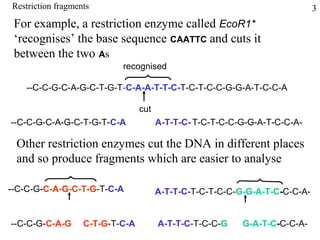
For example, a restriction enzyme called EcoR1*
‘recognises’ the base sequence CAATTC and cuts it
between the two As
--C-C-G-C-A-G-C-T-G-T-C-A-A-T-T-C-T-C-T-C-C-G-G-A-T-C-C-A
recognised
cut
--C-C-G-C-A-G-C-T-G-T-C-A
Other restriction enzymes cut the DNA in different places
and so produce fragments which are easier to analyse
--C-C-G-C-A-G-C-T-G-T-C-A
--C-C-G-C-A-G C-T-G-T-C-A A-T-T-C-T-C-C-G G-A-T-C-C-C-A-
A-T-T-C-T-C-T-C-C-G-G-A-T-C-C-C-A-
A-T-T-C- T-C-T-C-C-G-G-A-T-C-C-A-
Restriction fragments 3
The fragments can be separated using gel electrophoresis
(See slides 7 – 11)
The fragments cut by the restriction enzymes are called
restriction fragments
4
Genetic fingerprinting
90% or more of DNA does not carry nucleotide triplets that code
for proteins
The non-coding DNA is often called ‘junk DNA’ but this only
means that its functions have not yet been discovered
Some of the non-coding regions consist of repeated sequences
of nucleotides
For example -C-A-T-G-C-A-T-G-C-A-T-G-C-A-T-G- *
The number of repeats in any one section of DNA varies
from one individual to the next
Since these sections do not code for proteins (and, therefore are
not genes) there is no observable difference in these individuals
Genetic fingerprinting
5
Particular repeat sequences can be ‘cut out’ by restriction enzymes
For example
-CATCCACGACATGCATGCATGCATGCCACATCCA-
restriction enzyme cuts
here……………and…..….…..here
or
-CCACGACATGCATGCATGCATGCATGCATGCCACAT-
here…….…..…..………and…...….…………..here
Restriction enzymes 6
Gel electrophoresis
The different sized fragments are separated by a process
called gel electrophoresis
The separation takes place in a sheet of a firm but
jelly-like substance (a ‘gel’)
Samples of the DNA extracts are placed in shallow
cavities (‘wells’) cut into one end of the gel
A voltage is applied to opposite ends of the gel
DNA has a negative charge and moves slowly towards
the positive end
The shorter fragments travel through the gel faster than the
longer fragments
Gel electrophoresis
7
gelatinous sheet
well
solution
DNA extract
added
Gel electrophoresis 8
Voltage supply
negative electrode
DNA samples placed in
wells cut in gel
positive
electrode
thin slab of
gel
+
DNA fragments
Move from negative
To positive
Gel electrophoresis 9
A sample with the
shorter DNA fragments
travels through the gel
faster than a sample
with the larger fragments
10
Next slide
11
Appearance of separated fragments on gel
These bands will
contain the shorter
DNA fragments
These bands will
contain the longer
DNA fragments
starting positions Appearance of bands
12
© Prof. E. Wood© Prof. E.J.Wood
Genetic fingerprinting
DNA analysis can be used for catching criminals, establishing
parentage, finding how closely organisms are related and many other
applications.
The pattern of bands in a gel electrophoresis is known as a
genetic fingerprint or a ‘genetic profile’
If a genetic fingerprint found in a sample of blood or other tissue
at the scene of a crime matches the genetic fingerprint of a suspect,
this can be used as evidence
A DNA sample can be obtained from the suspect using blood, cheek
epithelial cells taken from the mouth lining or even the cells clinging
to the root of a hair
Genetic fingerprinting
13
….there is a chance of 1 in 10 that this
fragment occurs in many individuals…
Suppose that…………
…and.there is a chance of 1 in 20 that this
fragment occurs in many individuals…
…and.there is a chance of 1 in 10 that this
fragment occurs in many individuals…
…and.there is a chance of 1 in 30 that this
fragment occurs in many individuals, but…
Chances of a match 14
…the probability of all 4 bands matching in any person other than
the suspect is
1 in 10 x 1 in 20 x 1 in 10 x 1 in 30
= 1 in 10 x 20 x 10 x 30 That is 1 in 60,000
When a larger number of bands is involved, the probability that
the suspect is not guilty becomes one in many thousands*
Probability of a match 15
V S S1 S2 S3
V Victim
S Sample from crime scene
S1 Suspect 1
S2 Suspect 2
S3 Suspect 3
More than 20 fragments
from Suspect 1 match those
taken from the crime scene
DNA profiles 16
Evidence from genetic fingerprinting
Genetic fingerprinting is powerful evidence in criminal trials but…
Many restriction fragments may be crowded into a single band
There may be variability in the speed with which a fragment travels
through the gel
There is a chance of contamination with ‘foreign’ DNA
e.g. from bacteria
The jury may not understand the significance of genetic
fingerprinting and may be dependent on conflicting claims from
‘expert’ witnesses
There may be arguments about the statistical significance of a
match between DNA profiles
Evidence from genetic fingerprinting
17
Even if there is agreement about a match between the suspect’s
DNA profile and forensic samples, it shows only that the suspect
was present at the scene of the crime and does not prove that he or
she committed the crime
DNA evidence should be considered as conclusive proof of guilt
only if there is other supporting evidence
In cases of paternity disputes, the genetic evidence can be conclusive
Paternity can be decided on the basis of a single restriction site
Limitations of DNA evidence 18
position of
restriction
fragment
part of DNA strand
mother father
Child will receive one copy of the restriction fragment from the
mother and one from the father. It could be any one of these
combinations
child
Paternity test 19
Starting position of sample
1 2 3 4
Genetic fingerprint of …
1 mother
2 child
3 possible father A
4 possible father B
There is a match between one of
the child’s restriction fragments
and one of the mother’s.
There is also a match between the
child’s other fragment and one from
possible father A.
Neither of the child’s restriction
fragments match those of possible
father B
Paternity test
20
The Human Genome Project
An organism’s genome is its entire genetic make-up
The genome includes …
all the chromosomes
all the genes on the chromosomes
and all the DNA of the chromosomes
The human genome project set out to …
identify the genes in the human genome (about 25,000*)
discover the sequence of the base pairs (about 2.8 billion)
99% of the gene-containing part of human DNA had been
analysed by 2003
Human genome project
21
Mapping is the identification of genes and their positions in
the chromosome
Modern biochemical techniques are used to identify genes
and their positions in the chromosome
Special staining methods reveal bands in the chromosomes
These do not necessarily represent genes but help to identify
the position of genes
Chromosome 7
Chromosome 11
position of gene for cystic fibrosis
position of gene for sickle cell anaemia
Mapping
22
By special staining techniques, bands appear in
the ‘giant chromosome’ of the fruit-fly (Drosophila)
© Biophoto Associates
Giant chromosomes 23
The bands do not necessarily represent genes but if, in mutant
flies, some of the bands are missing, there is a corresponding
defect in the fly
If bands are missing from this
region, the fly has no colour
in its eyes (normally red)
If this band is missing there
is an irregularity in the wing
Loss of this band leads to a change
in the texture of the eye surface
One or more of the bands in
this region controls the normal
development of bristles
Chromosome banding
24
AGCTAGCCTCAGTTGATCATCGAGTGAGTACTGGACCATGC
Sequencing
Sequencing aims to find out the sequence of nucleotides in a
stretch of DNA
The process can be automated to give results relatively quickly
Analysis of a small piece of DNA might give results something
like this
Further analysis is needed to decide which sequences code for
proteins and represent genes
Sequencing
25
GCTTATCGATTCGGTGATACCATAGTGTAGTGTAGTCGCT
ATCCATCGCTTACGAGTCTGATGCGCATTAGCTAGCTAGCT
Applications of results from the Human Genome Project
It is hoped that a knowledge of the human genome will enable…
identification of defective genes and the chance of early treatment
identification of genes which could make a person susceptible to
certain diseases, and so lead to preventative measures
prediction of the proteins that genes produce, giving the opportunity
to enhance or inhibit these proteins by specially designed drugs
Among the possible drawbacks are the possibilities that …
insurance companies may refuse cover for people at risk of
developing a genetic disability or disease
prediction of a disease or disability could blight a person’s life
26
Application
Question 1
A restriction enzyme cuts DNA
(a) at random sites
(b) at sites with repeat nucleotides
(c) into single nucleotides
(d) at specific sites
27
Question 2
The proportion of human DNA which codes for proteins is
(a) 3-10%
(b) 10-20%
(c) 50-80%
(d) 80-90%
28
Question 3
Junk DNA is DNA which
(a) is functionless
(b) does not code for proteins
(c) codes for harmful genes
(d) may have functions not yet discovered
29
Question 4
A restriction fragment is a piece of DNA which
(a) contains a gene
(b) contains repeated nucleotide sequences
(c) breaks up DNA at specific sites
(d) codes for a protein
30
Question 5
In gel electrophoresis, the restriction fragments are separated
(a) by heat
(b) by chemicals
(c) by electricity
(d) by X-rays
31
Question 6
In gel electrophoresis
(a) short DNA fragments move faster than long fragments
(b) long DNA fragments move faster than short fragments
(c) the fragments move towards the positive end
(d) the fragments move towards the negative end
32
Question 7
If, in electrophoresis, specific bands appear in the same place
in 10% of the population, what are the chances of 5 of these bands
occurring in one individual?
(a) 1 in 100
(b) 1 in 1000
(c) 1 in 10,000
(d) 1 in 100,000
33
Question 8
In slide 19, each individual has two bands in the electrophoresis
separation. This is because
(a) only two fragments are being analysed
(b) DNA is double stranded
(c) in each individual, one of their fragments is inherited
from the father and one from the mother
(d) the results are intended to distinguish between two
possible fathers
34
Question 9
The human genome includes
(a) all the genes
(b) all the DNA
(c) all the nucleotides
(d) all the bases
35
Question 10
Mapping is
(a) identifying the genes
(b) finding the position of genes in the chromosome
(c) finding the sequence of nucleotides
(d) finding the number of genes in a chromosome
36
Question 11
Sequencing aims to find
(a) the sequence of nucleotides in DNA
(b) the sequence of genes in DNA
(c) the sequence of events in DNA replication
(d) the timing of the stages in replication
37
Answer
Correct
Answer
Incorrect

Biology DNA Analysis

  • 1.
  • 2.
    DNA molecules arevery long They may consist of millions of base pairs In order to study the structure of DNA, the molecules are broken up into smaller fragments by enzymes called restriction enzymes Restriction enzymes do not break up the DNA molecule randomly but ‘cut’ it at particular sites 2Restriction enzymes
  • 3.
    For example, arestriction enzyme called EcoR1* ‘recognises’ the base sequence CAATTC and cuts it between the two As --C-C-G-C-A-G-C-T-G-T-C-A-A-T-T-C-T-C-T-C-C-G-G-A-T-C-C-A recognised cut --C-C-G-C-A-G-C-T-G-T-C-A Other restriction enzymes cut the DNA in different places and so produce fragments which are easier to analyse --C-C-G-C-A-G-C-T-G-T-C-A --C-C-G-C-A-G C-T-G-T-C-A A-T-T-C-T-C-C-G G-A-T-C-C-C-A- A-T-T-C-T-C-T-C-C-G-G-A-T-C-C-C-A- A-T-T-C- T-C-T-C-C-G-G-A-T-C-C-A- Restriction fragments 3
  • 4.
    The fragments canbe separated using gel electrophoresis (See slides 7 – 11) The fragments cut by the restriction enzymes are called restriction fragments 4
  • 5.
    Genetic fingerprinting 90% ormore of DNA does not carry nucleotide triplets that code for proteins The non-coding DNA is often called ‘junk DNA’ but this only means that its functions have not yet been discovered Some of the non-coding regions consist of repeated sequences of nucleotides For example -C-A-T-G-C-A-T-G-C-A-T-G-C-A-T-G- * The number of repeats in any one section of DNA varies from one individual to the next Since these sections do not code for proteins (and, therefore are not genes) there is no observable difference in these individuals Genetic fingerprinting 5
  • 6.
    Particular repeat sequencescan be ‘cut out’ by restriction enzymes For example -CATCCACGACATGCATGCATGCATGCCACATCCA- restriction enzyme cuts here……………and…..….…..here or -CCACGACATGCATGCATGCATGCATGCATGCCACAT- here…….…..…..………and…...….…………..here Restriction enzymes 6
  • 7.
    Gel electrophoresis The differentsized fragments are separated by a process called gel electrophoresis The separation takes place in a sheet of a firm but jelly-like substance (a ‘gel’) Samples of the DNA extracts are placed in shallow cavities (‘wells’) cut into one end of the gel A voltage is applied to opposite ends of the gel DNA has a negative charge and moves slowly towards the positive end The shorter fragments travel through the gel faster than the longer fragments Gel electrophoresis 7
  • 8.
  • 9.
    Voltage supply negative electrode DNAsamples placed in wells cut in gel positive electrode thin slab of gel + DNA fragments Move from negative To positive Gel electrophoresis 9
  • 10.
    A sample withthe shorter DNA fragments travels through the gel faster than a sample with the larger fragments 10
  • 11.
  • 12.
    Appearance of separatedfragments on gel These bands will contain the shorter DNA fragments These bands will contain the longer DNA fragments starting positions Appearance of bands 12 © Prof. E. Wood© Prof. E.J.Wood
  • 13.
    Genetic fingerprinting DNA analysiscan be used for catching criminals, establishing parentage, finding how closely organisms are related and many other applications. The pattern of bands in a gel electrophoresis is known as a genetic fingerprint or a ‘genetic profile’ If a genetic fingerprint found in a sample of blood or other tissue at the scene of a crime matches the genetic fingerprint of a suspect, this can be used as evidence A DNA sample can be obtained from the suspect using blood, cheek epithelial cells taken from the mouth lining or even the cells clinging to the root of a hair Genetic fingerprinting 13
  • 14.
    ….there is achance of 1 in 10 that this fragment occurs in many individuals… Suppose that………… …and.there is a chance of 1 in 20 that this fragment occurs in many individuals… …and.there is a chance of 1 in 10 that this fragment occurs in many individuals… …and.there is a chance of 1 in 30 that this fragment occurs in many individuals, but… Chances of a match 14
  • 15.
    …the probability ofall 4 bands matching in any person other than the suspect is 1 in 10 x 1 in 20 x 1 in 10 x 1 in 30 = 1 in 10 x 20 x 10 x 30 That is 1 in 60,000 When a larger number of bands is involved, the probability that the suspect is not guilty becomes one in many thousands* Probability of a match 15
  • 16.
    V S S1S2 S3 V Victim S Sample from crime scene S1 Suspect 1 S2 Suspect 2 S3 Suspect 3 More than 20 fragments from Suspect 1 match those taken from the crime scene DNA profiles 16
  • 17.
    Evidence from geneticfingerprinting Genetic fingerprinting is powerful evidence in criminal trials but… Many restriction fragments may be crowded into a single band There may be variability in the speed with which a fragment travels through the gel There is a chance of contamination with ‘foreign’ DNA e.g. from bacteria The jury may not understand the significance of genetic fingerprinting and may be dependent on conflicting claims from ‘expert’ witnesses There may be arguments about the statistical significance of a match between DNA profiles Evidence from genetic fingerprinting 17
  • 18.
    Even if thereis agreement about a match between the suspect’s DNA profile and forensic samples, it shows only that the suspect was present at the scene of the crime and does not prove that he or she committed the crime DNA evidence should be considered as conclusive proof of guilt only if there is other supporting evidence In cases of paternity disputes, the genetic evidence can be conclusive Paternity can be decided on the basis of a single restriction site Limitations of DNA evidence 18
  • 19.
    position of restriction fragment part ofDNA strand mother father Child will receive one copy of the restriction fragment from the mother and one from the father. It could be any one of these combinations child Paternity test 19
  • 20.
    Starting position ofsample 1 2 3 4 Genetic fingerprint of … 1 mother 2 child 3 possible father A 4 possible father B There is a match between one of the child’s restriction fragments and one of the mother’s. There is also a match between the child’s other fragment and one from possible father A. Neither of the child’s restriction fragments match those of possible father B Paternity test 20
  • 21.
    The Human GenomeProject An organism’s genome is its entire genetic make-up The genome includes … all the chromosomes all the genes on the chromosomes and all the DNA of the chromosomes The human genome project set out to … identify the genes in the human genome (about 25,000*) discover the sequence of the base pairs (about 2.8 billion) 99% of the gene-containing part of human DNA had been analysed by 2003 Human genome project 21
  • 22.
    Mapping is theidentification of genes and their positions in the chromosome Modern biochemical techniques are used to identify genes and their positions in the chromosome Special staining methods reveal bands in the chromosomes These do not necessarily represent genes but help to identify the position of genes Chromosome 7 Chromosome 11 position of gene for cystic fibrosis position of gene for sickle cell anaemia Mapping 22
  • 23.
    By special stainingtechniques, bands appear in the ‘giant chromosome’ of the fruit-fly (Drosophila) © Biophoto Associates Giant chromosomes 23
  • 24.
    The bands donot necessarily represent genes but if, in mutant flies, some of the bands are missing, there is a corresponding defect in the fly If bands are missing from this region, the fly has no colour in its eyes (normally red) If this band is missing there is an irregularity in the wing Loss of this band leads to a change in the texture of the eye surface One or more of the bands in this region controls the normal development of bristles Chromosome banding 24
  • 25.
    AGCTAGCCTCAGTTGATCATCGAGTGAGTACTGGACCATGC Sequencing Sequencing aims tofind out the sequence of nucleotides in a stretch of DNA The process can be automated to give results relatively quickly Analysis of a small piece of DNA might give results something like this Further analysis is needed to decide which sequences code for proteins and represent genes Sequencing 25 GCTTATCGATTCGGTGATACCATAGTGTAGTGTAGTCGCT ATCCATCGCTTACGAGTCTGATGCGCATTAGCTAGCTAGCT
  • 26.
    Applications of resultsfrom the Human Genome Project It is hoped that a knowledge of the human genome will enable… identification of defective genes and the chance of early treatment identification of genes which could make a person susceptible to certain diseases, and so lead to preventative measures prediction of the proteins that genes produce, giving the opportunity to enhance or inhibit these proteins by specially designed drugs Among the possible drawbacks are the possibilities that … insurance companies may refuse cover for people at risk of developing a genetic disability or disease prediction of a disease or disability could blight a person’s life 26 Application
  • 27.
    Question 1 A restrictionenzyme cuts DNA (a) at random sites (b) at sites with repeat nucleotides (c) into single nucleotides (d) at specific sites 27
  • 28.
    Question 2 The proportionof human DNA which codes for proteins is (a) 3-10% (b) 10-20% (c) 50-80% (d) 80-90% 28
  • 29.
    Question 3 Junk DNAis DNA which (a) is functionless (b) does not code for proteins (c) codes for harmful genes (d) may have functions not yet discovered 29
  • 30.
    Question 4 A restrictionfragment is a piece of DNA which (a) contains a gene (b) contains repeated nucleotide sequences (c) breaks up DNA at specific sites (d) codes for a protein 30
  • 31.
    Question 5 In gelelectrophoresis, the restriction fragments are separated (a) by heat (b) by chemicals (c) by electricity (d) by X-rays 31
  • 32.
    Question 6 In gelelectrophoresis (a) short DNA fragments move faster than long fragments (b) long DNA fragments move faster than short fragments (c) the fragments move towards the positive end (d) the fragments move towards the negative end 32
  • 33.
    Question 7 If, inelectrophoresis, specific bands appear in the same place in 10% of the population, what are the chances of 5 of these bands occurring in one individual? (a) 1 in 100 (b) 1 in 1000 (c) 1 in 10,000 (d) 1 in 100,000 33
  • 34.
    Question 8 In slide19, each individual has two bands in the electrophoresis separation. This is because (a) only two fragments are being analysed (b) DNA is double stranded (c) in each individual, one of their fragments is inherited from the father and one from the mother (d) the results are intended to distinguish between two possible fathers 34
  • 35.
    Question 9 The humangenome includes (a) all the genes (b) all the DNA (c) all the nucleotides (d) all the bases 35
  • 36.
    Question 10 Mapping is (a)identifying the genes (b) finding the position of genes in the chromosome (c) finding the sequence of nucleotides (d) finding the number of genes in a chromosome 36
  • 37.
    Question 11 Sequencing aimsto find (a) the sequence of nucleotides in DNA (b) the sequence of genes in DNA (c) the sequence of events in DNA replication (d) the timing of the stages in replication 37
  • 38.
  • 39.

Editor's Notes

  • #2 The researcher is analysing the results from electrophoresis of DNA. Each vertical column shows a separation of specific DNA fragments (See slides 7-11)
  • #4 *Restriction enzymes occur in bacteria, and protect the bacteria from viruses by cutting up the virus DNA (or RNA) EcoR1 is extracted from the bacterium Escheria coli (E.coli)
  • #6 * The number of repeated sequences may be much greater than this; perhaps consisting of a thousand or more base pairs
  • #7 The cutting sites are the same but one restriction fragment is longer than the other
  • #8 Separation of the fragments may take an hour or more depending on the voltage applied
  • #9 The solution is a ‘buffer solution’ which stops the gel from drying out but does not affect the separation process
  • #13 I am grateful to Professor E.J. Wood and Denise Ashworth for permission to reproduce this image of DNA gel electrophoresis This account is necessarily greatly simplified. In fact the DNA fragments which are separated by electrophoresis are colourless and have to be revealed by special treatments. There may be hundreds of fragments separated in the gel. To reveal the fragments of particular interest, a nylon membrane is applied to the gel sheet and the DNA fragments transfer to this. The double-stranded DNA is then separated into single strands by heating. A radioactive probe is applied. The probe is a short length of DNA complementary to the fragments that are of interest The ‘probe’ binds to the corresponding section of DNA on the nylon membrane which is then placed on an X-ray film. When the film is developed, the radioactive bands show up..
  • #16 *Or, in some cases, millions.
  • #20 The vertical lines should not be confused with chromosomes. They each represent lengths of double-stranded DNA in a single chromosome
  • #22 The Human Genome Project was started in 1990 and completed in 2003 but analysis of the data continues. A number of other organisms have had their genomes sequenced. * This is an estimate. Currently 19,599 genes have been confirmed www.ornl.gov/sci/techresources/Human_Genome/home.shtml
  • #23 Currently, the position or approximate position of 19,599 identified genes is known
  • #24 The ‘giant chromosomes’ are from the salivary glands of the fruit fly (Drosophila) and are thought to be formed when the chromosomes fail to separate after repeated mitoses