Chemical Properties of Seawater
Water is a Polar Molecule
Being a “Polar
Molecule”
means that
one end of
the molecule
is slightly
negatively
charged and
the other end
is slightly
more
positively
charged
Water has Hydrogen Bonding
This refers to the
type of attraction
seen in this polar
molecule: the
negative oxygen
end of one water
molecule being
attracted to the
positive
hydrogen ends of
another water
molecule
Water demonstrates Adhesion & Cohesion
Since water is polar (has oppositely charged ends) it has a tendency to be
attracted to other polar and non-polar molecules
Adhesion – hint: think of Adhesive Tape-we say it is “adhesive” when we
use it to stick a piece of paper to our classroom door, or a person to a wall, for
example
An example of water’s adhesiveness:
when it adheres to and
climbs up a glass forming a meniscus
Water demonstrates Adhesion & Cohesion, cont.
Cohesion – hint: think of a team who works well together-we say they are a “cohesive” group
when they stick together to make a great play, for example
An example of water’s cohesiveness: when one water molecule sticks to another water
molecule to bubble over your glass without spilling (a handy trick of water’s that we call surface
tension – the tendency of the top of a liquid to resist external forces)
Water has Relatively Low Viscosity
Viscosity is the measure of a fluid’s resistance to flow – water flows
relatively easily (less easily than a gas, but more easily than many other
fluids)
What might influence viscosity?
-changes in temperature
-changes in salinity
-changes in pressure
Water has a specific Density
Density is mass/volume
A density less than one means something is able to float
in water
Water is most dense at 4⁰C
What might influence density of seawater?
-Changes in temperature
-Changes in salinity
-Changes in pressure
Q: Which is more dense, seawater or freshwater? Why?
Solid vs. Liquid
When water is a
liquid, its polar
molecules are
constantly moving
and bonds are
loose.
When water is a solid,
its polar molecules
are tightly bonded
and form a solid
lattice
This lattice is less
dense and so solid
water (ice) floats.
Water has a specific Heat Capacity
Heat capacity is the amount of
energy required to change the
temperature of the water by a
given amount
Important: The ocean is a “heat
buffer”, meaning that it takes a
REALLY long time to heat or
cool the world’s oceans. They
are really BIG so they hold
whatever heat they do have for
a LONG, LONG time…. Why?
Water’s polarity and its
hydrogen bonds mean it takes a
LOT of energy to change the
temperature, even by 1⁰
Water has a specific Heat Capacity
Heat capacity is the amount of
energy required to change the
temperature of the water by a
given amount
Important: The ocean is a “heat
buffer”, meaning that it takes a
REALLY long time to heat or
cool the world’s oceans. They
are really BIG so they hold
whatever heat they do have for
a LONG, LONG time…. Why?
Water’s polarity and its
hydrogen bonds mean it takes a
LOT of energy to change the
temperature, even by 1⁰

Properties of seawater

  • 1.
  • 2.
    Water is aPolar Molecule Being a “Polar Molecule” means that one end of the molecule is slightly negatively charged and the other end is slightly more positively charged
  • 3.
    Water has HydrogenBonding This refers to the type of attraction seen in this polar molecule: the negative oxygen end of one water molecule being attracted to the positive hydrogen ends of another water molecule
  • 4.
    Water demonstrates Adhesion& Cohesion Since water is polar (has oppositely charged ends) it has a tendency to be attracted to other polar and non-polar molecules Adhesion – hint: think of Adhesive Tape-we say it is “adhesive” when we use it to stick a piece of paper to our classroom door, or a person to a wall, for example An example of water’s adhesiveness: when it adheres to and climbs up a glass forming a meniscus
  • 5.
    Water demonstrates Adhesion& Cohesion, cont. Cohesion – hint: think of a team who works well together-we say they are a “cohesive” group when they stick together to make a great play, for example An example of water’s cohesiveness: when one water molecule sticks to another water molecule to bubble over your glass without spilling (a handy trick of water’s that we call surface tension – the tendency of the top of a liquid to resist external forces)
  • 6.
    Water has RelativelyLow Viscosity Viscosity is the measure of a fluid’s resistance to flow – water flows relatively easily (less easily than a gas, but more easily than many other fluids) What might influence viscosity? -changes in temperature -changes in salinity -changes in pressure
  • 7.
    Water has aspecific Density Density is mass/volume A density less than one means something is able to float in water Water is most dense at 4⁰C What might influence density of seawater? -Changes in temperature -Changes in salinity -Changes in pressure Q: Which is more dense, seawater or freshwater? Why?
  • 8.
    Solid vs. Liquid Whenwater is a liquid, its polar molecules are constantly moving and bonds are loose. When water is a solid, its polar molecules are tightly bonded and form a solid lattice This lattice is less dense and so solid water (ice) floats.
  • 9.
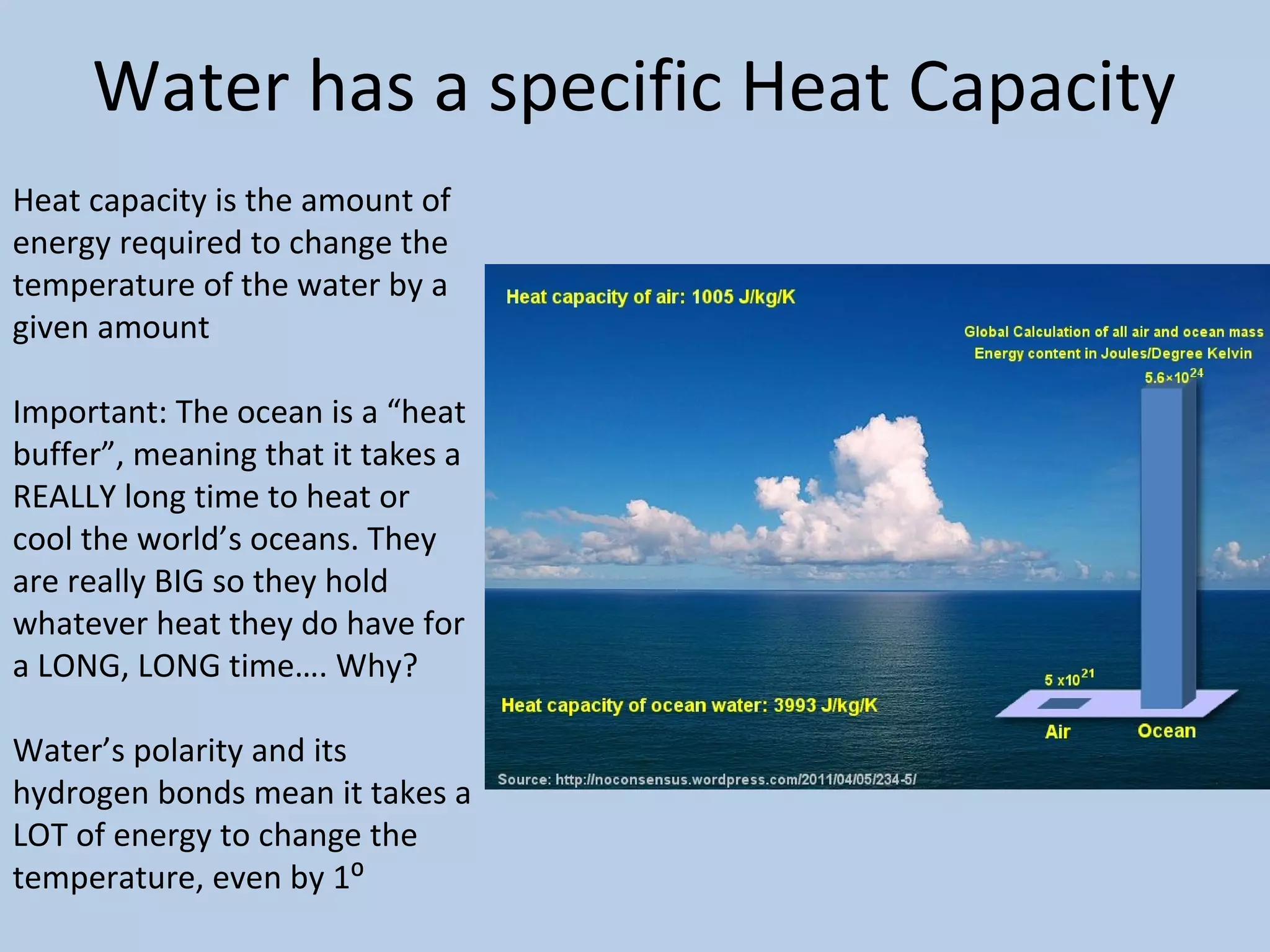
    Water has aspecific Heat Capacity Heat capacity is the amount of energy required to change the temperature of the water by a given amount Important: The ocean is a “heat buffer”, meaning that it takes a REALLY long time to heat or cool the world’s oceans. They are really BIG so they hold whatever heat they do have for a LONG, LONG time…. Why? Water’s polarity and its hydrogen bonds mean it takes a LOT of energy to change the temperature, even by 1⁰
  • 10.
    Water has aspecific Heat Capacity Heat capacity is the amount of energy required to change the temperature of the water by a given amount Important: The ocean is a “heat buffer”, meaning that it takes a REALLY long time to heat or cool the world’s oceans. They are really BIG so they hold whatever heat they do have for a LONG, LONG time…. Why? Water’s polarity and its hydrogen bonds mean it takes a LOT of energy to change the temperature, even by 1⁰