What Do You Really Know About Plankton?
Name means:
“Drifters” or
“Wanderers”
So. . .are they
autotrophs or
heterotrophs?

They can be
either one!
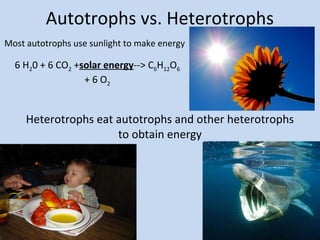
Autotrophs vs. Heterotrophs
Most autotrophs use sunlight to make energy

6 H20 + 6 CO2 +solar energy--> C6H12O6
+ 6 O2

Heterotrophs eat autotrophs and other heterotrophs
to obtain energy
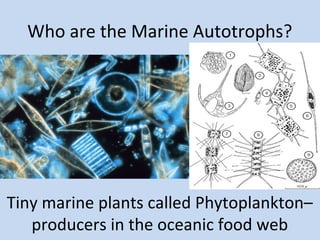
Who are the Marine Autotrophs?

Tiny marine plants called Phytoplankton–
producers in the oceanic food web
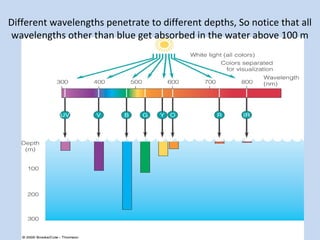
Different wavelengths penetrate to different depths, So notice that all
wavelengths other than blue get absorbed in the water above 100 m

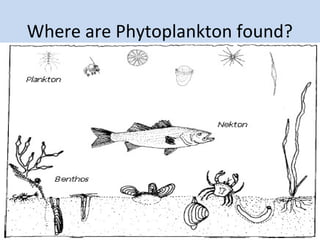
Plankton
Where are Phytoplankton found?
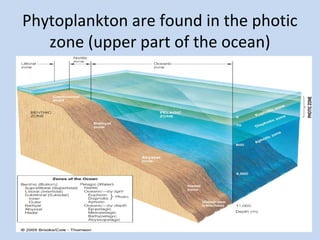
Phytoplankton are found in the photic
zone (upper part of the ocean)
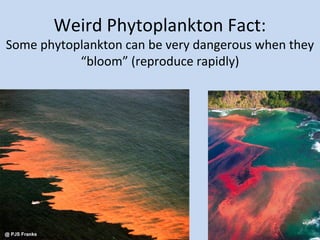
Weird Phytoplankton Fact:

Some phytoplankton can be very dangerous when they
“bloom” (reproduce rapidly)
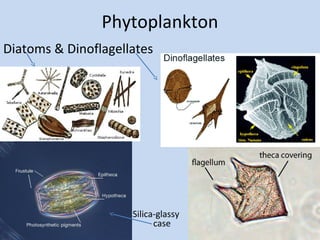
Phytoplankton
Diatoms & Dinoflagellates

Silica-glassy
case
Phytoplankton cont.
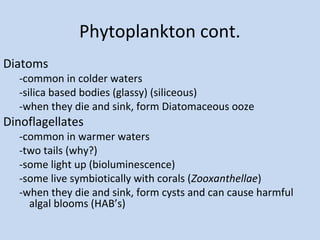
Diatoms

-common in colder waters
-silica based bodies (glassy) (siliceous)
-when they die and sink, form Diatomaceous ooze

Dinoflagellates

-common in warmer waters
-two tails (why?)
-some light up (bioluminescence)
-some live symbiotically with corals (Zooxanthellae)
-when they die and sink, form cysts and can cause harmful
algal blooms (HAB’s)
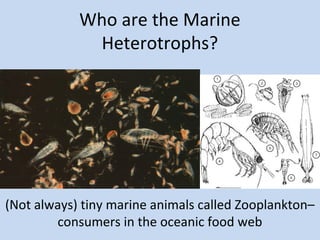
Who are the Marine
Heterotrophs?

(Not always) tiny marine animals called Zooplankton–
consumers in the oceanic food web
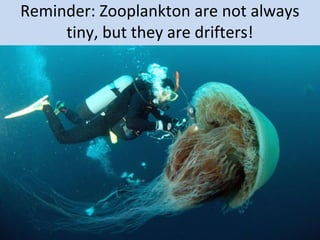
Reminder: Zooplankton are not always
tiny, but they are drifters!
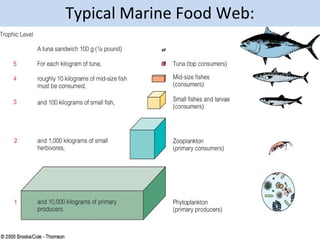
Typical Marine Food Web:
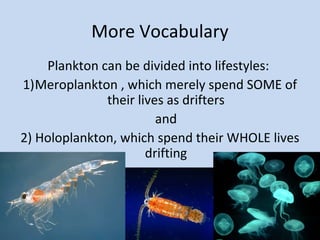
More Vocabulary
Plankton can be divided into lifestyles:
1)Meroplankton , which merely spend SOME of
their lives as drifters
and
2) Holoplankton, which spend their WHOLE lives
drifting
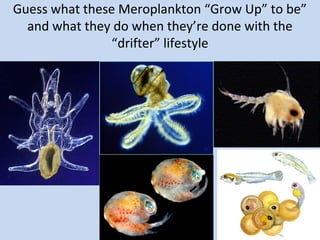
Guess what these Meroplankton “Grow Up” to be”
and what they do when they’re done with the
“drifter” lifestyle
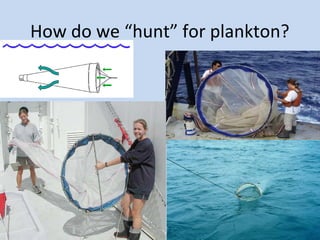
How do we “hunt” for plankton?
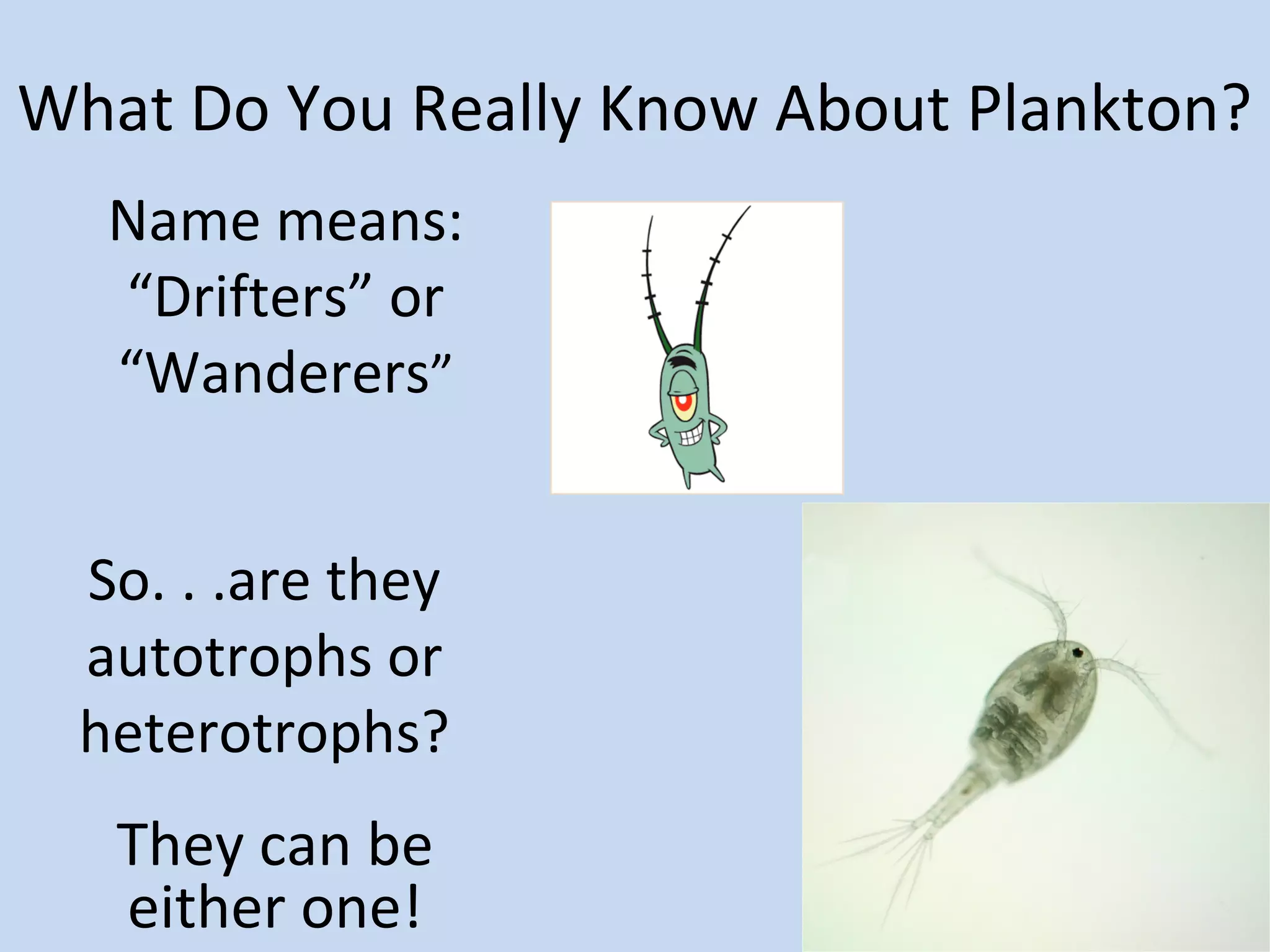
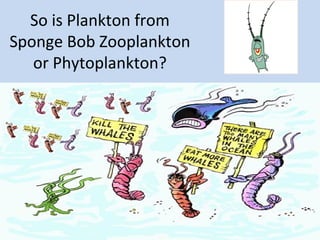
So is Plankton from
Sponge Bob Zooplankton
or Phytoplankton?

Plankton PowerPoint

Editor's Notes

  • #2 What other “P-L-A-N” word do you know that is a “drifter” or “wanderer”? (Planets) Copepods are the real “Plankton” on Sponge Bob
  • #3 Which are autotrophs and which are heterotrophs in these pictures?
  • #4 1-4) Dinoflagellates (whoa! Plants with tails!) 5-9) Diatoms Bioluminescence (quick): http://www.youtube.com/watch?v=pGgWYijK_ig&feature=related#
  • #5 Reminder: What do plants need? Light!
  • #6 Upper layers of the ocean, also introduce benthos and nekton
  • #8 Red Tide Turtle Deaths: http://www.cfnews13.com/MediaPlayer2/MediaPlayer.htm?video=1211RedTideUpdate_121120070445&cat=Local&title=Red Tide Turtles
  • #11 Ctenophore 2-3) mollusk pteropods 4) euphausid shrimp 5) amphipod 6) copepod 7) chaetognath http://www.answers.com/topic/plankton
  • #13 Can you tell which are the Autotrophs and which are the Heterotrophs?
  • #14 These photos are krill, copepods, and jellies (all mero). Then what do meroplankton do after their done drifting? Crawl (crabs, sea stars, lobsters, snails), swim (fish), burrow (worms, clams)
  • #15 Sea star (crawl), Snail veliger larvae (crawl), lobster larvae (crawl) crab zoea larvae (crawl), fish larvae (swim)
  • #16 Why don’t you catch fish in a plankton net?
  • #17 Holo- or Mero- too (Holo)