Presented by: Hina Amir
1.   Introduction
2.   Characteristics
          Food
          Management
          Productivity
3.   Advantages
4.   Disadvantages
5.   Comparison
6.   References
• Aquaculture
• Marine and freshwater species

        Categories:
      Extensive aquaculture.
      Semi-Intensive aquaculture.
      Intensive aquaculture.
Culture and rearing in which human
 intervention is concentrated on the
 reproduction of the stock, in addition to
 capture.

Selective increase of the production

 man’s food (salmon, oysters, etc.)
 industry (algoculture)
 pleasure (sport fishing, pearl culture, etc.).
• Not rely on excessive working in the growing
  process.

• The stock is left to grow on its own, utilizing
  natural food sources.

• Fish chosen for extensive aquaculture are very
  hardy

• Prawns, muscles, seaweed, carp, tilapia, tuna
  and salmon
 Utilizes natural photosynthetic production
  of food (algae, plankton, molluscs,
  crustaceans) to feed the fish.
 (insect larvae, snails; and worms).

 Certain producers provide additional feed.
 Examples – Carp, in mixed farming with
  other species (whitefish, catfish, etc.).
Water Management

Water management is totally dependent
 on tidal fluctuation.

Water change is effected through tidal
 means, i.e., new water is let in only
 during high tide and the pond can be
 drained only at low tide.
• Undeveloped parts of the World
      (Southeast Asia)

• Areas of coastal mangrove swamps,
  marshes, estuaries.
    (not in use for other purposes)

• Indonesia = six million acres
• Low stocking densities (e.g., 5 000-10 000
  shrimp post larvae (PL)/ha/crop)

• The ponds used for extensive culture are
  usually (more than two ha) and may be
  shallow

• Production is generally low at less than 1
  t/ha/y
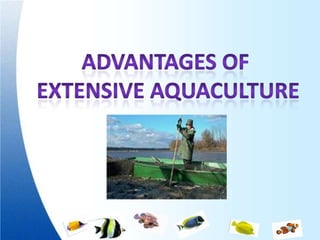
1. Can be undertaken in existing farm
   dams.

2. Negates the need for costly built
   structures.

3. Low overheads and production costs
   due to no feeding and aeration
   requirements.
4- Low labor costs.
 low stocking densities
 less attention to water quality issues and
    stock monitoring .

5- Many other uses of the waterway, such as
  recreational boating and fishing, occur
  simultaneously
1- Natural habitat destruction

  Example:
• Philippines, shrimp aquaculture,
  destruction of thousands of acres of
  mangrove fields

• Benthic habitats are being depleted,
  organic waste produced by the fish.
• Phytoplankton and algae, reduces the
  amount of available oxygen in the water
  column, kills the Benthic organisms.

2-Another serious problem, extensive
  aquaculture is the introduction of invasive
  species into ecosystems
3- Foreign fish interbreed with wild species,
  upset the genetic variability of the species,
  more prone to disease and infection.

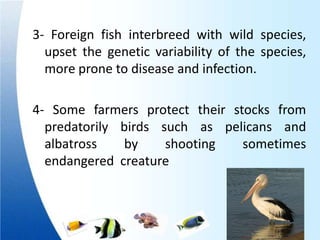
4- Some farmers protect their stocks from
  predatorily birds such as pelicans and
  albatross   by     shooting   sometimes
  endangered creature
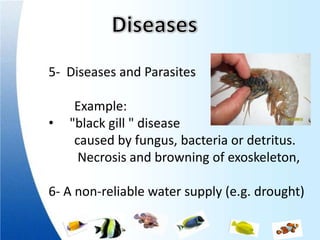
5- Diseases and Parasites

     Example:
•   "black gill " disease
     caused by fungus, bacteria or detritus.
      Necrosis and browning of exoskeleton,

6- A non-reliable water supply (e.g. drought)
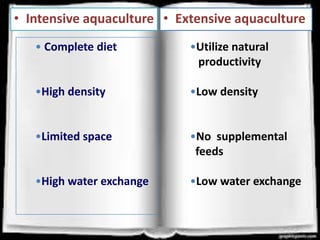
• Intensive aquaculture • Extensive aquaculture
   • Complete diet          •Utilize natural
                             productivity

   •High density            •Low density


   •Limited space           •No supplemental
                             feeds

   •High water exchange     •Low water exchange
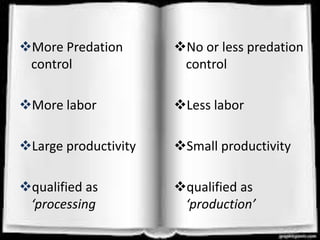
More Predation       No or less predation
 control               control

More labor           Less labor

Large productivity   Small productivity

qualified as         qualified as
 ‘processing           ‘production’
REFERENCES
• Allen, .(1989). Freshwater Fishes of Australia.
  T.F.H Publications: New Jersey, USA.
• Mackinnon, M. (1995). Fish for Farm Dams.
  Queensland Department of Primary
  Industries, Brisbane.
• .
• NSW Fisheries (1994). Freshwater Crayfish
  Advisory Pack. NSW Fisheries, Sydney.
• Tidwell, J. H. (2012) Aquaculture Production
  Systems ,John Wiley & Sons,
  ISBN0813801265 :pp.88-89

• McCormack, G. and Jackson, P. (1991). The
  Farm Fish Book - Proceedings of the Seminar
  on Stocking Fish in Farm Dams for Recreation
  and Farm Table Use. Queensland Department
  of Primary Industries, Brisbane

Extensive Aquaculture

  • 1.
  • 2.
    1. Introduction 2. Characteristics  Food  Management  Productivity 3. Advantages 4. Disadvantages 5. Comparison 6. References
  • 3.
    • Aquaculture • Marineand freshwater species Categories:  Extensive aquaculture.  Semi-Intensive aquaculture.  Intensive aquaculture.
  • 4.
    Culture and rearingin which human intervention is concentrated on the reproduction of the stock, in addition to capture. Selective increase of the production  man’s food (salmon, oysters, etc.)  industry (algoculture)  pleasure (sport fishing, pearl culture, etc.).
  • 5.
    • Not relyon excessive working in the growing process. • The stock is left to grow on its own, utilizing natural food sources. • Fish chosen for extensive aquaculture are very hardy • Prawns, muscles, seaweed, carp, tilapia, tuna and salmon
  • 7.
     Utilizes naturalphotosynthetic production of food (algae, plankton, molluscs, crustaceans) to feed the fish.  (insect larvae, snails; and worms).  Certain producers provide additional feed.  Examples – Carp, in mixed farming with other species (whitefish, catfish, etc.).
  • 8.
    Water Management Water managementis totally dependent on tidal fluctuation. Water change is effected through tidal means, i.e., new water is let in only during high tide and the pond can be drained only at low tide.
  • 9.
    • Undeveloped partsof the World (Southeast Asia) • Areas of coastal mangrove swamps, marshes, estuaries. (not in use for other purposes) • Indonesia = six million acres
  • 10.
    • Low stockingdensities (e.g., 5 000-10 000 shrimp post larvae (PL)/ha/crop) • The ponds used for extensive culture are usually (more than two ha) and may be shallow • Production is generally low at less than 1 t/ha/y
  • 12.
    1. Can beundertaken in existing farm dams. 2. Negates the need for costly built structures. 3. Low overheads and production costs due to no feeding and aeration requirements.
  • 13.
    4- Low laborcosts.  low stocking densities  less attention to water quality issues and stock monitoring . 5- Many other uses of the waterway, such as recreational boating and fishing, occur simultaneously
  • 14.
    1- Natural habitatdestruction Example: • Philippines, shrimp aquaculture, destruction of thousands of acres of mangrove fields • Benthic habitats are being depleted, organic waste produced by the fish.
  • 15.
    • Phytoplankton andalgae, reduces the amount of available oxygen in the water column, kills the Benthic organisms. 2-Another serious problem, extensive aquaculture is the introduction of invasive species into ecosystems
  • 16.
    3- Foreign fishinterbreed with wild species, upset the genetic variability of the species, more prone to disease and infection. 4- Some farmers protect their stocks from predatorily birds such as pelicans and albatross by shooting sometimes endangered creature
  • 17.
    5- Diseases andParasites Example: • "black gill " disease caused by fungus, bacteria or detritus. Necrosis and browning of exoskeleton, 6- A non-reliable water supply (e.g. drought)
  • 18.
    • Intensive aquaculture• Extensive aquaculture • Complete diet •Utilize natural productivity •High density •Low density •Limited space •No supplemental feeds •High water exchange •Low water exchange
  • 19.
    More Predation No or less predation control control More labor Less labor Large productivity Small productivity qualified as qualified as ‘processing ‘production’
  • 21.
    REFERENCES • Allen, .(1989).Freshwater Fishes of Australia. T.F.H Publications: New Jersey, USA. • Mackinnon, M. (1995). Fish for Farm Dams. Queensland Department of Primary Industries, Brisbane. • . • NSW Fisheries (1994). Freshwater Crayfish Advisory Pack. NSW Fisheries, Sydney.
  • 22.
    • Tidwell, J.H. (2012) Aquaculture Production Systems ,John Wiley & Sons, ISBN0813801265 :pp.88-89 • McCormack, G. and Jackson, P. (1991). The Farm Fish Book - Proceedings of the Seminar on Stocking Fish in Farm Dams for Recreation and Farm Table Use. Queensland Department of Primary Industries, Brisbane