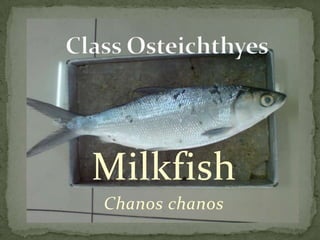
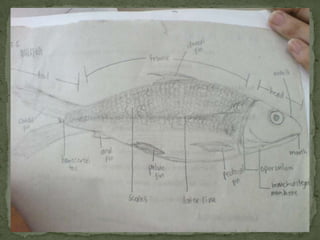
Milkfish
Chanos chanos
 Actinopterygii (Ray-finned fishes)
 Sarcopterygii (Lobe-finned fishes)
 Membranous fins are supported by slender fin rays
    radiating from basal skeletal elements within the body
    wall
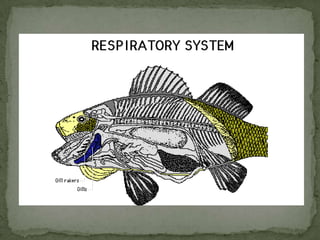
   Gill slits covered by a bony operculum
   Air sac is usually present
   Internal nares are lacking
   Basal Actinopterygians
   Neopterygians
 Paleoniscoids
   Large ganoid scales
   Well-ossified endoskeleton
   Air sacs are connected to the pharynx by an air duct that
    enebles aerial respiration
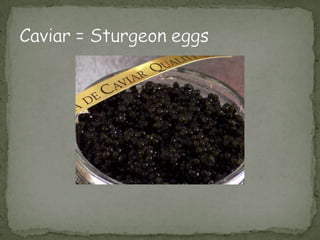
 Sturgeons and paddlefishes
   Have endoskeleton is largely cartilaginous
   Scales lack ganion
   Skin of paddle-fishes is naked exept for small bony
    scales on tail
 Gras and bowfins
   Trunk and tail of gars are covered with ganoid scales; trunk
    and tail of Amia have modern fish scales
   Endoskeleton is ossified
   Brainacase (neurocranium) remains largely cartilaginous
 Teleosts
   “modern”
   Scales are in the dermis, very thin and flexible
   Dermal bones of the skull are thinner and more numerous
   Jaws and palate are more independently maneuverable
   Pelvic fins are far forward
- Fleshy lobe at the base of their paired fins
- Have internal nares that open into the oropharyngeal
  cavity and retain a gas-filled air
- Gill slits are covered by a bony opercullum that grows
  caudad from the second pharyngeal arch

- Actinistia
  - coelacanths
- Rhipidistia
  - Dipnoans
Lateral View
Tail fin (caudal fin)
2 types of tail fin
* Homocercal- Top and bottom
halves the same size.
* Heterocercal- Top half different
size than bottom half.
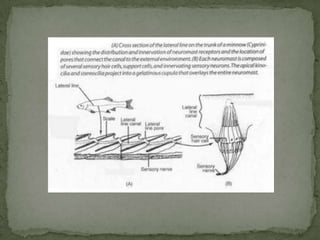
LATERAL LINE


 a.    A system of canals on the sides of fishes that helps fish
 detect changes in pressure, vibrations and currents.
 b. This incredible sense organ helps fishes to detect prey,
 adjust their position to the currents, and keep in position in a
 school.
 c.    They pick up vibrations from the swimming of other
 animals and water disturbed by sound waves, which cause
 changes in pressure.
 d. The longer the fish’s body the longer is the lateral line
 and the more sensitive to the environment. The canals are not
 only in the skin but also in the bone or cartilage of the head.
 Found on non-teleost
 bony fishes

 Usually diamond
 shaped bony scales

 “Heavy armor”
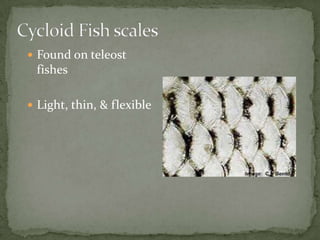
 Found on teleost
 fishes

 Light, thin, & flexible
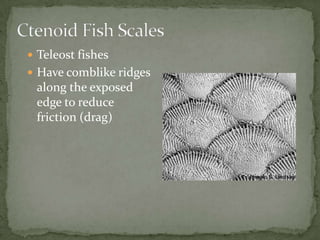
 Teleost fishes
 Have comblike ridges
 along the exposed
 edge to reduce
 friction (drag)
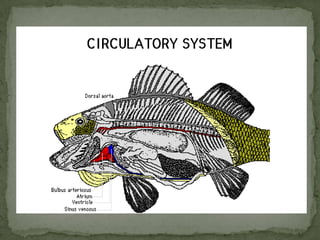
a.     Closed circulatory system
       i. The blood is always kept in vessels
b. Heart
       i.   Only has two chambers
      ii.   Blood goes from heart to gills to
the rest of the body
      iii.   Mammals blood goes; heart,
lungs, heart, rest of body
Class osteichthyans
Class osteichthyans
Class osteichthyans
Class osteichthyans
Class osteichthyans
Class osteichthyans
Class osteichthyans

Class osteichthyans

  • 1.
  • 2.
     Actinopterygii (Ray-finnedfishes)  Sarcopterygii (Lobe-finned fishes)
  • 3.
     Membranous finsare supported by slender fin rays radiating from basal skeletal elements within the body wall  Gill slits covered by a bony operculum  Air sac is usually present  Internal nares are lacking  Basal Actinopterygians  Neopterygians
  • 4.
     Paleoniscoids  Large ganoid scales  Well-ossified endoskeleton  Air sacs are connected to the pharynx by an air duct that enebles aerial respiration  Sturgeons and paddlefishes  Have endoskeleton is largely cartilaginous  Scales lack ganion  Skin of paddle-fishes is naked exept for small bony scales on tail
  • 5.
     Gras andbowfins  Trunk and tail of gars are covered with ganoid scales; trunk and tail of Amia have modern fish scales  Endoskeleton is ossified  Brainacase (neurocranium) remains largely cartilaginous  Teleosts  “modern”  Scales are in the dermis, very thin and flexible  Dermal bones of the skull are thinner and more numerous  Jaws and palate are more independently maneuverable  Pelvic fins are far forward
  • 6.
    - Fleshy lobeat the base of their paired fins - Have internal nares that open into the oropharyngeal cavity and retain a gas-filled air - Gill slits are covered by a bony opercullum that grows caudad from the second pharyngeal arch - Actinistia - coelacanths - Rhipidistia - Dipnoans
  • 7.
  • 8.
    Tail fin (caudalfin) 2 types of tail fin * Homocercal- Top and bottom halves the same size. * Heterocercal- Top half different size than bottom half.
  • 10.
    LATERAL LINE a. A system of canals on the sides of fishes that helps fish detect changes in pressure, vibrations and currents. b. This incredible sense organ helps fishes to detect prey, adjust their position to the currents, and keep in position in a school. c. They pick up vibrations from the swimming of other animals and water disturbed by sound waves, which cause changes in pressure. d. The longer the fish’s body the longer is the lateral line and the more sensitive to the environment. The canals are not only in the skin but also in the bone or cartilage of the head.
  • 11.
     Found onnon-teleost bony fishes  Usually diamond shaped bony scales  “Heavy armor”
  • 12.
     Found onteleost fishes  Light, thin, & flexible
  • 13.
     Teleost fishes Have comblike ridges along the exposed edge to reduce friction (drag)
  • 17.
    a. Closed circulatory system i. The blood is always kept in vessels b. Heart i. Only has two chambers ii. Blood goes from heart to gills to the rest of the body iii. Mammals blood goes; heart, lungs, heart, rest of body