Monoculture (Aquaculture) 
ZOM – 601 
Submitted by – 
Savy Panamkuttiyiel Minal 
B.Sc. (zoology honours)
Introduction 
⹡Recently researchers conducted by CIFRI (Center 
Inland fishery research institute) have revolutionized 
research institute in India for fishery and net production 
of about 85,000 kilogram per hectare per year has been 
achieved in fish production in India. 
⹡Monoculture fish farming refers to the fish farming 
where only one type of fish species and breed is raised 
on a farm,
Indian Fisheries 
• Global position 3rd in Fisheries 
• 2nd in Aquaculture 
• Per capita fish availability (Kg.)9.0 
• Annual Export earnings (Rs. In Crore)7,200 
• Employment in sector (million)14.0
Fish culture 
There are two systems of fish culture in commercial fish farming 
Monoculture and Polyculture fish farming 
Monoculture fish farming : this refer to fish farming where only one 
types of fish species and breed is raised on a farm. 
∂ Advantages of monoculture fish farming : easy to monitor 
individual fish breed performance , their is no undue competition for 
space and feed . 
∂ Disadvantages of monoculture fish farming : these includes : 
regression in water quality , cannibalism among fish themselves , 
overstocking of pond with fish which may leads to diseases outbreak
Monoculture of aquatic animal 
⹡It is a branch of animal husbandry involving raising or breeding 
of animals such as Fin – Fish , shell – fish , oyster shell , clams , 
cockles , shrimps , crayfish , periwinkles , in a controlled water 
body to marketable size .
Fish culture is divided into many categories 
a) Fresh water fish monoculture , 
b) Marine water fish monoculture , 
c) Brackish water or salty water fish monoculture (these fishes 
are acclimatized to fresh water)
Terms used in monoculture fish farming 
∂ Fishery : The study of fish or fishes, 
∂ Pond : Artificial body of water where fish where reared , 
∂ Fry : Newly hatched fish , 
∂ Fingerling : Young fish or baby fish , 
∂ Hatchery : This is a unit where fish eggs are been hatch artificially into 
fry, 
∂Gears : Equipments for harvesting fish .
Objectives of monoculture in fish culture 
• To get maximum amount of production, and to prevent species 
extinction by over – exploitation , 
• High nutrient rich fish cultivation , 
• Supply high quality animal protein and vitamin rich oil e.g. – 
cod liver fish oil from cod fish which is rich in vitamin A and D, 
• Fish oil used in medicines and in soap making industries for 
research purposes ,
Qualities of cultivable fish species in monoculture 
• Should have fast growth rate , 
• Should have ability to feed on natural and cheap artificial food , 
• Should be hardy and resistance to disease , 
• Should be able to tolerate adverse and physico – chemical 
conditions of pond water, 
• Should consume small quantity of food for development , 
• Should be of high nutritive value ,
• Should be gentle and non – poisonous , 
• Should be easily harvested , 
• Should be a proliferate breeder 
• Can reproduce under confined conditions , 
• Should support high population density in pond .
Factors to consider when siting fish farm 
1. Availability of good quality water 
2. Availability of good quality fish feed 
3. Availability of suitable fingerling , fingerling that can grow rapidly and have good feed to 
flesh convertibility 
4. Soil type must be the types that have good water retention ability and also rich in humus 
content therefore clay soil rich in humus content is the best soil for lining pond . 
5. Do not site fish pond on soil rich in heavy metals like copper , mercury , arsenic , lead or 
in highly industrialized area because the sulphur fumes produced in industrial area are 
poisonous to fish when dissolve by rain water . 
6. Avoid acidic soil or rocky soil 
7. Vegetation of the soil must be easy to clear 
8. Topography of the land must not be easily flooded
Types of cultivable fish species in Indian system 
I. Indigenous or Natural fresh water fishes : 
such as Mesocarps like Catla catla , Labeo rohita ,Cirrihinus mrigala, 
Labeo calbasu , Cirrihinus cirrhosa and few salt water species 
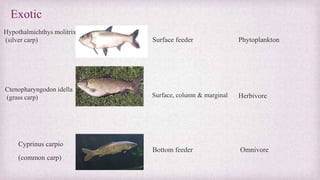
II. Exotic carps : such as , Hypothalmichthys molitrix (silver carp), 
Ctenopharyngodon idella (grass carp), Cyprinus carpio (common carp)
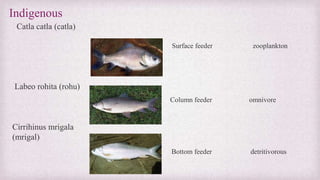
Indigenous 
Catla catla (catla) 
Labeo rohita (rohu) 
Cirrihinus mrigala 
(mrigal) 
Surface feeder zooplankton 
Column feeder omnivore 
Bottom feeder detritivorous
Exotic 
Hypothalmichthys molitrix 
(silver carp) 
Ctenopharyngodon idella 
(grass carp) 
Cyprinus carpio 
(common carp) 
Surface feeder Phytoplankton 
Herbivore 
Surface, column & marginal 
Bottom feeder Omnivore
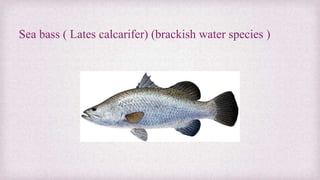
Sea bass ( Lates calcarifer) (brackish water species )
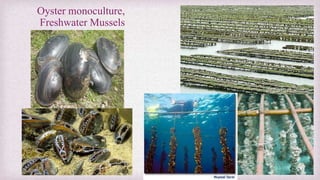
Oyster monoculture, 
Freshwater Mussels
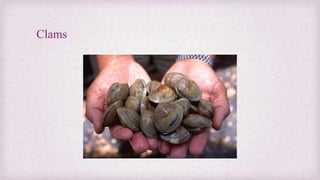
Clams
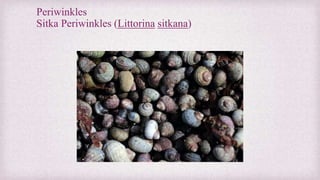
Periwinkles 
Sitka Periwinkles (Littorina sitkana)
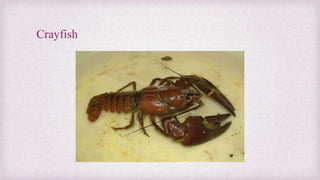
Crayfish
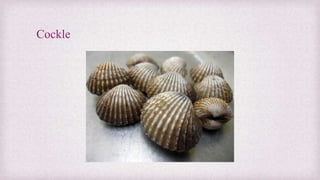
Cockle
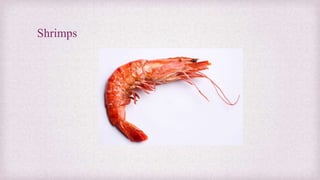
Shrimps
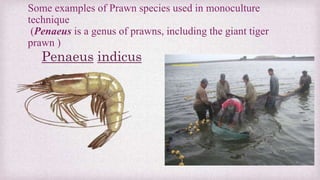
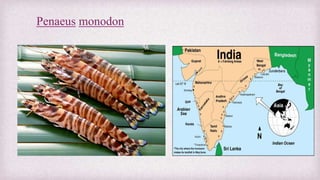
Some examples of Prawn species used in monoculture 
technique 
(Penaeus is a genus of prawns, including the giant tiger 
prawn ) 
Penaeus indicus
Penaeus monodon
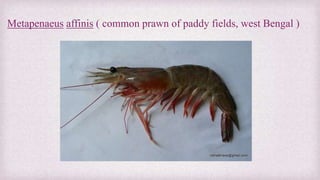
Metapenaeus affinis ( common prawn of paddy fields, west Bengal )
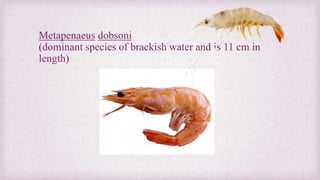
Metapenaeus dobsoni 
(dominant species of brackish water and is 11 cm in 
length)
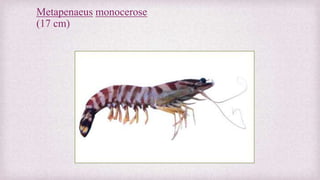
Metapenaeus monocerose 
(17 cm)
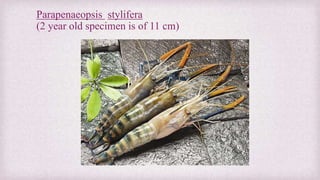
Parapenaeopsis stylifera 
(2 year old specimen is of 11 cm)
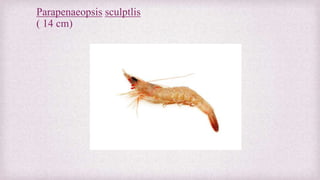
Parapenaeopsis sculptlis 
( 14 cm)
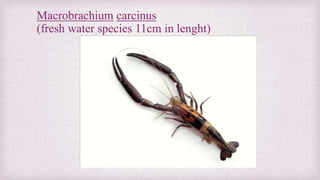
Macrobrachium carcinus 
(fresh water species 11cm in lenght)
Indigenous carps 
1. Catla catla (catla) 
Characteristics : 
1. Body is oblong and 4 sided view , 
2. Eyes are situated on the lower halves of lateral line , 
3. It does not breed in pond 
4. Embryos hatch after 10 – 80 days of fertilization and adult 
character attain after 6 weeks of hatching , 
5. It attains the length of 38 – 45 cm at the end of first year , 
with average weight 900 gm. , 
6. At the end of second year the weight is about 4 – 5 kg ,
Fecundity 
• Egg laying capacity is 80 eggs per grams of body weight, 
Especially when it becomes two year old and the weight is about 
5 kg
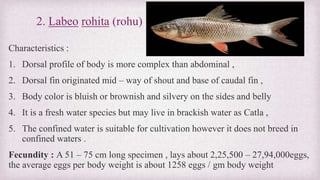
2. Labeo rohita (rohu) 
Characteristics : 
1. Dorsal profile of body is more complex than abdominal , 
2. Dorsal fin originated mid – way of shout and base of caudal fin , 
3. Body color is bluish or brownish and silvery on the sides and belly 
4. It is a fresh water species but may live in brackish water as Catla , 
5. The confined water is suitable for cultivation however it does not breed in 
confined waters . 
Fecundity : A 51 – 75 cm long specimen , lays about 2,25,500 – 27,94,000eggs, 
the average eggs per body weight is about 1258 eggs / gm body weight
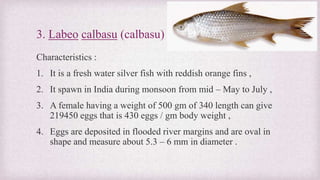
3. Labeo calbasu (calbasu) 
Characteristics : 
1. It is a fresh water silver fish with reddish orange fins , 
2. It spawn in India during monsoon from mid – May to July , 
3. A female having a weight of 500 gm of 340 length can give 
219450 eggs that is 430 eggs / gm body weight , 
4. Eggs are deposited in flooded river margins and are oval in 
shape and measure about 5.3 – 6 mm in diameter .
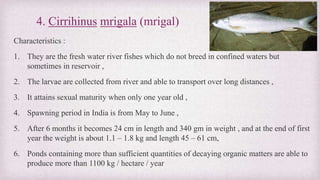
4. Cirrihinus mrigala (mrigal) 
Characteristics : 
1. They are the fresh water river fishes which do not breed in confined waters but 
sometimes in reservoir , 
2. The larvae are collected from river and able to transport over long distances , 
3. It attains sexual maturity when only one year old , 
4. Spawning period in India is from May to June , 
5. After 6 months it becomes 24 cm in length and 340 gm in weight , and at the end of first 
year the weight is about 1.1 – 1.8 kg and length 45 – 61 cm, 
6. Ponds containing more than sufficient quantities of decaying organic matters are able to 
produce more than 1100 kg / hectare / year
II . Exotic carp 
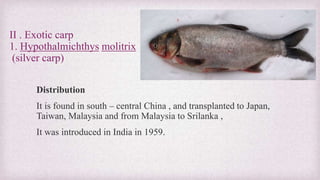
1. Hypothalmichthys molitrix 
(silver carp) 
Distribution 
It is found in south – central China , and transplanted to Japan, 
Taiwan, Malaysia and from Malaysia to Srilanka , 
It was introduced in India in 1959.
Characteristics : 
1. They don’t breed in ponds but sometimes in reservoirs , 
2. It is able to live in slightly brackish water fry are collected from 
rivers and reared in nurseries , 
3. Breeding takes place from April to June , 
4. During first year growth is not very fast, however in second year 
the average length reached is 33mm and weight 900 gm, the 
length after third year become 450 mm and weight 1.8 kg .
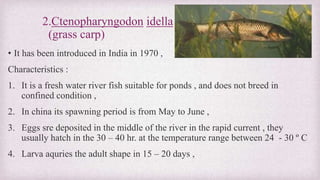
2.Ctenopharyngodon idella 
(grass carp) 
• It has been introduced in India in 1970 , 
Characteristics : 
1. It is a fresh water river fish suitable for ponds , and does not breed in 
confined condition , 
2. In china its spawning period is from May to June , 
3. Eggs sre deposited in the middle of the river in the rapid current , they 
usually hatch in the 30 – 40 hr. at the temperature range between 24 - 30 º C 
4. Larva aquries the adult shape in 15 – 20 days ,
5. At end of the first year they attain a length of 120 – 300 mm , 
and weight about225 – 500 gm, 
6. At the end of second year, length is about 600 mm and weight 
is about 1.8 - 2.3 kg , 
7. At the end of fourth year, they become 4.5 kg in weight and 
can be grown alone in ponds , 
8. Male may mature in 2 years while female a year later 
9. Female fish weighing 3 – 4 kg, have been found to possess 
1,80,000 – 4,92,750 eggs .
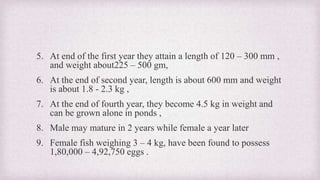
3. Cyprinus carpio 
(common carp) 
• It was introduced to India from Srilanka in 1839 . 
Characteristics : 
1. It is a major carp, attain a length of about 3 feet , 
2. It is essentially a cold water fish but being hardy, it easily adapts itself to 
warm waters of the tropics, 
3. It is world wide and most extensively cultivated 
4. In India it was first stocked in Nilgiri hills, however it has now being 
distributed in other states also ,
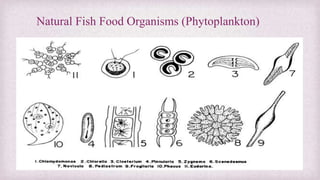
Natural Fish Food Organisms (Phytoplankton)
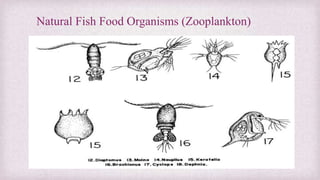
Natural Fish Food Organisms (Zooplankton)
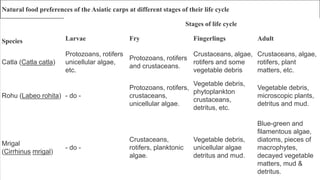
Natural food preferences of the Asiatic carps at different stages of their life cycle 
Species 
Stages of life cycle 
Larvae Fry Fingerlings Adult 
Catla (Catla catla) 
Protozoans, rotifers 
unicellular algae, 
etc. 
Protozoans, rotifers 
and crustaceans. 
Crustaceans, algae, 
rotifers and some 
vegetable debris 
Crustaceans, algae, 
rotifers, plant 
matters, etc. 
Rohu (Labeo rohita) - do - 
Protozoans, rotifers, 
crustaceans, 
unicellular algae. 
Vegetable debris, 
phytoplankton 
crustaceans, 
detritus, etc. 
Vegetable debris, 
microscopic plants, 
detritus and mud. 
Mrigal 
(Cirrhinus mrigal) 
- do - 
Crustaceans, 
rotifers, planktonic 
algae. 
Vegetable debris, 
unicellular algae 
detritus and mud. 
Blue-green and 
filamentous algae, 
diatoms, pieces of 
macrophytes, 
decayed vegetable 
matters, mud & 
detritus.
Grass carp 
(Ctenopharyngodoni 
della) 
Protozoans, rotifers, 
copepod nauplii. 
Protozoans, rotifers, 
crustaceans, 
microzoobenthos, 
detritus, microalgae, 
plant fragments. 
Detritus and aquatic 
plants. 
Aquatic plants such 
as wolffia, lemna, 
spirodela, hydrilla, 
najas, 
ceratophyllum, 
chara, etc. 
Silver carp 
(Hypophthalmichthy 
smolitrix) 
Unicellular 
planktonic 
organisms, nauplii 
and rotifers. 
Copepods, 
cladocerans and 
phytoplankton. 
Falagellata, 
dinoflagellata, 
myxophyceae, 
bacillariophycea, 
etc. 
Mainly 
phytoplankton. 
Common carp 
(Cyprinus carpio) 
Var. Communis 
Protozoans, rotifers, 
cereodaphnia, 
moina, nauplii, etc. 
Rotifers, cyclops, 
cereodaphnia, 
moina, nauplii, 
euglena, oscillatoria, 
etc. 
Diaptomus, cyclops, 
moina, 
cereodaphnia, 
ostracods, insects 
including chironomid 
larvae. 
Decayed vegetable 
matter, worms, 
molluscs, 
chironomids, 
ephemerids and 
trichopterans. 
Species 
Stages of life cycle 
Larvae Fry Fingerlings Adult
Types of pond 
∂ Nursery pond : pond where male and female fish / fishes are 
rear together 
∂Growing pond : Pond where grow out fish / fishes are rear until 
they attained market size 
∂ Hatching pond : Pond where fertilized fish eggs are hatched 
into fry until they developed into fingerling 
∂ Rearing pond : Pond where fingerlings are reared into grower
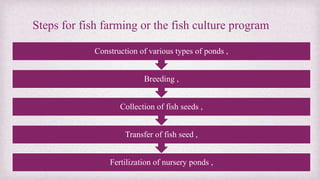
Steps for fish farming or the fish culture program 
Construction of various types of ponds , 
Breeding , 
Collection of fish seeds , 
Transfer of fish seed , 
Fertilization of nursery ponds ,
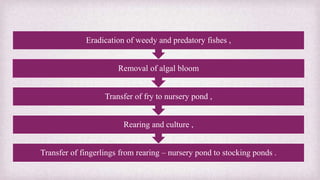
Eradication of weedy and predatory fishes , 
Removal of algal bloom 
Transfer of fry to nursery pond , 
Rearing and culture , 
Transfer of fingerlings from rearing – nursery pond to stocking ponds .
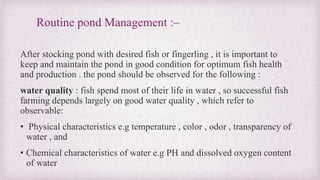
Routine pond Management :– 
After stocking pond with desired fish or fingerling , it is important to 
keep and maintain the pond in good condition for optimum fish health 
and production . the pond should be observed for the following : 
water quality : fish spend most of their life in water , so successful fish 
farming depends largely on good water quality , which refer to 
observable: 
• Physical characteristics e.g temperature , color , odor , transparency of 
water , and 
• Chemical characteristics of water e.g PH and dissolved oxygen content 
of water
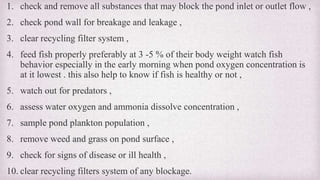
1. check and remove all substances that may block the pond inlet or outlet flow , 
2. check pond wall for breakage and leakage , 
3. clear recycling filter system , 
4. feed fish properly preferably at 3 -5 % of their body weight watch fish 
behavior especially in the early morning when pond oxygen concentration is 
at it lowest . this also help to know if fish is healthy or not , 
5. watch out for predators , 
6. assess water oxygen and ammonia dissolve concentration , 
7. sample pond plankton population , 
8. remove weed and grass on pond surface , 
9. check for signs of disease or ill health , 
10. clear recycling filters system of any blockage.
…….Thank you…….

Monoculture (aquaculture)

  • 1.
    Monoculture (Aquaculture) ZOM– 601 Submitted by – Savy Panamkuttiyiel Minal B.Sc. (zoology honours)
  • 2.
    Introduction ⹡Recently researchersconducted by CIFRI (Center Inland fishery research institute) have revolutionized research institute in India for fishery and net production of about 85,000 kilogram per hectare per year has been achieved in fish production in India. ⹡Monoculture fish farming refers to the fish farming where only one type of fish species and breed is raised on a farm,
  • 3.
    Indian Fisheries •Global position 3rd in Fisheries • 2nd in Aquaculture • Per capita fish availability (Kg.)9.0 • Annual Export earnings (Rs. In Crore)7,200 • Employment in sector (million)14.0
  • 4.
    Fish culture Thereare two systems of fish culture in commercial fish farming Monoculture and Polyculture fish farming Monoculture fish farming : this refer to fish farming where only one types of fish species and breed is raised on a farm. ∂ Advantages of monoculture fish farming : easy to monitor individual fish breed performance , their is no undue competition for space and feed . ∂ Disadvantages of monoculture fish farming : these includes : regression in water quality , cannibalism among fish themselves , overstocking of pond with fish which may leads to diseases outbreak
  • 5.
    Monoculture of aquaticanimal ⱷIt is a branch of animal husbandry involving raising or breeding of animals such as Fin – Fish , shell – fish , oyster shell , clams , cockles , shrimps , crayfish , periwinkles , in a controlled water body to marketable size .
  • 6.
    Fish culture isdivided into many categories a) Fresh water fish monoculture , b) Marine water fish monoculture , c) Brackish water or salty water fish monoculture (these fishes are acclimatized to fresh water)
  • 7.
    Terms used inmonoculture fish farming ∂ Fishery : The study of fish or fishes, ∂ Pond : Artificial body of water where fish where reared , ∂ Fry : Newly hatched fish , ∂ Fingerling : Young fish or baby fish , ∂ Hatchery : This is a unit where fish eggs are been hatch artificially into fry, ∂Gears : Equipments for harvesting fish .
  • 8.
    Objectives of monoculturein fish culture • To get maximum amount of production, and to prevent species extinction by over – exploitation , • High nutrient rich fish cultivation , • Supply high quality animal protein and vitamin rich oil e.g. – cod liver fish oil from cod fish which is rich in vitamin A and D, • Fish oil used in medicines and in soap making industries for research purposes ,
  • 9.
    Qualities of cultivablefish species in monoculture • Should have fast growth rate , • Should have ability to feed on natural and cheap artificial food , • Should be hardy and resistance to disease , • Should be able to tolerate adverse and physico – chemical conditions of pond water, • Should consume small quantity of food for development , • Should be of high nutritive value ,
  • 10.
    • Should begentle and non – poisonous , • Should be easily harvested , • Should be a proliferate breeder • Can reproduce under confined conditions , • Should support high population density in pond .
  • 11.
    Factors to considerwhen siting fish farm 1. Availability of good quality water 2. Availability of good quality fish feed 3. Availability of suitable fingerling , fingerling that can grow rapidly and have good feed to flesh convertibility 4. Soil type must be the types that have good water retention ability and also rich in humus content therefore clay soil rich in humus content is the best soil for lining pond . 5. Do not site fish pond on soil rich in heavy metals like copper , mercury , arsenic , lead or in highly industrialized area because the sulphur fumes produced in industrial area are poisonous to fish when dissolve by rain water . 6. Avoid acidic soil or rocky soil 7. Vegetation of the soil must be easy to clear 8. Topography of the land must not be easily flooded
  • 12.
    Types of cultivablefish species in Indian system I. Indigenous or Natural fresh water fishes : such as Mesocarps like Catla catla , Labeo rohita ,Cirrihinus mrigala, Labeo calbasu , Cirrihinus cirrhosa and few salt water species II. Exotic carps : such as , Hypothalmichthys molitrix (silver carp), Ctenopharyngodon idella (grass carp), Cyprinus carpio (common carp)
  • 13.
    Indigenous Catla catla(catla) Labeo rohita (rohu) Cirrihinus mrigala (mrigal) Surface feeder zooplankton Column feeder omnivore Bottom feeder detritivorous
  • 14.
    Exotic Hypothalmichthys molitrix (silver carp) Ctenopharyngodon idella (grass carp) Cyprinus carpio (common carp) Surface feeder Phytoplankton Herbivore Surface, column & marginal Bottom feeder Omnivore
  • 15.
    Sea bass (Lates calcarifer) (brackish water species )
  • 16.
  • 17.
  • 18.
    Periwinkles Sitka Periwinkles(Littorina sitkana)
  • 19.
  • 20.
  • 21.
  • 22.
    Some examples ofPrawn species used in monoculture technique (Penaeus is a genus of prawns, including the giant tiger prawn ) Penaeus indicus
  • 23.
  • 24.
    Metapenaeus affinis (common prawn of paddy fields, west Bengal )
  • 25.
    Metapenaeus dobsoni (dominantspecies of brackish water and is 11 cm in length)
  • 26.
  • 27.
    Parapenaeopsis stylifera (2year old specimen is of 11 cm)
  • 28.
  • 29.
    Macrobrachium carcinus (freshwater species 11cm in lenght)
  • 30.
    Indigenous carps 1.Catla catla (catla) Characteristics : 1. Body is oblong and 4 sided view , 2. Eyes are situated on the lower halves of lateral line , 3. It does not breed in pond 4. Embryos hatch after 10 – 80 days of fertilization and adult character attain after 6 weeks of hatching , 5. It attains the length of 38 – 45 cm at the end of first year , with average weight 900 gm. , 6. At the end of second year the weight is about 4 – 5 kg ,
  • 31.
    Fecundity • Egglaying capacity is 80 eggs per grams of body weight, Especially when it becomes two year old and the weight is about 5 kg
  • 32.
    2. Labeo rohita(rohu) Characteristics : 1. Dorsal profile of body is more complex than abdominal , 2. Dorsal fin originated mid – way of shout and base of caudal fin , 3. Body color is bluish or brownish and silvery on the sides and belly 4. It is a fresh water species but may live in brackish water as Catla , 5. The confined water is suitable for cultivation however it does not breed in confined waters . Fecundity : A 51 – 75 cm long specimen , lays about 2,25,500 – 27,94,000eggs, the average eggs per body weight is about 1258 eggs / gm body weight
  • 33.
    3. Labeo calbasu(calbasu) Characteristics : 1. It is a fresh water silver fish with reddish orange fins , 2. It spawn in India during monsoon from mid – May to July , 3. A female having a weight of 500 gm of 340 length can give 219450 eggs that is 430 eggs / gm body weight , 4. Eggs are deposited in flooded river margins and are oval in shape and measure about 5.3 – 6 mm in diameter .
  • 34.
    4. Cirrihinus mrigala(mrigal) Characteristics : 1. They are the fresh water river fishes which do not breed in confined waters but sometimes in reservoir , 2. The larvae are collected from river and able to transport over long distances , 3. It attains sexual maturity when only one year old , 4. Spawning period in India is from May to June , 5. After 6 months it becomes 24 cm in length and 340 gm in weight , and at the end of first year the weight is about 1.1 – 1.8 kg and length 45 – 61 cm, 6. Ponds containing more than sufficient quantities of decaying organic matters are able to produce more than 1100 kg / hectare / year
  • 35.
    II . Exoticcarp 1. Hypothalmichthys molitrix (silver carp) Distribution It is found in south – central China , and transplanted to Japan, Taiwan, Malaysia and from Malaysia to Srilanka , It was introduced in India in 1959.
  • 36.
    Characteristics : 1.They don’t breed in ponds but sometimes in reservoirs , 2. It is able to live in slightly brackish water fry are collected from rivers and reared in nurseries , 3. Breeding takes place from April to June , 4. During first year growth is not very fast, however in second year the average length reached is 33mm and weight 900 gm, the length after third year become 450 mm and weight 1.8 kg .
  • 37.
    2.Ctenopharyngodon idella (grasscarp) • It has been introduced in India in 1970 , Characteristics : 1. It is a fresh water river fish suitable for ponds , and does not breed in confined condition , 2. In china its spawning period is from May to June , 3. Eggs sre deposited in the middle of the river in the rapid current , they usually hatch in the 30 – 40 hr. at the temperature range between 24 - 30 º C 4. Larva aquries the adult shape in 15 – 20 days ,
  • 38.
    5. At endof the first year they attain a length of 120 – 300 mm , and weight about225 – 500 gm, 6. At the end of second year, length is about 600 mm and weight is about 1.8 - 2.3 kg , 7. At the end of fourth year, they become 4.5 kg in weight and can be grown alone in ponds , 8. Male may mature in 2 years while female a year later 9. Female fish weighing 3 – 4 kg, have been found to possess 1,80,000 – 4,92,750 eggs .
  • 39.
    3. Cyprinus carpio (common carp) • It was introduced to India from Srilanka in 1839 . Characteristics : 1. It is a major carp, attain a length of about 3 feet , 2. It is essentially a cold water fish but being hardy, it easily adapts itself to warm waters of the tropics, 3. It is world wide and most extensively cultivated 4. In India it was first stocked in Nilgiri hills, however it has now being distributed in other states also ,
  • 40.
    Natural Fish FoodOrganisms (Phytoplankton)
  • 41.
    Natural Fish FoodOrganisms (Zooplankton)
  • 42.
    Natural food preferencesof the Asiatic carps at different stages of their life cycle Species Stages of life cycle Larvae Fry Fingerlings Adult Catla (Catla catla) Protozoans, rotifers unicellular algae, etc. Protozoans, rotifers and crustaceans. Crustaceans, algae, rotifers and some vegetable debris Crustaceans, algae, rotifers, plant matters, etc. Rohu (Labeo rohita) - do - Protozoans, rotifers, crustaceans, unicellular algae. Vegetable debris, phytoplankton crustaceans, detritus, etc. Vegetable debris, microscopic plants, detritus and mud. Mrigal (Cirrhinus mrigal) - do - Crustaceans, rotifers, planktonic algae. Vegetable debris, unicellular algae detritus and mud. Blue-green and filamentous algae, diatoms, pieces of macrophytes, decayed vegetable matters, mud & detritus.
  • 43.
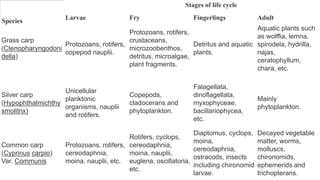
    Grass carp (Ctenopharyngodoni della) Protozoans, rotifers, copepod nauplii. Protozoans, rotifers, crustaceans, microzoobenthos, detritus, microalgae, plant fragments. Detritus and aquatic plants. Aquatic plants such as wolffia, lemna, spirodela, hydrilla, najas, ceratophyllum, chara, etc. Silver carp (Hypophthalmichthy smolitrix) Unicellular planktonic organisms, nauplii and rotifers. Copepods, cladocerans and phytoplankton. Falagellata, dinoflagellata, myxophyceae, bacillariophycea, etc. Mainly phytoplankton. Common carp (Cyprinus carpio) Var. Communis Protozoans, rotifers, cereodaphnia, moina, nauplii, etc. Rotifers, cyclops, cereodaphnia, moina, nauplii, euglena, oscillatoria, etc. Diaptomus, cyclops, moina, cereodaphnia, ostracods, insects including chironomid larvae. Decayed vegetable matter, worms, molluscs, chironomids, ephemerids and trichopterans. Species Stages of life cycle Larvae Fry Fingerlings Adult
  • 44.
    Types of pond ∂ Nursery pond : pond where male and female fish / fishes are rear together ∂Growing pond : Pond where grow out fish / fishes are rear until they attained market size ∂ Hatching pond : Pond where fertilized fish eggs are hatched into fry until they developed into fingerling ∂ Rearing pond : Pond where fingerlings are reared into grower
  • 45.
    Steps for fishfarming or the fish culture program Construction of various types of ponds , Breeding , Collection of fish seeds , Transfer of fish seed , Fertilization of nursery ponds ,
  • 46.
    Eradication of weedyand predatory fishes , Removal of algal bloom Transfer of fry to nursery pond , Rearing and culture , Transfer of fingerlings from rearing – nursery pond to stocking ponds .
  • 47.
    Routine pond Management:– After stocking pond with desired fish or fingerling , it is important to keep and maintain the pond in good condition for optimum fish health and production . the pond should be observed for the following : water quality : fish spend most of their life in water , so successful fish farming depends largely on good water quality , which refer to observable: • Physical characteristics e.g temperature , color , odor , transparency of water , and • Chemical characteristics of water e.g PH and dissolved oxygen content of water
  • 48.
    1. check andremove all substances that may block the pond inlet or outlet flow , 2. check pond wall for breakage and leakage , 3. clear recycling filter system , 4. feed fish properly preferably at 3 -5 % of their body weight watch fish behavior especially in the early morning when pond oxygen concentration is at it lowest . this also help to know if fish is healthy or not , 5. watch out for predators , 6. assess water oxygen and ammonia dissolve concentration , 7. sample pond plankton population , 8. remove weed and grass on pond surface , 9. check for signs of disease or ill health , 10. clear recycling filters system of any blockage.
  • 52.