Vertebrate AnimalsDOMAIN- Eukarya  KINGDOM- AnimaliaPHYLUM- ChordataSUBPHYLUM- VertebrataCLASS- 7 differentORDERS- 10 Placental mammals
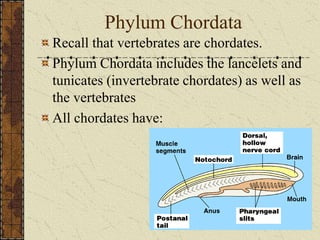
Phylum ChordataRecall that vertebrates are chordates.Phylum Chordata includes the lancelets and tunicates (invertebrate chordates) as well as the vertebratesAll chordates have:
Characteristics of all VertebratesEndoskeleton with a backbone for support of a dorsal nerve cord & muscle attachmentDistinct skull/cephalizationBilateral symmetry2 pairs of jointed appendagesCoelom Closed circulatory system & chambered heart
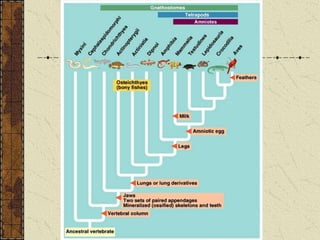
Vertebrate Evolution
Major Groups of VertebratesFish – aquatic tetrapods with scales, gills, & 2 chambered hearts
Agnathans – jawless fishes – hagfish and lampreys
Chondrichthyes – cartilagenous fish - sharks & rays
Osteichthyes – bony fish – mahi-mahi, tilapia, halibut, puffer fish, tetras, guppies
Amphibians – semiaquatic tetrapods with split lives & 3-chambered hearts
Anura – “tailless ones” – frogs & toads
Urodela – “tailed ones” – salamanders & newts
Apoda – “legless ones” - caecilians
Reptiles – terrestrial amniote tetrapods with scales & lungs & 3-ish to 4 chambered hearts
Squamata – lizards and snakes
Testudines – turtles & tortoises
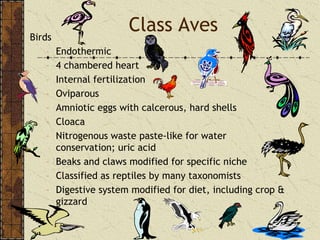
Crocodilia – alligators, crocodiles, and related speciesBirds – terrestrial amniote tetrapods with feathers & lungs & 4 chambered hearts
Ratites – ostriches, emus, kiwis
Passeriformes – perching birds – jays, sparrows, crows, etc.
Aquatic birds – ducks, swans, geese
Raptors – eagles, falcolns, hawks
Penguins
Mammals – terrestrial amniote tetrapods with lungs,  hair and mammary glands & 4 chambered hearts
Monotremes – echidna and platypus
Marsupials – koala, kangaroo, opossom
Placentals – humans, bears, tigers, giraffes, deer, pigs, dogs, cats, raccoons, squirrels, whales, walruses, manatees, etcFish VocabularyGill – respiratory structure that uses countercurrent exchange to extract oxygen from water
Operculum – gill covering in bony fish
Lateral line - a row of microscopic organs sensitive to pressure changes, can detect low frequency vibrations.
Swim bladder – internal, air-filled sac that acts as an organ for buoyancy in bony fish; sharks have oils in their livers to help them remain buoyant
Scale – small, platelike structure covering an organism (or parts of an organism); sharks, fish, reptiles, and birds all have different types of scales
Fin – paired appendage found on fish used for locomotion and steering
Reproduction
External fertilization – release of gametes to the environment where fertilization takes place; bony fish
Internal fertilization – deposition of sperm in the female reproductive tract where fertilization takes place; sharks
Hermaphrodite – some organisms are capable of producing both male and female gametes; few are capable of self-fertilization; most exchange sperm; evolutionary adaptation for solitary and slow-moving or sessile organisms
Ovoviviparous = eggs are fertilized inside the parent and hatch inside the parent and are born liveOviparous = eggs are laid in a nest or in the ground and hatchViviparous = internal fertilization with live born young (as soon as the egg is fertilized, it becomes an embryo and develops as a fetus).
Class AgnathaHagfish and lampreysJawless & finless
Skeleton of cartilage
Reproduce sexually

Vertebrates Powerpoint