“Agnathans”
By: J.Q
Agnathans
. Agnathans meaning “without jaws” these “jawless” fishes lack
a biting apparatus.
Examples: Hagfishes (Myxinoidea) and lamprey
(Petromyzontida)
- together, these two living groups are known as cyclostomes
(meaning “round” and “mouth”).
Extinct group of agnathans
-conodonts
-ostracoderms
-pteraspidomophs
Living Agnathans
- arose within Cambrian period
- all living agnathans lack bone and possess a single nostril
Myxinoidea
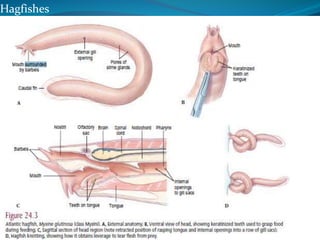
HAGFISHES
- deep sea, mud-burrowing, eel-like
- scavengers
- use teeth like processes on their muscular “tongue” to rasp
flesh from prey or reel in worms.
-possess slime glands beneath the skin release mucus
- mucus, or “slime,” may serve to slip them from the grip of a
predator or clog its gills.
- hagfishes can knot their bodies to escape capture or give them
force to tear off food
Hagfishes
Petromyzontida
LAMPREY.
- uses its oval mouth to grasp a stone and hold its position in a
current.
Two types:
parasitic – marine
non-parasitic - freshwater
- parasitic lampreys, constitute about half of all living
lampreys, the mouth clings to live prey so that the rough
“tongue” can rasp away flesh or clear skin, allowing the fish
to open blood vessels below and drink of the fluid within.
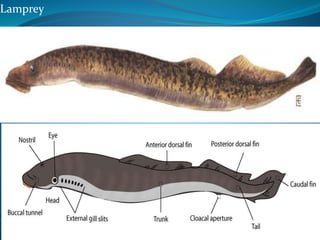
- Medial fins are present, but paired fins and limbs are
absent.
- Vertebrae are represented by individual blocks of
cartilage that ride atop the lamprey’s prominent notochord.
- vestibular organ or ear for balancing
Lamprey
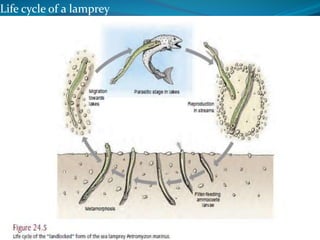
Life cycle of a lamprey
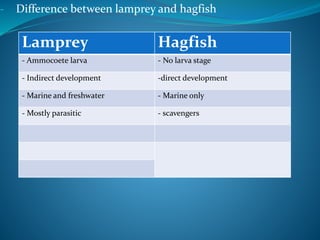
- Difference between lamprey and hagfish
Lamprey Hagfish
- Ammocoete larva - No larva stage
- Indirect development -direct development
- Marine and freshwater - Marine only
- Mostly parasitic - scavengers
3 Early living fossils
- Conodonts
- Ostracoderms
- Pteraspidomorpha
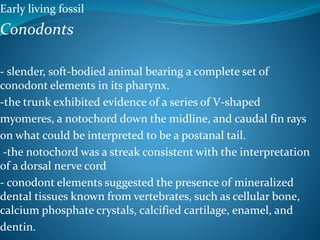
Early living fossil
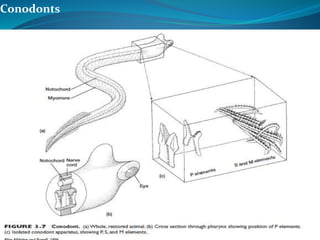
Conodonts
- slender, soft-bodied animal bearing a complete set of
conodont elements in its pharynx.
-the trunk exhibited evidence of a series of V-shaped
myomeres, a notochord down the midline, and caudal fin rays
on what could be interpreted to be a postanal tail.
-the notochord was a streak consistent with the interpretation
of a dorsal nerve cord
- conodont elements suggested the presence of mineralized
dental tissues known from vertebrates, such as cellular bone,
calcium phosphate crystals, calcified cartilage, enamel, and
dentin.
Conodonts
Ostracoderms
- appeared in the very Late Cambrian
- they had complex eye muscles and dentin like tissues.
- a few possessed paired appendages.
- They were the first vertebrates to possess an intricate lateral-
line system,
- an inner ear with two semicircular canals, and
bone, although the bone is located almost exclusively in the
outer exoskeleton that encases the body.
- The endoskeleton of these later agnathans was not well
developed and, when present was usually of cartilage inside the
body.
Pteraspidomorpha
- appear in the Ordovician
- they are represented at first only by splinters of primitive
bone lacking true bone cells (acellular bone).
- a vestibular apparatus with two semicircular canals and the
presence of paired nasal openings seem to characterize most
pteraspidomorphs.
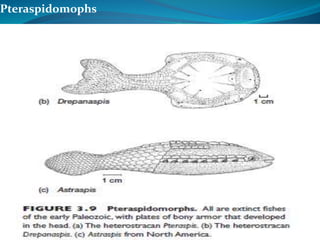
- pteraspidomorphs had head shields formed by fusion of
several large bony plates
Pteraspidomophs

Agnathan (By: J.Q)

  • 1.
  • 2.
    Agnathans . Agnathans meaning“without jaws” these “jawless” fishes lack a biting apparatus. Examples: Hagfishes (Myxinoidea) and lamprey (Petromyzontida) - together, these two living groups are known as cyclostomes (meaning “round” and “mouth”). Extinct group of agnathans -conodonts -ostracoderms -pteraspidomophs
  • 3.
    Living Agnathans - arosewithin Cambrian period - all living agnathans lack bone and possess a single nostril Myxinoidea HAGFISHES - deep sea, mud-burrowing, eel-like - scavengers - use teeth like processes on their muscular “tongue” to rasp flesh from prey or reel in worms. -possess slime glands beneath the skin release mucus - mucus, or “slime,” may serve to slip them from the grip of a predator or clog its gills. - hagfishes can knot their bodies to escape capture or give them force to tear off food
  • 4.
  • 5.
    Petromyzontida LAMPREY. - uses itsoval mouth to grasp a stone and hold its position in a current. Two types: parasitic – marine non-parasitic - freshwater - parasitic lampreys, constitute about half of all living lampreys, the mouth clings to live prey so that the rough “tongue” can rasp away flesh or clear skin, allowing the fish to open blood vessels below and drink of the fluid within.
  • 6.
    - Medial finsare present, but paired fins and limbs are absent. - Vertebrae are represented by individual blocks of cartilage that ride atop the lamprey’s prominent notochord. - vestibular organ or ear for balancing
  • 7.
  • 8.
    Life cycle ofa lamprey
  • 9.
    - Difference betweenlamprey and hagfish Lamprey Hagfish - Ammocoete larva - No larva stage - Indirect development -direct development - Marine and freshwater - Marine only - Mostly parasitic - scavengers
  • 10.
    3 Early livingfossils - Conodonts - Ostracoderms - Pteraspidomorpha
  • 11.
    Early living fossil Conodonts -slender, soft-bodied animal bearing a complete set of conodont elements in its pharynx. -the trunk exhibited evidence of a series of V-shaped myomeres, a notochord down the midline, and caudal fin rays on what could be interpreted to be a postanal tail. -the notochord was a streak consistent with the interpretation of a dorsal nerve cord - conodont elements suggested the presence of mineralized dental tissues known from vertebrates, such as cellular bone, calcium phosphate crystals, calcified cartilage, enamel, and dentin.
  • 12.
  • 13.
    Ostracoderms - appeared inthe very Late Cambrian - they had complex eye muscles and dentin like tissues. - a few possessed paired appendages. - They were the first vertebrates to possess an intricate lateral- line system, - an inner ear with two semicircular canals, and bone, although the bone is located almost exclusively in the outer exoskeleton that encases the body. - The endoskeleton of these later agnathans was not well developed and, when present was usually of cartilage inside the body.
  • 14.
    Pteraspidomorpha - appear inthe Ordovician - they are represented at first only by splinters of primitive bone lacking true bone cells (acellular bone). - a vestibular apparatus with two semicircular canals and the presence of paired nasal openings seem to characterize most pteraspidomorphs. - pteraspidomorphs had head shields formed by fusion of several large bony plates
  • 15.