TABLET FRIABILITY,HARDNESS AND DISSOLUTION By Don Jacob
Tablet Friability Tablets are constantly subjected to mechanical shocks & aberration during the manufacturing, packing and transportation process.  Such stress can lead to capping, aberration or eve breakage of the tablets It is there fore important that the tablet is formulated to withstand such stress
Tablet Friability In order to monitor the resistance of tablets to such stress and to decide on their suitability for further processing such as coating, tablets are routinely subjected to friability test
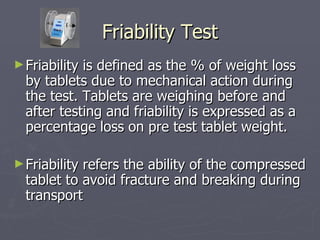
Friability Test Friability is defined as the % of weight loss by tablets due to mechanical action during the test. Tablets are weighing before and after testing and friability is expressed as a percentage loss on pre test tablet weight. Friability refers the ability of the compressed tablet to avoid fracture and breaking during transport
Friability Test Friability is closely related to tablet harness and is designed to evaluate the ability of the tablet to with stand aberration in packing, Handling and shipping. Friability is usually measured by the use of Roche fibrilator or tumbler test.
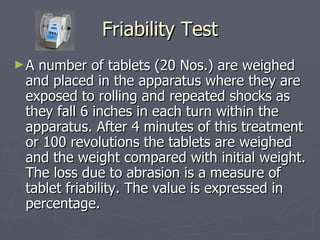
Friability Test A number of tablets (20 Nos.) are weighed and placed in the apparatus where they are exposed to rolling and repeated shocks as they fall 6 inches in each turn within the apparatus. After 4 minutes of this treatment or 100 revolutions the tablets are weighed and the weight compared with initial weight. The loss due to abrasion is a measure of tablet friability. The value is expressed in percentage.
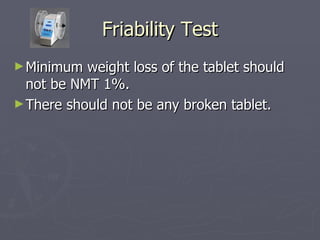
Friability Test Minimum weight loss of the tablet should not be NMT 1%. There should not be any broken tablet.
Hardness
Hardness The resistance of tablets to capping,aberation or breakage under conditions of storage, transportation and handling before usage depends on its hardness. Hardness is nothing but crushing strength
Hardness If tablet is too hard, it may not disintegrate in the required period of time and will fail dissolution test If tablet is too soft it may not be able to withstand handling during subsequent processing such as coating or packaging and shipping operations.
Hardness The force required to break tablet is measured in kilograms and a crushing strength of 4 KG is usually considered to be  the minimum for satisfactory tablets. Oral tablets normally have a hardness of 4-10kg,However hypodermic and chewable tablets are usually much softer (3 kg) and some substained release tablets are much harder 10-20 kg.
Hardness Tablet hardness has been associated with tablet property such as density and porosity. Hardness generally increase with normal storage of tablets & depends on the shape, chemical properties, binding agent & pressure applied during compression.
Hardness Hardness is expressed in Newton. Hardness can also expressed in Kpa.
DISSOLUTION
Dissolution Active absorption of oral dosage forms depends on adequate release of the API from the product. Dissolution or solubility of the API play pivotal role in this aspect. Dissolution testing is used as a tool to identify a crucial effect in the bioavailability of the API.

Tablet friability,harness and dissolution testing

  • 1.
    TABLET FRIABILITY,HARDNESS ANDDISSOLUTION By Don Jacob
  • 2.
    Tablet Friability Tabletsare constantly subjected to mechanical shocks & aberration during the manufacturing, packing and transportation process. Such stress can lead to capping, aberration or eve breakage of the tablets It is there fore important that the tablet is formulated to withstand such stress
  • 3.
    Tablet Friability Inorder to monitor the resistance of tablets to such stress and to decide on their suitability for further processing such as coating, tablets are routinely subjected to friability test
  • 4.
    Friability Test Friabilityis defined as the % of weight loss by tablets due to mechanical action during the test. Tablets are weighing before and after testing and friability is expressed as a percentage loss on pre test tablet weight. Friability refers the ability of the compressed tablet to avoid fracture and breaking during transport
  • 5.
    Friability Test Friabilityis closely related to tablet harness and is designed to evaluate the ability of the tablet to with stand aberration in packing, Handling and shipping. Friability is usually measured by the use of Roche fibrilator or tumbler test.
  • 6.
    Friability Test Anumber of tablets (20 Nos.) are weighed and placed in the apparatus where they are exposed to rolling and repeated shocks as they fall 6 inches in each turn within the apparatus. After 4 minutes of this treatment or 100 revolutions the tablets are weighed and the weight compared with initial weight. The loss due to abrasion is a measure of tablet friability. The value is expressed in percentage.
  • 7.
    Friability Test Minimumweight loss of the tablet should not be NMT 1%. There should not be any broken tablet.
  • 8.
  • 9.
    Hardness The resistanceof tablets to capping,aberation or breakage under conditions of storage, transportation and handling before usage depends on its hardness. Hardness is nothing but crushing strength
  • 10.
    Hardness If tabletis too hard, it may not disintegrate in the required period of time and will fail dissolution test If tablet is too soft it may not be able to withstand handling during subsequent processing such as coating or packaging and shipping operations.
  • 11.
    Hardness The forcerequired to break tablet is measured in kilograms and a crushing strength of 4 KG is usually considered to be the minimum for satisfactory tablets. Oral tablets normally have a hardness of 4-10kg,However hypodermic and chewable tablets are usually much softer (3 kg) and some substained release tablets are much harder 10-20 kg.
  • 12.
    Hardness Tablet hardnesshas been associated with tablet property such as density and porosity. Hardness generally increase with normal storage of tablets & depends on the shape, chemical properties, binding agent & pressure applied during compression.
  • 13.
    Hardness Hardness isexpressed in Newton. Hardness can also expressed in Kpa.
  • 14.
  • 15.
    Dissolution Active absorptionof oral dosage forms depends on adequate release of the API from the product. Dissolution or solubility of the API play pivotal role in this aspect. Dissolution testing is used as a tool to identify a crucial effect in the bioavailability of the API.