Presented By-
Miss S. M. Kumbhar
Under the Guidance of-
Dr. A. S. Kulkarni
1
VALIDATION
History-
 Concept of validation was first proposed
by FDA officials in 1970, by Ted Byers &
Bud Loftus.
 Concept was first develop for equipment
and process.
2
REASONS FOR VALIDATION
 To improve Quality of
Pharmaceuticals
 To design system properly to
provide high degree of assurance.
3
VALIDATION
Validation is process of establishing
documented evidence that provides high
degree of assurance that specific process will
consistently produce a product meeting its
predetermined specifications and quality.
4
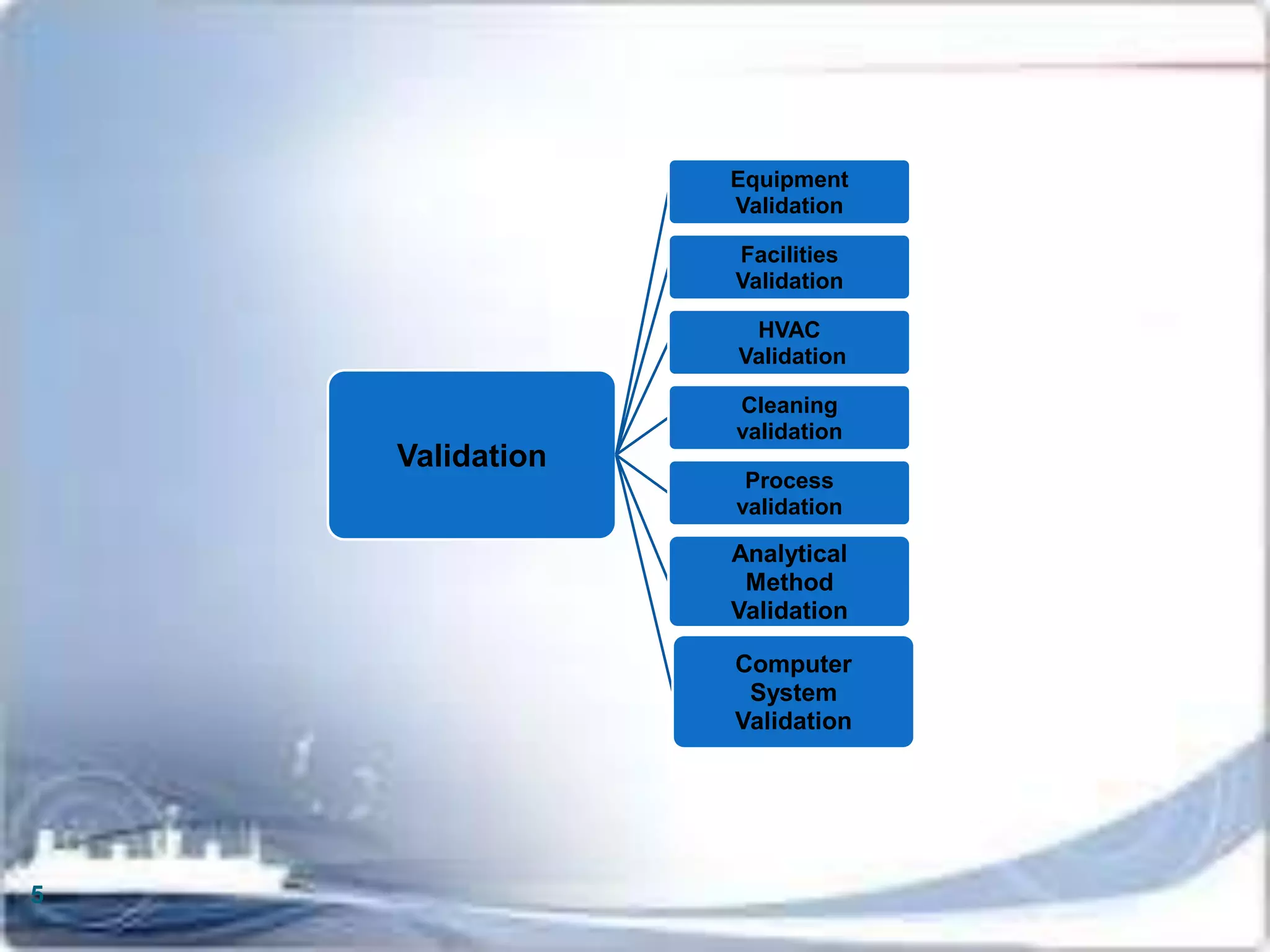
Validation
Equipment
Validation
Facilities
Validation
HVAC
Validation
Cleaning
validation
Process
validation
Analytical
Method
Validation
Computer
System
Validation
5
DISSOLUTION
 Process by which known amount of drug
substance goes into solution per unit time
under standardized conditions.
 Primary goal- to provide measurements for
bioavailability & to demonstrate
bioequivalence from batch to batch.
6
NEEDS OF DISSOLUTION
TESTING
1. To ensure continuity of product quality &
performance of manufacturing process
2. Requirement for regulatory approval for
product marketing
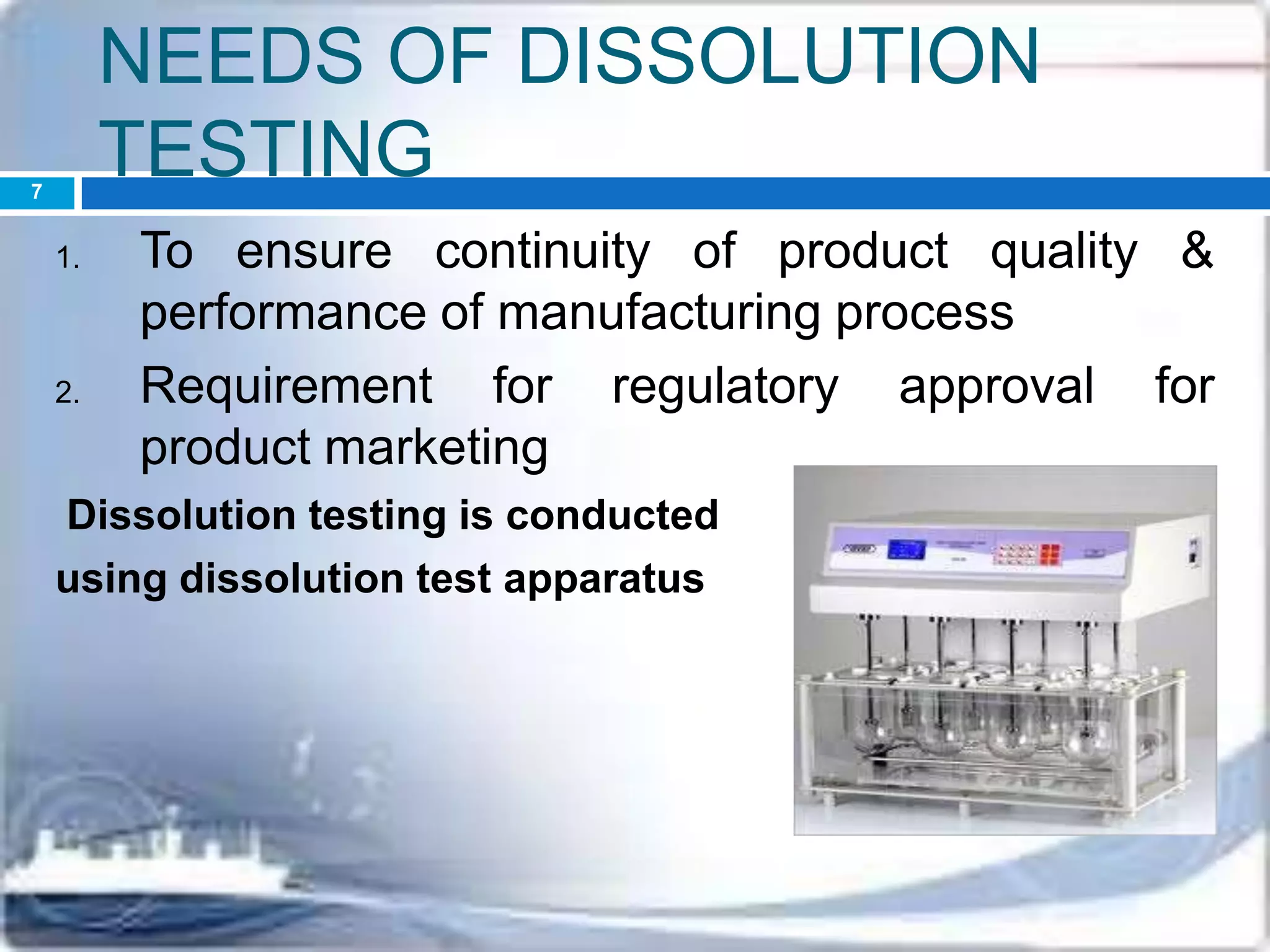
Dissolution testing is conducted
using dissolution test apparatus
7
Validation of dissolution test
apparatus.
Why???
8
To have a high degree of assurance
dissolution apparatus should be
consistence and accurate in its
performance.
Therefore validation of this equipment is
required.
.
Validation of Dissolution Test
Apparatus9
QUALIFICATION
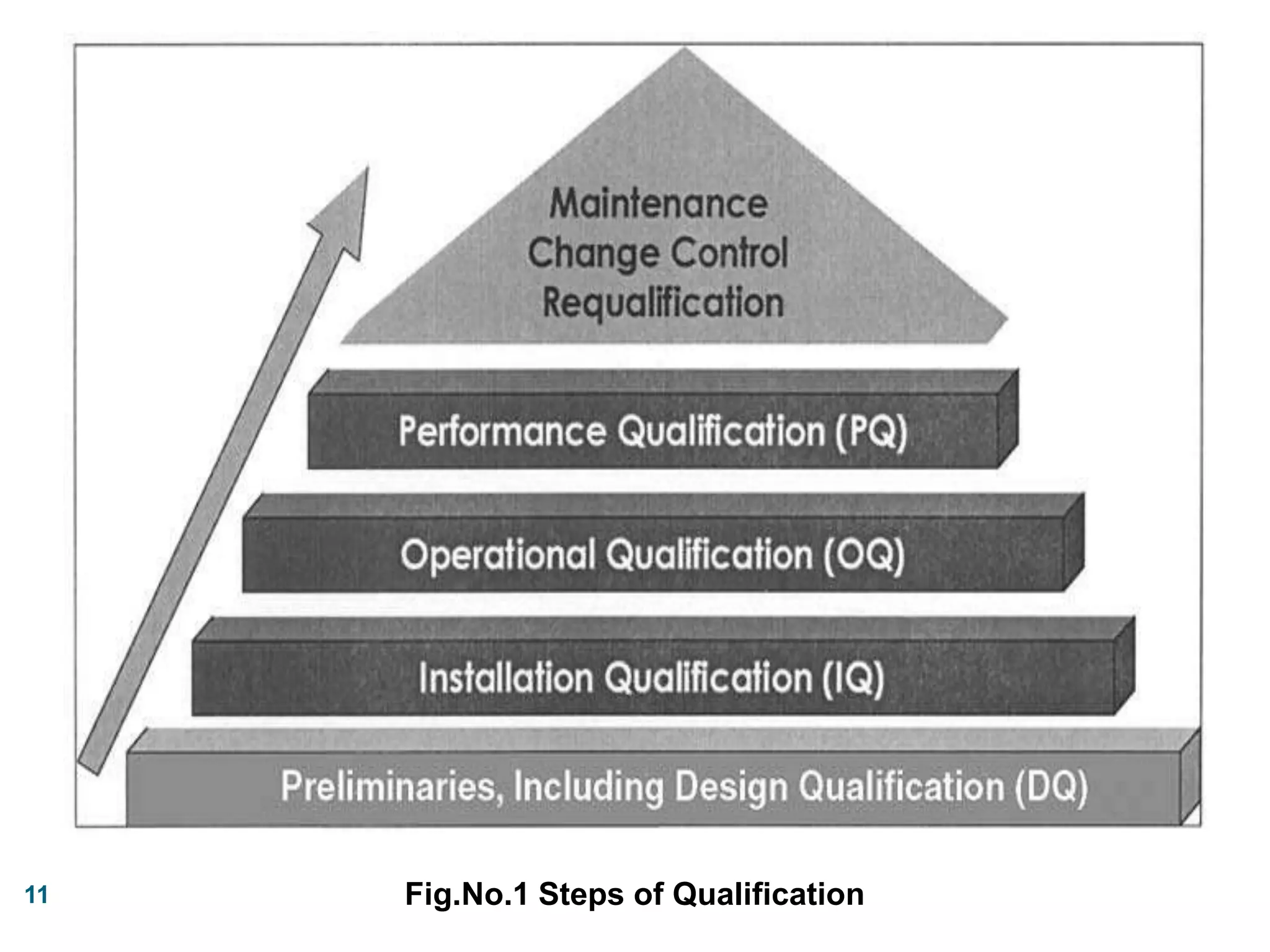
To ensure that equipment is fit for intended
purpose,
there are no. of qualifying steps that vendor /
analyst
should apply to analytical instruments.
Equipment is evaluated through these tests &
successful
completion justifies instrument operates and
performs
10
Fig.No.1 Steps of Qualification11
DESIGN
QUALIFICATION
When developing dissolution method DQ is built
into apparatus selection of process,
Dosage form & delivery system will determine
choice of equipment.
Example-first choice for beaded product may be
USP app 3…… as it is designed to confine
beads in a screened-in cylinder.
12
INSTALLATION
QUALIFICATION
Used to verify that instrument has assembled
in the appropriate environment & its
functioning according to predefined set of limit.
Example-
Setting up fully automated dissolution testing
apparatus requires: proper plumbing, hot water
source, stable bench top.
13
OPERATIONAL
QUALIFICATION
During this qualification analyst or vendor
assess that
equipment works as specified & generates
documented data.
Example-
For dissolution water bath temperature, shaft
rpm
speed would be obvious operational parameters
14
PERFORMANCE
QUALIFICATION
This is conducted to ensure that system is in
normal
operating environment & performing designed
set of
tasks within the specifications.
Example-
Centering, wobble, height of paddle or basket
attached to shaft, speed, temperature
15
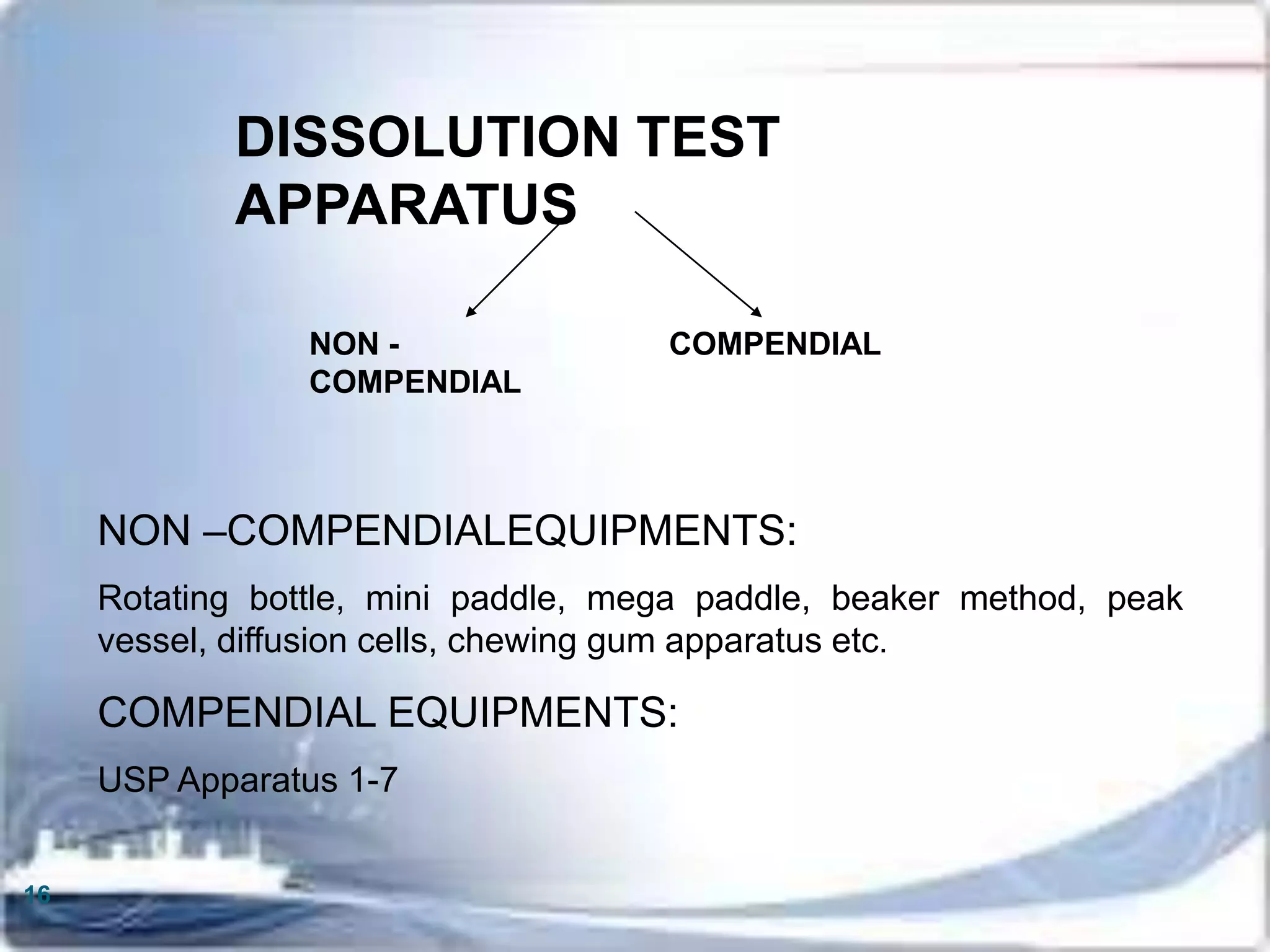
DISSOLUTION TEST
APPARATUS
NON -
COMPENDIAL
COMPENDIAL
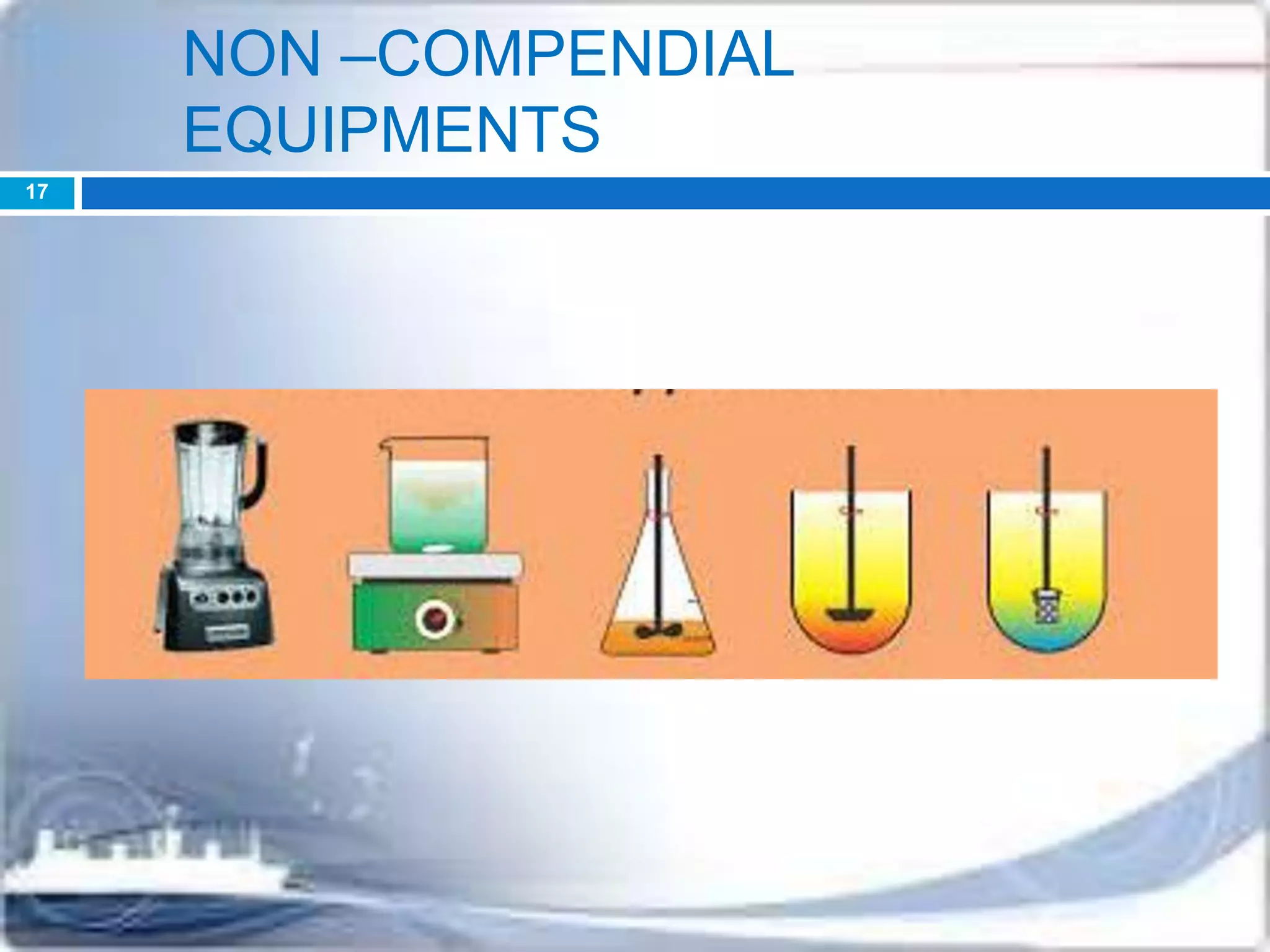
NON –COMPENDIALEQUIPMENTS:
Rotating bottle, mini paddle, mega paddle, beaker method, peak
vessel, diffusion cells, chewing gum apparatus etc.
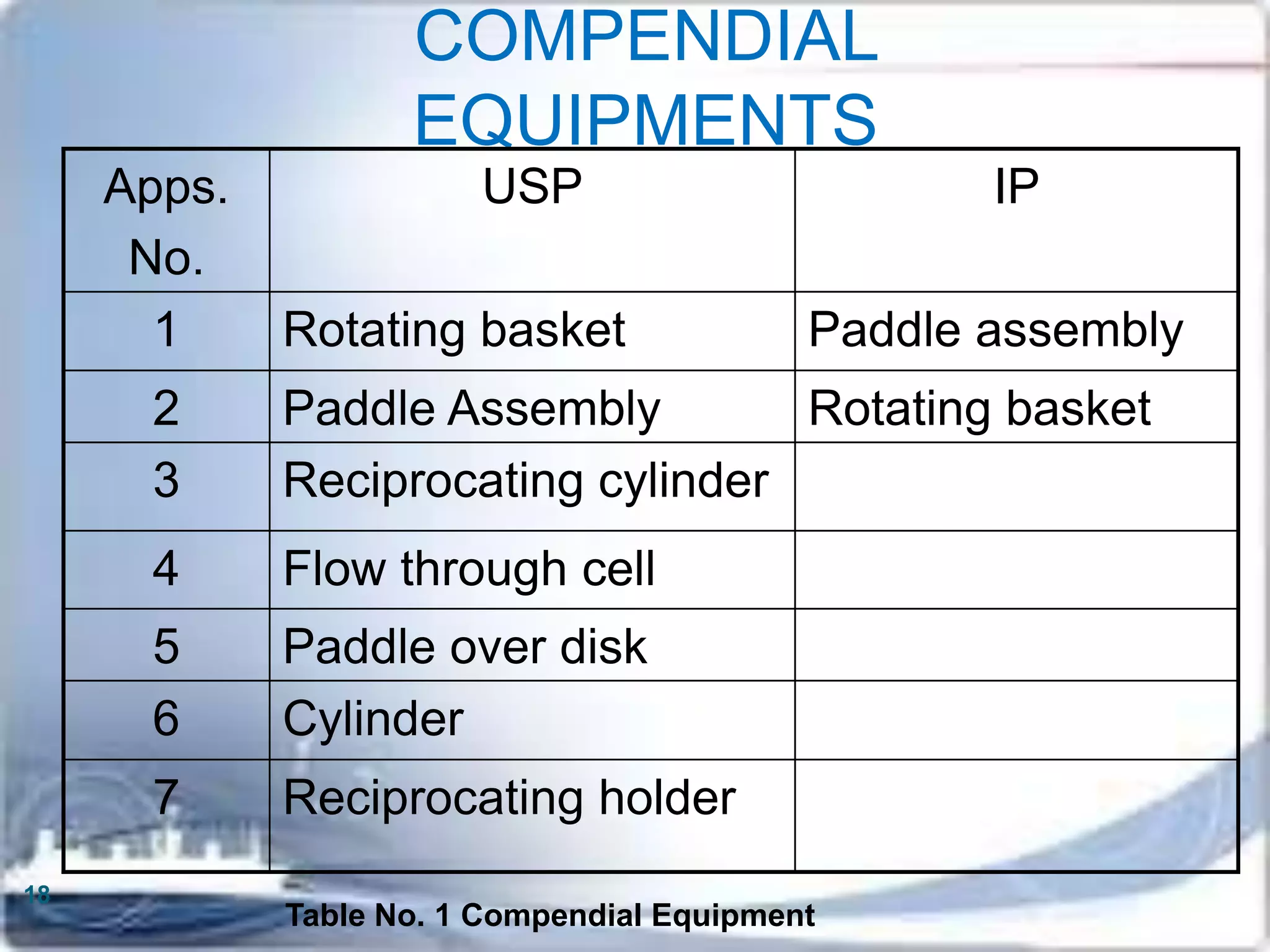
COMPENDIAL EQUIPMENTS:
USP Apparatus 1-7
16
NON –COMPENDIAL
EQUIPMENTS
17
COMPENDIAL
EQUIPMENTS
Apps.
No.
USP IP
1 Rotating basket Paddle assembly
2 Paddle Assembly Rotating basket
3 Reciprocating cylinder
4 Flow through cell
5 Paddle over disk
6 Cylinder
7 Reciprocating holder
18
Table No. 1 Compendial Equipment
QUALIFICATION OF NON-COMPENDIAL
EQUIPMENT
If equipment is commercial product IQ and OQ
can be
obtained from the equipment vendor which
includes
vendor specification and tolerances for equipment.
But if equipment is in-house design then process
becomes difficult.
We have to look at adjustments & moving parts,
obtain
operational parameters i. e. agitation rate, flow
rate,
19
METHODS
A] Calibration
 Non-compendial & some compendial apparatus
do not have calibrator tablets, in some case in
house calibrator tablets are designed.
 Some unique aspects of equipment can only be
detected with USP calibrated tablets, there are
no practical measuring tools available for
analyst. e.g. vibration and vessel
irregularities.
20
B] HYDRODYNAMICS
Dissolution fluid flow should be free from
irregularities
or variable turbulence.
Highly variable data may be unsuitable for that
product.
C] OTHER CONSIDERATIONS-
Ruggedness should be thoroughly evaluated
before
considering transferring product testing to
another site.21
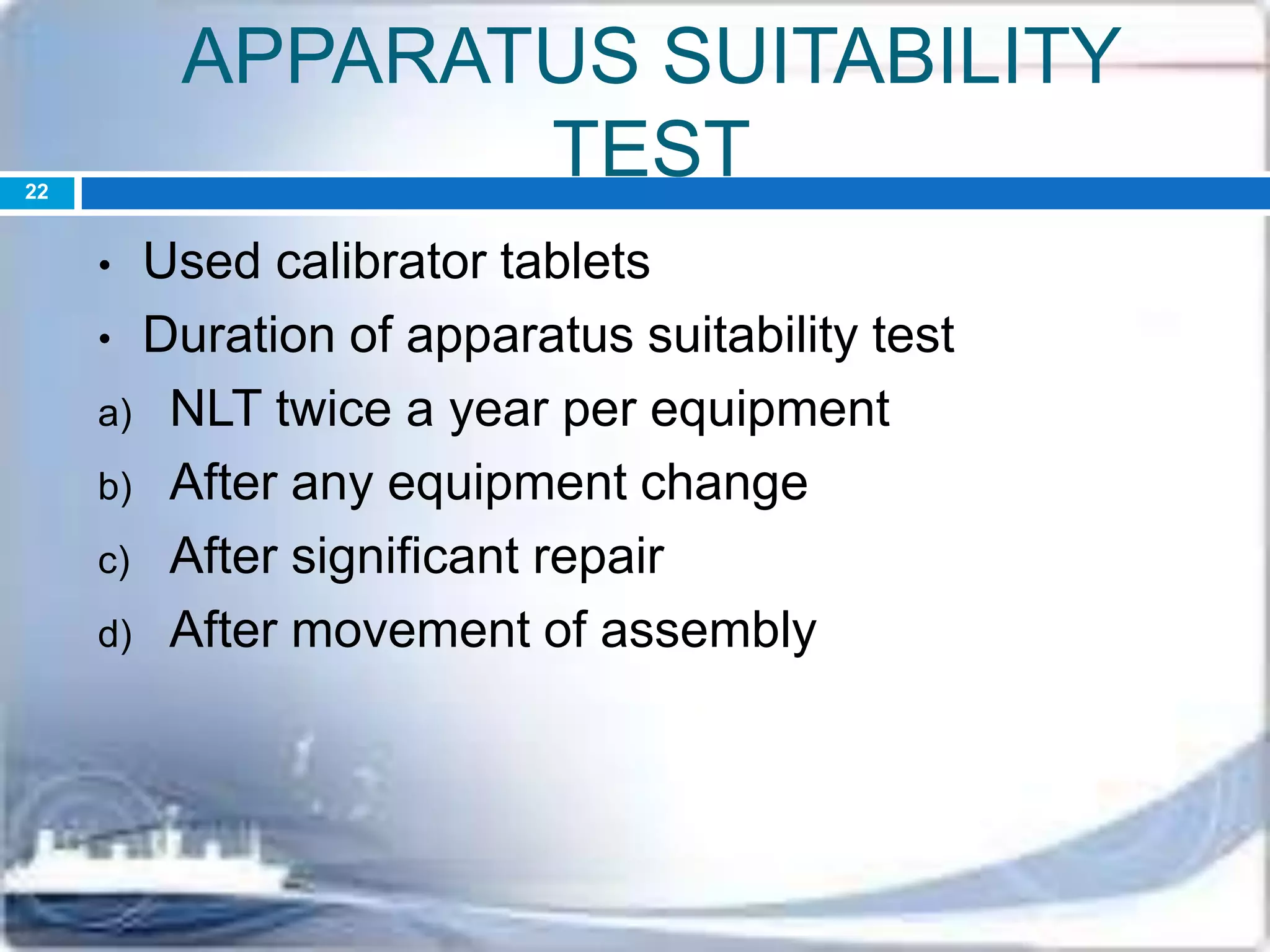
APPARATUS SUITABILITY
TEST
• Used calibrator tablets
• Duration of apparatus suitability test
a) NLT twice a year per equipment
b) After any equipment change
c) After significant repair
d) After movement of assembly
22
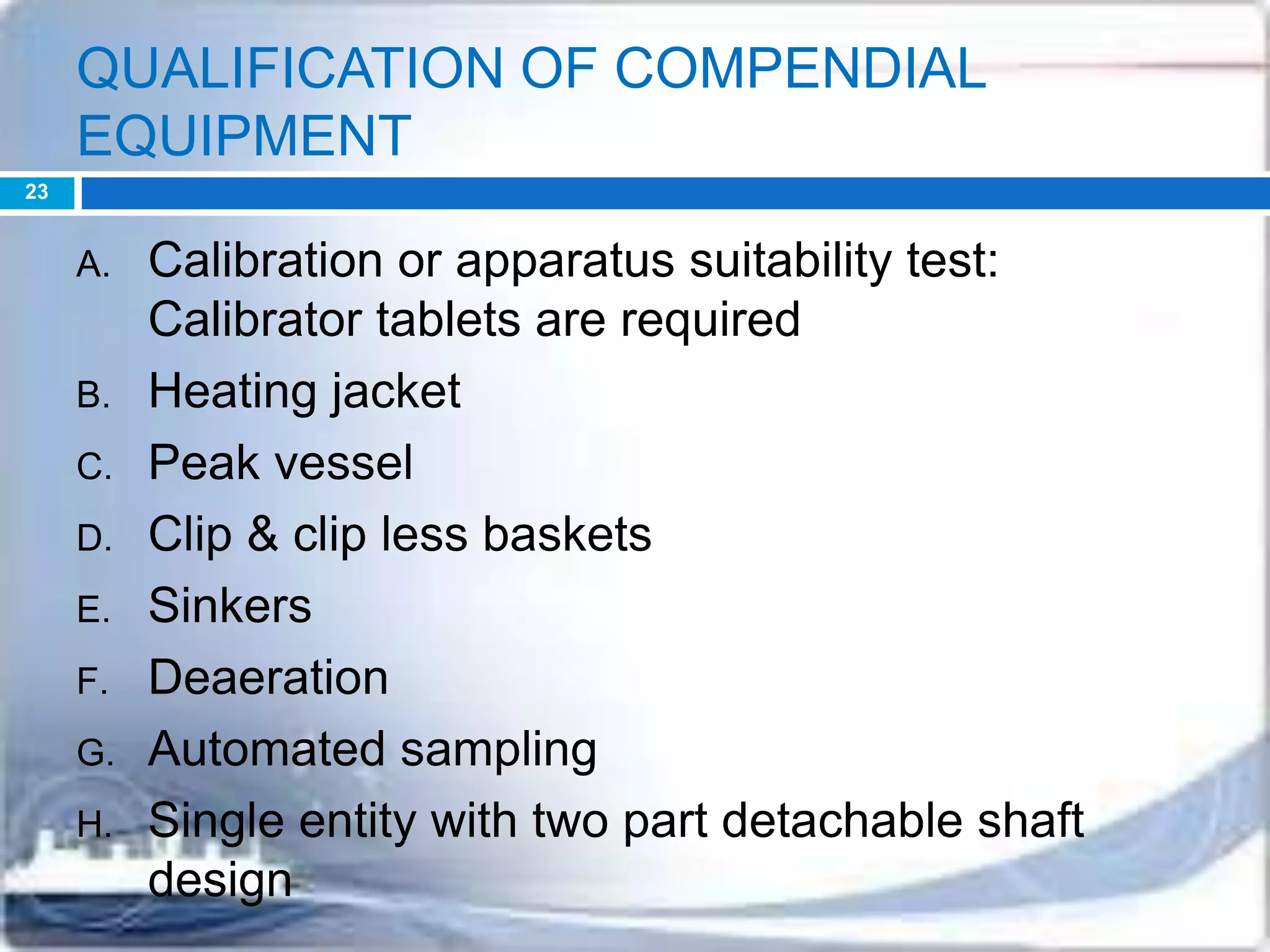
QUALIFICATION OF COMPENDIAL
EQUIPMENT
A. Calibration or apparatus suitability test:
Calibrator tablets are required
B. Heating jacket
C. Peak vessel
D. Clip & clip less baskets
E. Sinkers
F. Deaeration
G. Automated sampling
H. Single entity with two part detachable shaft
design
23
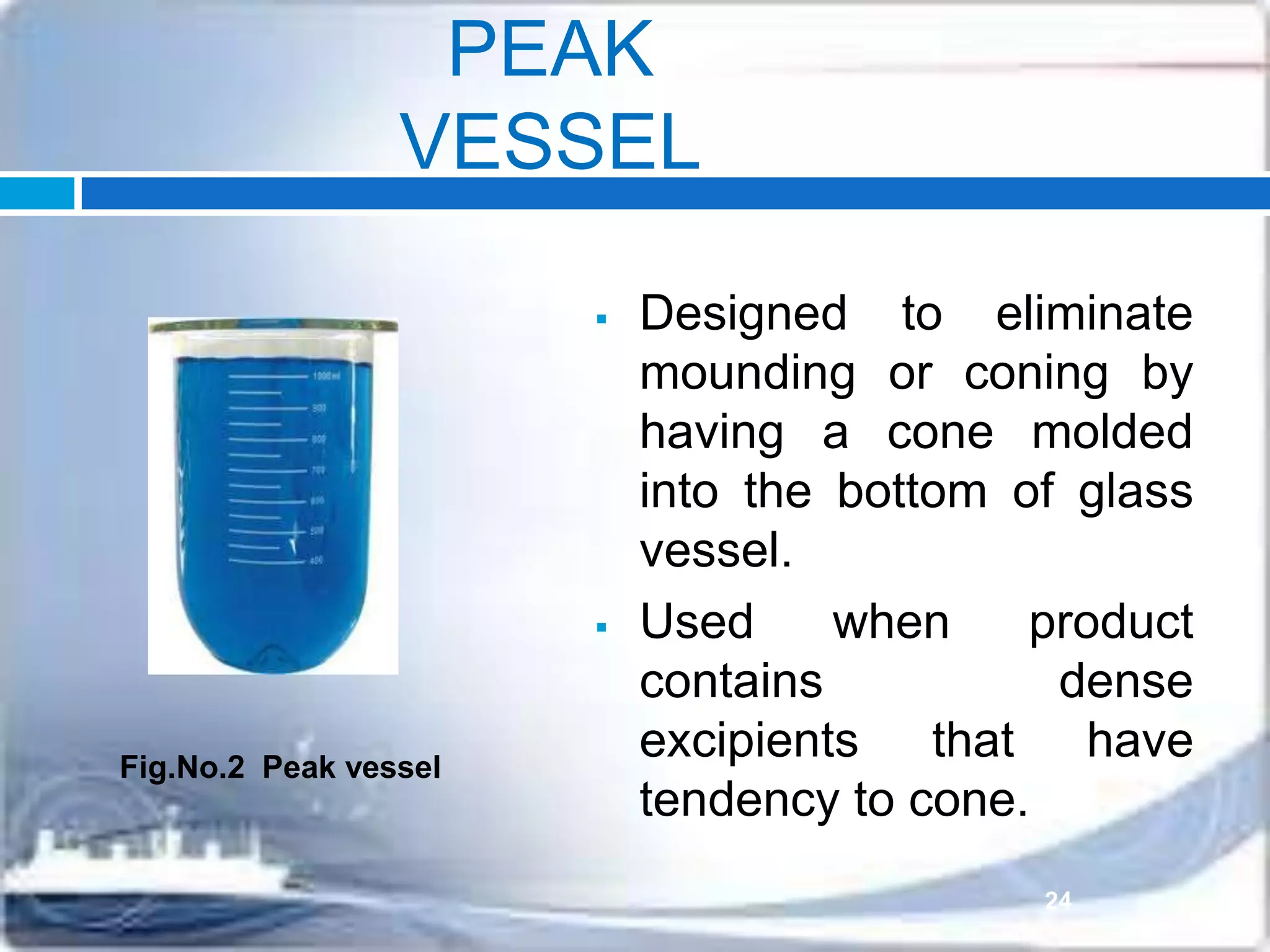
PEAK
VESSEL
 Designed to eliminate
mounding or coning by
having a cone molded
into the bottom of glass
vessel.
 Used when product
contains dense
excipients that have
tendency to cone.
Fig.No.2 Peak vessel
24
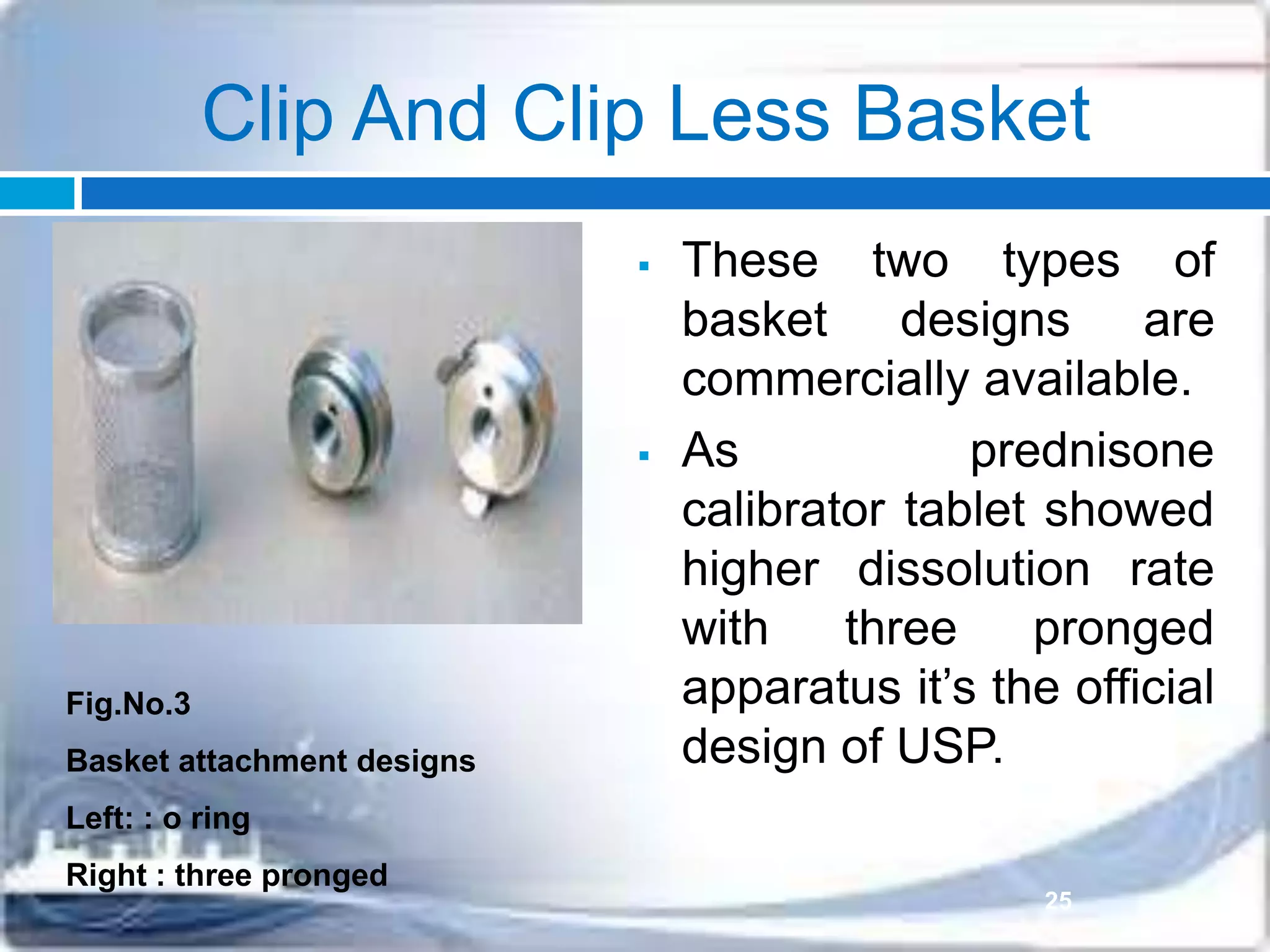
Clip And Clip Less Basket
 These two types of
basket designs are
commercially available.
 As prednisone
calibrator tablet showed
higher dissolution rate
with three pronged
apparatus it’s the official
design of USP.
Fig.No.3
Basket attachment designs
Left: : o ring
Right : three pronged
25
Drawbacks of O Ring And Three Pronged Apparatus
Design
O ring design
 In Robotic dissolution
tester, robotic arm
can remove o ring
type basket more
efficiently
 Gives different
results than 3
pronged apparatus
Three pronged
apparatus design
 Clips disturbs the
fluid flow in the
vessel
 Can weaken
overtime
 Causes basket to
attached too loosely
to shaft & increases
the wobble
26
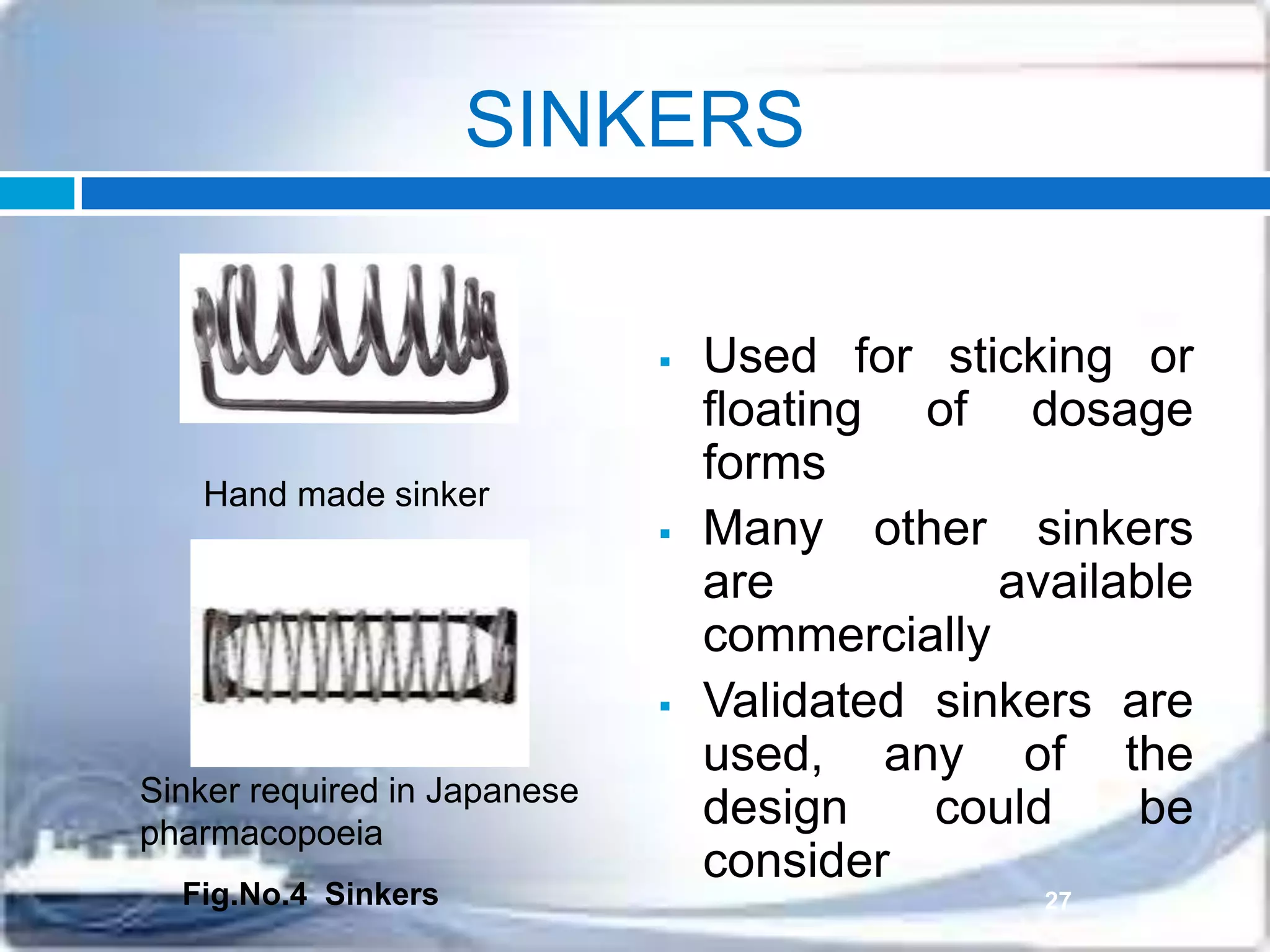
SINKERS
 Used for sticking or
floating of dosage
forms
 Many other sinkers
are available
commercially
 Validated sinkers are
used, any of the
design could be
consider
Hand made sinker
Sinker required in Japanese
pharmacopoeia
27Fig.No.4 Sinkers
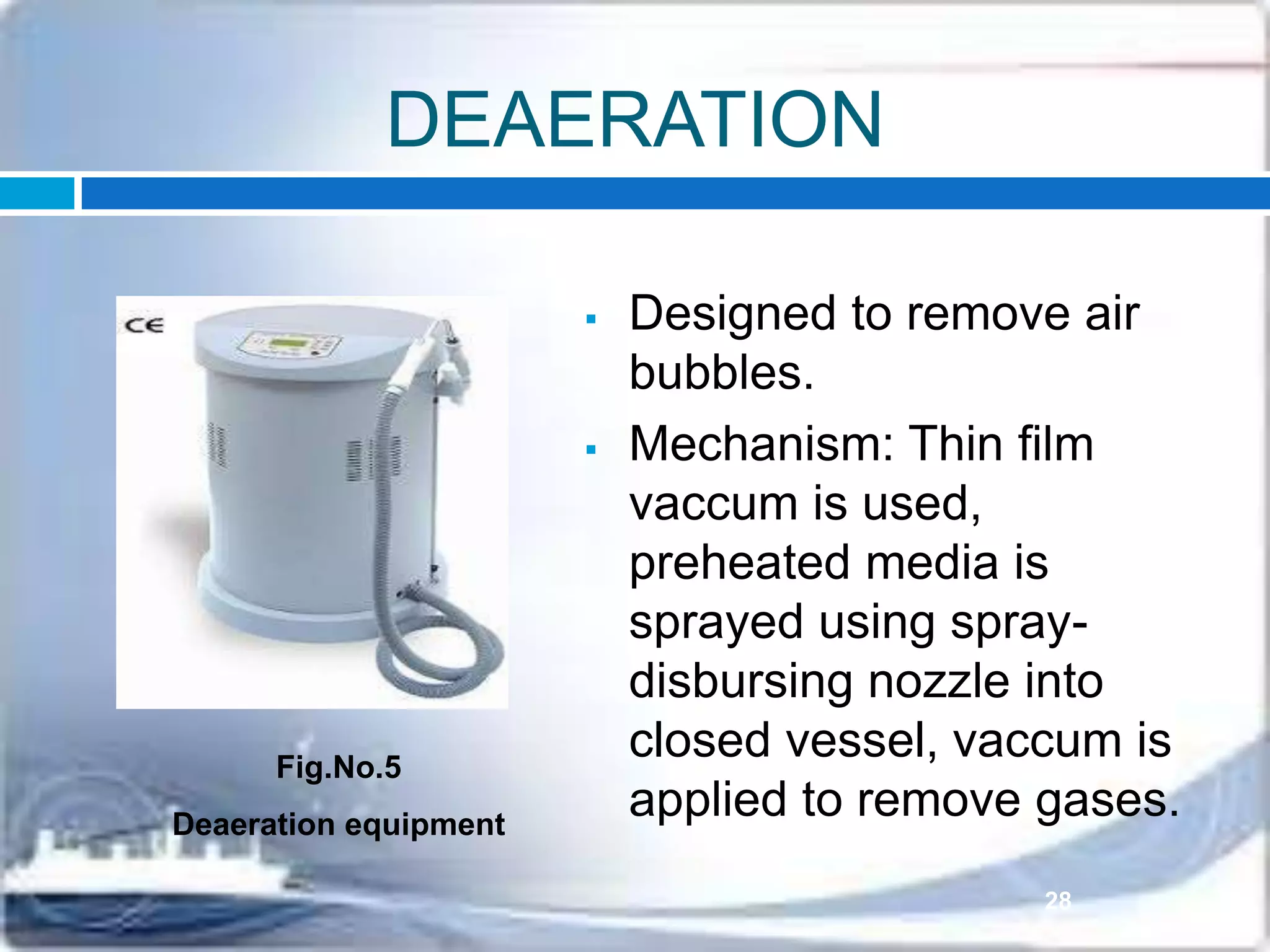
DEAERATION
 Designed to remove air
bubbles.
 Mechanism: Thin film
vaccum is used,
preheated media is
sprayed using spray-
disbursing nozzle into
closed vessel, vaccum is
applied to remove gases.
Fig.No.5
Deaeration equipment
28
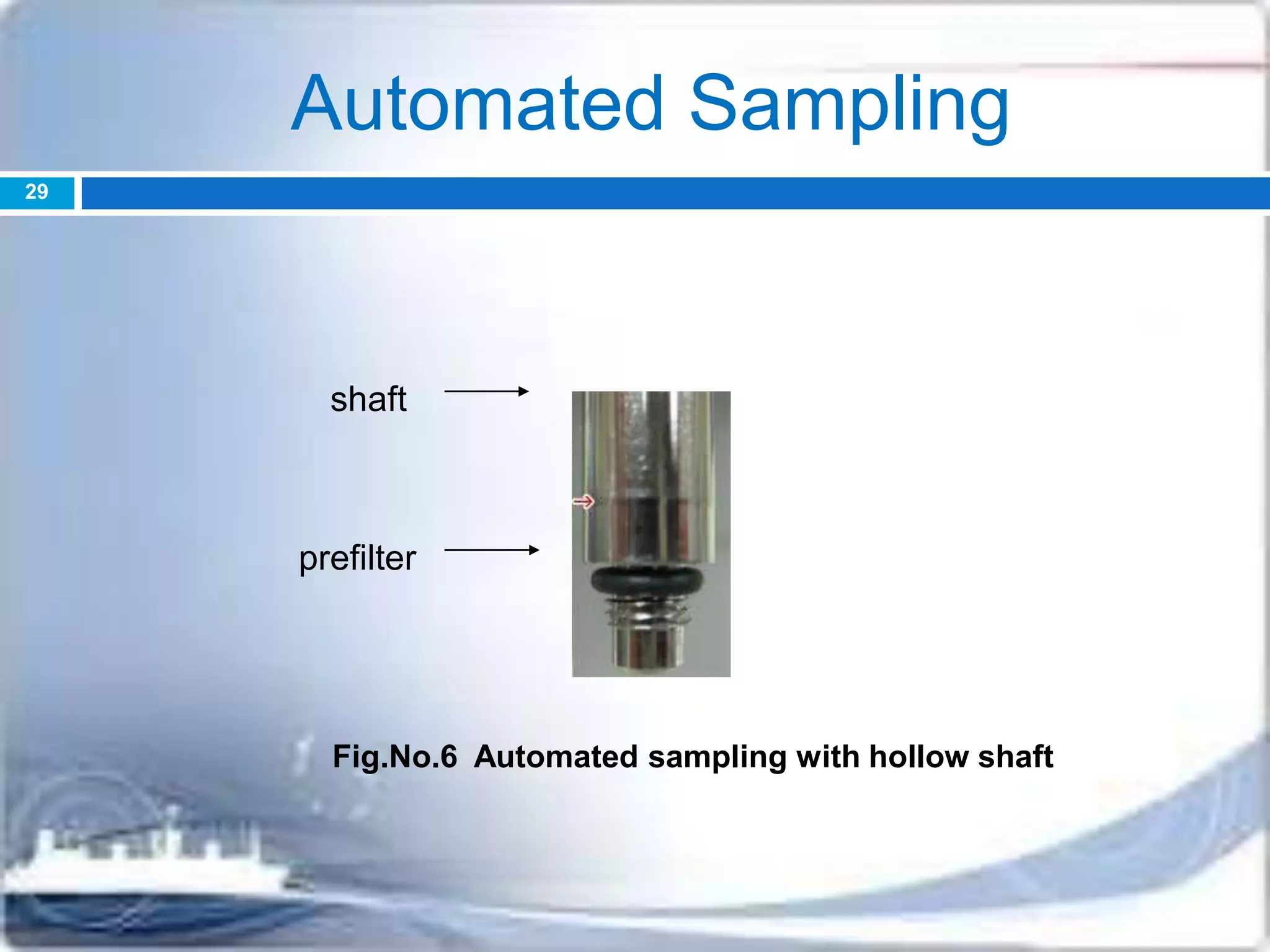
Automated Sampling
shaft
prefilter
Fig.No.6 Automated sampling with hollow shaft
29
ROTATION SPEED STUDY
 This study should be conducted during OQ
 Study includes measurement of speed of shaft
rotation.
 Speed should be measured with photo
tachometer for 30 mins.
 Speed of shaft rotation should be verified to be
within 4% of speed specified in monograph.
30
TEMPERATURE DISTRIBUTION
STUDY
 Study should be conducted during OQ
 Includes temperature mapping of each vessel
 Temp. should be mapped by using data
acquisition system for minimum time as per
monograph/1hr.
 Temperature of apparatus 1, 2, 3, 4 = 370 c ± 0.50
c
 Temperature of apparatus 5, 6 = 320 c ± 0.50 c
31
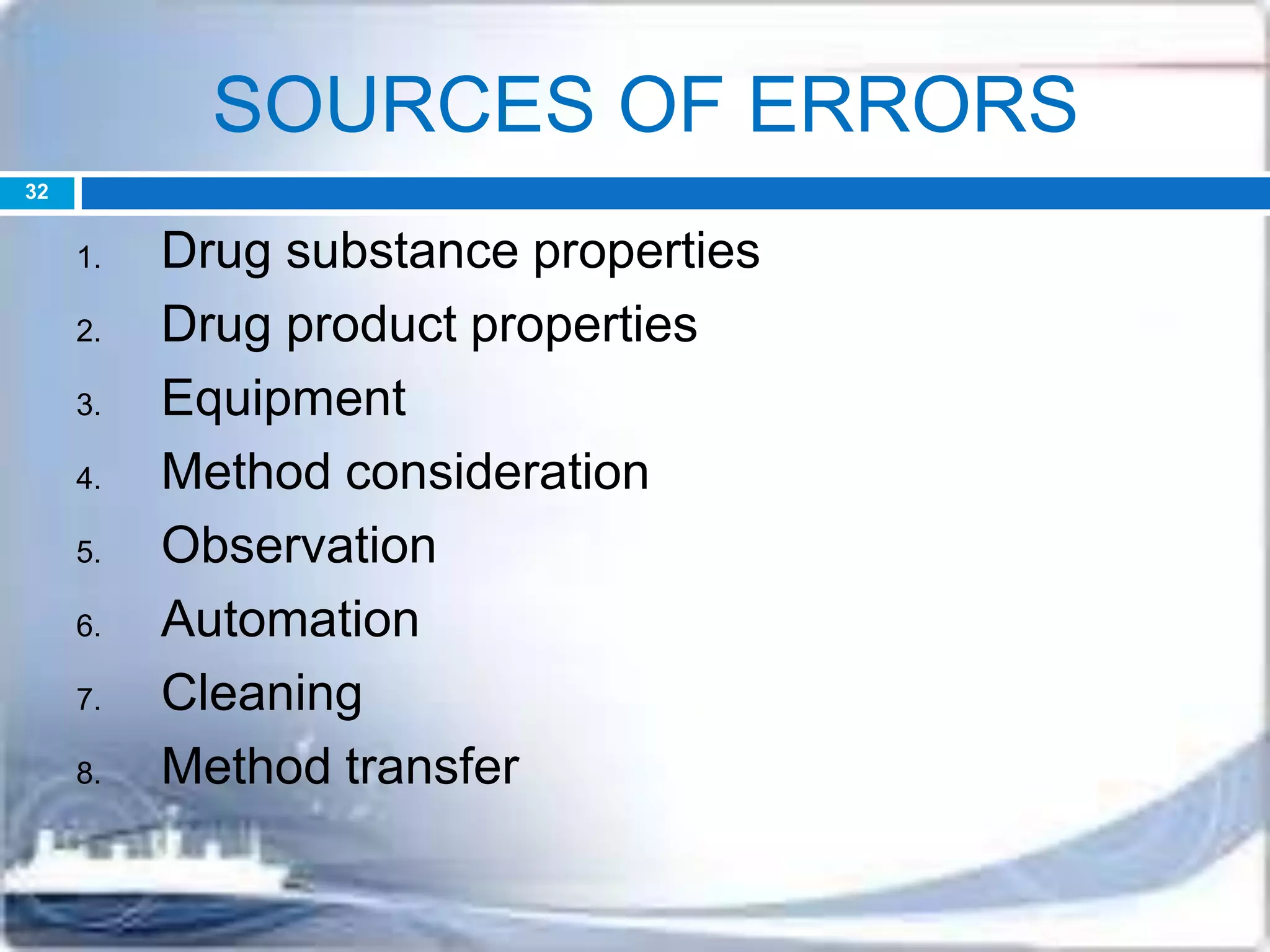
SOURCES OF ERRORS
1. Drug substance properties
2. Drug product properties
3. Equipment
4. Method consideration
5. Observation
6. Automation
7. Cleaning
8. Method transfer
32
SOURCES OF ERRORS
A] Drug substance properties
e.g. Solubility, pH
B] Drug product properties
Mechanical, formulation
C] Equipment
Mechanical & chemical aspects, Apparatus suitability test
D] Method consideration
To avoid errors
Film coated tablets-sticky-sinker
Suspension-syringe/pipette/beaker
Medium-volume difference
Presence of surfactants
33
SOURCES OF ERRORS
E] Observation
Sinkers-turns of wire helix-its effect
Manual sampling
F] Automation
Problems-disconnection, inadequate cleaning, mix-ups
G] Cleaning
Many products, same equipment major source of error
H] Method transfer
Sinkers, dispensing apparatus, sampling methods, precise
medium, standard preparations, grade of reagents
should be uniform.
34
CONCLUSION
At the conclusion acceptable OQ, IQ, PQ, DQ
the dissolution apparatus is considered,
validated and acceptable for use to perform
dissolution testing.
35
REFERENCES
• Abdou H. M. (1989). Dissolution, Bioavailability &
bioequivalence (pp.5-33,73-100). Easton Pennsylvania:
Mack publishing company.
• Ansel H. C., Popovich N. G.,& Allen L. V. (2010).
Pharmaceutical Dosage Forms and Drug Delivery Systems
(pp.151-153) Baltimore, Maryland: Lippincott Williams.
• Dressman J., & Kraimer J. (2005). Pharmaceutical
dissolution testing (PP.39-67) Singapore, New York: Taylor &
Francis Group.
• Frost S. M. A. (2004, Feb).Introduction to validation of
Dissolution apparatus (pp.19-21).Dissolution technology.
• Indian Pharmacopoeia (2007). Government of India, Ministry
of Health and Family welfare (vol -I, 179-181), Ghaziabad:
The Indian Pharmacopoeia Commission
36
REFERENCES
• Lachman L., Lieberman, & Kanig (2009).Theory and
Practice of Industrial Pharmacy (pp. 301-303,832-833), CBS
Publishers & Distributors.
• Martin A (1991). Physical Pharmacy, physical chemical
principles in pharmaceutical science (pp.352, 408-412),
Mumbai: K. M. Varghese company.
• Nash R. A., Berry I. R. (3rd ed). Pharmaceutical process
validation, Peither T. L., Equipment and facility (vol-129,
pp.443-463). New York: Marcel Dekker.
• The United States Pharmacopeia National Formulary ( USP
24, NF 19). Twinbrook parkway, Rockville: United States
Pharmacopeia Convention (pp.1941-1943)
37
38

Validation of dissolution apparatus

  • 1.
    Presented By- Miss S.M. Kumbhar Under the Guidance of- Dr. A. S. Kulkarni 1
  • 2.
    VALIDATION History-  Concept ofvalidation was first proposed by FDA officials in 1970, by Ted Byers & Bud Loftus.  Concept was first develop for equipment and process. 2
  • 3.
    REASONS FOR VALIDATION To improve Quality of Pharmaceuticals  To design system properly to provide high degree of assurance. 3
  • 4.
    VALIDATION Validation is processof establishing documented evidence that provides high degree of assurance that specific process will consistently produce a product meeting its predetermined specifications and quality. 4
  • 5.
  • 6.
    DISSOLUTION  Process bywhich known amount of drug substance goes into solution per unit time under standardized conditions.  Primary goal- to provide measurements for bioavailability & to demonstrate bioequivalence from batch to batch. 6
  • 7.
    NEEDS OF DISSOLUTION TESTING 1.To ensure continuity of product quality & performance of manufacturing process 2. Requirement for regulatory approval for product marketing Dissolution testing is conducted using dissolution test apparatus 7
  • 8.
    Validation of dissolutiontest apparatus. Why??? 8
  • 9.
    To have ahigh degree of assurance dissolution apparatus should be consistence and accurate in its performance. Therefore validation of this equipment is required. . Validation of Dissolution Test Apparatus9
  • 10.
    QUALIFICATION To ensure thatequipment is fit for intended purpose, there are no. of qualifying steps that vendor / analyst should apply to analytical instruments. Equipment is evaluated through these tests & successful completion justifies instrument operates and performs 10
  • 11.
    Fig.No.1 Steps ofQualification11
  • 12.
    DESIGN QUALIFICATION When developing dissolutionmethod DQ is built into apparatus selection of process, Dosage form & delivery system will determine choice of equipment. Example-first choice for beaded product may be USP app 3…… as it is designed to confine beads in a screened-in cylinder. 12
  • 13.
    INSTALLATION QUALIFICATION Used to verifythat instrument has assembled in the appropriate environment & its functioning according to predefined set of limit. Example- Setting up fully automated dissolution testing apparatus requires: proper plumbing, hot water source, stable bench top. 13
  • 14.
    OPERATIONAL QUALIFICATION During this qualificationanalyst or vendor assess that equipment works as specified & generates documented data. Example- For dissolution water bath temperature, shaft rpm speed would be obvious operational parameters 14
  • 15.
    PERFORMANCE QUALIFICATION This is conductedto ensure that system is in normal operating environment & performing designed set of tasks within the specifications. Example- Centering, wobble, height of paddle or basket attached to shaft, speed, temperature 15
  • 16.
    DISSOLUTION TEST APPARATUS NON - COMPENDIAL COMPENDIAL NON–COMPENDIALEQUIPMENTS: Rotating bottle, mini paddle, mega paddle, beaker method, peak vessel, diffusion cells, chewing gum apparatus etc. COMPENDIAL EQUIPMENTS: USP Apparatus 1-7 16
  • 17.
  • 18.
    COMPENDIAL EQUIPMENTS Apps. No. USP IP 1 Rotatingbasket Paddle assembly 2 Paddle Assembly Rotating basket 3 Reciprocating cylinder 4 Flow through cell 5 Paddle over disk 6 Cylinder 7 Reciprocating holder 18 Table No. 1 Compendial Equipment
  • 19.
    QUALIFICATION OF NON-COMPENDIAL EQUIPMENT Ifequipment is commercial product IQ and OQ can be obtained from the equipment vendor which includes vendor specification and tolerances for equipment. But if equipment is in-house design then process becomes difficult. We have to look at adjustments & moving parts, obtain operational parameters i. e. agitation rate, flow rate, 19
  • 20.
    METHODS A] Calibration  Non-compendial& some compendial apparatus do not have calibrator tablets, in some case in house calibrator tablets are designed.  Some unique aspects of equipment can only be detected with USP calibrated tablets, there are no practical measuring tools available for analyst. e.g. vibration and vessel irregularities. 20
  • 21.
    B] HYDRODYNAMICS Dissolution fluidflow should be free from irregularities or variable turbulence. Highly variable data may be unsuitable for that product. C] OTHER CONSIDERATIONS- Ruggedness should be thoroughly evaluated before considering transferring product testing to another site.21
  • 22.
    APPARATUS SUITABILITY TEST • Usedcalibrator tablets • Duration of apparatus suitability test a) NLT twice a year per equipment b) After any equipment change c) After significant repair d) After movement of assembly 22
  • 23.
    QUALIFICATION OF COMPENDIAL EQUIPMENT A.Calibration or apparatus suitability test: Calibrator tablets are required B. Heating jacket C. Peak vessel D. Clip & clip less baskets E. Sinkers F. Deaeration G. Automated sampling H. Single entity with two part detachable shaft design 23
  • 24.
    PEAK VESSEL  Designed toeliminate mounding or coning by having a cone molded into the bottom of glass vessel.  Used when product contains dense excipients that have tendency to cone. Fig.No.2 Peak vessel 24
  • 25.
    Clip And ClipLess Basket  These two types of basket designs are commercially available.  As prednisone calibrator tablet showed higher dissolution rate with three pronged apparatus it’s the official design of USP. Fig.No.3 Basket attachment designs Left: : o ring Right : three pronged 25
  • 26.
    Drawbacks of ORing And Three Pronged Apparatus Design O ring design  In Robotic dissolution tester, robotic arm can remove o ring type basket more efficiently  Gives different results than 3 pronged apparatus Three pronged apparatus design  Clips disturbs the fluid flow in the vessel  Can weaken overtime  Causes basket to attached too loosely to shaft & increases the wobble 26
  • 27.
    SINKERS  Used forsticking or floating of dosage forms  Many other sinkers are available commercially  Validated sinkers are used, any of the design could be consider Hand made sinker Sinker required in Japanese pharmacopoeia 27Fig.No.4 Sinkers
  • 28.
    DEAERATION  Designed toremove air bubbles.  Mechanism: Thin film vaccum is used, preheated media is sprayed using spray- disbursing nozzle into closed vessel, vaccum is applied to remove gases. Fig.No.5 Deaeration equipment 28
  • 29.
  • 30.
    ROTATION SPEED STUDY This study should be conducted during OQ  Study includes measurement of speed of shaft rotation.  Speed should be measured with photo tachometer for 30 mins.  Speed of shaft rotation should be verified to be within 4% of speed specified in monograph. 30
  • 31.
    TEMPERATURE DISTRIBUTION STUDY  Studyshould be conducted during OQ  Includes temperature mapping of each vessel  Temp. should be mapped by using data acquisition system for minimum time as per monograph/1hr.  Temperature of apparatus 1, 2, 3, 4 = 370 c ± 0.50 c  Temperature of apparatus 5, 6 = 320 c ± 0.50 c 31
  • 32.
    SOURCES OF ERRORS 1.Drug substance properties 2. Drug product properties 3. Equipment 4. Method consideration 5. Observation 6. Automation 7. Cleaning 8. Method transfer 32
  • 33.
    SOURCES OF ERRORS A]Drug substance properties e.g. Solubility, pH B] Drug product properties Mechanical, formulation C] Equipment Mechanical & chemical aspects, Apparatus suitability test D] Method consideration To avoid errors Film coated tablets-sticky-sinker Suspension-syringe/pipette/beaker Medium-volume difference Presence of surfactants 33
  • 34.
    SOURCES OF ERRORS E]Observation Sinkers-turns of wire helix-its effect Manual sampling F] Automation Problems-disconnection, inadequate cleaning, mix-ups G] Cleaning Many products, same equipment major source of error H] Method transfer Sinkers, dispensing apparatus, sampling methods, precise medium, standard preparations, grade of reagents should be uniform. 34
  • 35.
    CONCLUSION At the conclusionacceptable OQ, IQ, PQ, DQ the dissolution apparatus is considered, validated and acceptable for use to perform dissolution testing. 35
  • 36.
    REFERENCES • Abdou H.M. (1989). Dissolution, Bioavailability & bioequivalence (pp.5-33,73-100). Easton Pennsylvania: Mack publishing company. • Ansel H. C., Popovich N. G.,& Allen L. V. (2010). Pharmaceutical Dosage Forms and Drug Delivery Systems (pp.151-153) Baltimore, Maryland: Lippincott Williams. • Dressman J., & Kraimer J. (2005). Pharmaceutical dissolution testing (PP.39-67) Singapore, New York: Taylor & Francis Group. • Frost S. M. A. (2004, Feb).Introduction to validation of Dissolution apparatus (pp.19-21).Dissolution technology. • Indian Pharmacopoeia (2007). Government of India, Ministry of Health and Family welfare (vol -I, 179-181), Ghaziabad: The Indian Pharmacopoeia Commission 36
  • 37.
    REFERENCES • Lachman L.,Lieberman, & Kanig (2009).Theory and Practice of Industrial Pharmacy (pp. 301-303,832-833), CBS Publishers & Distributors. • Martin A (1991). Physical Pharmacy, physical chemical principles in pharmaceutical science (pp.352, 408-412), Mumbai: K. M. Varghese company. • Nash R. A., Berry I. R. (3rd ed). Pharmaceutical process validation, Peither T. L., Equipment and facility (vol-129, pp.443-463). New York: Marcel Dekker. • The United States Pharmacopeia National Formulary ( USP 24, NF 19). Twinbrook parkway, Rockville: United States Pharmacopeia Convention (pp.1941-1943) 37
  • 38.