DISSOLUTION
P. KRISHNAMOORTHY
RESEARCH ASSOCIATE
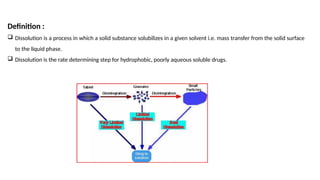
Definition :
 Dissolution is a process in which a solid substance solubilizes in a given solvent i.e. mass transfer from the solid surface
to the liquid phase.
 Dissolution is the rate determining step for hydrophobic, poorly aqueous soluble drugs.
Background:
 New drug applications (NDAs) submitted to the Food and Drug Administration (FDA) contain bioavailability data and in
vitro dissolution data, that, together with chemistry, manufacturing, and controls (CMC) data, characterize the quality
and performance of the drug product.
 In vitro dissolution data are generally obtained from batches that have been used in pivotal clinical and/or
bioavailability studies and from other human studies conducted during product development.
 Acceptable bioequivalence data and comparable in vitro dissolution and CMC data are required for approval of
abbreviated new drug applications(ANDA).
BIOPHARMACEUTICS CLASSIFICATION SYSTEM:
 The BCS suggests that for high solubility, high permeability (case 1) drugs and in some instances for high solubility,
low permeability (case 3) drugs, 85% dissolution in 0.1N HCl in 15 minutes can ensure that the bioavailability of the
drug is not limited by dissolution.
 In these cases, the rate limiting step for drug absorption is gastric emptying. The mean T50% gastric residence
(emptying) time is 15-20 minutes under fasting conditions. Based on this information, a conservative conclusion is that
a drug product undergoing 85% dissolution in 15 minutes under mild dissolution test conditions in 0.1N HCl behaves
like a solution and generally should not have any bioavailability problems.
 If the dissolution is slower than gastric emptying, a dissolution profile with multiple time points in multimedia is
recommended.
 In the case of low solubility/high permeability drugs (case 2), drug dissolution may be the rate limiting step for
drug absorption and an IVIVC may be expected.
 A dissolution profile in multiple media is recommended for drug products in this category. In the case of high
solubility/low permeability drugs (case 3), permeability is the rate controlling step and a limited IVIVC may be
possible, depending on the relative rates of dissolution and intestinal transit.
 Drugs in case 4 (i.e., low solubility/low permeability drugs) present significant problems for oral drug delivery.
Why dissolution studies?
1. To show that the release of drug from the tablet is close to 100%.
2. To show that the rate of drug release is uniform batch to batch.
3. And to show that release is equivalent to those batches proven to be bioavailable and clinically effective.
Mechanism of dissolution:
i. Diffusion layer model
ii. Danckwert’s model
iii. Interfacial barrier model
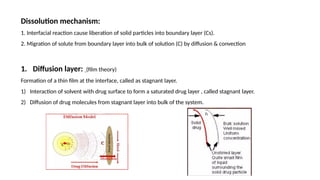
Dissolution mechanism:
1. Interfacial reaction cause liberation of solid particles into boundary layer (Cs).
2. Migration of solute from boundary layer into bulk of solution (C) by diffusion & convection
1. Diffusion layer: (film theory)
Formation of a thin film at the interface, called as stagnant layer.
1) Interaction of solvent with drug surface to form a saturated drug layer , called stagnant layer.
2) Diffusion of drug molecules from stagnant layer into bulk of the system.
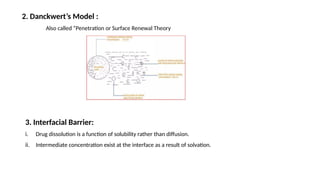
2. Danckwert’s Model :
Also called “Penetration or Surface Renewal Theory
3. Interfacial Barrier:
i. Drug dissolution is a function of solubility rather than diffusion.
ii. Intermediate concentration exist at the interface as a result of solvation.
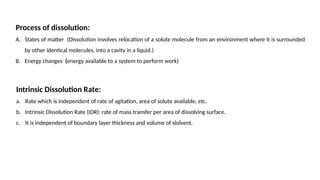
Process of dissolution:
A. States of matter (Dissolution involves relocation of a solute molecule from an environment where it is surrounded
by other identical molecules, into a cavity in a liquid.)
B. Energy changes (energy available to a system to perform work)
Intrinsic Dissolution Rate:
a. Rate which is independent of rate of agitation, area of solute available, etc.
b. Intrinsic Dissolution Rate (IDR): rate of mass transfer per area of dissolving surface.
c. It is independent of boundary layer thickness and volume of slolvent.
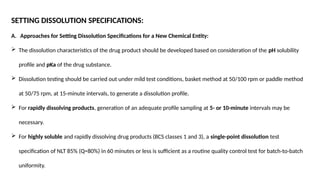
SETTING DISSOLUTION SPECIFICATIONS:
A. Approaches for Setting Dissolution Specifications for a New Chemical Entity:
 The dissolution characteristics of the drug product should be developed based on consideration of the pH solubility
profile and pKa of the drug substance.
 Dissolution testing should be carried out under mild test conditions, basket method at 50/100 rpm or paddle method
at 50/75 rpm, at 15-minute intervals, to generate a dissolution profile.
 For rapidly dissolving products, generation of an adequate profile sampling at 5- or 10-minute intervals may be
necessary.
 For highly soluble and rapidly dissolving drug products (BCS classes 1 and 3), a single-point dissolution test
specification of NLT 85% (Q=80%) in 60 minutes or less is sufficient as a routine quality control test for batch-to-batch
uniformity.
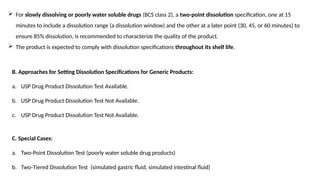
B. Approaches for Setting Dissolution Specifications for Generic Products:
a. USP Drug Product Dissolution Test Available.
b. USP Drug Product Dissolution Test Not Available.
c. USP Drug Product Dissolution Test Not Available.
C. Special Cases:
a. Two-Point Dissolution Test (poorly water soluble drug products)
b. Two-Tiered Dissolution Test (simulated gastric fluid, simulated intestinal fluid)
 For slowly dissolving or poorly water soluble drugs (BCS class 2), a two-point dissolution specification, one at 15
minutes to include a dissolution range (a dissolution window) and the other at a later point (30, 45, or 60 minutes) to
ensure 85% dissolution, is recommended to characterize the quality of the product.
 The product is expected to comply with dissolution specifications throughout its shelf life.
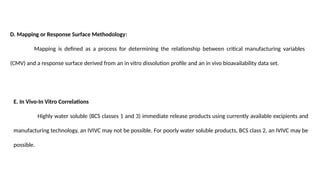
D. Mapping or Response Surface Methodology:
Mapping is defined as a process for determining the relationship between critical manufacturing variables
(CMV) and a response surface derived from an in vitro dissolution profile and an in vivo bioavailability data set.
E. In Vivo-In Vitro Correlations
Highly water soluble (BCS classes 1 and 3) immediate release products using currently available excipients and
manufacturing technology, an IVIVC may not be possible. For poorly water soluble products, BCS class 2, an IVIVC may be
possible.
Measurement of dissolution:
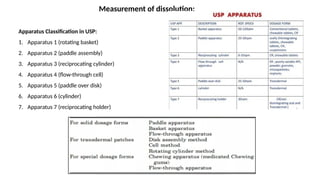
Apparatus Classification in USP:
1. Apparatus 1 (rotating basket)
2. Apparatus 2 (paddle assembly)
3. Apparatus 3 (reciprocating cylinder)
4. Apparatus 4 (flow-through cell)
5. Apparatus 5 (paddle over disk)
6. Apparatus 6 (cylinder)
7. Apparatus 7 (reciprocating holder)
Dissolution Medium:
 The testing conditions should be based on physicochemical characteristics of the drug substance and the environmental
conditions the dosage form might be exposed to after oral administration.
 The volume of the dissolution medium is generally 500, 900, or 1000 mL. Sink conditions are desirable but not mandatory.
 An aqueous medium with pH range 1.2 to 6.8 (ionic strength of buffers the same as in USP) should be used. To simulate
intestinal fluid (SIF), a dissolution medium of pH 6.8 should be employed.
 A higher pH should be justified on a case-by-case basis and, in general, should not exceed pH 8.0. To simulate gastric fluid
(SGF), a dissolution medium of pH 1.2 should be employed without enzymes.
 Use of water as a dissolution medium also is discouraged because test conditions such as pH and surface tension
can vary depending on the source of water and may change during the dissolution test itself, due to the influence
of the active and inactive ingredients.
 All dissolution tests for IR dosage forms should be conducted at 37±0.5°C. The basket and paddle method can be
used for performing dissolution tests under multimedia conditions (e.g., the initial dissolution test can be carried
out at pH 1.2, and, after a suitable time interval, a small amount of buffer can be added to raise pH to 6.8).
 Alternatively, if addition of an enzyme is desired, it can be added after initial studies (without enzymes). Use of
Apparatus 3 allows easy change of the medium. Apparatus 4 can also be adopted for a change in dissolution
medium during the dissolution run.
DISSOLUTION PRESENTATION, Tical Bio Park, Chennai.

DISSOLUTION PRESENTATION, Tical Bio Park, Chennai.

  • 1.
  • 2.
    Definition :  Dissolutionis a process in which a solid substance solubilizes in a given solvent i.e. mass transfer from the solid surface to the liquid phase.  Dissolution is the rate determining step for hydrophobic, poorly aqueous soluble drugs.
  • 3.
    Background:  New drugapplications (NDAs) submitted to the Food and Drug Administration (FDA) contain bioavailability data and in vitro dissolution data, that, together with chemistry, manufacturing, and controls (CMC) data, characterize the quality and performance of the drug product.  In vitro dissolution data are generally obtained from batches that have been used in pivotal clinical and/or bioavailability studies and from other human studies conducted during product development.  Acceptable bioequivalence data and comparable in vitro dissolution and CMC data are required for approval of abbreviated new drug applications(ANDA).
  • 4.
    BIOPHARMACEUTICS CLASSIFICATION SYSTEM: The BCS suggests that for high solubility, high permeability (case 1) drugs and in some instances for high solubility, low permeability (case 3) drugs, 85% dissolution in 0.1N HCl in 15 minutes can ensure that the bioavailability of the drug is not limited by dissolution.  In these cases, the rate limiting step for drug absorption is gastric emptying. The mean T50% gastric residence (emptying) time is 15-20 minutes under fasting conditions. Based on this information, a conservative conclusion is that a drug product undergoing 85% dissolution in 15 minutes under mild dissolution test conditions in 0.1N HCl behaves like a solution and generally should not have any bioavailability problems.  If the dissolution is slower than gastric emptying, a dissolution profile with multiple time points in multimedia is recommended.
  • 5.
     In thecase of low solubility/high permeability drugs (case 2), drug dissolution may be the rate limiting step for drug absorption and an IVIVC may be expected.  A dissolution profile in multiple media is recommended for drug products in this category. In the case of high solubility/low permeability drugs (case 3), permeability is the rate controlling step and a limited IVIVC may be possible, depending on the relative rates of dissolution and intestinal transit.  Drugs in case 4 (i.e., low solubility/low permeability drugs) present significant problems for oral drug delivery.
  • 6.
    Why dissolution studies? 1.To show that the release of drug from the tablet is close to 100%. 2. To show that the rate of drug release is uniform batch to batch. 3. And to show that release is equivalent to those batches proven to be bioavailable and clinically effective. Mechanism of dissolution: i. Diffusion layer model ii. Danckwert’s model iii. Interfacial barrier model
  • 7.
    Dissolution mechanism: 1. Interfacialreaction cause liberation of solid particles into boundary layer (Cs). 2. Migration of solute from boundary layer into bulk of solution (C) by diffusion & convection 1. Diffusion layer: (film theory) Formation of a thin film at the interface, called as stagnant layer. 1) Interaction of solvent with drug surface to form a saturated drug layer , called stagnant layer. 2) Diffusion of drug molecules from stagnant layer into bulk of the system.
  • 8.
    2. Danckwert’s Model: Also called “Penetration or Surface Renewal Theory 3. Interfacial Barrier: i. Drug dissolution is a function of solubility rather than diffusion. ii. Intermediate concentration exist at the interface as a result of solvation.
  • 9.
    Process of dissolution: A.States of matter (Dissolution involves relocation of a solute molecule from an environment where it is surrounded by other identical molecules, into a cavity in a liquid.) B. Energy changes (energy available to a system to perform work) Intrinsic Dissolution Rate: a. Rate which is independent of rate of agitation, area of solute available, etc. b. Intrinsic Dissolution Rate (IDR): rate of mass transfer per area of dissolving surface. c. It is independent of boundary layer thickness and volume of slolvent.
  • 10.
    SETTING DISSOLUTION SPECIFICATIONS: A.Approaches for Setting Dissolution Specifications for a New Chemical Entity:  The dissolution characteristics of the drug product should be developed based on consideration of the pH solubility profile and pKa of the drug substance.  Dissolution testing should be carried out under mild test conditions, basket method at 50/100 rpm or paddle method at 50/75 rpm, at 15-minute intervals, to generate a dissolution profile.  For rapidly dissolving products, generation of an adequate profile sampling at 5- or 10-minute intervals may be necessary.  For highly soluble and rapidly dissolving drug products (BCS classes 1 and 3), a single-point dissolution test specification of NLT 85% (Q=80%) in 60 minutes or less is sufficient as a routine quality control test for batch-to-batch uniformity.
  • 11.
    B. Approaches forSetting Dissolution Specifications for Generic Products: a. USP Drug Product Dissolution Test Available. b. USP Drug Product Dissolution Test Not Available. c. USP Drug Product Dissolution Test Not Available. C. Special Cases: a. Two-Point Dissolution Test (poorly water soluble drug products) b. Two-Tiered Dissolution Test (simulated gastric fluid, simulated intestinal fluid)  For slowly dissolving or poorly water soluble drugs (BCS class 2), a two-point dissolution specification, one at 15 minutes to include a dissolution range (a dissolution window) and the other at a later point (30, 45, or 60 minutes) to ensure 85% dissolution, is recommended to characterize the quality of the product.  The product is expected to comply with dissolution specifications throughout its shelf life.
  • 12.
    D. Mapping orResponse Surface Methodology: Mapping is defined as a process for determining the relationship between critical manufacturing variables (CMV) and a response surface derived from an in vitro dissolution profile and an in vivo bioavailability data set. E. In Vivo-In Vitro Correlations Highly water soluble (BCS classes 1 and 3) immediate release products using currently available excipients and manufacturing technology, an IVIVC may not be possible. For poorly water soluble products, BCS class 2, an IVIVC may be possible.
  • 13.
    Measurement of dissolution: ApparatusClassification in USP: 1. Apparatus 1 (rotating basket) 2. Apparatus 2 (paddle assembly) 3. Apparatus 3 (reciprocating cylinder) 4. Apparatus 4 (flow-through cell) 5. Apparatus 5 (paddle over disk) 6. Apparatus 6 (cylinder) 7. Apparatus 7 (reciprocating holder)
  • 14.
    Dissolution Medium:  Thetesting conditions should be based on physicochemical characteristics of the drug substance and the environmental conditions the dosage form might be exposed to after oral administration.  The volume of the dissolution medium is generally 500, 900, or 1000 mL. Sink conditions are desirable but not mandatory.  An aqueous medium with pH range 1.2 to 6.8 (ionic strength of buffers the same as in USP) should be used. To simulate intestinal fluid (SIF), a dissolution medium of pH 6.8 should be employed.  A higher pH should be justified on a case-by-case basis and, in general, should not exceed pH 8.0. To simulate gastric fluid (SGF), a dissolution medium of pH 1.2 should be employed without enzymes.
  • 15.
     Use ofwater as a dissolution medium also is discouraged because test conditions such as pH and surface tension can vary depending on the source of water and may change during the dissolution test itself, due to the influence of the active and inactive ingredients.  All dissolution tests for IR dosage forms should be conducted at 37±0.5°C. The basket and paddle method can be used for performing dissolution tests under multimedia conditions (e.g., the initial dissolution test can be carried out at pH 1.2, and, after a suitable time interval, a small amount of buffer can be added to raise pH to 6.8).  Alternatively, if addition of an enzyme is desired, it can be added after initial studies (without enzymes). Use of Apparatus 3 allows easy change of the medium. Apparatus 4 can also be adopted for a change in dissolution medium during the dissolution run.