Presented by:
K. ARSHAD AHMED KHAN M.Pharm, (Ph.D)
Department of Pharmaceutics,
Raghavendra Institute of Pharmaceutical Education and Research [RIPER]
Anantapur.
CHAPTER- 4
DISSOLUTION TESTING:
1. Introduction to dissolution equipment
2. Calibration of dissolution apparatus
3. Dissolution procedure development and
validation
4. Dissolution method development for
generic drug product,
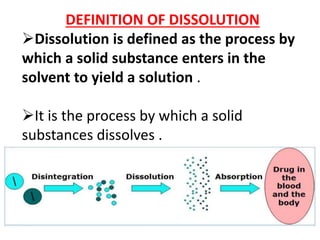
DEFINITION OF DISSOLUTION
Dissolution is defined as the process by
which a solid substance enters in the
solvent to yield a solution .
It is the process by which a solid
substances dissolves .
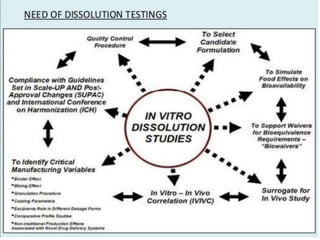
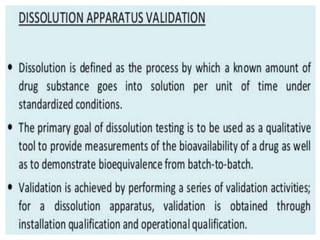
In-vitro dissolution tests are used to
(1) Assess the lot-to lot quality of drug product
(2) Guide development of new formulations
(3 ) Ensure continuing quality & performance during the
changes, such as, change in formulation, manufacturing
process, site of manufacturing etc.
So, the dissolution testing is an important tool-
1) For characterizing the biopharmaceutical quality of
product
2) For evaluation of active ingredients
3) For evaluation of possible risk such as - Dose dumping,
Food effects, Interaction with other drugs
HISTORY of DISSOLUTION
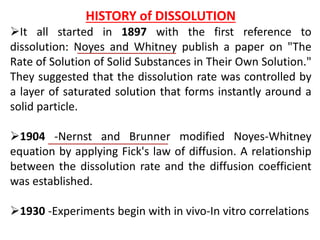
It all started in 1897 with the first reference to
dissolution: Noyes and Whitney publish a paper on "The
Rate of Solution of Solid Substances in Their Own Solution."
They suggested that the dissolution rate was controlled by
a layer of saturated solution that forms instantly around a
solid particle.
1904 -Nernst and Brunner modified Noyes-Whitney
equation by applying Fick's law of diffusion. A relationship
between the dissolution rate and the diffusion coefficient
was established.
1930 -Experiments begin with in vivo-In vitro correlations
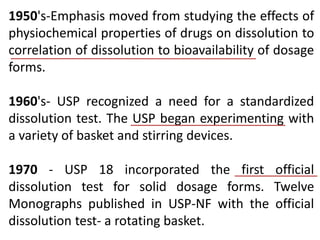
1950's-Emphasis moved from studying the effects of
physiochemical properties of drugs on dissolution to
correlation of dissolution to bioavailability of dosage
forms.
1960's- USP recognized a need for a standardized
dissolution test. The USP began experimenting with
a variety of basket and stirring devices.
1970 - USP 18 incorporated the first official
dissolution test for solid dosage forms. Twelve
Monographs published in USP-NF with the official
dissolution test- a rotating basket.
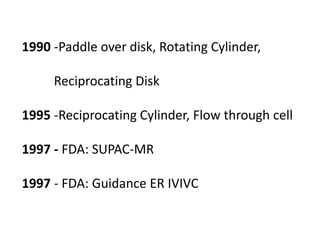
1990 -Paddle over disk, Rotating Cylinder,
Reciprocating Disk
1995 -Reciprocating Cylinder, Flow through cell
1997 - FDA: SUPAC-MR
1997 - FDA: Guidance ER IVIVC
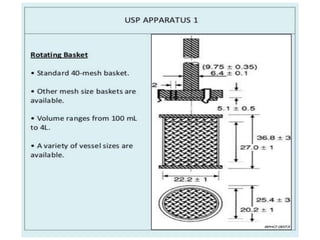
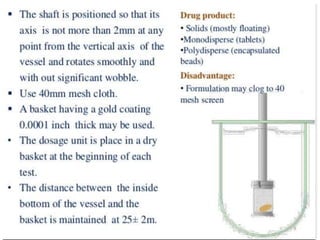
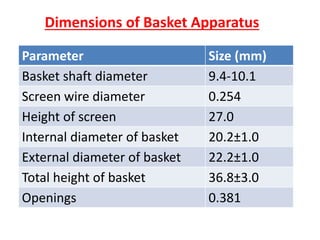
Dimensions of Basket Apparatus
Parameter Size (mm)
Basket shaft diameter 9.4-10.1
Screen wire diameter 0.254
Height of screen 27.0
Internal diameter of basket 20.2±1.0
External diameter of basket 22.2±1.0
Total height of basket 36.8±3.0
Openings 0.381
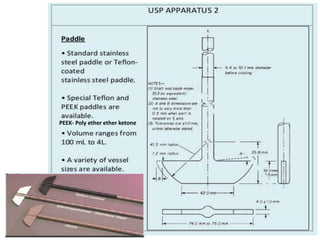
PEEK- Poly ether ether ketone
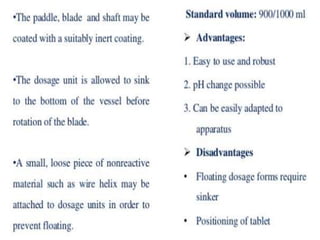
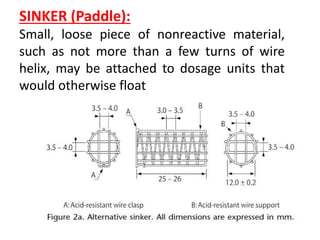
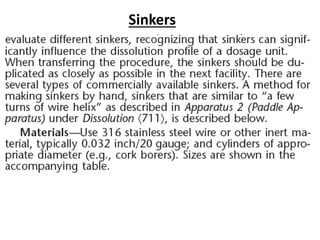
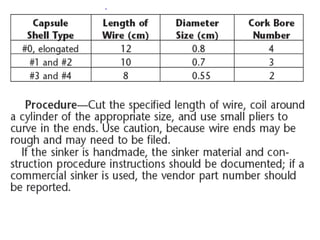
SINKER (Paddle):
Small, loose piece of nonreactive material,
such as not more than a few turns of wire
helix, may be attached to dosage units that
would otherwise float
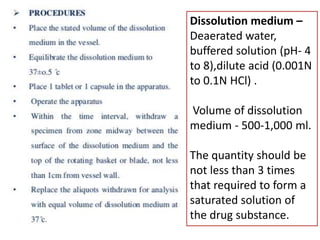
Dissolution medium –
Deaerated water,
buffered solution (pH- 4
to 8),dilute acid (0.001N
to 0.1N HCl) .
Volume of dissolution
medium - 500-1,000 ml.
The quantity should be
not less than 3 times
that required to form a
saturated solution of
the drug substance.
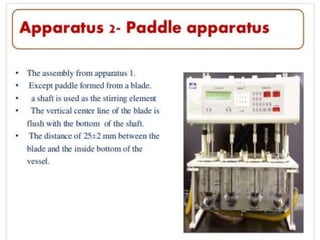
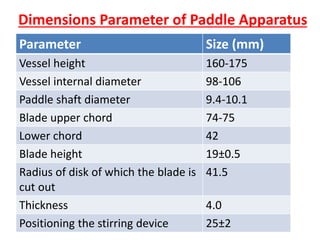
Dimensions Parameter of Paddle Apparatus
Parameter Size (mm)
Vessel height 160-175
Vessel internal diameter 98-106
Paddle shaft diameter 9.4-10.1
Blade upper chord 74-75
Lower chord 42
Blade height 19±0.5
Radius of disk of which the blade is
cut out
41.5
Thickness 4.0
Positioning the stirring device 25±2
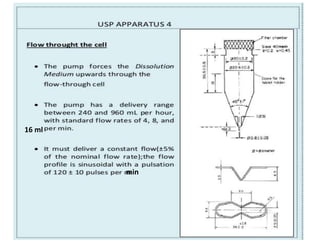
16 ml
min
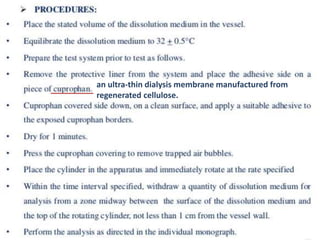
an ultra-thin dialysis membrane manufactured from
regenerated cellulose.
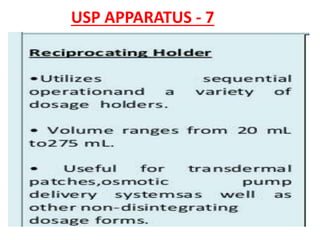
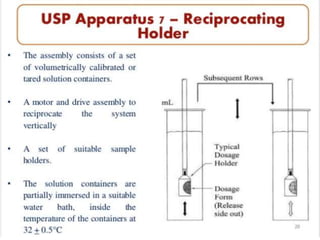
USP APPARATUS - 7
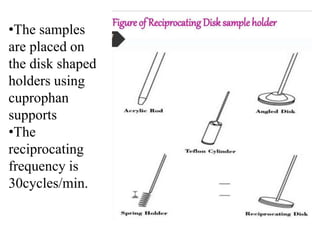
•The samples
are placed on
the disk shaped
holders using
cuprophan
supports
•The
reciprocating
frequency is
30cycles/min.
48
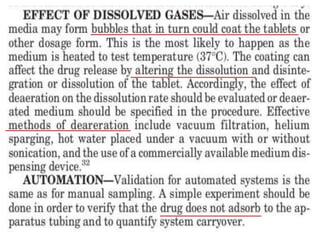
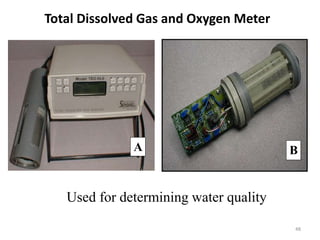
Used for determining water quality
A B
Total Dissolved Gas and Oxygen Meter
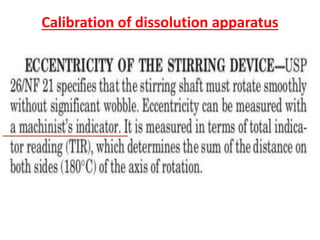
Calibration of dissolution apparatus
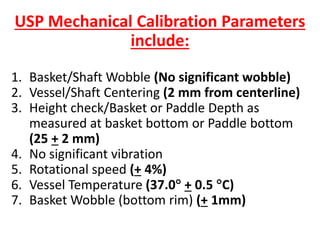
USP Mechanical Calibration Parameters
include:
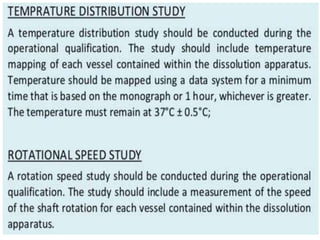
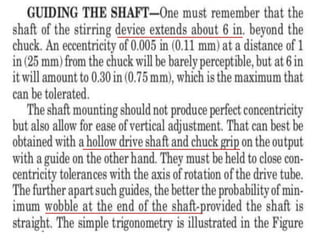
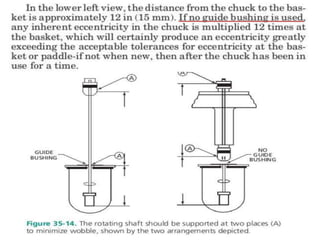
1. Basket/Shaft Wobble (No significant wobble)
2. Vessel/Shaft Centering (2 mm from centerline)
3. Height check/Basket or Paddle Depth as
measured at basket bottom or Paddle bottom
(25 + 2 mm)
4. No significant vibration
5. Rotational speed (+ 4%)
6. Vessel Temperature (37.0 + 0.5 C)
7. Basket Wobble (bottom rim) (+ 1mm)
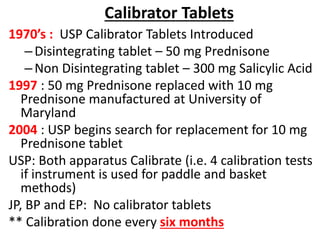
Calibrator Tablets
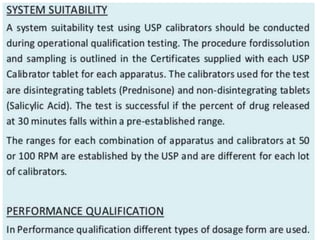
1970’s : USP Calibrator Tablets Introduced
–Disintegrating tablet – 50 mg Prednisone
–Non Disintegrating tablet – 300 mg Salicylic Acid
1997 : 50 mg Prednisone replaced with 10 mg
Prednisone manufactured at University of
Maryland
2004 : USP begins search for replacement for 10 mg
Prednisone tablet
USP: Both apparatus Calibrate (i.e. 4 calibration tests
if instrument is used for paddle and basket
methods)
JP, BP and EP: No calibrator tablets
** Calibration done every six months
58
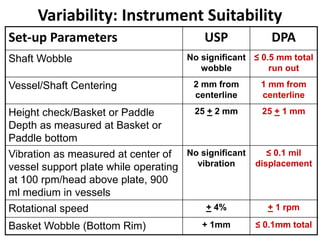
Variability: Instrument Suitability
Set-up Parameters USP DPA
Shaft Wobble No significant
wobble
≤ 0.5 mm total
run out
Vessel/Shaft Centering 2 mm from
centerline
1 mm from
centerline
Height check/Basket or Paddle
Depth as measured at Basket or
Paddle bottom
25 + 2 mm 25 + 1 mm
Vibration as measured at center of
vessel support plate while operating
at 100 rpm/head above plate, 900
ml medium in vessels
No significant
vibration
≤ 0.1 mil
displacement
Rotational speed + 4% + 1 rpm
Basket Wobble (Bottom Rim) + 1mm ≤ 0.1mm total
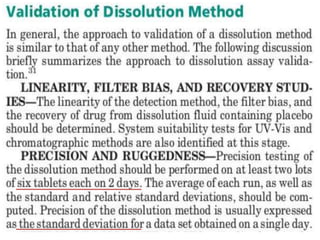
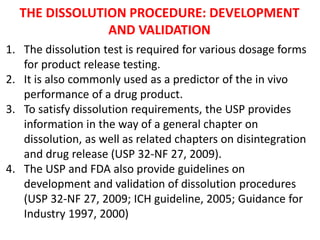
THE DISSOLUTION PROCEDURE: DEVELOPMENT
AND VALIDATION
1. The dissolution test is required for various dosage forms
for product release testing.
2. It is also commonly used as a predictor of the in vivo
performance of a drug product.
3. To satisfy dissolution requirements, the USP provides
information in the way of a general chapter on
dissolution, as well as related chapters on disintegration
and drug release (USP 32-NF 27, 2009).
4. The USP and FDA also provide guidelines on
development and validation of dissolution procedures
(USP 32-NF 27, 2009; ICH guideline, 2005; Guidance for
Industry 1997, 2000)
IDEAL DISSOLUTION PROCEDURE
•The dissolution procedure requires an apparatus, a
dissolution medium, and test conditions that provide a
method that is discriminating yet sufficiently rugged and
reproducible for day-to-day operation and capable of being
transferred between laboratories.
•The procedure should be appropriately discriminating,
capable of distinguishing significant changes in a
composition or manufacturing process that might be
expected to affect in vivo performance.
•Assessing the results from multiple batches that represent
typical variability in composition and manufacturing
parameters (lubrication, blend time, compression force)
may assist in this evaluation.
 With regard to stability, the dissolution test should
appropriately reflect relevant changes in the drug product
over time that are caused by temperature, humidity,
photosensitivity, and other stresses.
 A properly designed test should result in data that are not
highly variable as it makes difficult to identify effects of
formulation changes.
 Dissolution results may be considered highly variable if
the relative standard deviation (RSD) is greater than 20%
at time points of 10 minutes or less and greater than 10%
RSD at later time points.
 Most dissolution results exhibit less variability than this.
The source of the variability (Formulation, Test procedure)
should be investigated and attempts should be made to
reduce variability
Dissolution procedure development and validation
include following conditions
• Medium-
(volume, deaeration, enzyme & IVIVC)
• Apparatus/ agitation rate-
(apparatus, sinkers & agitation)
• Study design-
(time points, observation, sampling, filters & centrifugation)
• Assay & validation-
(Specificity, linearity and range, accuracy, precessions,
robustness, solution stability, spectrophotometric
analysis & HPLC)
• Acceptance criteria.
1. MEDIUM
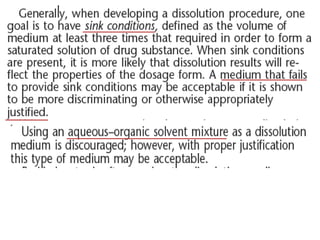
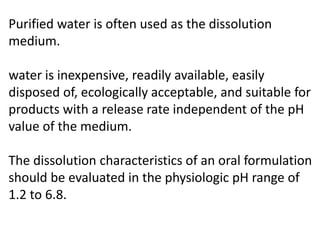
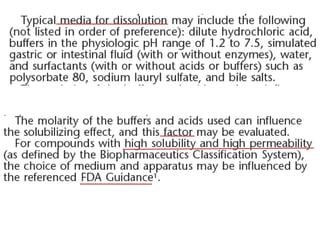
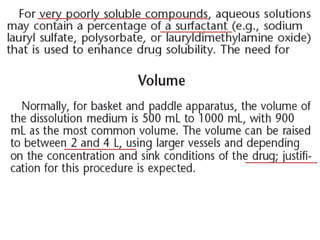
Purified water is often used as the dissolution
medium.
water is inexpensive, readily available, easily
disposed of, ecologically acceptable, and suitable for
products with a release rate independent of the pH
value of the medium.
The dissolution characteristics of an oral formulation
should be evaluated in the physiologic pH range of
1.2 to 6.8.
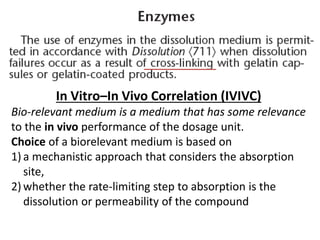
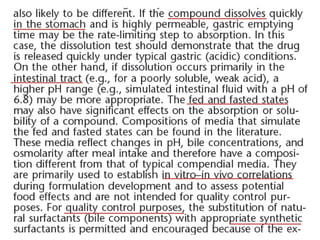
In Vitro–In Vivo Correlation (IVIVC)
Bio-relevant medium is a medium that has some relevance
to the in vivo performance of the dosage unit.
Choice of a biorelevant medium is based on
1) a mechanistic approach that considers the absorption
site,
2) whether the rate-limiting step to absorption is the
dissolution or permeability of the compound
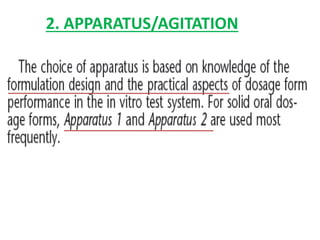
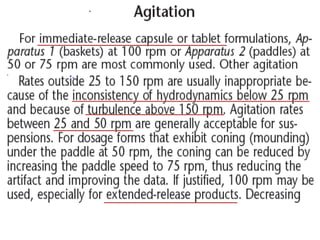
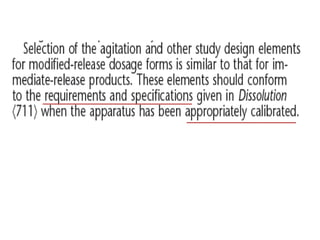
2. APPARATUS/AGITATION
Sinkers
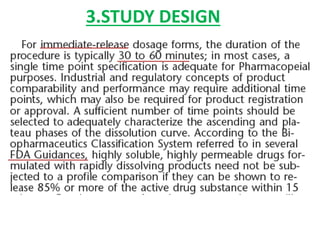
3.STUDY DESIGN
DISSOLUTION METHOD DEVELOPMENT FOR
GENERIC DRUG PRODUCTS
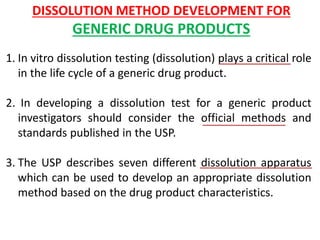
1. In vitro dissolution testing (dissolution) plays a critical role
in the life cycle of a generic drug product.
2. In developing a dissolution test for a generic product
investigators should consider the official methods and
standards published in the USP.
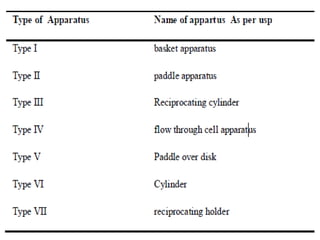
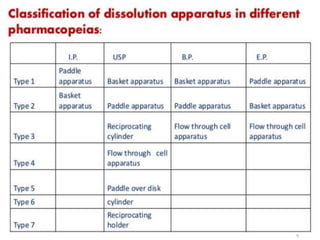
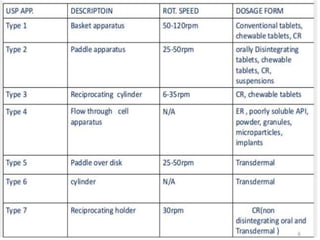
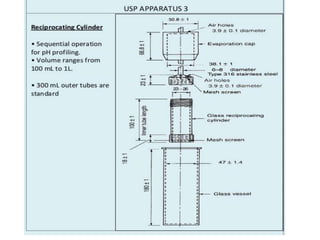
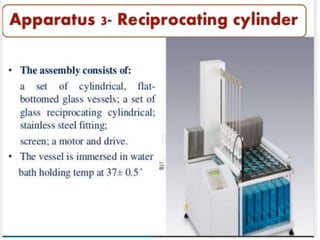
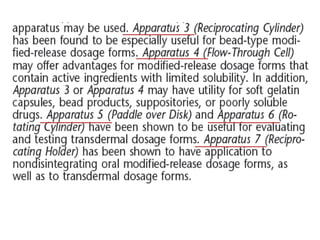
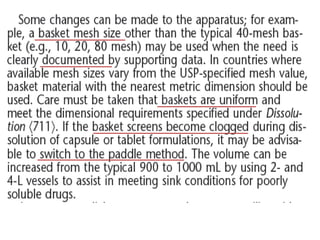
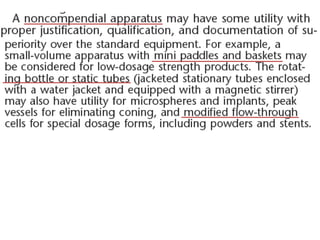
3. The USP describes seven different dissolution apparatus
which can be used to develop an appropriate dissolution
method based on the drug product characteristics.
• The dissolution method should be sufficiently rugged
and reproducible for daily operations, capable of being
transferred between laboratories and adequately
discriminating to distinguish any changes that could
affect the product’s in vivo performance.
• The Division of Bioequivalence (DBE), in the Office of
Generic Drugs, Center for Drug Evaluation and
Research, US-FDA asks investigators to conduct
comparative dissolution testing using at least 12
dosage units each of test and reference products.
• Dissolution data should be generated by sampling the
dissolution medium at time points appropriate to
characterize the dissolution profile.
• It is suggested that three to four or more dissolution
time points (other than zero), equally spaced, be utilized
for rapidly dissolving drugs.
• For dissolution of extended release(ER) formulations,
more sampling time points are suggested, in order to
adequately characterize the complete dissolution profile.
DISSOLUTION METHOD DEVELOPMENT FOR
SOLID ORAL GENERIC DRUG PRODUCTS
One of the first step during the BE review of a potential
new generic drug product is an assessment of whether the
dissolution method proposed for the product is the
appropriate one or not.
It is recommended that the critical material attributes
(CMA) and critical process parameters (CPP) affecting the
dissolution/drug release be identified
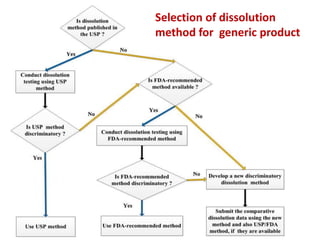
DBE recommends following steps to select a dissolution
method for their generic product
Selection of dissolution
method for generic product
 In cases where neither a USP and nor FDA-
recommended method is available, an appropriate new
dissolution method should be developed.
 The new dissolution method development report
should be submitted to the ANDA, so that the DBE can
evaluate the feasibility of the new method.
 The new dissolution method development report
should include a pH solubility profile of the drug
substance, dissolution profiles at different rotational
speeds and dissolution media.
 Dissolution profiles should be generated using at least
three dissolution media for example, pH 1.2, 4.5, and
6.8 buffers.
 Water may also be tested as an additional dissolution
medium for method optimization.
 It may be difficult to achieve sink conditions for poorly
water-soluble drugs; therefore a suitable surfactant in
an appropriate concentration can be used in the
dissolution medium for these drug products.
 applicant should characterize comparative dissolution
testing using at least 12 dosage units each of test and
reference products.
 For immediate-release (IR) generic products,
dissolution testing using a single method may be
sufficient.
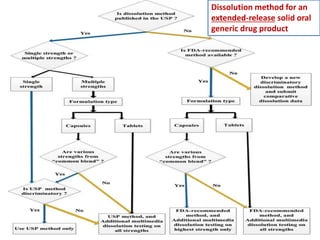
Dissolution method for an
extended-release solid oral
generic drug product
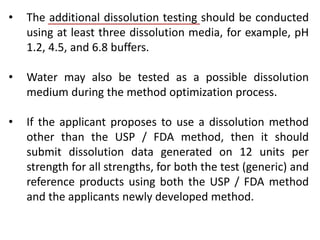
• The additional dissolution testing should be conducted
using at least three dissolution media, for example, pH
1.2, 4.5, and 6.8 buffers.
• Water may also be tested as a possible dissolution
medium during the method optimization process.
• If the applicant proposes to use a dissolution method
other than the USP / FDA method, then it should
submit dissolution data generated on 12 units per
strength for all strengths, for both the test (generic) and
reference products using both the USP / FDA method
and the applicants newly developed method.
 For delayed-release (DR) solid oral dosage forms, the
dissolution testing should demonstrate that
(a) the product is stable under the acidic conditions of the
stomach (pH 1.2); and
(b) release in the pH present in the intestine.
 If a USP method is available then dissolution should be
conducted using that method.
 If there is no USP method, then for all the strengths of a
DR product the DBE recommends that dissolution
testing should be conducted under acidic conditions (pH
1.2) for 2 h followed by neutral medium (e.g., pH 6.8).
 In general, DR products should display acid resistance
under the dissolution testing conditions.
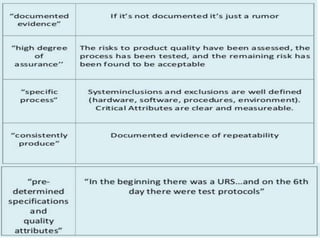
 Suspensions can be considered to be similar to
disintegrated forms of solid formulations.
 Bioavailability of various poorly soluble drugs
administrated as suspension formulations has been
reported to be dissolution rate-limited.
 For dissolution testing of oral suspensions, the DBE
generally recommends the use of USP apparatus 2
(paddle) at 25 or 50 rpm.
 The in vitro testing of suspensions should be conducted
using a total of 12 units of both test product and RLD
(reference listed drug) product from 12 different
containers.
DISSOLUTION METHOD DEVELOPMENT FOR
OTHER ORAL GENERIC DRUG PRODUCTS
• Liquid-filled capsules can be composed of hydrophilic or
lipophilic drug substances.
• For liquid-filled capsules containing lipophilic drugs, the
DBE asks applicants to develop a “quantitative rupture”
in vitro drug release test; where, after the rupture of the
capsule shell the drug is released and measured in the
medium.
• A suitable surfactant in an appropriate concentration can
be used in the aqueous medium for these formulations.
• The use of organic solvents in the dissolution media is
not encouraged.
• For other types of formulations, applicant must provide
appropriate new validated in vitro method with strong
scientific evidence of suitability for drug product
• Chewing gums are sometimes used as drug delivery
dosage forms.
• Drug release from the chewing gum formulation is
complex since it is based not only on the solubilization
of the drug but also on the shear forces encountered by
the formulation.
• The USP currently does not describe a drug release test
for the chewing gum formulation.
• However, the European Pharmacopeia has published a
method for drug release testing of these formulations.
• For chewing gums, the DBE currently accepts the use of
an appropriate in vitro dissolution method using the
apparatus described in the European Pharmacopeia.
DISSOLUTION METHOD DEVELOPMENT FOR
NON-ORAL GENERIC DRUG PRODUCTS
• As with oral formulations, release of the API from a
non-oral formulation is the key to the performance of a
drug product.
• For non-oral dosage forms, the test is referred as “drug
release” rather than “dissolution” testing.
• For ophthalmic suspensions, generic liposome
formulations, and rectal and vaginal suppositories, if
there is no USP or FDA recommended method then the
DBE encourages the firms to develop a method to
characterize the in vitro release.
• For parenteral, implants, microparticles and
suspensions, if there is no USP or FDA-recommended
method then the DBE asks the firms to develop a drug
release test using USP 4 (Flow-Through Cell), or, if
applicable, apparatus 2 (paddle) or any other
appropriate method.
• Transdermal delivery systems are complex dosage
forms for which the rate and extent of the drug
release may be influenced by various parameters.
• Therefore, besides other quality control tests, quality
and reproducibility of the transdermal products
should be tested using in vitro drug release testing.
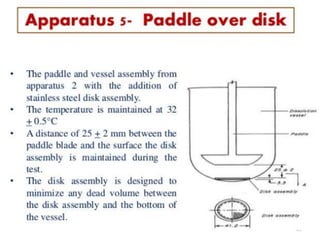
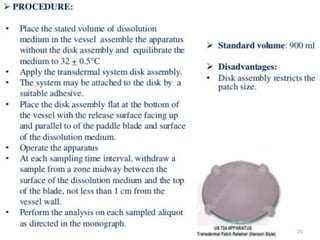
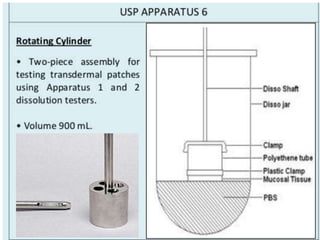
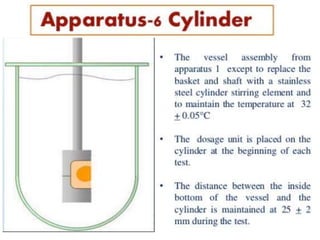
• Currently, USP describes three in vitro release testing
methods (USP apparatus 5, 6 and 7) for these
systems.
 Semisolid dosage forms, including creams, gels,
lotions and ointments, are generally intended for
topical route of application.
 Currently DBE does not request in vitro release
testing data in support of BE submissions to ANDAs
for the generic drug products in this category.
 In vitro release testing methods, for semisolid drug
products are done to compare performance of
certain types of pre-change and post-change
formulations.
 This can be developed using an open chamber
diffusion cell system such as a Franz cell system.
Generic Product specific dissolution method
development
Three Components:
1. Evaluation of the dissolution method
2. Discriminating ability of the dissolution method
3. The Acceptance criterion/criteria
1. Evaluation of the dissolution method
a) Drug substance solubility profile
b) Sink condition [are recommended, NOT necessary]
c) Justification and data to support selection of surfactant
[type, concentration]
d) Dissolution data in different pH media [pH 1.0, 4.5, 6.8]
without and with [if needed] surfactant
e) Selection of an appropriate apparatus/rotation speed.
f) Selection of in vitro dissolution/release medium/media
g) Selection of an appropriate analytical method
2. Discriminating ability of the dissolution
method
• Dissolution method should discriminates drug
products manufactured under target conditions vs.
formulations with meaningful variations for the most
relevant manufacturing variables (i.e., ± 10-20%
change to the specification-ranges of these variables)
• If available, submit the data showing that the selected
dissolution method is able to reject batches that are
not bioequivalent.
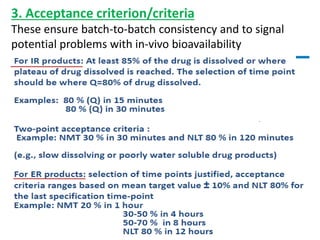
3. Acceptance criterion/criteria
These ensure batch-to-batch consistency and to signal
potential problems with in-vivo bioavailability
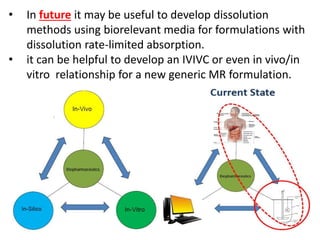
• In future it may be useful to develop dissolution
methods using biorelevant media for formulations with
dissolution rate-limited absorption.
• it can be helpful to develop an IVIVC or even in vivo/in
vitro relationship for a new generic MR formulation.
Dissolution chapter

Dissolution chapter

  • 1.
    Presented by: K. ARSHADAHMED KHAN M.Pharm, (Ph.D) Department of Pharmaceutics, Raghavendra Institute of Pharmaceutical Education and Research [RIPER] Anantapur.
  • 2.
    CHAPTER- 4 DISSOLUTION TESTING: 1.Introduction to dissolution equipment 2. Calibration of dissolution apparatus 3. Dissolution procedure development and validation 4. Dissolution method development for generic drug product,
  • 3.
    DEFINITION OF DISSOLUTION Dissolutionis defined as the process by which a solid substance enters in the solvent to yield a solution . It is the process by which a solid substances dissolves .
  • 4.
    In-vitro dissolution testsare used to (1) Assess the lot-to lot quality of drug product (2) Guide development of new formulations (3 ) Ensure continuing quality & performance during the changes, such as, change in formulation, manufacturing process, site of manufacturing etc. So, the dissolution testing is an important tool- 1) For characterizing the biopharmaceutical quality of product 2) For evaluation of active ingredients 3) For evaluation of possible risk such as - Dose dumping, Food effects, Interaction with other drugs
  • 6.
    HISTORY of DISSOLUTION Itall started in 1897 with the first reference to dissolution: Noyes and Whitney publish a paper on "The Rate of Solution of Solid Substances in Their Own Solution." They suggested that the dissolution rate was controlled by a layer of saturated solution that forms instantly around a solid particle. 1904 -Nernst and Brunner modified Noyes-Whitney equation by applying Fick's law of diffusion. A relationship between the dissolution rate and the diffusion coefficient was established. 1930 -Experiments begin with in vivo-In vitro correlations
  • 7.
    1950's-Emphasis moved fromstudying the effects of physiochemical properties of drugs on dissolution to correlation of dissolution to bioavailability of dosage forms. 1960's- USP recognized a need for a standardized dissolution test. The USP began experimenting with a variety of basket and stirring devices. 1970 - USP 18 incorporated the first official dissolution test for solid dosage forms. Twelve Monographs published in USP-NF with the official dissolution test- a rotating basket.
  • 8.
    1990 -Paddle overdisk, Rotating Cylinder, Reciprocating Disk 1995 -Reciprocating Cylinder, Flow through cell 1997 - FDA: SUPAC-MR 1997 - FDA: Guidance ER IVIVC
  • 15.
    Dimensions of BasketApparatus Parameter Size (mm) Basket shaft diameter 9.4-10.1 Screen wire diameter 0.254 Height of screen 27.0 Internal diameter of basket 20.2±1.0 External diameter of basket 22.2±1.0 Total height of basket 36.8±3.0 Openings 0.381
  • 16.
    PEEK- Poly etherether ketone
  • 19.
    SINKER (Paddle): Small, loosepiece of nonreactive material, such as not more than a few turns of wire helix, may be attached to dosage units that would otherwise float
  • 20.
    Dissolution medium – Deaeratedwater, buffered solution (pH- 4 to 8),dilute acid (0.001N to 0.1N HCl) . Volume of dissolution medium - 500-1,000 ml. The quantity should be not less than 3 times that required to form a saturated solution of the drug substance.
  • 21.
    Dimensions Parameter ofPaddle Apparatus Parameter Size (mm) Vessel height 160-175 Vessel internal diameter 98-106 Paddle shaft diameter 9.4-10.1 Blade upper chord 74-75 Lower chord 42 Blade height 19±0.5 Radius of disk of which the blade is cut out 41.5 Thickness 4.0 Positioning the stirring device 25±2
  • 25.
  • 34.
    an ultra-thin dialysismembrane manufactured from regenerated cellulose.
  • 35.
  • 37.
    •The samples are placedon the disk shaped holders using cuprophan supports •The reciprocating frequency is 30cycles/min.
  • 48.
    48 Used for determiningwater quality A B Total Dissolved Gas and Oxygen Meter
  • 49.
  • 56.
    USP Mechanical CalibrationParameters include: 1. Basket/Shaft Wobble (No significant wobble) 2. Vessel/Shaft Centering (2 mm from centerline) 3. Height check/Basket or Paddle Depth as measured at basket bottom or Paddle bottom (25 + 2 mm) 4. No significant vibration 5. Rotational speed (+ 4%) 6. Vessel Temperature (37.0 + 0.5 C) 7. Basket Wobble (bottom rim) (+ 1mm)
  • 57.
    Calibrator Tablets 1970’s :USP Calibrator Tablets Introduced –Disintegrating tablet – 50 mg Prednisone –Non Disintegrating tablet – 300 mg Salicylic Acid 1997 : 50 mg Prednisone replaced with 10 mg Prednisone manufactured at University of Maryland 2004 : USP begins search for replacement for 10 mg Prednisone tablet USP: Both apparatus Calibrate (i.e. 4 calibration tests if instrument is used for paddle and basket methods) JP, BP and EP: No calibrator tablets ** Calibration done every six months
  • 58.
    58 Variability: Instrument Suitability Set-upParameters USP DPA Shaft Wobble No significant wobble ≤ 0.5 mm total run out Vessel/Shaft Centering 2 mm from centerline 1 mm from centerline Height check/Basket or Paddle Depth as measured at Basket or Paddle bottom 25 + 2 mm 25 + 1 mm Vibration as measured at center of vessel support plate while operating at 100 rpm/head above plate, 900 ml medium in vessels No significant vibration ≤ 0.1 mil displacement Rotational speed + 4% + 1 rpm Basket Wobble (Bottom Rim) + 1mm ≤ 0.1mm total
  • 59.
    THE DISSOLUTION PROCEDURE:DEVELOPMENT AND VALIDATION 1. The dissolution test is required for various dosage forms for product release testing. 2. It is also commonly used as a predictor of the in vivo performance of a drug product. 3. To satisfy dissolution requirements, the USP provides information in the way of a general chapter on dissolution, as well as related chapters on disintegration and drug release (USP 32-NF 27, 2009). 4. The USP and FDA also provide guidelines on development and validation of dissolution procedures (USP 32-NF 27, 2009; ICH guideline, 2005; Guidance for Industry 1997, 2000)
  • 60.
    IDEAL DISSOLUTION PROCEDURE •Thedissolution procedure requires an apparatus, a dissolution medium, and test conditions that provide a method that is discriminating yet sufficiently rugged and reproducible for day-to-day operation and capable of being transferred between laboratories. •The procedure should be appropriately discriminating, capable of distinguishing significant changes in a composition or manufacturing process that might be expected to affect in vivo performance. •Assessing the results from multiple batches that represent typical variability in composition and manufacturing parameters (lubrication, blend time, compression force) may assist in this evaluation.
  • 61.
     With regardto stability, the dissolution test should appropriately reflect relevant changes in the drug product over time that are caused by temperature, humidity, photosensitivity, and other stresses.  A properly designed test should result in data that are not highly variable as it makes difficult to identify effects of formulation changes.  Dissolution results may be considered highly variable if the relative standard deviation (RSD) is greater than 20% at time points of 10 minutes or less and greater than 10% RSD at later time points.  Most dissolution results exhibit less variability than this. The source of the variability (Formulation, Test procedure) should be investigated and attempts should be made to reduce variability
  • 62.
    Dissolution procedure developmentand validation include following conditions • Medium- (volume, deaeration, enzyme & IVIVC) • Apparatus/ agitation rate- (apparatus, sinkers & agitation) • Study design- (time points, observation, sampling, filters & centrifugation) • Assay & validation- (Specificity, linearity and range, accuracy, precessions, robustness, solution stability, spectrophotometric analysis & HPLC) • Acceptance criteria.
  • 63.
  • 65.
    Purified water isoften used as the dissolution medium. water is inexpensive, readily available, easily disposed of, ecologically acceptable, and suitable for products with a release rate independent of the pH value of the medium. The dissolution characteristics of an oral formulation should be evaluated in the physiologic pH range of 1.2 to 6.8.
  • 69.
    In Vitro–In VivoCorrelation (IVIVC) Bio-relevant medium is a medium that has some relevance to the in vivo performance of the dosage unit. Choice of a biorelevant medium is based on 1) a mechanistic approach that considers the absorption site, 2) whether the rate-limiting step to absorption is the dissolution or permeability of the compound
  • 71.
  • 75.
  • 79.
  • 91.
    DISSOLUTION METHOD DEVELOPMENTFOR GENERIC DRUG PRODUCTS 1. In vitro dissolution testing (dissolution) plays a critical role in the life cycle of a generic drug product. 2. In developing a dissolution test for a generic product investigators should consider the official methods and standards published in the USP. 3. The USP describes seven different dissolution apparatus which can be used to develop an appropriate dissolution method based on the drug product characteristics.
  • 92.
    • The dissolutionmethod should be sufficiently rugged and reproducible for daily operations, capable of being transferred between laboratories and adequately discriminating to distinguish any changes that could affect the product’s in vivo performance. • The Division of Bioequivalence (DBE), in the Office of Generic Drugs, Center for Drug Evaluation and Research, US-FDA asks investigators to conduct comparative dissolution testing using at least 12 dosage units each of test and reference products.
  • 93.
    • Dissolution datashould be generated by sampling the dissolution medium at time points appropriate to characterize the dissolution profile. • It is suggested that three to four or more dissolution time points (other than zero), equally spaced, be utilized for rapidly dissolving drugs. • For dissolution of extended release(ER) formulations, more sampling time points are suggested, in order to adequately characterize the complete dissolution profile.
  • 94.
    DISSOLUTION METHOD DEVELOPMENTFOR SOLID ORAL GENERIC DRUG PRODUCTS One of the first step during the BE review of a potential new generic drug product is an assessment of whether the dissolution method proposed for the product is the appropriate one or not. It is recommended that the critical material attributes (CMA) and critical process parameters (CPP) affecting the dissolution/drug release be identified DBE recommends following steps to select a dissolution method for their generic product
  • 95.
  • 96.
     In caseswhere neither a USP and nor FDA- recommended method is available, an appropriate new dissolution method should be developed.  The new dissolution method development report should be submitted to the ANDA, so that the DBE can evaluate the feasibility of the new method.  The new dissolution method development report should include a pH solubility profile of the drug substance, dissolution profiles at different rotational speeds and dissolution media.  Dissolution profiles should be generated using at least three dissolution media for example, pH 1.2, 4.5, and 6.8 buffers.  Water may also be tested as an additional dissolution medium for method optimization.
  • 97.
     It maybe difficult to achieve sink conditions for poorly water-soluble drugs; therefore a suitable surfactant in an appropriate concentration can be used in the dissolution medium for these drug products.  applicant should characterize comparative dissolution testing using at least 12 dosage units each of test and reference products.  For immediate-release (IR) generic products, dissolution testing using a single method may be sufficient.
  • 98.
    Dissolution method foran extended-release solid oral generic drug product
  • 99.
    • The additionaldissolution testing should be conducted using at least three dissolution media, for example, pH 1.2, 4.5, and 6.8 buffers. • Water may also be tested as a possible dissolution medium during the method optimization process. • If the applicant proposes to use a dissolution method other than the USP / FDA method, then it should submit dissolution data generated on 12 units per strength for all strengths, for both the test (generic) and reference products using both the USP / FDA method and the applicants newly developed method.
  • 100.
     For delayed-release(DR) solid oral dosage forms, the dissolution testing should demonstrate that (a) the product is stable under the acidic conditions of the stomach (pH 1.2); and (b) release in the pH present in the intestine.  If a USP method is available then dissolution should be conducted using that method.  If there is no USP method, then for all the strengths of a DR product the DBE recommends that dissolution testing should be conducted under acidic conditions (pH 1.2) for 2 h followed by neutral medium (e.g., pH 6.8).  In general, DR products should display acid resistance under the dissolution testing conditions.
  • 101.
     Suspensions canbe considered to be similar to disintegrated forms of solid formulations.  Bioavailability of various poorly soluble drugs administrated as suspension formulations has been reported to be dissolution rate-limited.  For dissolution testing of oral suspensions, the DBE generally recommends the use of USP apparatus 2 (paddle) at 25 or 50 rpm.  The in vitro testing of suspensions should be conducted using a total of 12 units of both test product and RLD (reference listed drug) product from 12 different containers. DISSOLUTION METHOD DEVELOPMENT FOR OTHER ORAL GENERIC DRUG PRODUCTS
  • 102.
    • Liquid-filled capsulescan be composed of hydrophilic or lipophilic drug substances. • For liquid-filled capsules containing lipophilic drugs, the DBE asks applicants to develop a “quantitative rupture” in vitro drug release test; where, after the rupture of the capsule shell the drug is released and measured in the medium. • A suitable surfactant in an appropriate concentration can be used in the aqueous medium for these formulations. • The use of organic solvents in the dissolution media is not encouraged. • For other types of formulations, applicant must provide appropriate new validated in vitro method with strong scientific evidence of suitability for drug product
  • 103.
    • Chewing gumsare sometimes used as drug delivery dosage forms. • Drug release from the chewing gum formulation is complex since it is based not only on the solubilization of the drug but also on the shear forces encountered by the formulation. • The USP currently does not describe a drug release test for the chewing gum formulation. • However, the European Pharmacopeia has published a method for drug release testing of these formulations. • For chewing gums, the DBE currently accepts the use of an appropriate in vitro dissolution method using the apparatus described in the European Pharmacopeia.
  • 104.
    DISSOLUTION METHOD DEVELOPMENTFOR NON-ORAL GENERIC DRUG PRODUCTS • As with oral formulations, release of the API from a non-oral formulation is the key to the performance of a drug product. • For non-oral dosage forms, the test is referred as “drug release” rather than “dissolution” testing. • For ophthalmic suspensions, generic liposome formulations, and rectal and vaginal suppositories, if there is no USP or FDA recommended method then the DBE encourages the firms to develop a method to characterize the in vitro release.
  • 105.
    • For parenteral,implants, microparticles and suspensions, if there is no USP or FDA-recommended method then the DBE asks the firms to develop a drug release test using USP 4 (Flow-Through Cell), or, if applicable, apparatus 2 (paddle) or any other appropriate method. • Transdermal delivery systems are complex dosage forms for which the rate and extent of the drug release may be influenced by various parameters. • Therefore, besides other quality control tests, quality and reproducibility of the transdermal products should be tested using in vitro drug release testing. • Currently, USP describes three in vitro release testing methods (USP apparatus 5, 6 and 7) for these systems.
  • 106.
     Semisolid dosageforms, including creams, gels, lotions and ointments, are generally intended for topical route of application.  Currently DBE does not request in vitro release testing data in support of BE submissions to ANDAs for the generic drug products in this category.  In vitro release testing methods, for semisolid drug products are done to compare performance of certain types of pre-change and post-change formulations.  This can be developed using an open chamber diffusion cell system such as a Franz cell system.
  • 107.
    Generic Product specificdissolution method development Three Components: 1. Evaluation of the dissolution method 2. Discriminating ability of the dissolution method 3. The Acceptance criterion/criteria
  • 108.
    1. Evaluation ofthe dissolution method a) Drug substance solubility profile b) Sink condition [are recommended, NOT necessary] c) Justification and data to support selection of surfactant [type, concentration] d) Dissolution data in different pH media [pH 1.0, 4.5, 6.8] without and with [if needed] surfactant e) Selection of an appropriate apparatus/rotation speed. f) Selection of in vitro dissolution/release medium/media g) Selection of an appropriate analytical method
  • 109.
    2. Discriminating abilityof the dissolution method • Dissolution method should discriminates drug products manufactured under target conditions vs. formulations with meaningful variations for the most relevant manufacturing variables (i.e., ± 10-20% change to the specification-ranges of these variables) • If available, submit the data showing that the selected dissolution method is able to reject batches that are not bioequivalent.
  • 110.
    3. Acceptance criterion/criteria Theseensure batch-to-batch consistency and to signal potential problems with in-vivo bioavailability
  • 111.
    • In futureit may be useful to develop dissolution methods using biorelevant media for formulations with dissolution rate-limited absorption. • it can be helpful to develop an IVIVC or even in vivo/in vitro relationship for a new generic MR formulation.