A PRESENTAITON ON
DISSOLUTION
TESTING APPARATUS
Prepared by
Sourav Kar
6th
Sem, Div-II
Roll No-1427704097
Mentor: Dr. Gopa Roy Biswas
NSHM Institute Of Pharmaceutical
Technology
Definition
 Dissolution is the process by which a solid solute enters in to
a solution i.e. , mass transfer from solid surface to liquid phase.
2
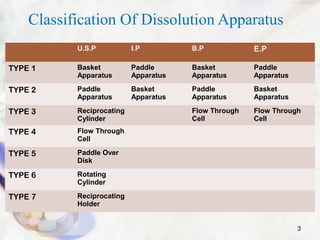
Classification Of Dissolution Apparatus
U.S.P I.P B.P E.P
TYPE 1 Basket
Apparatus
Paddle
Apparatus
Basket
Apparatus
Paddle
Apparatus
TYPE 2 Paddle
Apparatus
Basket
Apparatus
Paddle
Apparatus
Basket
Apparatus
TYPE 3 Reciprocating
Cylinder
Flow Through
Cell
Flow Through
Cell
TYPE 4 Flow Through
Cell
TYPE 5 Paddle Over
Disk
TYPE 6 Rotating
Cylinder
TYPE 7 Reciprocating
Holder
3
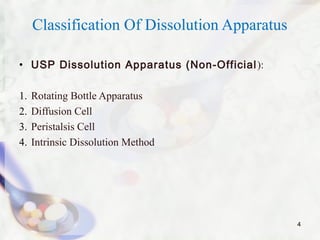
Classification Of Dissolution Apparatus
• USP Dissolution Apparatus (Non-Official):
1. Rotating Bottle Apparatus
2. Diffusion Cell
3. Peristalsis Cell
4. Intrinsic Dissolution Method
4
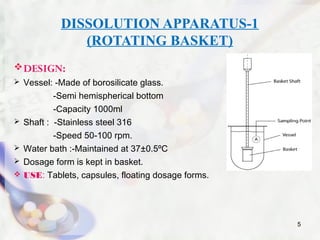
DISSOLUTION APPARATUS-1
(ROTATING BASKET)
DESIGN:
 Vessel: -Made of borosilicate glass.
-Semi hemispherical bottom
-Capacity 1000ml
 Shaft : -Stainless steel 316
-Speed 50-100 rpm.
 Water bath :-Maintained at 37±0.5ºC
 Dosage form is kept in basket.
 USE: Tablets, capsules, floating dosage forms.
5
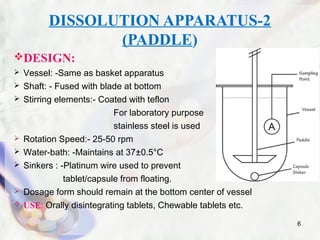
DISSOLUTION APPARATUS-2
(PADDLE)
DESIGN:
 Vessel: -Same as basket apparatus
 Shaft: - Fused with blade at bottom
 Stirring elements:- Coated with teflon
For laboratory purpose
stainless steel is used
 Rotation Speed:- 25-50 rpm
 Water-bath: -Maintains at 37±0.5°C
 Sinkers : -Platinum wire used to prevent
tablet/capsule from floating.
 Dosage form should remain at the bottom center of vessel
 USE: Orally disintegrating tablets, Chewable tablets etc.
6
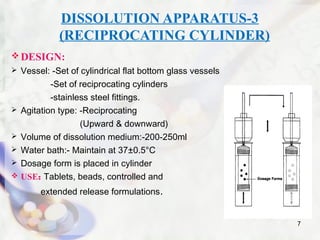
DISSOLUTION APPARATUS-3
(RECIPROCATING CYLINDER)
DESIGN:
 Vessel: -Set of cylindrical flat bottom glass vessels
-Set of reciprocating cylinders
-stainless steel fittings.
 Agitation type: -Reciprocating
(Upward & downward)
 Volume of dissolution medium:-200-250ml
 Water bath:- Maintain at 37±0.5°C
 Dosage form is placed in cylinder
 USE: Tablets, beads, controlled and
extended release formulations.
7
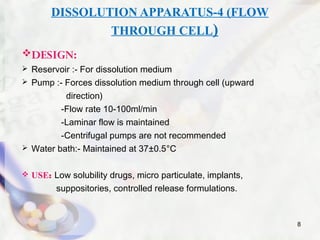
DISSOLUTION APPARATUS-4 (FLOW
THROUGH CELL)
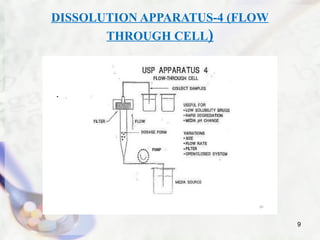
DESIGN:
 Reservoir :- For dissolution medium
 Pump :- Forces dissolution medium through cell (upward
direction)
-Flow rate 10-100ml/min
-Laminar flow is maintained
-Centrifugal pumps are not recommended
 Water bath:- Maintained at 37±0.5°C
 USE: Low solubility drugs, micro particulate, implants,
suppositories, controlled release formulations.
8
DISSOLUTION APPARATUS-4 (FLOW
THROUGH CELL)
9
DISSOLUTION APPARATUS-5 (PADDLE-
OVER-DISK)
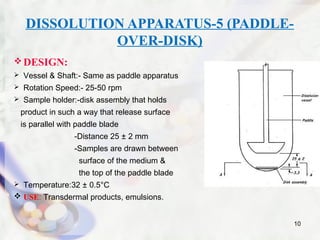
DESIGN:
 Vessel & Shaft:- Same as paddle apparatus
 Rotation Speed:- 25-50 rpm
 Sample holder:-disk assembly that holds
product in such a way that release surface
is parallel with paddle blade
-Distance 25 ± 2 mm
-Samples are drawn between
surface of the medium &
the top of the paddle blade
 Temperature:32 ± 0.5°C
 USE: Transdermal products, emulsions.
10
DISSOLUTION APPARATUS-6 (ROTATING
CYLINDER)
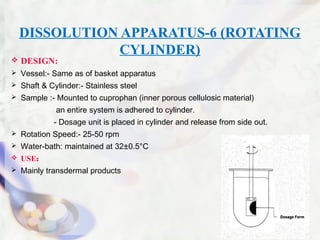
 DESIGN:
 Vessel:- Same as of basket apparatus
 Shaft & Cylinder:- Stainless steel
 Sample :- Mounted to cuprophan (inner porous cellulosic material)
an entire system is adhered to cylinder.
- Dosage unit is placed in cylinder and release from side out.
 Rotation Speed:- 25-50 rpm
 Water-bath: maintained at 32±0.5°C
 USE:
 Mainly transdermal products
11
DISSOLUTION APPARATUS-7
(RECIPROCATING-HOLDER)
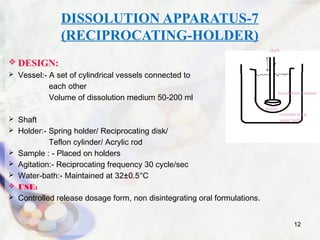
 DESIGN:
 Vessel:- A set of cylindrical vessels connected to
each other
Volume of dissolution medium 50-200 ml
 Shaft
 Holder:- Spring holder/ Reciprocating disk/
Teflon cylinder/ Acrylic rod
 Sample : - Placed on holders
 Agitation:- Reciprocating frequency 30 cycle/sec
 Water-bath:- Maintained at 32±0.5°C
 USE:
 Controlled release dosage form, non disintegrating oral formulations.
12
dissolution medium
shaft
holder
constant temp
water bath
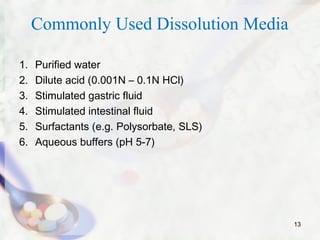
Commonly Used Dissolution Media
1. Purified water
2. Dilute acid (0.001N – 0.1N HCl)
3. Stimulated gastric fluid
4. Stimulated intestinal fluid
5. Surfactants (e.g. Polysorbate, SLS)
6. Aqueous buffers (pH 5-7)
13
CONCLUSION
 Dissolution research started to develop in 1897 when Noyes
and Whitney derived their equation in the course of their
dissolution studies on benzoic acid and lead chloride.
 The goal of dissolution testing is to assure the
pharmaceutical quality of the product (manufacturing of
product, release property & biopharmaceutical characteristics
e.g. rate and extent of absorption).
 Dissolution testing is a routine work for pharmaceutical
quality control for oral solid dosage forms like tablets,
capsules and transdermal drug delivery systems.
 The science of dissolution testing is developing every day.
14
REFERENCES
D.M.Brahmankar, S Jaiswal, “Biopharmaceutics
and
Pharmacokinetics A Treatise”, Vallabh
Prakashan, 3rd
Edition, pg: 330-333.
V.U Banakar et all, “Pharmaceutical Dissolution
Testing”,
Markcel Daken, pg: 4,16,57,136,137.
The Science And Practice of Pharmacy by
REMINGTON ,Mack Pub Co. , 19th Edition,
pg: 594,
601,602.
15
16

Dissolution Testing Apparatus

  • 1.
    A PRESENTAITON ON DISSOLUTION TESTINGAPPARATUS Prepared by Sourav Kar 6th Sem, Div-II Roll No-1427704097 Mentor: Dr. Gopa Roy Biswas NSHM Institute Of Pharmaceutical Technology
  • 2.
    Definition  Dissolution isthe process by which a solid solute enters in to a solution i.e. , mass transfer from solid surface to liquid phase. 2
  • 3.
    Classification Of DissolutionApparatus U.S.P I.P B.P E.P TYPE 1 Basket Apparatus Paddle Apparatus Basket Apparatus Paddle Apparatus TYPE 2 Paddle Apparatus Basket Apparatus Paddle Apparatus Basket Apparatus TYPE 3 Reciprocating Cylinder Flow Through Cell Flow Through Cell TYPE 4 Flow Through Cell TYPE 5 Paddle Over Disk TYPE 6 Rotating Cylinder TYPE 7 Reciprocating Holder 3
  • 4.
    Classification Of DissolutionApparatus • USP Dissolution Apparatus (Non-Official): 1. Rotating Bottle Apparatus 2. Diffusion Cell 3. Peristalsis Cell 4. Intrinsic Dissolution Method 4
  • 5.
    DISSOLUTION APPARATUS-1 (ROTATING BASKET) DESIGN: Vessel: -Made of borosilicate glass. -Semi hemispherical bottom -Capacity 1000ml  Shaft : -Stainless steel 316 -Speed 50-100 rpm.  Water bath :-Maintained at 37±0.5ºC  Dosage form is kept in basket.  USE: Tablets, capsules, floating dosage forms. 5
  • 6.
    DISSOLUTION APPARATUS-2 (PADDLE) DESIGN:  Vessel:-Same as basket apparatus  Shaft: - Fused with blade at bottom  Stirring elements:- Coated with teflon For laboratory purpose stainless steel is used  Rotation Speed:- 25-50 rpm  Water-bath: -Maintains at 37±0.5°C  Sinkers : -Platinum wire used to prevent tablet/capsule from floating.  Dosage form should remain at the bottom center of vessel  USE: Orally disintegrating tablets, Chewable tablets etc. 6
  • 7.
    DISSOLUTION APPARATUS-3 (RECIPROCATING CYLINDER) DESIGN: Vessel: -Set of cylindrical flat bottom glass vessels -Set of reciprocating cylinders -stainless steel fittings.  Agitation type: -Reciprocating (Upward & downward)  Volume of dissolution medium:-200-250ml  Water bath:- Maintain at 37±0.5°C  Dosage form is placed in cylinder  USE: Tablets, beads, controlled and extended release formulations. 7
  • 8.
    DISSOLUTION APPARATUS-4 (FLOW THROUGHCELL) DESIGN:  Reservoir :- For dissolution medium  Pump :- Forces dissolution medium through cell (upward direction) -Flow rate 10-100ml/min -Laminar flow is maintained -Centrifugal pumps are not recommended  Water bath:- Maintained at 37±0.5°C  USE: Low solubility drugs, micro particulate, implants, suppositories, controlled release formulations. 8
  • 9.
  • 10.
    DISSOLUTION APPARATUS-5 (PADDLE- OVER-DISK) DESIGN: Vessel & Shaft:- Same as paddle apparatus  Rotation Speed:- 25-50 rpm  Sample holder:-disk assembly that holds product in such a way that release surface is parallel with paddle blade -Distance 25 ± 2 mm -Samples are drawn between surface of the medium & the top of the paddle blade  Temperature:32 ± 0.5°C  USE: Transdermal products, emulsions. 10
  • 11.
    DISSOLUTION APPARATUS-6 (ROTATING CYLINDER) DESIGN:  Vessel:- Same as of basket apparatus  Shaft & Cylinder:- Stainless steel  Sample :- Mounted to cuprophan (inner porous cellulosic material) an entire system is adhered to cylinder. - Dosage unit is placed in cylinder and release from side out.  Rotation Speed:- 25-50 rpm  Water-bath: maintained at 32±0.5°C  USE:  Mainly transdermal products 11
  • 12.
    DISSOLUTION APPARATUS-7 (RECIPROCATING-HOLDER)  DESIGN: Vessel:- A set of cylindrical vessels connected to each other Volume of dissolution medium 50-200 ml  Shaft  Holder:- Spring holder/ Reciprocating disk/ Teflon cylinder/ Acrylic rod  Sample : - Placed on holders  Agitation:- Reciprocating frequency 30 cycle/sec  Water-bath:- Maintained at 32±0.5°C  USE:  Controlled release dosage form, non disintegrating oral formulations. 12 dissolution medium shaft holder constant temp water bath
  • 13.
    Commonly Used DissolutionMedia 1. Purified water 2. Dilute acid (0.001N – 0.1N HCl) 3. Stimulated gastric fluid 4. Stimulated intestinal fluid 5. Surfactants (e.g. Polysorbate, SLS) 6. Aqueous buffers (pH 5-7) 13
  • 14.
    CONCLUSION  Dissolution researchstarted to develop in 1897 when Noyes and Whitney derived their equation in the course of their dissolution studies on benzoic acid and lead chloride.  The goal of dissolution testing is to assure the pharmaceutical quality of the product (manufacturing of product, release property & biopharmaceutical characteristics e.g. rate and extent of absorption).  Dissolution testing is a routine work for pharmaceutical quality control for oral solid dosage forms like tablets, capsules and transdermal drug delivery systems.  The science of dissolution testing is developing every day. 14
  • 15.
    REFERENCES D.M.Brahmankar, S Jaiswal,“Biopharmaceutics and Pharmacokinetics A Treatise”, Vallabh Prakashan, 3rd Edition, pg: 330-333. V.U Banakar et all, “Pharmaceutical Dissolution Testing”, Markcel Daken, pg: 4,16,57,136,137. The Science And Practice of Pharmacy by REMINGTON ,Mack Pub Co. , 19th Edition, pg: 594, 601,602. 15
  • 16.