
Regulatory Affairs
Contents
 Introduction
 Historical overview of RA
 Responsibilities of RA
 Regulatory Authorities
 Role of RA department
Introduction
 Pharmaceutical & Clinical Research Industry most regulated
among all the industries.
 Every drug before getting market approval must undergo
clinical trials to ensure its Safety, Efficacy & Quality.
 Standards are set by regulatory authorities.
 RA department acts as a crucial link between company,
products & regulatory authorities.
What is DRA
 Unique mix of science and management to achieve a
commercially important goal.
 It touches everything relating to drugs from the
development manufacture and marketing.
 RA takes care of
Design = Development Plan
Co-ordination = Writing/ reviewing, supervising
Construction = Assembling& Submission management
 It is a dynamic and challenging field in the pharmaceutical
industry.
 It is an link between the competent authority and an
applicant (company) to manage life cycle of the products.
 In present regulatory scenario, company requires experts in
regulatory activities to manage the product life cycle.
 RA experts are qualified professionals to provide right
solution to the technical problems under the light of laws
Historical overview of RA:
The drug industry in India was at very primitive stage till 20th
century. Most of the drugs Were imported from foreign
countries.
(a)1900-1960:
Government passed the Poisons Act, 1919 to check and hold
the control on cheap drugs available in market.
This Act helps in the administered possession of substance or
sale of substances as specified as poison.
It also stated the safe and protected custody of the poisons,
packaging and labeling of poisons, maximum quantity to be
sold and inspection as well as examination of the poison sold
by vendor during the year.
 The Poisons Act was followed by The Dangerous Drugs
Act, 1930 which includes the regulation of cultivation,
manufacturing, possession and trade of opium.
 In1985, Dangerous Drugs Act, 1930 and Opium Act, 1878
was revoked by passing of the Narcotics and Psychotropic
Substances Act.
Following acts and rules were passed during this era:
 Drugs and Cosmetics Act, 1940: This act regulates the
manufacturing, distribution, import and sale of allopathic,
homeopathic, unani and siddha drugs.
 Drugs and Cosmetics Rules, 1945: This act regulates
manufacture of Ayurvedic drugs for sale only, and not for
consumption and use or possession.
 Pharmacy Act, 1948: This law was amended in 1986 and
it generally controls and regulates the profession of
pharmacy in India.
 Drugs and Magic Remedies (Objectionable
Advertisements) Rule, 1955: This rule regulates the
advertisement of drugs in India.
 Drugs Prices Control Order, 1955 (DPCO) (under the
essential commodities Act): DPCO was further amended
in 1995. As per this rule, government has a jurisdiction to
review and fix maximum sale price for bulk drugs as well as
formulation.
(b) 1960-1970:
The Indian Pharmaceutical industry was not mature enough
and major market share was dominated by MNC and very few
Indian manufacturers were in competition.
 Focus on pure research and development was very little
because of deficiency of patent protection. The low
availability and high drug price is because majority shares
depend upon the high drug import.
(c) 1970-1980: Government took control for the medicines
regulation and issued few acts and rules.
Indian Patent Act 1970 (which came in force on 20 April 1972
and replaced Indian Patents and Designs Act of 1911): It
serves as the basis for patent protection in India.
Under this Act product patent was not allowed but the process
and method of manufacturing of Drug substance was allowed
to get the patent
Drug prices capped: Drug Prices Control Order (DPCO) was
introduced to control the high price against consumers.
(d) 1980-1990: The Indian industry has started investing in
process development of API and created production
infrastructure for the same.
(e) 1990-2000: A rapid expansion in domestic market has
observed in pharmaceutical industry. The companies have
started entering into Research and Development.
(f) 2000-2010: This period is considered to be the Innovation
and Research era. During these years, innovative research
activity, patenting of the drugs formula, process, indication as
well as merger of companies was started.
Patent Amendment Act 2005: Indian Government brought
out the Patents (Amendment) Ordinance, 2004 to address
the issues relating to the patent in the country which was later
replaced by the Indian Patent (Amendment) Act, 2005.
The new Act brought some crucial changes on the legal
regime of patent protection so as to address patent issues in
technology, chemicals and pharmaceuticals sectors
Compulsory Licenses: Such licenses can be granted for
manufacture and export of the drug products "to any country
having insufficient or no manufacturing capacity, for the said
product, to address public health problems”.
Few names are given below:
Drugs and Cosmetics (First Amendment) Rules. 2011: It
mandates registration of Clinical Research Organization
(CRO) for conducting Clinical Trials (CT).
Clinical Trial Registry-India (CTRI): It has been set up by
the ICMR's (Indian Council of Medical Research) National
Institute of Medical Statistics (NIMS).
Pharmacovigilance Program of India (PvPI): The Central
Drugs Standard Control Organization (CDSCO) has
launched Pharmacovigilance programme to assure drugs
safety to Indian patients
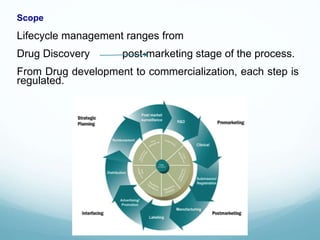
Scope
Lifecycle management ranges from
Drug Discovery post-marketing stage of the process.
From Drug development to commercialization, each step is
regulated.
Responsibilities of RA professional
 Keep up-to-date about international legislation, guidelines
and customer practices.
 Update with company's product range.
 Compliance of company's product with current regulations
 Impart training to R&D, Pilot plant, ADL on current
regulatory requirements
 Formulate regulatory submission strategies.
 Prepare IMPD, DMF, ANDA, MAA, Dossiers amendments
& supplements etc. as per regional guidelines, submit them
to regulatory authorities in a specified time frame
Responsibilities of RA professional cont...
 Monitor progress of all registration submissions
 Respond to queries as they arise and ensure that
registration/approvals are granted without delay.
 Handle regulatory and customer inspections, review audit
reports and compliance
 Arranges consultations and meetings between the firm
and government regulatory agencies
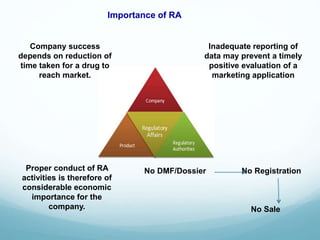
Importance of RA
Company success
depends on reduction of
time taken for a drug to
reach market.
Inadequate reporting of
data may prevent a timely
positive evaluation of a
marketing application
Proper conduct of RA
activities is therefore of
considerable economic
importance for the
company.
No DMF/Dossier No Registration
No Sale
Regulatory Agencies
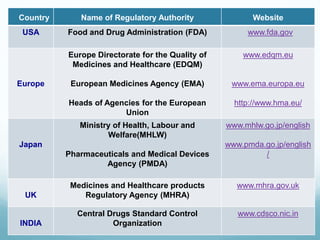
Country Name of Regulatory Authority Website
USA Food and Drug Administration (FDA) www.fda.gov
Europe
Europe Directorate for the Quality of
Medicines and Healthcare (EDQM)
European Medicines Agency (EMA)
Heads of Agencies for the European
Union
www.edqm.eu
www.ema.europa.eu
http://www.hma.eu/
Japan
Ministry of Health, Labour and
Welfare(MHLW)
Pharmaceuticals and Medical Devices
Agency (PMDA)
www.mhlw.go.jp/english
www.pmda.go.jp/english
/
UK
Medicines and Healthcare products
Regulatory Agency (MHRA)
www.mhra.gov.uk
INDIA
Central Drugs Standard Control
Organization
www.cdsco.nic.in
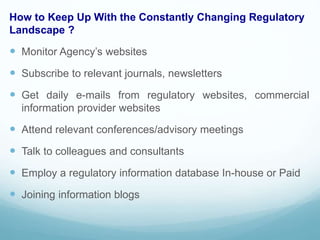
How to Keep Up With the Constantly Changing Regulatory
Landscape ?
 Monitor Agency’s websites
 Subscribe to relevant journals, newsletters
 Get daily e-mails from regulatory websites, commercial
information provider websites
 Attend relevant conferences/advisory meetings
 Talk to colleagues and consultants
 Employ a regulatory information database In-house or Paid
 Joining information blogs
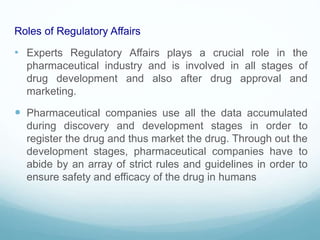
Roles of Regulatory Affairs
• Experts Regulatory Affairs plays a crucial role in the
pharmaceutical industry and is involved in all stages of
drug development and also after drug approval and
marketing.
 Pharmaceutical companies use all the data accumulated
during discovery and development stages in order to
register the drug and thus market the drug. Through out the
development stages, pharmaceutical companies have to
abide by an array of strict rules and guidelines in order to
ensure safety and efficacy of the drug in humans
 In this highly regulated environment, regulatory affairs plays
a critical role not only as the interface with health agencies
and as a link between different departments in the company
but also as the leading department to provide strategic
advice on extremely difficult decisions through the life of a
drug.
 Regulatory professionals keep working with the authorities
and different departments within the company in order to
meet regulatory commitments with the health authorities.
 Regulatory experts also ensures the maintenance of the
marketing license and leads life cycle extension activities
such as broadening the indication of the drug, change of
formulation, changes in the dosage etc..
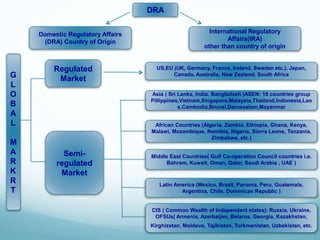
DRA
Domestic Regulatory Affairs
(DRA) Country of Origin
International Regulatory
Affairs(IRA)
other than country of origin
G
L
O
B
A
L
M
A
R
K
R
T
Regulated
Market
Semi-
regulated
Market
US,EU (UK, Germany, France, Ireland, Sweden etc.), Japan,
Canada, Australia, New Zealand, South Africa
Asia ( Sri Lanka, India, Bangladesh )ASEN: 10 countries group
Pillippines,Vietnam,Singapore,Malaysia,Thailand,Indonesia,Lao
s,Cambodia,Brunei,Darussalam,Mayanmar
African Countries (Algeria, Zambia, Ethiopia, Ghana, Kenya,
Malawi, Mozambique, Namibia, Nigeria, Sierra Leone, Tanzania,
Zimbabwe, etc.)
Middle East Countries( Gulf Co-operation Council countries i.e.
Bahram, Kuwait, Oman, Qatar, Saudi Arabia , UAE )
Latin America (Mexico, Brazil, Panama, Peru, Guatemala,
Argentina, Chile, Dominican Republic )
CIS ( Common Wealth of Independent states): Russia, Ukraine,
OFSUs( Armenia, Azerbaijan, Belarus, Georgia, Kazakhstan,
Kirghizstan, Moldova, Tajikistan, Turkmenistan, Uzbekistan, etc.
Thank you

REGULATORY AFFAIRS ( IP-2 / UNIT 3 )

  • 1.
  • 2.
    Contents  Introduction  Historicaloverview of RA  Responsibilities of RA  Regulatory Authorities  Role of RA department
  • 3.
    Introduction  Pharmaceutical &Clinical Research Industry most regulated among all the industries.  Every drug before getting market approval must undergo clinical trials to ensure its Safety, Efficacy & Quality.  Standards are set by regulatory authorities.  RA department acts as a crucial link between company, products & regulatory authorities.
  • 4.
    What is DRA Unique mix of science and management to achieve a commercially important goal.  It touches everything relating to drugs from the development manufacture and marketing.  RA takes care of Design = Development Plan Co-ordination = Writing/ reviewing, supervising Construction = Assembling& Submission management
  • 5.
     It isa dynamic and challenging field in the pharmaceutical industry.  It is an link between the competent authority and an applicant (company) to manage life cycle of the products.  In present regulatory scenario, company requires experts in regulatory activities to manage the product life cycle.  RA experts are qualified professionals to provide right solution to the technical problems under the light of laws
  • 6.
    Historical overview ofRA: The drug industry in India was at very primitive stage till 20th century. Most of the drugs Were imported from foreign countries. (a)1900-1960: Government passed the Poisons Act, 1919 to check and hold the control on cheap drugs available in market. This Act helps in the administered possession of substance or sale of substances as specified as poison. It also stated the safe and protected custody of the poisons, packaging and labeling of poisons, maximum quantity to be sold and inspection as well as examination of the poison sold by vendor during the year.
  • 7.
     The PoisonsAct was followed by The Dangerous Drugs Act, 1930 which includes the regulation of cultivation, manufacturing, possession and trade of opium.  In1985, Dangerous Drugs Act, 1930 and Opium Act, 1878 was revoked by passing of the Narcotics and Psychotropic Substances Act.
  • 8.
    Following acts andrules were passed during this era:  Drugs and Cosmetics Act, 1940: This act regulates the manufacturing, distribution, import and sale of allopathic, homeopathic, unani and siddha drugs.  Drugs and Cosmetics Rules, 1945: This act regulates manufacture of Ayurvedic drugs for sale only, and not for consumption and use or possession.  Pharmacy Act, 1948: This law was amended in 1986 and it generally controls and regulates the profession of pharmacy in India.
  • 9.
     Drugs andMagic Remedies (Objectionable Advertisements) Rule, 1955: This rule regulates the advertisement of drugs in India.  Drugs Prices Control Order, 1955 (DPCO) (under the essential commodities Act): DPCO was further amended in 1995. As per this rule, government has a jurisdiction to review and fix maximum sale price for bulk drugs as well as formulation. (b) 1960-1970: The Indian Pharmaceutical industry was not mature enough and major market share was dominated by MNC and very few Indian manufacturers were in competition.
  • 10.
     Focus onpure research and development was very little because of deficiency of patent protection. The low availability and high drug price is because majority shares depend upon the high drug import. (c) 1970-1980: Government took control for the medicines regulation and issued few acts and rules. Indian Patent Act 1970 (which came in force on 20 April 1972 and replaced Indian Patents and Designs Act of 1911): It serves as the basis for patent protection in India.
  • 11.
    Under this Actproduct patent was not allowed but the process and method of manufacturing of Drug substance was allowed to get the patent Drug prices capped: Drug Prices Control Order (DPCO) was introduced to control the high price against consumers. (d) 1980-1990: The Indian industry has started investing in process development of API and created production infrastructure for the same. (e) 1990-2000: A rapid expansion in domestic market has observed in pharmaceutical industry. The companies have started entering into Research and Development.
  • 12.
    (f) 2000-2010: Thisperiod is considered to be the Innovation and Research era. During these years, innovative research activity, patenting of the drugs formula, process, indication as well as merger of companies was started. Patent Amendment Act 2005: Indian Government brought out the Patents (Amendment) Ordinance, 2004 to address the issues relating to the patent in the country which was later replaced by the Indian Patent (Amendment) Act, 2005. The new Act brought some crucial changes on the legal regime of patent protection so as to address patent issues in technology, chemicals and pharmaceuticals sectors
  • 13.
    Compulsory Licenses: Suchlicenses can be granted for manufacture and export of the drug products "to any country having insufficient or no manufacturing capacity, for the said product, to address public health problems”. Few names are given below: Drugs and Cosmetics (First Amendment) Rules. 2011: It mandates registration of Clinical Research Organization (CRO) for conducting Clinical Trials (CT).
  • 14.
    Clinical Trial Registry-India(CTRI): It has been set up by the ICMR's (Indian Council of Medical Research) National Institute of Medical Statistics (NIMS). Pharmacovigilance Program of India (PvPI): The Central Drugs Standard Control Organization (CDSCO) has launched Pharmacovigilance programme to assure drugs safety to Indian patients
  • 15.
    Scope Lifecycle management rangesfrom Drug Discovery post-marketing stage of the process. From Drug development to commercialization, each step is regulated.
  • 16.
    Responsibilities of RAprofessional  Keep up-to-date about international legislation, guidelines and customer practices.  Update with company's product range.  Compliance of company's product with current regulations  Impart training to R&D, Pilot plant, ADL on current regulatory requirements  Formulate regulatory submission strategies.  Prepare IMPD, DMF, ANDA, MAA, Dossiers amendments & supplements etc. as per regional guidelines, submit them to regulatory authorities in a specified time frame
  • 17.
    Responsibilities of RAprofessional cont...  Monitor progress of all registration submissions  Respond to queries as they arise and ensure that registration/approvals are granted without delay.  Handle regulatory and customer inspections, review audit reports and compliance  Arranges consultations and meetings between the firm and government regulatory agencies
  • 18.
    Importance of RA Companysuccess depends on reduction of time taken for a drug to reach market. Inadequate reporting of data may prevent a timely positive evaluation of a marketing application Proper conduct of RA activities is therefore of considerable economic importance for the company. No DMF/Dossier No Registration No Sale
  • 19.
  • 20.
    Country Name ofRegulatory Authority Website USA Food and Drug Administration (FDA) www.fda.gov Europe Europe Directorate for the Quality of Medicines and Healthcare (EDQM) European Medicines Agency (EMA) Heads of Agencies for the European Union www.edqm.eu www.ema.europa.eu http://www.hma.eu/ Japan Ministry of Health, Labour and Welfare(MHLW) Pharmaceuticals and Medical Devices Agency (PMDA) www.mhlw.go.jp/english www.pmda.go.jp/english / UK Medicines and Healthcare products Regulatory Agency (MHRA) www.mhra.gov.uk INDIA Central Drugs Standard Control Organization www.cdsco.nic.in
  • 21.
    How to KeepUp With the Constantly Changing Regulatory Landscape ?  Monitor Agency’s websites  Subscribe to relevant journals, newsletters  Get daily e-mails from regulatory websites, commercial information provider websites  Attend relevant conferences/advisory meetings  Talk to colleagues and consultants  Employ a regulatory information database In-house or Paid  Joining information blogs
  • 22.
    Roles of RegulatoryAffairs • Experts Regulatory Affairs plays a crucial role in the pharmaceutical industry and is involved in all stages of drug development and also after drug approval and marketing.  Pharmaceutical companies use all the data accumulated during discovery and development stages in order to register the drug and thus market the drug. Through out the development stages, pharmaceutical companies have to abide by an array of strict rules and guidelines in order to ensure safety and efficacy of the drug in humans
  • 23.
     In thishighly regulated environment, regulatory affairs plays a critical role not only as the interface with health agencies and as a link between different departments in the company but also as the leading department to provide strategic advice on extremely difficult decisions through the life of a drug.  Regulatory professionals keep working with the authorities and different departments within the company in order to meet regulatory commitments with the health authorities.  Regulatory experts also ensures the maintenance of the marketing license and leads life cycle extension activities such as broadening the indication of the drug, change of formulation, changes in the dosage etc..
  • 24.
    DRA Domestic Regulatory Affairs (DRA)Country of Origin International Regulatory Affairs(IRA) other than country of origin G L O B A L M A R K R T Regulated Market Semi- regulated Market US,EU (UK, Germany, France, Ireland, Sweden etc.), Japan, Canada, Australia, New Zealand, South Africa Asia ( Sri Lanka, India, Bangladesh )ASEN: 10 countries group Pillippines,Vietnam,Singapore,Malaysia,Thailand,Indonesia,Lao s,Cambodia,Brunei,Darussalam,Mayanmar African Countries (Algeria, Zambia, Ethiopia, Ghana, Kenya, Malawi, Mozambique, Namibia, Nigeria, Sierra Leone, Tanzania, Zimbabwe, etc.) Middle East Countries( Gulf Co-operation Council countries i.e. Bahram, Kuwait, Oman, Qatar, Saudi Arabia , UAE ) Latin America (Mexico, Brazil, Panama, Peru, Guatemala, Argentina, Chile, Dominican Republic ) CIS ( Common Wealth of Independent states): Russia, Ukraine, OFSUs( Armenia, Azerbaijan, Belarus, Georgia, Kazakhstan, Kirghizstan, Moldova, Tajikistan, Turkmenistan, Uzbekistan, etc.
  • 25.