Disk Operating System (DOS)
Introduction, Structure and Commands
Disk Operating System
In the late 1980s the operating system that shipped with most PCs was Disk Operating System (DOS)
created by Microsoft: MS-DOS.
 MS-DOS is a disk operating system for IBM PC–compatible computers.
 In its day, it was the most popular operating system in the world.
It is a Single-user, Single-tasking Computer Operating System that uses a Command Line Interface.
Disk Operating System
Despite of its very small size and relative simplicity, It is one of the most successful operating systems
that has been developed to date.
DOS enables the user to organize the files in a disk into directories and sub-directories.
 Directory is just like a file folder, which contain all the logically related files.
 Directory within another directory is called a sub- directory there may be sub-directories of sub-directories.
Structure of MS DOS
 The Operating-system loader:
 It brings the operating system from the start-up into RAM called Bootstrapping.
 The MS-DOS BIOS (Basic Input/Output systems)
 Loaded from the file IO.SYS during initialization.
 Layer that sits between operating system kernel and hardware.
Structure of MS DOS
 The MS-DOS Kernel:
 Read into memory at initialization time from MSDOS.SYS file on boot disk
 Heart of the operating system
 it is a proprietary program supplied by Microsoft corporation
 The User Interface (shell):
 Conventional program that allows the user to interact with the operating system.
 Default MS – DOS user interface is a shell program called Command.com
Structure of MS DOS
 MS-DOS PROMPT:
 A command prompt is an entry point for typing computer commands in the Command
Prompt window.
 By typing commands at the command prompt, you can perform tasks on your computer
without using the Windows graphical interface.
File Organization
 DOS files are organized in a hierarchical or an inverted tree-like structure.
 Using path to specify the location of files
 A path is the route that leads from the root directory of a drive to the file you want to use.
File Organization
 File naming conventions:
 Primary Name and Secondary Name. eg: Letter.doc
 Primary name cannot exceed limit of 8 characters.
 Extension cannot exceed the limit of 3 characters.
 Other Special characters cannot be part of file name. eg: ?, *, >, <,|
 There cannot be any spaces in between the file name.
File Organization
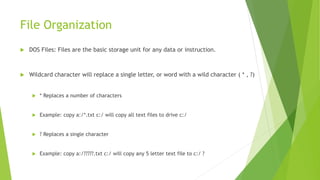
 DOS Files: Files are the basic storage unit for any data or instruction.
 Wildcard character will replace a single letter, or word with a wild character ( * , ?)
 * Replaces a number of characters
 Example: copy a:/*.txt c:/ will copy all text files to drive c:/
 ? Replaces a single character
 Example: copy a:/?????.txt c:/ will copy any 5 letter text file to c:/ ?
Commands
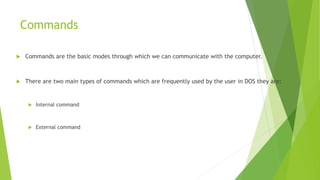
 Commands are the basic modes through which we can communicate with the computer.
 There are two main types of commands which are frequently used by the user in DOS they are:
 Internal command
 External command
Internal Commands
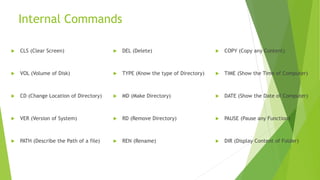
 CLS (Clear Screen)
 VOL (Volume of Disk)
 CD (Change Location of Directory)
 VER (Version of System)
 PATH (Describe the Path of a file)
 DEL (Delete)
 TYPE (Know the type of Directory)
 MD (Make Directory)
 RD (Remove Directory)
 REN (Rename)
 COPY (Copy any Content)
 TIME (Show the Time of Computer)
 DATE (Show the Date of Computer)
 PAUSE (Pause any Function)
 DIR (Display Content of Folder)
Internal Commands
 Basic Command ‘CLS’
 Example: C> CLS will clear all the instructions and screen will become blank
 Basic Command ‘DIR’:
 ‘SYNTAX: DIR [Drive:][Path][File]
 Example: C>DIR will display all the detail in the directory
Internal Commands
 Basic Command ‘COPY’:
 SYNTAX: COPY [Path][Drive:] <Source file> <[Drive:][Path]>
 Example C>COPY A:file.txt C: will copy the file from a: to c:
 Basic Command ‘DEL’:
 SYNTAX: DEL [Drive:][Path] <Filename>
 Example: C>DEL Newfile.txt will delete the file named newfile.txt from C: drive
Internal Commands
 Basic Command ‘REN’:
 SYNATX: REN [Drive:][Path] <old Filename> <new Filename>
 Example : C>REN D:file.txt myfile.txt will rename the file.txt to myfile.txt
 Basic Command ‘CD’:
 SYNATX: CD [Drive:][Path] <Directory name>
 Example : C>CD Personnel will change the directory to personnel To move backward use C>CD
Internal Commands
 Basic Command ‘MD’:
 SYNTAX: MD [Drive:][Path] <Directory name>
 Example: C>MD myfolder will make a folder called myfolder in current directory
 Basic Command ‘RD’:
 SYNTAX: RD [Drive:][Path] <Directory name>
 Example: C>RD myfolder will remove a folder called myfolder in current directory. etc
External Commands
 Backup (Backup ur Data in a Disk)
 Restore (Restore Data from Previous Disk)
 Chkdsk (Check Disk Space)
 Tree (Determine the whole tree of a disk)
 Diskcopy
 Diskcomp
 Copy con (Copy the Content of one disk to another)
 Print (Print to printer)
 Move (Move from one Directory to Another)
 Undelete (Un Do)
 Format (Format the Whole Disk)
 Deltree (Delete Whole Tree)
 Attrib (changes or displays the attributes of a file)
External Commands
 Format command:
 Example c>format a: will format the drive a:
 Attrib command
 Syntax: attrib [modes] [[drive:][path] filename]
 Example c>attrib or c>attrib +r *.doc will make the file with extension .doc read only
External Commands
 move command
 move will move the file or directory from one location to another syntax: move [path][drive:] <source file>
<[drive:][path]> example: c>move a:file.txt c:file.txt will move the file to the c: drive
 break command
 break command can be used to stop an activity (example- sorting of files) syntax: break [on/off] example c>
break off
External Commands
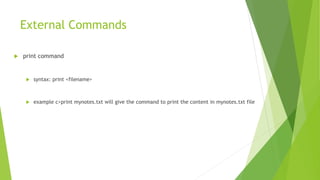
 print command
 syntax: print <filename>
 example c>print mynotes.txt will give the command to print the content in mynotes.txt file

Disk Operating System.pptx

  • 1.
    Disk Operating System(DOS) Introduction, Structure and Commands
  • 2.
    Disk Operating System Inthe late 1980s the operating system that shipped with most PCs was Disk Operating System (DOS) created by Microsoft: MS-DOS.  MS-DOS is a disk operating system for IBM PC–compatible computers.  In its day, it was the most popular operating system in the world. It is a Single-user, Single-tasking Computer Operating System that uses a Command Line Interface.
  • 3.
    Disk Operating System Despiteof its very small size and relative simplicity, It is one of the most successful operating systems that has been developed to date. DOS enables the user to organize the files in a disk into directories and sub-directories.  Directory is just like a file folder, which contain all the logically related files.  Directory within another directory is called a sub- directory there may be sub-directories of sub-directories.
  • 4.
    Structure of MSDOS  The Operating-system loader:  It brings the operating system from the start-up into RAM called Bootstrapping.  The MS-DOS BIOS (Basic Input/Output systems)  Loaded from the file IO.SYS during initialization.  Layer that sits between operating system kernel and hardware.
  • 5.
    Structure of MSDOS  The MS-DOS Kernel:  Read into memory at initialization time from MSDOS.SYS file on boot disk  Heart of the operating system  it is a proprietary program supplied by Microsoft corporation  The User Interface (shell):  Conventional program that allows the user to interact with the operating system.  Default MS – DOS user interface is a shell program called Command.com
  • 6.
    Structure of MSDOS  MS-DOS PROMPT:  A command prompt is an entry point for typing computer commands in the Command Prompt window.  By typing commands at the command prompt, you can perform tasks on your computer without using the Windows graphical interface.
  • 7.
    File Organization  DOSfiles are organized in a hierarchical or an inverted tree-like structure.  Using path to specify the location of files  A path is the route that leads from the root directory of a drive to the file you want to use.
  • 8.
    File Organization  Filenaming conventions:  Primary Name and Secondary Name. eg: Letter.doc  Primary name cannot exceed limit of 8 characters.  Extension cannot exceed the limit of 3 characters.  Other Special characters cannot be part of file name. eg: ?, *, >, <,|  There cannot be any spaces in between the file name.
  • 9.
    File Organization  DOSFiles: Files are the basic storage unit for any data or instruction.  Wildcard character will replace a single letter, or word with a wild character ( * , ?)  * Replaces a number of characters  Example: copy a:/*.txt c:/ will copy all text files to drive c:/  ? Replaces a single character  Example: copy a:/?????.txt c:/ will copy any 5 letter text file to c:/ ?
  • 10.
    Commands  Commands arethe basic modes through which we can communicate with the computer.  There are two main types of commands which are frequently used by the user in DOS they are:  Internal command  External command
  • 11.
    Internal Commands  CLS(Clear Screen)  VOL (Volume of Disk)  CD (Change Location of Directory)  VER (Version of System)  PATH (Describe the Path of a file)  DEL (Delete)  TYPE (Know the type of Directory)  MD (Make Directory)  RD (Remove Directory)  REN (Rename)  COPY (Copy any Content)  TIME (Show the Time of Computer)  DATE (Show the Date of Computer)  PAUSE (Pause any Function)  DIR (Display Content of Folder)
  • 12.
    Internal Commands  BasicCommand ‘CLS’  Example: C> CLS will clear all the instructions and screen will become blank  Basic Command ‘DIR’:  ‘SYNTAX: DIR [Drive:][Path][File]  Example: C>DIR will display all the detail in the directory
  • 13.
    Internal Commands  BasicCommand ‘COPY’:  SYNTAX: COPY [Path][Drive:] <Source file> <[Drive:][Path]>  Example C>COPY A:file.txt C: will copy the file from a: to c:  Basic Command ‘DEL’:  SYNTAX: DEL [Drive:][Path] <Filename>  Example: C>DEL Newfile.txt will delete the file named newfile.txt from C: drive
  • 14.
    Internal Commands  BasicCommand ‘REN’:  SYNATX: REN [Drive:][Path] <old Filename> <new Filename>  Example : C>REN D:file.txt myfile.txt will rename the file.txt to myfile.txt  Basic Command ‘CD’:  SYNATX: CD [Drive:][Path] <Directory name>  Example : C>CD Personnel will change the directory to personnel To move backward use C>CD
  • 15.
    Internal Commands  BasicCommand ‘MD’:  SYNTAX: MD [Drive:][Path] <Directory name>  Example: C>MD myfolder will make a folder called myfolder in current directory  Basic Command ‘RD’:  SYNTAX: RD [Drive:][Path] <Directory name>  Example: C>RD myfolder will remove a folder called myfolder in current directory. etc
  • 16.
    External Commands  Backup(Backup ur Data in a Disk)  Restore (Restore Data from Previous Disk)  Chkdsk (Check Disk Space)  Tree (Determine the whole tree of a disk)  Diskcopy  Diskcomp  Copy con (Copy the Content of one disk to another)  Print (Print to printer)  Move (Move from one Directory to Another)  Undelete (Un Do)  Format (Format the Whole Disk)  Deltree (Delete Whole Tree)  Attrib (changes or displays the attributes of a file)
  • 17.
    External Commands  Formatcommand:  Example c>format a: will format the drive a:  Attrib command  Syntax: attrib [modes] [[drive:][path] filename]  Example c>attrib or c>attrib +r *.doc will make the file with extension .doc read only
  • 18.
    External Commands  movecommand  move will move the file or directory from one location to another syntax: move [path][drive:] <source file> <[drive:][path]> example: c>move a:file.txt c:file.txt will move the file to the c: drive  break command  break command can be used to stop an activity (example- sorting of files) syntax: break [on/off] example c> break off
  • 19.
    External Commands  printcommand  syntax: print <filename>  example c>print mynotes.txt will give the command to print the content in mynotes.txt file