Azerbaijan State Oil and Industry University
Computer Science
Subject: Operation Systems
Teacher: Karimova Sevinj
Student: Rasulzade Shams
Group: 606.20E
The MS-DOS File
System
Plan
 About MS-DOS
 MS-DOS File Structure
 Directory Structure
 MS-DOS Commands
MS-DOS ( Microsoft Disk Operating System) is an operating
system for personal computers mostly developed by Microsoft. Some
operating systems attempting to be compatible with MS-DOS, are
sometimes referred to as "DOS" which is also the generic acronym
for disk operating system.
MS-DOS was the main operating system for IBM PC compatible
personal computers during the 1980s, from which point it was gradually
superseded by operating systems offering a graphical user interface (GUI)
, in various generations of the graphical Microsoft Windows operating
system.
MS-DOS went through eight versions, until development ceased in 2000.
What is MS-DOS ?
DOS-based software generally makes use of the graphics and
sound features of the computer with little or no use. Multitasking,
on the other hand, could only be in limited possibilities in some
versions.
Despite its diminishing role in desktop computer systems,
MS-DOS is still used in various embedded systems today due to
its simple architecture and minimal processor speed and memory
requirement.
MS-DOS compatible systems include:
IBM PC DOS
DR DOS, Novell DOS, OpenDOS
FreeDOS
PTS-DOS
ROM-DOS
MS-DOS coordinates the functioning of the computer for application programs.
This is really important, but the advantages of MS-DOS are not just that.
Although it may seem simple to people and strange to use, the MS-DOS
operating system is the best remedy in case of computer damage. It is the best
system used by MS-DOS hardware installers. For example, if Windows does not
open, it constantly gives problems, they usually manage these problems by
formatting the HDD and reinstalling the operating system, but it is an error.
Because if the HDD is formatted continuously, the HDD will be damaged,
causing a bad sector (unusable or bad area) to occur and the "boot sector" (the
place where the information of the HDD is kept) to be damaged. But without
formatting, it can be restored including the computer's system by still using MS-
DOS.
You can also use MS-DOS itself for certain jobs; by using the instructions
called command, you can direct MS-DOS in file management, controlling
workflow and performing daily tasks without requiring additional software.
For example, MS-DOS includes a program that you can use to create and
modify text files. Although the MS-DOS editor is not a word processor, short
correspondence is very useful for lists. Using it, you can write small documents
in much less time than with a word processor.
You can create powerful commands or even your own small applications by
combining commands to meet your specific needs in MS-DOS. For example, you
can create a simple file manager using only MS-DOS commands.
MS-DOS versions 4.0 and above include a separate program that allows you to
select commands and files from lists called menu. With this program called Shell,
you can perform all your routine work, you can use it from time to time or you can
not use it at all.
Now all these applications, the applications of Dos have become easier and more
understandable after the Windows interface created for MS-DOS.
MS-DOS File Structure
All information and programs are saved to disk / floppy disk as a
collection of information called file. A file in DOS operating system
consists of two parts, the filename and the file extension.
MS-DOS filename and file extension rules;
• The file name consists of a maximum of 8 characters.
• The file extension consists of a maximum of 3 characters.
• There is a period (.) sign between the file name and its extension.
• There is no space character in the file name and extension.
• File names are not case sensitive.
• While writing the file name and extension name, we can use numbers 0-9, letters from A to Z and
some special characters ($,%, &, # ...). But some special characters (such as *,.,?) are not used.
Directory Structure
Files on the computer can be divided into groups of files according to their content
or characteristics. These groups are called directories. In the Windows environment,
the folder name is used instead of the directory name. There are 3 different directory
types.
It is the main directory of the computer. Identifies the drive used with letters such as
(a: , b: , c: ). The user cannot create or delete a root directory. This can only be
done by the administrator with disk partitioning tools.
Folders created under the root directory.
Folders created under (within) users created folders. Sub-directories (folders within a
folder) are not visible on the screen by simply typing the DIR command when in the
root directory. With DIR / S you can show all subdirectories.
Root Directory
Directory
Subdirectory
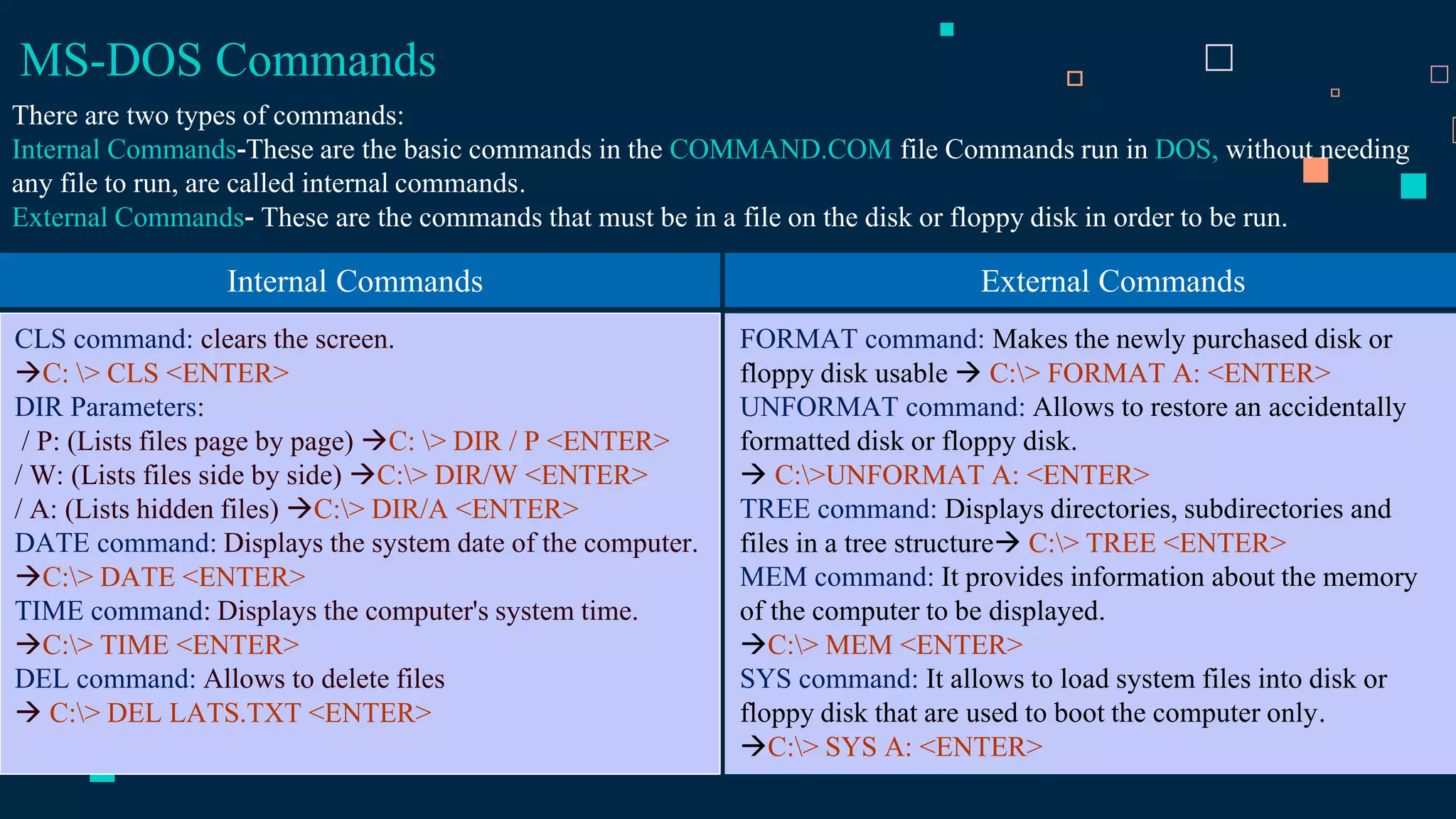
MS-DOS Commands
There are two types of commands:
Internal Commands-These are the basic commands in the COMMAND.COM file Commands run in DOS, without needing
any file to run, are called internal commands.
External Commands- These are the commands that must be in a file on the disk or floppy disk in order to be run.
Internal Commands External Commands
CLS command: clears the screen.
C: > CLS <ENTER>
DIR Parameters:
/ P: (Lists files page by page) C: > DIR / P <ENTER>
/ W: (Lists files side by side) C:> DIR/W <ENTER>
/ A: (Lists hidden files) C:> DIR/A <ENTER>
DATE command: Displays the system date of the computer.
C:> DATE <ENTER>
TIME command: Displays the computer's system time.
C:> TIME <ENTER>
DEL command: Allows to delete files
 C:> DEL LATS.TXT <ENTER>
FORMAT command: Makes the newly purchased disk or
floppy disk usable  C:> FORMAT A: <ENTER>
UNFORMAT command: Allows to restore an accidentally
formatted disk or floppy disk.
 C:>UNFORMAT A: <ENTER>
TREE command: Displays directories, subdirectories and
files in a tree structure C:> TREE <ENTER>
MEM command: It provides information about the memory
of the computer to be displayed.
C:> MEM <ENTER>
SYS command: It allows to load system files into disk or
floppy disk that are used to boot the computer only.
C:> SYS A: <ENTER>
Resources
https://en.wikipedia.org/wiki/MS-DOS#Competition
https://tr.wikipedia.org/wiki/MS-DOS
CREDITS: This presentation template was created by Slidesgo,
including icons by Flaticon, and infographics & images by Freepik
THANKS FOR
ATTENTION

The MS-DOS File System.pptx

  • 1.
    Azerbaijan State Oiland Industry University Computer Science Subject: Operation Systems Teacher: Karimova Sevinj Student: Rasulzade Shams Group: 606.20E
  • 2.
  • 3.
    Plan  About MS-DOS MS-DOS File Structure  Directory Structure  MS-DOS Commands
  • 4.
    MS-DOS ( MicrosoftDisk Operating System) is an operating system for personal computers mostly developed by Microsoft. Some operating systems attempting to be compatible with MS-DOS, are sometimes referred to as "DOS" which is also the generic acronym for disk operating system. MS-DOS was the main operating system for IBM PC compatible personal computers during the 1980s, from which point it was gradually superseded by operating systems offering a graphical user interface (GUI) , in various generations of the graphical Microsoft Windows operating system. MS-DOS went through eight versions, until development ceased in 2000. What is MS-DOS ?
  • 5.
    DOS-based software generallymakes use of the graphics and sound features of the computer with little or no use. Multitasking, on the other hand, could only be in limited possibilities in some versions. Despite its diminishing role in desktop computer systems, MS-DOS is still used in various embedded systems today due to its simple architecture and minimal processor speed and memory requirement. MS-DOS compatible systems include: IBM PC DOS DR DOS, Novell DOS, OpenDOS FreeDOS PTS-DOS ROM-DOS
  • 6.
    MS-DOS coordinates thefunctioning of the computer for application programs. This is really important, but the advantages of MS-DOS are not just that. Although it may seem simple to people and strange to use, the MS-DOS operating system is the best remedy in case of computer damage. It is the best system used by MS-DOS hardware installers. For example, if Windows does not open, it constantly gives problems, they usually manage these problems by formatting the HDD and reinstalling the operating system, but it is an error. Because if the HDD is formatted continuously, the HDD will be damaged, causing a bad sector (unusable or bad area) to occur and the "boot sector" (the place where the information of the HDD is kept) to be damaged. But without formatting, it can be restored including the computer's system by still using MS- DOS.
  • 7.
    You can alsouse MS-DOS itself for certain jobs; by using the instructions called command, you can direct MS-DOS in file management, controlling workflow and performing daily tasks without requiring additional software. For example, MS-DOS includes a program that you can use to create and modify text files. Although the MS-DOS editor is not a word processor, short correspondence is very useful for lists. Using it, you can write small documents in much less time than with a word processor.
  • 8.
    You can createpowerful commands or even your own small applications by combining commands to meet your specific needs in MS-DOS. For example, you can create a simple file manager using only MS-DOS commands. MS-DOS versions 4.0 and above include a separate program that allows you to select commands and files from lists called menu. With this program called Shell, you can perform all your routine work, you can use it from time to time or you can not use it at all. Now all these applications, the applications of Dos have become easier and more understandable after the Windows interface created for MS-DOS.
  • 9.
    MS-DOS File Structure Allinformation and programs are saved to disk / floppy disk as a collection of information called file. A file in DOS operating system consists of two parts, the filename and the file extension. MS-DOS filename and file extension rules; • The file name consists of a maximum of 8 characters. • The file extension consists of a maximum of 3 characters. • There is a period (.) sign between the file name and its extension. • There is no space character in the file name and extension. • File names are not case sensitive. • While writing the file name and extension name, we can use numbers 0-9, letters from A to Z and some special characters ($,%, &, # ...). But some special characters (such as *,.,?) are not used.
  • 10.
    Directory Structure Files onthe computer can be divided into groups of files according to their content or characteristics. These groups are called directories. In the Windows environment, the folder name is used instead of the directory name. There are 3 different directory types. It is the main directory of the computer. Identifies the drive used with letters such as (a: , b: , c: ). The user cannot create or delete a root directory. This can only be done by the administrator with disk partitioning tools. Folders created under the root directory. Folders created under (within) users created folders. Sub-directories (folders within a folder) are not visible on the screen by simply typing the DIR command when in the root directory. With DIR / S you can show all subdirectories. Root Directory Directory Subdirectory
  • 11.
    MS-DOS Commands There aretwo types of commands: Internal Commands-These are the basic commands in the COMMAND.COM file Commands run in DOS, without needing any file to run, are called internal commands. External Commands- These are the commands that must be in a file on the disk or floppy disk in order to be run. Internal Commands External Commands CLS command: clears the screen. C: > CLS <ENTER> DIR Parameters: / P: (Lists files page by page) C: > DIR / P <ENTER> / W: (Lists files side by side) C:> DIR/W <ENTER> / A: (Lists hidden files) C:> DIR/A <ENTER> DATE command: Displays the system date of the computer. C:> DATE <ENTER> TIME command: Displays the computer's system time. C:> TIME <ENTER> DEL command: Allows to delete files  C:> DEL LATS.TXT <ENTER> FORMAT command: Makes the newly purchased disk or floppy disk usable  C:> FORMAT A: <ENTER> UNFORMAT command: Allows to restore an accidentally formatted disk or floppy disk.  C:>UNFORMAT A: <ENTER> TREE command: Displays directories, subdirectories and files in a tree structure C:> TREE <ENTER> MEM command: It provides information about the memory of the computer to be displayed. C:> MEM <ENTER> SYS command: It allows to load system files into disk or floppy disk that are used to boot the computer only. C:> SYS A: <ENTER>
  • 12.
  • 13.
    CREDITS: This presentationtemplate was created by Slidesgo, including icons by Flaticon, and infographics & images by Freepik THANKS FOR ATTENTION