GOHEL VISHAL H 
LECTURER OF COMPUTER DEPTT. 
GP BHUJ 
MO.9638893297 
Chapter 20 Slide 1 of 23
Working with the BIOS / CMOS
Objectives 
Describe about motherboard BIOS 
Explain the Preboot Environment 
Explain BIOS packaging 
Define CMOS 
Upgrade the BIOS 
Describe BIOS Setup Utility 
Troubleshoot the system using the BIOS beep 
codes 
Chapter 20 Slide 3 of 23
Motherboard BIOS - I 
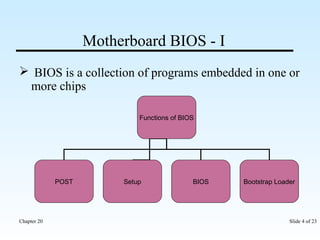
 BIOS is a collection of programs embedded in one or 
more chips 
Functions of BIOS 
POST Setup BIOS Bootstrap Loader 
Chapter 20 Slide 4 of 23
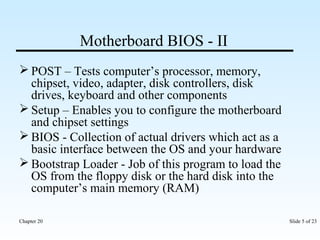
Motherboard BIOS - II 
POST – Tests computer’s processor, memory, 
chipset, video, adapter, disk controllers, disk 
drives, keyboard and other components 
Setup – Enables you to configure the motherboard 
and chipset settings 
BIOS - Collection of actual drivers which act as a 
basic interface between the OS and your hardware 
Bootstrap Loader - Job of this program to load the 
OS from the floppy disk or the hard disk into the 
computer’s main memory (RAM) 
Chapter 20 Slide 5 of 23
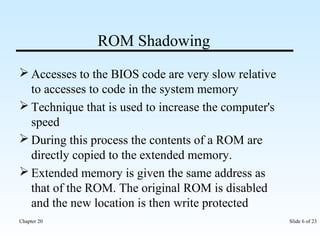
ROM Shadowing 
Accesses to the BIOS code are very slow relative 
to accesses to code in the system memory 
Technique that is used to increase the computer's 
speed 
During this process the contents of a ROM are 
directly copied to the extended memory. 
Extended memory is given the same address as 
that of the ROM. The original ROM is disabled 
and the new location is then write protected 
Chapter 20 Slide 6 of 23
BIOS Manufacturer 
AMI 
Award 
Phoenix 
MR BIOS 
Chapter 20 Slide 7 of 23
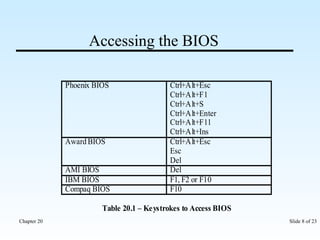
Accessing the BIOS 
Phoenix BIOS Ctrl+Alt+Esc 
Ctrl+Alt+F1 
Ctrl+Alt+S 
Ctrl+Alt+Enter 
Ctrl+Alt+F11 
Ctrl+Alt+Ins 
Award BIOS Ctrl+Alt+Esc 
Esc 
Del 
AMI BIOS Del 
IBM BIOS F1, F2 or F10 
Compaq BIOS F10 
Table 20.1 – Keystrokes to Access BIOS 
Chapter 20 Slide 8 of 23
Preboot Environment & Dual BIOS 
 Preboot environment is an environment in which various 
applications can run without requiring the presence of an 
operating system 
 Phoenix FirstBIOS have a common preboot environment 
with a graphical user interface 
 This enables a user to access the BIOS setup, extended 
diagnostics, a backup/restore application or a full recovery 
of the original system contents 
 On GIGABYTE motherboards with Dual BIOS there are 
physically two BIOS chips one is called "Primary" BIOS 
and the other is "Secondary" BIOS 
 If your "Primary" BIOS fails, the "Secondary" BIOS 
automatically takes over on your next system boot. 
Chapter 20 Slide 9 of 23
Basic Input / Output System (BIOS) - I 
 Enables you to control and troubleshoot the system and the 
different hardware components before loading the 
operating system 
 Types of BIOS chips 
• Rectangular shaped 32-pin Dual In-line Package (DIP) 
• Square 28-pin Plastic Leaded Chip Carrier (PLCC) 
Chapter 20 Slide 10 of 23
Basic Input / Output System (BIOS) - II 
Runs the power-on self-test (POST) when the 
system starts 
Receives signals from the hardware 
Loads the custom settings from the CMOS that 
stores the BIOS settings 
Displays the settings 
Locates the bootable devices and loads the 
operating system from the bootable device 
Chapter 20 Slide 11 of 23
Complementary Metal Oxide 
Semiconductor (CMOS) 
 Memory chip located on the motherboard that stores the 
BIOS settings 
Battery must be replaced when it becomes weak or 
you may lose the stored BIOS settings 
Receives power from the battery that is installed on 
the motherboard 
 Clear the BIOS settings stored in the CMOS using the 
jumpers located on the motherboard or by removing the 
battery from the motherboard 
Chapter 20 Slide 12 of 23
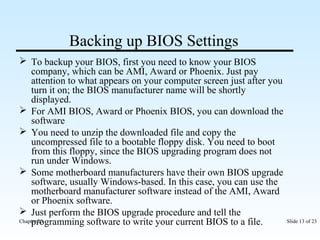
Backing up BIOS Settings 
 To backup your BIOS, first you need to know your BIOS 
company, which can be AMI, Award or Phoenix. Just pay 
attention to what appears on your computer screen just after you 
turn it on; the BIOS manufacturer name will be shortly 
displayed. 
 For AMI BIOS, Award or Phoenix BIOS, you can download the 
software 
 You need to unzip the downloaded file and copy the 
uncompressed file to a bootable floppy disk. You need to boot 
from this floppy, since the BIOS upgrading program does not 
run under Windows. 
 Some motherboard manufacturers have their own BIOS upgrade 
software, usually Windows-based. In this case, you can use the 
motherboard manufacturer software instead of the AMI, Award 
or Phoenix software. 
 Just perform the BIOS upgrade procedure and tell the 
programming software to write your current BIOS to a file. 
Chapter 20 Slide 13 of 23
Upgrading the BIOS - I 
Two ways for 
upgrading a 
Motherboard BIOS 
Replacing 
Physical 
BIOS Chip 
Performing 
a Flash 
Update 
Chapter 20 Slide 14 of 23
Performing a Flash Update 
 Download the BIOS software from the Internet. The 
software will be available in a zip file. 
 Unzip the file to a folder. 
 Insert a blank floppy in the floppy disk drive. 
 Run the .exe file from the folder. 
 Follow the steps displayed by the wizard to create a 
bootable BIOS update floppy disk. 
 Restart the system with the BIOS update floppy disk 
in the floppy disk drive and boot the system from 
floppy. The system will update the BIOS. 
 Restart the system and enter the BIOS to check if it 
is updated. 
Chapter 20 Slide 15 of 23
BIOS Setup Utility 
Enables you to modify the settings and store them 
in the CMOS 
Enables you to control the boot sequence 
Changes the BIOS setting to correct any hardware 
problems 
Chapter 20 Slide 16 of 23
BIOS Main Menu Page 
 Displays the different BIOS options which can be changed 
Chapter 20 Slide 17 of 23
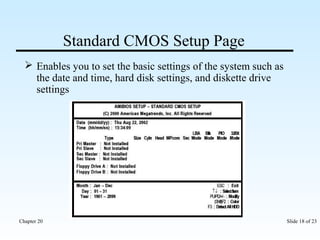
Standard CMOS Setup Page 
 Enables you to set the basic settings of the system such as 
the date and time, hard disk settings, and diskette drive 
settings 
Chapter 20 Slide 18 of 23
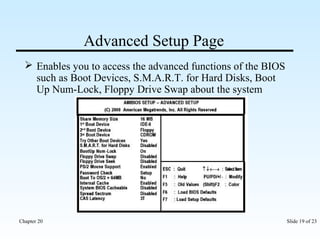
Advanced Setup Page 
 Enables you to access the advanced functions of the BIOS 
such as Boot Devices, S.M.A.R.T. for Hard Disks, Boot 
Up Num-Lock, Floppy Drive Swap about the system 
Chapter 20 Slide 19 of 23
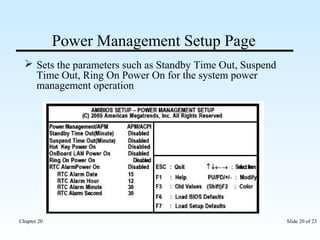
Power Management Setup Page 
 Sets the parameters such as Standby Time Out, Suspend 
Time Out, Ring On Power On for the system power 
management operation 
Chapter 20 Slide 20 of 23
PCI / Plug and Play Setup Page 
 Enables the system to automatically search for new 
hardware connected to the system 
 Automatically search for the drivers to use the device 
Chapter 20 Slide 21 of 23
Applying Settings 
Applying Optimal settings enables to set the 
default options 
Best Performance Settings enables to set BIOS 
options to make the system perform at best level 
Chapter 20 Slide 22 of 23
Features Setup Page 
Controls the built-in motherboard components 
Chapter 20 Slide 23 of 23
CPU PnP Setup Page 
Enables to change the microprocessor settings, to 
adjust the speed of the microprocessor 
Chapter 20 Slide 24 of 23
Hardware Monitor Page 
Displays the system hardware details 
Enables to monitor the system to prevent 
overheating 
Chapter 20 Slide 25 of 23
Setting the BIOS Password 
Protects the BIOS settings stored in the CMOS 
Password option from the Advanced Setup page 
should be enabled 
Prompts to enter the password before accessing 
the Setup Utility 
Chapter 20 Slide 26 of 23
Troubleshooting Using AMI BIOS Beep 
Codes - I 
Number of Beeps Solving Problem 
1 Short Beep System OK. If system does not start check that the 
power and data cables are properly connected 
2 / 3 / 4 Short Beeps Check that the RAM and Video Adapter cards are 
properly connected. 
5 Short Beeps Check that the RAM is properly installed. Check that 
the microprocessor is properly installed. 
Replace the microprocessor or the motherboard. 
6 Short Beeps Check or replace keyboard. 
Chapter 20 Slide 27 of 23
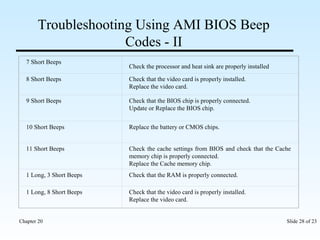
Troubleshooting Using AMI BIOS Beep 
Codes - II 
7 Short Beeps 
Check the processor and heat sink are properly installed 
8 Short Beeps Check that the video card is properly installed. 
Replace the video card. 
9 Short Beeps Check that the BIOS chip is properly connected. 
Update or Replace the BIOS chip. 
10 Short Beeps Replace the battery or CMOS chips. 
11 Short Beeps Check the cache settings from BIOS and check that the Cache 
memory chip is properly connected. 
Replace the Cache memory chip. 
1 Long, 3 Short Beeps Check that the RAM is properly connected. 
1 Long, 8 Short Beeps Check that the video card is properly installed. 
Replace the video card. 
Chapter 20 Slide 28 of 23
Summary - I 
BIOS software enables you to control and 
troubleshoot the system 
Types of BIOS chips include Dual In-line Package 
and Plastic Leaded Chip Carrier 
BIOS run the power-on self-test when the system 
starts 
CMOS stores the BIOS settings 
Updating the BISO adds additional functions to the 
BIOS and it also fixes all the errors and bugs in the 
BIOS 
Chapter 20 Slide 29 of 23
Summary - II 
BIOS Setup Utility enables you to modify the 
settings and store them in the CMOS 
The BIOS Setup Utility Main menu page displays 
different BIOS options that you can change 
BIOS password used to protect the settings stored 
in CMOS 
You can troubleshoot the system using the BIOS 
beep codes. 
Chapter 20 Slide 30 of 23

Bios

  • 1.
    GOHEL VISHAL H LECTURER OF COMPUTER DEPTT. GP BHUJ MO.9638893297 Chapter 20 Slide 1 of 23
  • 2.
    Working with theBIOS / CMOS
  • 3.
    Objectives Describe aboutmotherboard BIOS Explain the Preboot Environment Explain BIOS packaging Define CMOS Upgrade the BIOS Describe BIOS Setup Utility Troubleshoot the system using the BIOS beep codes Chapter 20 Slide 3 of 23
  • 4.
    Motherboard BIOS -I  BIOS is a collection of programs embedded in one or more chips Functions of BIOS POST Setup BIOS Bootstrap Loader Chapter 20 Slide 4 of 23
  • 5.
    Motherboard BIOS -II POST – Tests computer’s processor, memory, chipset, video, adapter, disk controllers, disk drives, keyboard and other components Setup – Enables you to configure the motherboard and chipset settings BIOS - Collection of actual drivers which act as a basic interface between the OS and your hardware Bootstrap Loader - Job of this program to load the OS from the floppy disk or the hard disk into the computer’s main memory (RAM) Chapter 20 Slide 5 of 23
  • 6.
    ROM Shadowing Accessesto the BIOS code are very slow relative to accesses to code in the system memory Technique that is used to increase the computer's speed During this process the contents of a ROM are directly copied to the extended memory. Extended memory is given the same address as that of the ROM. The original ROM is disabled and the new location is then write protected Chapter 20 Slide 6 of 23
  • 7.
    BIOS Manufacturer AMI Award Phoenix MR BIOS Chapter 20 Slide 7 of 23
  • 8.
    Accessing the BIOS Phoenix BIOS Ctrl+Alt+Esc Ctrl+Alt+F1 Ctrl+Alt+S Ctrl+Alt+Enter Ctrl+Alt+F11 Ctrl+Alt+Ins Award BIOS Ctrl+Alt+Esc Esc Del AMI BIOS Del IBM BIOS F1, F2 or F10 Compaq BIOS F10 Table 20.1 – Keystrokes to Access BIOS Chapter 20 Slide 8 of 23
  • 9.
    Preboot Environment &Dual BIOS  Preboot environment is an environment in which various applications can run without requiring the presence of an operating system  Phoenix FirstBIOS have a common preboot environment with a graphical user interface  This enables a user to access the BIOS setup, extended diagnostics, a backup/restore application or a full recovery of the original system contents  On GIGABYTE motherboards with Dual BIOS there are physically two BIOS chips one is called "Primary" BIOS and the other is "Secondary" BIOS  If your "Primary" BIOS fails, the "Secondary" BIOS automatically takes over on your next system boot. Chapter 20 Slide 9 of 23
  • 10.
    Basic Input /Output System (BIOS) - I  Enables you to control and troubleshoot the system and the different hardware components before loading the operating system  Types of BIOS chips • Rectangular shaped 32-pin Dual In-line Package (DIP) • Square 28-pin Plastic Leaded Chip Carrier (PLCC) Chapter 20 Slide 10 of 23
  • 11.
    Basic Input /Output System (BIOS) - II Runs the power-on self-test (POST) when the system starts Receives signals from the hardware Loads the custom settings from the CMOS that stores the BIOS settings Displays the settings Locates the bootable devices and loads the operating system from the bootable device Chapter 20 Slide 11 of 23
  • 12.
    Complementary Metal Oxide Semiconductor (CMOS)  Memory chip located on the motherboard that stores the BIOS settings Battery must be replaced when it becomes weak or you may lose the stored BIOS settings Receives power from the battery that is installed on the motherboard  Clear the BIOS settings stored in the CMOS using the jumpers located on the motherboard or by removing the battery from the motherboard Chapter 20 Slide 12 of 23
  • 13.
    Backing up BIOSSettings  To backup your BIOS, first you need to know your BIOS company, which can be AMI, Award or Phoenix. Just pay attention to what appears on your computer screen just after you turn it on; the BIOS manufacturer name will be shortly displayed.  For AMI BIOS, Award or Phoenix BIOS, you can download the software  You need to unzip the downloaded file and copy the uncompressed file to a bootable floppy disk. You need to boot from this floppy, since the BIOS upgrading program does not run under Windows.  Some motherboard manufacturers have their own BIOS upgrade software, usually Windows-based. In this case, you can use the motherboard manufacturer software instead of the AMI, Award or Phoenix software.  Just perform the BIOS upgrade procedure and tell the programming software to write your current BIOS to a file. Chapter 20 Slide 13 of 23
  • 14.
    Upgrading the BIOS- I Two ways for upgrading a Motherboard BIOS Replacing Physical BIOS Chip Performing a Flash Update Chapter 20 Slide 14 of 23
  • 15.
    Performing a FlashUpdate  Download the BIOS software from the Internet. The software will be available in a zip file.  Unzip the file to a folder.  Insert a blank floppy in the floppy disk drive.  Run the .exe file from the folder.  Follow the steps displayed by the wizard to create a bootable BIOS update floppy disk.  Restart the system with the BIOS update floppy disk in the floppy disk drive and boot the system from floppy. The system will update the BIOS.  Restart the system and enter the BIOS to check if it is updated. Chapter 20 Slide 15 of 23
  • 16.
    BIOS Setup Utility Enables you to modify the settings and store them in the CMOS Enables you to control the boot sequence Changes the BIOS setting to correct any hardware problems Chapter 20 Slide 16 of 23
  • 17.
    BIOS Main MenuPage  Displays the different BIOS options which can be changed Chapter 20 Slide 17 of 23
  • 18.
    Standard CMOS SetupPage  Enables you to set the basic settings of the system such as the date and time, hard disk settings, and diskette drive settings Chapter 20 Slide 18 of 23
  • 19.
    Advanced Setup Page  Enables you to access the advanced functions of the BIOS such as Boot Devices, S.M.A.R.T. for Hard Disks, Boot Up Num-Lock, Floppy Drive Swap about the system Chapter 20 Slide 19 of 23
  • 20.
    Power Management SetupPage  Sets the parameters such as Standby Time Out, Suspend Time Out, Ring On Power On for the system power management operation Chapter 20 Slide 20 of 23
  • 21.
    PCI / Plugand Play Setup Page  Enables the system to automatically search for new hardware connected to the system  Automatically search for the drivers to use the device Chapter 20 Slide 21 of 23
  • 22.
    Applying Settings ApplyingOptimal settings enables to set the default options Best Performance Settings enables to set BIOS options to make the system perform at best level Chapter 20 Slide 22 of 23
  • 23.
    Features Setup Page Controls the built-in motherboard components Chapter 20 Slide 23 of 23
  • 24.
    CPU PnP SetupPage Enables to change the microprocessor settings, to adjust the speed of the microprocessor Chapter 20 Slide 24 of 23
  • 25.
    Hardware Monitor Page Displays the system hardware details Enables to monitor the system to prevent overheating Chapter 20 Slide 25 of 23
  • 26.
    Setting the BIOSPassword Protects the BIOS settings stored in the CMOS Password option from the Advanced Setup page should be enabled Prompts to enter the password before accessing the Setup Utility Chapter 20 Slide 26 of 23
  • 27.
    Troubleshooting Using AMIBIOS Beep Codes - I Number of Beeps Solving Problem 1 Short Beep System OK. If system does not start check that the power and data cables are properly connected 2 / 3 / 4 Short Beeps Check that the RAM and Video Adapter cards are properly connected. 5 Short Beeps Check that the RAM is properly installed. Check that the microprocessor is properly installed. Replace the microprocessor or the motherboard. 6 Short Beeps Check or replace keyboard. Chapter 20 Slide 27 of 23
  • 28.
    Troubleshooting Using AMIBIOS Beep Codes - II 7 Short Beeps Check the processor and heat sink are properly installed 8 Short Beeps Check that the video card is properly installed. Replace the video card. 9 Short Beeps Check that the BIOS chip is properly connected. Update or Replace the BIOS chip. 10 Short Beeps Replace the battery or CMOS chips. 11 Short Beeps Check the cache settings from BIOS and check that the Cache memory chip is properly connected. Replace the Cache memory chip. 1 Long, 3 Short Beeps Check that the RAM is properly connected. 1 Long, 8 Short Beeps Check that the video card is properly installed. Replace the video card. Chapter 20 Slide 28 of 23
  • 29.
    Summary - I BIOS software enables you to control and troubleshoot the system Types of BIOS chips include Dual In-line Package and Plastic Leaded Chip Carrier BIOS run the power-on self-test when the system starts CMOS stores the BIOS settings Updating the BISO adds additional functions to the BIOS and it also fixes all the errors and bugs in the BIOS Chapter 20 Slide 29 of 23
  • 30.
    Summary - II BIOS Setup Utility enables you to modify the settings and store them in the CMOS The BIOS Setup Utility Main menu page displays different BIOS options that you can change BIOS password used to protect the settings stored in CMOS You can troubleshoot the system using the BIOS beep codes. Chapter 20 Slide 30 of 23