
A Video Watermarking Scheme Based on the
Dual-Tree Complex Wavelet Transform
TERMPAPER REVIEW
guided by: presentation by:
Smt. T.Geetamma A.Srinivasa Rao
Assistant professor 12341A0402
dept. of ECE ECE
GMRIT GMRIT
ABSTRACT
In this method, the video is watermarked in such a way that its display is
not permitted if a compliant video player detects the watermark. A watermark that is
robust to geometric distortions (rotation, scaling, cropping) and lossy compression is
required in order to block access to media content that has been re-recorded with a
camera inside a movie theater.
This paper proposed a new video watermarking algorithm for playback
control that takes advantage of the properties of the dual-tree complex wavelet
transform. This transform offers the advantages of the regular and the complex
wavelets. This method relies on these characteristics to create a watermark that is
robust to geometric distortions and lossy compression. The proposed scheme is
simple to implement and outperforms comparable methods when tested against
geometric distortions.
INTRODUCTION
• PIRACY means the practice of selling, acquiring,
copying or distributing copyrighted material without
permission.
• Although digital technology has brought many benefits
to the content creators and the public, it has also
increased the ease by which movies can be pirated.
• In this paper the advanced method called video
watermarking using dual tree complex wavelet
transform was proposed in order to protect the
copyrights.
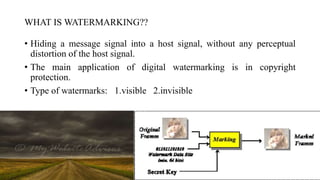
WHAT IS WATERMARKING??
• Hiding a message signal into a host signal, without any perceptual
distortion of the host signal.
• The main application of digital watermarking is in copyright
protection.
• Type of watermarks: 1.visible 2.invisible
LITERACY SURVEY
Ref1:Persistent access control to prevent piracy of digital information[1997]
1. Watermarking technology was first introduced in 1990’s where
playback control application, the watermark embedded in the video
sequence.
2. With help of this playback control application it will provide
information that whether video players are authorized to display the
content or not.
Ref2:Rotation, scale and translation invariant digital image
watermarking[1999]
• In this paper author proposed an image watermarking method
based on the Fourier–Mellin transform is proposed
• The embedded marks may be designed to be unaffected by any
combination of rotation, scale and translation transformations.
• The scheme is robust to rotation and scaling but weak to
distortions caused by lossy compression.
Ref3:Rotation, scale, and translation resilient watermarking for
images[2001]
1. The watermark is embedded into a 1-D signal, which is obtained
by taking the Fourier transform of the image, resampling it in to
log-polar coordinates, and integrating along the radial dimension.
2. This method is robust to rotation, scaling, and translation and lossy
compression which is one of advantage compared to previous
results.
3. However this scheme cannot withstand cropping.
Ref4: DWT based high-capacity blind video watermarking ,in
variant to geometrical attacks[2003]
1. In this two watermarks are employed. The first one is used to embed
the message while the second one, a 0-b watermark, is employed as
a geometric reference.
2. Once the reference watermark has been changed, the decoder
assumes that there is no watermark embedded in the content and,
therefore, does not search for the hidden message.
3. Even though this method is tricky secure, introducing two
watermarks in the same video is complex and may effect the host
signal.
PROPOSED METHOD
The proposed method has following steps to create DTCWT algorithm:
A. Creating the Watermark.
B. Embedding the Watermark. 1) Perceptual Masks
2) Adding the Watermark
C. Decoding the Watermark.
Brief Introduction to the DT CWT
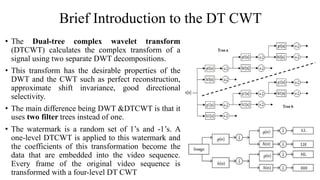
• The Dual-tree complex wavelet transform
(DTCWT) calculates the complex transform of a
signal using two separate DWT decompositions.
• This transform has the desirable properties of the
DWT and the CWT such as perfect reconstruction,
approximate shift invariance, good directional
selectivity.
• The main difference being DWT &DTCWT is that it
uses two filter trees instead of one.
• The watermark is a random set of 1’s and -1’s. A
one-level DTCWT is applied to this watermark and
the coefficients of this transformation become the
data that are embedded into the video sequence.
Every frame of the original video sequence is
transformed with a four-level DT CWT
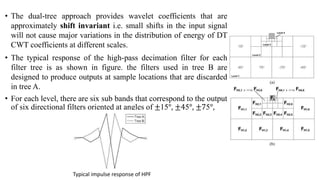
• The dual-tree approach provides wavelet coefficients that are
approximately shift invariant i.e. small shifts in the input signal
will not cause major variations in the distribution of energy of DT
CWT coefficients at different scales.
• The typical response of the high-pass decimation filter for each
filter tree is as shown in figure. the filters used in tree B are
designed to produce outputs at sample locations that are discarded
in tree A.
• For each level, there are six sub bands that correspond to the output
of six directional filters oriented at angles of ±15°, ±45°, ±75°,
Typical impulse response of HPF
Creating the Watermark
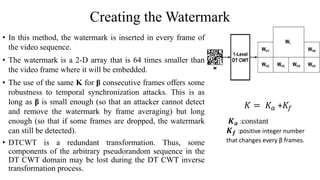
• In this method, the watermark is inserted in every frame of
the video sequence.
• The watermark is a 2-D array that is 64 times smaller than
the video frame where it will be embedded.
• The use of the same K for β consecutive frames offers some
robustness to temporal synchronization attacks. This is as
long as β is small enough (so that an attacker cannot detect
and remove the watermark by frame averaging) but long
enough (so that if some frames are dropped, the watermark
can still be detected).
• DTCWT is a redundant transformation. Thus, some
components of the arbitrary pseudorandom sequence in the
DT CWT domain may be lost during the DT CWT inverse
transformation process.
𝑲 𝒂 :constant
𝑲 𝒇 :positive integer number
that changes every β frames.
𝐾 = 𝐾𝑎 +𝐾𝑓
Embedding the Watermark
Embedding the watermark carried out in 2 steps i. Perceptual Masks
ii. Adding the Watermark
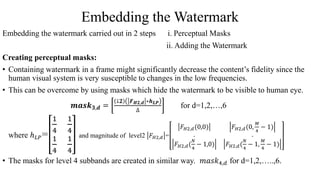
Creating perceptual masks:
• Containing watermark in a frame might significantly decrease the content’s fidelity since the
human visual system is very susceptible to changes in the low frequencies.
• This can be overcome by using masks which hide the watermark to be visible to human eye.
𝒎𝒂𝒔𝒌 𝟑,𝒅 =
↓𝟐 𝑭 𝑯𝟐,𝒅 ∗𝒉 𝑳𝑷
∆
for d=1,2,…,6
where ℎ 𝐿𝑃=
1
4
1
4
1
4
1
4
and magnitude of level2 𝐹 𝐻2,𝑑 =
𝐹 𝐻2,𝑑(0,0) 𝐹 𝐻2,𝑑(0,
𝑀
4
− 1)
. .
𝐹 𝐻2,𝑑(
𝑁
4
− 1,0) 𝐹 𝐻2,𝑑(
𝑁
4
− 1,
𝑀
4
− 1)
• The masks for level 4 subbands are created in similar way. 𝑚𝑎𝑠𝑘4,𝑑 for d=1,2,…..,6.
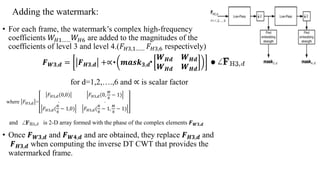
Adding the watermark:
• For each frame, the watermark’s complex high-frequency
coefficients 𝑊𝐻1…… 𝑊𝐻6 are added to the magnitudes of the
coefficients of level 3 and level 4.(𝐹 𝐻3,1…… 𝐹 𝐻3,6 respectively)
𝑭 𝑾𝟑,𝒅 = 𝑭 𝑯𝟑,𝒅 +∝ 𝒎𝒂𝒔𝒌 𝟑,𝒅
𝑾 𝑯𝒅 𝑾 𝑯𝒅
𝑾 𝑯𝒅 𝑾 𝑯𝒅
for d=1,2,….,6 and ∝ is scalar factor
where 𝐹 𝐻3,𝑑 =
𝐹 𝐻3,𝑑(0,0) 𝐹 𝐻3,𝑑(0,
𝑀
8
− 1)
. .
𝐹 𝐻3,𝑑(
𝑁
8
− 1,0) 𝐹 𝐻3,𝑑(
𝑁
8
− 1,
𝑀
8
− 1)
and is 2-D array formed with the phase of the complex elements 𝑭 𝑾𝟑,𝒅
• Once 𝑭 𝑾𝟑,𝒅 and 𝑭 𝑾𝟒,𝒅 and are obtained, they replace 𝑭 𝑯𝟑,𝒅 and
𝑭 𝑯𝟑,𝒅 when computing the inverse DT CWT that provides the
watermarked frame.
Decoding the Watermark
• Embedding and adding the watermark to a video frames is not the only work of a
creator but having the knowledge of decoding the watermark also plays an
important role.
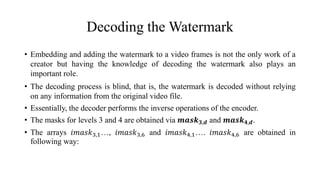
• The decoding process is blind, that is, the watermark is decoded without relying
on any information from the original video file.
• Essentially, the decoder performs the inverse operations of the encoder.
• The masks for levels 3 and 4 are obtained via 𝒎𝒂𝒔𝒌 𝟑,𝒅 and 𝒎𝒂𝒔𝒌 𝟒,𝒅.
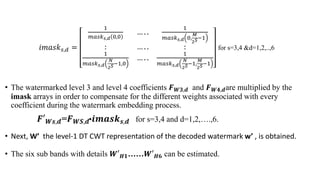
• The arrays 𝑖𝑚𝑎𝑠𝑘3,1…, 𝑖𝑚𝑎𝑠𝑘3,6 and 𝑖𝑚𝑎𝑠𝑘4,1…. 𝑖𝑚𝑎𝑠𝑘4,6 are obtained in
following way:
𝑖𝑚𝑎𝑠𝑘 𝑠,𝑑 =
1
𝑚𝑎𝑠𝑘 𝑠,𝑑 0,0
… . .
1
𝑚𝑎𝑠𝑘 𝑠,𝑑 0,
𝑀
2 𝑆−1
: … . . :
1
𝑚𝑎𝑠𝑘 𝑠,𝑑
𝑁
2 𝑆−1,0
… . .
1
𝑚𝑎𝑠𝑘 𝑠,𝑑
𝑁
2 𝑆−1,
𝑀
2 𝑆−1
for s=3,4 &d=1,2,..,6
• The watermarked level 3 and level 4 coefficients 𝑭 𝑾𝟑,𝒅 and 𝑭 𝑾𝟒,𝒅are multiplied by the
imask arrays in order to compensate for the different weights associated with every
coefficient during the watermark embedding process.
𝑭′ 𝑾𝒔,𝒅=𝑭 𝑾𝑺,𝒅 𝒊𝒎𝒂𝒔𝒌 𝒔,𝒅 for s=3,4 and d=1,2,….,6.
• Next, W’ the level-1 DT CWT representation of the decoded watermark w’ , is obtained.
• The six sub bands with details 𝑾′ 𝑯𝟏……𝑾′ 𝑯𝟔 can be estimated.
EXPERIMENTAL RESULTS
• In order to study the performance of this method, DTCWT is compared with results
against two algorithms that employ the regular DWT.
• The first method we use as reference is basically the same algorithm as proposed in this
paper except DWT replaces DT CWT. We will refer to this method as DWT1.
• The second method is the one presented in ref9 which is also based on DWT. In this
method, which we denote as DWT2.
• To tested the robustness of this method to common distortions. In one experiment,
watermarks were decoded after the video sequences had gone through some scaling and
cropping distortions.
• For the second test, the video sequences were rotated by a few degrees and the
watermark was later decoded. Here the effects of lossy compression are also tested
• Finally all of these distortions: scaling, rotation, cropping, and lossy compression were
put together as a joint attack.
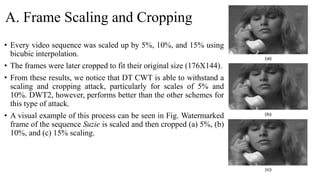
A. Frame Scaling and Cropping
• Every video sequence was scaled up by 5%, 10%, and 15% using
bicubic interpolation.
• The frames were later cropped to fit their original size (176X144).
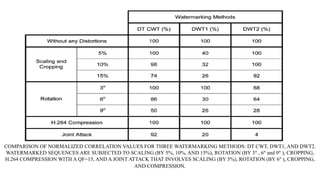
• From these results, we notice that DT CWT is able to withstand a
scaling and cropping attack, particularly for scales of 5% and
10%. DWT2, however, performs better than the other schemes for
this type of attack.
• A visual example of this process can be seen in Fig. Watermarked
frame of the sequence Suzie is scaled and then cropped (a) 5%, (b)
10%, and (c) 15% scaling.
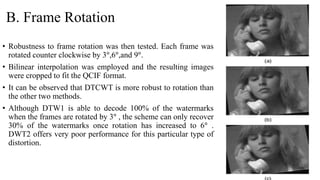
B. Frame Rotation
• Robustness to frame rotation was then tested. Each frame was
rotated counter clockwise by 3°,6°,and 9°.
• Bilinear interpolation was employed and the resulting images
were cropped to fit the QCIF format.
• It can be observed that DTCWT is more robust to rotation than
the other two methods.
• Although DTW1 is able to decode 100% of the watermarks
when the frames are rotated by 3° , the scheme can only recover
30% of the watermarks once rotation has increased to 6° .
DWT2 offers very poor performance for this particular type of
distortion.
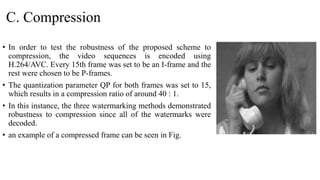
C. Compression
• In order to test the robustness of the proposed scheme to
compression, the video sequences is encoded using
H.264/AVC. Every 15th frame was set to be an I-frame and the
rest were chosen to be P-frames.
• The quantization parameter QP for both frames was set to 15,
which results in a compression ratio of around 40 : 1.
• In this instance, the three watermarking methods demonstrated
robustness to compression since all of the watermarks were
decoded.
• an example of a compressed frame can be seen in Fig.
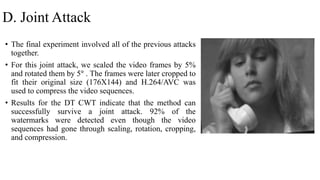
D. Joint Attack
• The final experiment involved all of the previous attacks
together.
• For this joint attack, we scaled the video frames by 5%
and rotated them by 5° . The frames were later cropped to
fit their original size (176X144) and H.264/AVC was
used to compress the video sequences.
• Results for the DT CWT indicate that the method can
successfully survive a joint attack. 92% of the
watermarks were detected even though the video
sequences had gone through scaling, rotation, cropping,
and compression.
COMPARISON OF NORMALIZED CORRELATION VALUES FOR THREE WATERMARKING METHODS: DT CWT, DWT1, AND DWT2.
WATERMARKED SEQUENCES ARE SUBJECTED TO SCALING (BY 5%, 10%, AND 15%), ROTATION (BY 3° , 6° and 9° ), CROPPING,
H.264 COMPRESSION WITH A QF=15, AND A JOINT ATTACK THAT INVOLVES SCALING (BY 5%), ROTATION (BY 6° ), CROPPING,
AND COMPRESSION.
CONCLUSION
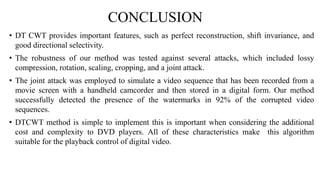
• DT CWT provides important features, such as perfect reconstruction, shift invariance, and
good directional selectivity.
• The robustness of our method was tested against several attacks, which included lossy
compression, rotation, scaling, cropping, and a joint attack.
• The joint attack was employed to simulate a video sequence that has been recorded from a
movie screen with a handheld camcorder and then stored in a digital form. Our method
successfully detected the presence of the watermarks in 92% of the corrupted video
sequences.
• DTCWT method is simple to implement this is important when considering the additional
cost and complexity to DVD players. All of these characteristics make this algorithm
suitable for the playback control of digital video.
REFERENCES:
• A Video Watermarking Scheme Based on the Dual-Tree Complex Wavelet Transform. Lino E. Coria, Member,
IEEE, Mark R. Pickering, Member, IEEE, Panos Nasiopoulos, Member, IEEE, and Rabab Kreidieh Ward, Fellow,
IEEE VOL. 3, NO. 3, SEPTEMBER 2008.
• P. B. Schneck, “Persistent access control to prevent piracy of digital information,” Proc. IEEE, vol. 87, no. 7, pp.
1239–1249, Jul. 1999.
• I. J. Cox, M. L. Miller, and J. A. Bloom, Digital Watermarking. San Francisco, CA: Morgan Kaufmann, 2002.
• J. J. K. O’Ruanaidh and T. Pun, “Rotation, scale and translation invariant digital image watermarking,” in Proc. Int.
Conf. Image Processing,1997, pp. 536–539.
• C.-Y. Lin, M.Wu, J. A. Bloom, I. J. Cox, M. L. Miller, and Y. M. Lui, “Rotation, scale, and translation resilient
watermarking for images,” IEEE Trans. Image Process., vol. 10, no. 5, pp. 767–782, May 2001.
• C. V. Serdean, M. A. Ambroze, M. Tomlinson, and J. G.Wade, “DWTbased high-capacity blind video
watermarking, invariant to geometrical attacks,” Proc. Inst. Elect. Eng., Vis., Image Signal Process., vol. 150,pp.
51–58, Feb. 2003.
• P. Bas, J. M. Chassery, and B. Macq, “Geometrically invariant watermarking using feature points,” IEEE Trans.
Image Process., vol. 11, no. 9, pp. 1014–1028, Sep. 2002.
• P. W. Chan, M. R. Lyu, and R. T. Chin, “A novel scheme for hybrid
• digital video watermarking: Approach, evaluation and experimentation,” IEEE Trans. Circuits Syst. Video Technol.,
vol. 15, no. 12, pp.1638–1649, Dec. 2005.
Ppt

Ppt

  • 1.
    A Video WatermarkingScheme Based on the Dual-Tree Complex Wavelet Transform TERMPAPER REVIEW guided by: presentation by: Smt. T.Geetamma A.Srinivasa Rao Assistant professor 12341A0402 dept. of ECE ECE GMRIT GMRIT
  • 2.
    ABSTRACT In this method,the video is watermarked in such a way that its display is not permitted if a compliant video player detects the watermark. A watermark that is robust to geometric distortions (rotation, scaling, cropping) and lossy compression is required in order to block access to media content that has been re-recorded with a camera inside a movie theater. This paper proposed a new video watermarking algorithm for playback control that takes advantage of the properties of the dual-tree complex wavelet transform. This transform offers the advantages of the regular and the complex wavelets. This method relies on these characteristics to create a watermark that is robust to geometric distortions and lossy compression. The proposed scheme is simple to implement and outperforms comparable methods when tested against geometric distortions.
  • 3.
    INTRODUCTION • PIRACY meansthe practice of selling, acquiring, copying or distributing copyrighted material without permission. • Although digital technology has brought many benefits to the content creators and the public, it has also increased the ease by which movies can be pirated. • In this paper the advanced method called video watermarking using dual tree complex wavelet transform was proposed in order to protect the copyrights.
  • 4.
    WHAT IS WATERMARKING?? •Hiding a message signal into a host signal, without any perceptual distortion of the host signal. • The main application of digital watermarking is in copyright protection. • Type of watermarks: 1.visible 2.invisible
  • 5.
    LITERACY SURVEY Ref1:Persistent accesscontrol to prevent piracy of digital information[1997] 1. Watermarking technology was first introduced in 1990’s where playback control application, the watermark embedded in the video sequence. 2. With help of this playback control application it will provide information that whether video players are authorized to display the content or not.
  • 6.
    Ref2:Rotation, scale andtranslation invariant digital image watermarking[1999] • In this paper author proposed an image watermarking method based on the Fourier–Mellin transform is proposed • The embedded marks may be designed to be unaffected by any combination of rotation, scale and translation transformations. • The scheme is robust to rotation and scaling but weak to distortions caused by lossy compression.
  • 7.
    Ref3:Rotation, scale, andtranslation resilient watermarking for images[2001] 1. The watermark is embedded into a 1-D signal, which is obtained by taking the Fourier transform of the image, resampling it in to log-polar coordinates, and integrating along the radial dimension. 2. This method is robust to rotation, scaling, and translation and lossy compression which is one of advantage compared to previous results. 3. However this scheme cannot withstand cropping.
  • 8.
    Ref4: DWT basedhigh-capacity blind video watermarking ,in variant to geometrical attacks[2003] 1. In this two watermarks are employed. The first one is used to embed the message while the second one, a 0-b watermark, is employed as a geometric reference. 2. Once the reference watermark has been changed, the decoder assumes that there is no watermark embedded in the content and, therefore, does not search for the hidden message. 3. Even though this method is tricky secure, introducing two watermarks in the same video is complex and may effect the host signal.
  • 9.
    PROPOSED METHOD The proposedmethod has following steps to create DTCWT algorithm: A. Creating the Watermark. B. Embedding the Watermark. 1) Perceptual Masks 2) Adding the Watermark C. Decoding the Watermark.
  • 10.
    Brief Introduction tothe DT CWT • The Dual-tree complex wavelet transform (DTCWT) calculates the complex transform of a signal using two separate DWT decompositions. • This transform has the desirable properties of the DWT and the CWT such as perfect reconstruction, approximate shift invariance, good directional selectivity. • The main difference being DWT &DTCWT is that it uses two filter trees instead of one. • The watermark is a random set of 1’s and -1’s. A one-level DTCWT is applied to this watermark and the coefficients of this transformation become the data that are embedded into the video sequence. Every frame of the original video sequence is transformed with a four-level DT CWT
  • 11.
    • The dual-treeapproach provides wavelet coefficients that are approximately shift invariant i.e. small shifts in the input signal will not cause major variations in the distribution of energy of DT CWT coefficients at different scales. • The typical response of the high-pass decimation filter for each filter tree is as shown in figure. the filters used in tree B are designed to produce outputs at sample locations that are discarded in tree A. • For each level, there are six sub bands that correspond to the output of six directional filters oriented at angles of ±15°, ±45°, ±75°, Typical impulse response of HPF
  • 12.
    Creating the Watermark •In this method, the watermark is inserted in every frame of the video sequence. • The watermark is a 2-D array that is 64 times smaller than the video frame where it will be embedded. • The use of the same K for β consecutive frames offers some robustness to temporal synchronization attacks. This is as long as β is small enough (so that an attacker cannot detect and remove the watermark by frame averaging) but long enough (so that if some frames are dropped, the watermark can still be detected). • DTCWT is a redundant transformation. Thus, some components of the arbitrary pseudorandom sequence in the DT CWT domain may be lost during the DT CWT inverse transformation process. 𝑲 𝒂 :constant 𝑲 𝒇 :positive integer number that changes every β frames. 𝐾 = 𝐾𝑎 +𝐾𝑓
  • 13.
    Embedding the Watermark Embeddingthe watermark carried out in 2 steps i. Perceptual Masks ii. Adding the Watermark Creating perceptual masks: • Containing watermark in a frame might significantly decrease the content’s fidelity since the human visual system is very susceptible to changes in the low frequencies. • This can be overcome by using masks which hide the watermark to be visible to human eye. 𝒎𝒂𝒔𝒌 𝟑,𝒅 = ↓𝟐 𝑭 𝑯𝟐,𝒅 ∗𝒉 𝑳𝑷 ∆ for d=1,2,…,6 where ℎ 𝐿𝑃= 1 4 1 4 1 4 1 4 and magnitude of level2 𝐹 𝐻2,𝑑 = 𝐹 𝐻2,𝑑(0,0) 𝐹 𝐻2,𝑑(0, 𝑀 4 − 1) . . 𝐹 𝐻2,𝑑( 𝑁 4 − 1,0) 𝐹 𝐻2,𝑑( 𝑁 4 − 1, 𝑀 4 − 1) • The masks for level 4 subbands are created in similar way. 𝑚𝑎𝑠𝑘4,𝑑 for d=1,2,…..,6.
  • 14.
    Adding the watermark: •For each frame, the watermark’s complex high-frequency coefficients 𝑊𝐻1…… 𝑊𝐻6 are added to the magnitudes of the coefficients of level 3 and level 4.(𝐹 𝐻3,1…… 𝐹 𝐻3,6 respectively) 𝑭 𝑾𝟑,𝒅 = 𝑭 𝑯𝟑,𝒅 +∝ 𝒎𝒂𝒔𝒌 𝟑,𝒅 𝑾 𝑯𝒅 𝑾 𝑯𝒅 𝑾 𝑯𝒅 𝑾 𝑯𝒅 for d=1,2,….,6 and ∝ is scalar factor where 𝐹 𝐻3,𝑑 = 𝐹 𝐻3,𝑑(0,0) 𝐹 𝐻3,𝑑(0, 𝑀 8 − 1) . . 𝐹 𝐻3,𝑑( 𝑁 8 − 1,0) 𝐹 𝐻3,𝑑( 𝑁 8 − 1, 𝑀 8 − 1) and is 2-D array formed with the phase of the complex elements 𝑭 𝑾𝟑,𝒅 • Once 𝑭 𝑾𝟑,𝒅 and 𝑭 𝑾𝟒,𝒅 and are obtained, they replace 𝑭 𝑯𝟑,𝒅 and 𝑭 𝑯𝟑,𝒅 when computing the inverse DT CWT that provides the watermarked frame.
  • 15.
    Decoding the Watermark •Embedding and adding the watermark to a video frames is not the only work of a creator but having the knowledge of decoding the watermark also plays an important role. • The decoding process is blind, that is, the watermark is decoded without relying on any information from the original video file. • Essentially, the decoder performs the inverse operations of the encoder. • The masks for levels 3 and 4 are obtained via 𝒎𝒂𝒔𝒌 𝟑,𝒅 and 𝒎𝒂𝒔𝒌 𝟒,𝒅. • The arrays 𝑖𝑚𝑎𝑠𝑘3,1…, 𝑖𝑚𝑎𝑠𝑘3,6 and 𝑖𝑚𝑎𝑠𝑘4,1…. 𝑖𝑚𝑎𝑠𝑘4,6 are obtained in following way:
  • 16.
    𝑖𝑚𝑎𝑠𝑘 𝑠,𝑑 = 1 𝑚𝑎𝑠𝑘𝑠,𝑑 0,0 … . . 1 𝑚𝑎𝑠𝑘 𝑠,𝑑 0, 𝑀 2 𝑆−1 : … . . : 1 𝑚𝑎𝑠𝑘 𝑠,𝑑 𝑁 2 𝑆−1,0 … . . 1 𝑚𝑎𝑠𝑘 𝑠,𝑑 𝑁 2 𝑆−1, 𝑀 2 𝑆−1 for s=3,4 &d=1,2,..,6 • The watermarked level 3 and level 4 coefficients 𝑭 𝑾𝟑,𝒅 and 𝑭 𝑾𝟒,𝒅are multiplied by the imask arrays in order to compensate for the different weights associated with every coefficient during the watermark embedding process. 𝑭′ 𝑾𝒔,𝒅=𝑭 𝑾𝑺,𝒅 𝒊𝒎𝒂𝒔𝒌 𝒔,𝒅 for s=3,4 and d=1,2,….,6. • Next, W’ the level-1 DT CWT representation of the decoded watermark w’ , is obtained. • The six sub bands with details 𝑾′ 𝑯𝟏……𝑾′ 𝑯𝟔 can be estimated.
  • 17.
    EXPERIMENTAL RESULTS • Inorder to study the performance of this method, DTCWT is compared with results against two algorithms that employ the regular DWT. • The first method we use as reference is basically the same algorithm as proposed in this paper except DWT replaces DT CWT. We will refer to this method as DWT1. • The second method is the one presented in ref9 which is also based on DWT. In this method, which we denote as DWT2. • To tested the robustness of this method to common distortions. In one experiment, watermarks were decoded after the video sequences had gone through some scaling and cropping distortions. • For the second test, the video sequences were rotated by a few degrees and the watermark was later decoded. Here the effects of lossy compression are also tested • Finally all of these distortions: scaling, rotation, cropping, and lossy compression were put together as a joint attack.
  • 18.
    A. Frame Scalingand Cropping • Every video sequence was scaled up by 5%, 10%, and 15% using bicubic interpolation. • The frames were later cropped to fit their original size (176X144). • From these results, we notice that DT CWT is able to withstand a scaling and cropping attack, particularly for scales of 5% and 10%. DWT2, however, performs better than the other schemes for this type of attack. • A visual example of this process can be seen in Fig. Watermarked frame of the sequence Suzie is scaled and then cropped (a) 5%, (b) 10%, and (c) 15% scaling.
  • 19.
    B. Frame Rotation •Robustness to frame rotation was then tested. Each frame was rotated counter clockwise by 3°,6°,and 9°. • Bilinear interpolation was employed and the resulting images were cropped to fit the QCIF format. • It can be observed that DTCWT is more robust to rotation than the other two methods. • Although DTW1 is able to decode 100% of the watermarks when the frames are rotated by 3° , the scheme can only recover 30% of the watermarks once rotation has increased to 6° . DWT2 offers very poor performance for this particular type of distortion.
  • 20.
    C. Compression • Inorder to test the robustness of the proposed scheme to compression, the video sequences is encoded using H.264/AVC. Every 15th frame was set to be an I-frame and the rest were chosen to be P-frames. • The quantization parameter QP for both frames was set to 15, which results in a compression ratio of around 40 : 1. • In this instance, the three watermarking methods demonstrated robustness to compression since all of the watermarks were decoded. • an example of a compressed frame can be seen in Fig.
  • 21.
    D. Joint Attack •The final experiment involved all of the previous attacks together. • For this joint attack, we scaled the video frames by 5% and rotated them by 5° . The frames were later cropped to fit their original size (176X144) and H.264/AVC was used to compress the video sequences. • Results for the DT CWT indicate that the method can successfully survive a joint attack. 92% of the watermarks were detected even though the video sequences had gone through scaling, rotation, cropping, and compression.
  • 22.
    COMPARISON OF NORMALIZEDCORRELATION VALUES FOR THREE WATERMARKING METHODS: DT CWT, DWT1, AND DWT2. WATERMARKED SEQUENCES ARE SUBJECTED TO SCALING (BY 5%, 10%, AND 15%), ROTATION (BY 3° , 6° and 9° ), CROPPING, H.264 COMPRESSION WITH A QF=15, AND A JOINT ATTACK THAT INVOLVES SCALING (BY 5%), ROTATION (BY 6° ), CROPPING, AND COMPRESSION.
  • 23.
    CONCLUSION • DT CWTprovides important features, such as perfect reconstruction, shift invariance, and good directional selectivity. • The robustness of our method was tested against several attacks, which included lossy compression, rotation, scaling, cropping, and a joint attack. • The joint attack was employed to simulate a video sequence that has been recorded from a movie screen with a handheld camcorder and then stored in a digital form. Our method successfully detected the presence of the watermarks in 92% of the corrupted video sequences. • DTCWT method is simple to implement this is important when considering the additional cost and complexity to DVD players. All of these characteristics make this algorithm suitable for the playback control of digital video.
  • 24.
    REFERENCES: • A VideoWatermarking Scheme Based on the Dual-Tree Complex Wavelet Transform. Lino E. Coria, Member, IEEE, Mark R. Pickering, Member, IEEE, Panos Nasiopoulos, Member, IEEE, and Rabab Kreidieh Ward, Fellow, IEEE VOL. 3, NO. 3, SEPTEMBER 2008. • P. B. Schneck, “Persistent access control to prevent piracy of digital information,” Proc. IEEE, vol. 87, no. 7, pp. 1239–1249, Jul. 1999. • I. J. Cox, M. L. Miller, and J. A. Bloom, Digital Watermarking. San Francisco, CA: Morgan Kaufmann, 2002. • J. J. K. O’Ruanaidh and T. Pun, “Rotation, scale and translation invariant digital image watermarking,” in Proc. Int. Conf. Image Processing,1997, pp. 536–539. • C.-Y. Lin, M.Wu, J. A. Bloom, I. J. Cox, M. L. Miller, and Y. M. Lui, “Rotation, scale, and translation resilient watermarking for images,” IEEE Trans. Image Process., vol. 10, no. 5, pp. 767–782, May 2001. • C. V. Serdean, M. A. Ambroze, M. Tomlinson, and J. G.Wade, “DWTbased high-capacity blind video watermarking, invariant to geometrical attacks,” Proc. Inst. Elect. Eng., Vis., Image Signal Process., vol. 150,pp. 51–58, Feb. 2003. • P. Bas, J. M. Chassery, and B. Macq, “Geometrically invariant watermarking using feature points,” IEEE Trans. Image Process., vol. 11, no. 9, pp. 1014–1028, Sep. 2002. • P. W. Chan, M. R. Lyu, and R. T. Chin, “A novel scheme for hybrid • digital video watermarking: Approach, evaluation and experimentation,” IEEE Trans. Circuits Syst. Video Technol., vol. 15, no. 12, pp.1638–1649, Dec. 2005.