CHAPTER5
FOURIERTRANSFORMATION
Dr. Varun Kumar Ojha
and
Prof. (Dr.) Paramartha Dutta
Visva Bharati University
Santiniketan, West Bengal, India
Fourier Transformation
 Continuous & Discrete Fourier Transformation
 Properties of Fourier Transformation
 Fast Fourier Transformation
Back to Course Content Page
Click Here
Fourier Transformation ( 1-D Continuous
Signal)
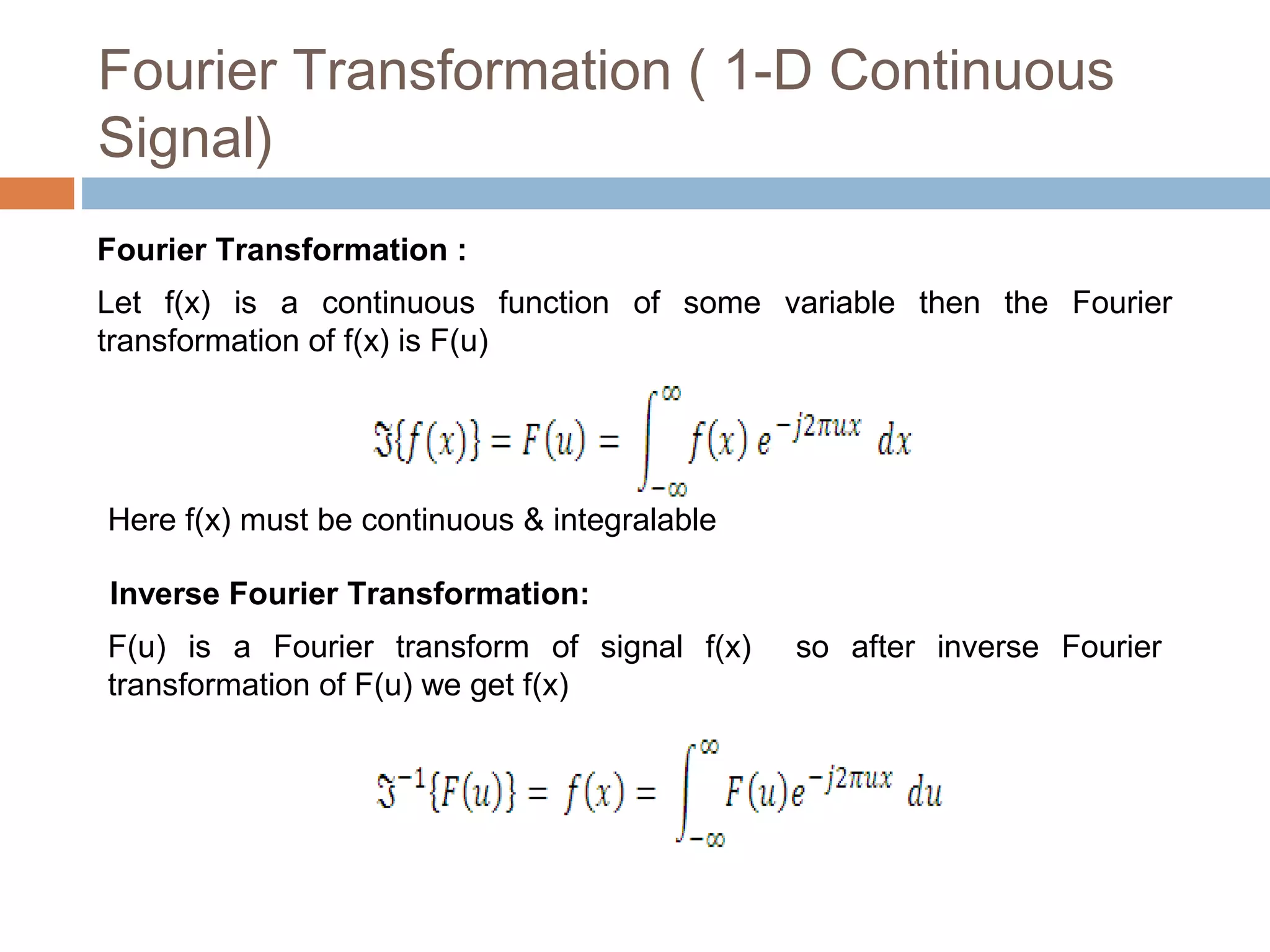
Let f(x) is a continuous function of some variable then the Fourier
transformation of f(x) is F(u)
Here f(x) must be continuous & integralable
Inverse Fourier Transformation:
F(u) is a Fourier transform of signal f(x) so after inverse Fourier
transformation of F(u) we get f(x)
Fourier Transformation :
Fourier Transformation ( 1-D Continuous
Signal)
Fourier Transformation Pair
F(u) → Fourier Transform of signal f(x)
F(x) → Original Signal or Inverse Fourier Transform of F(u)
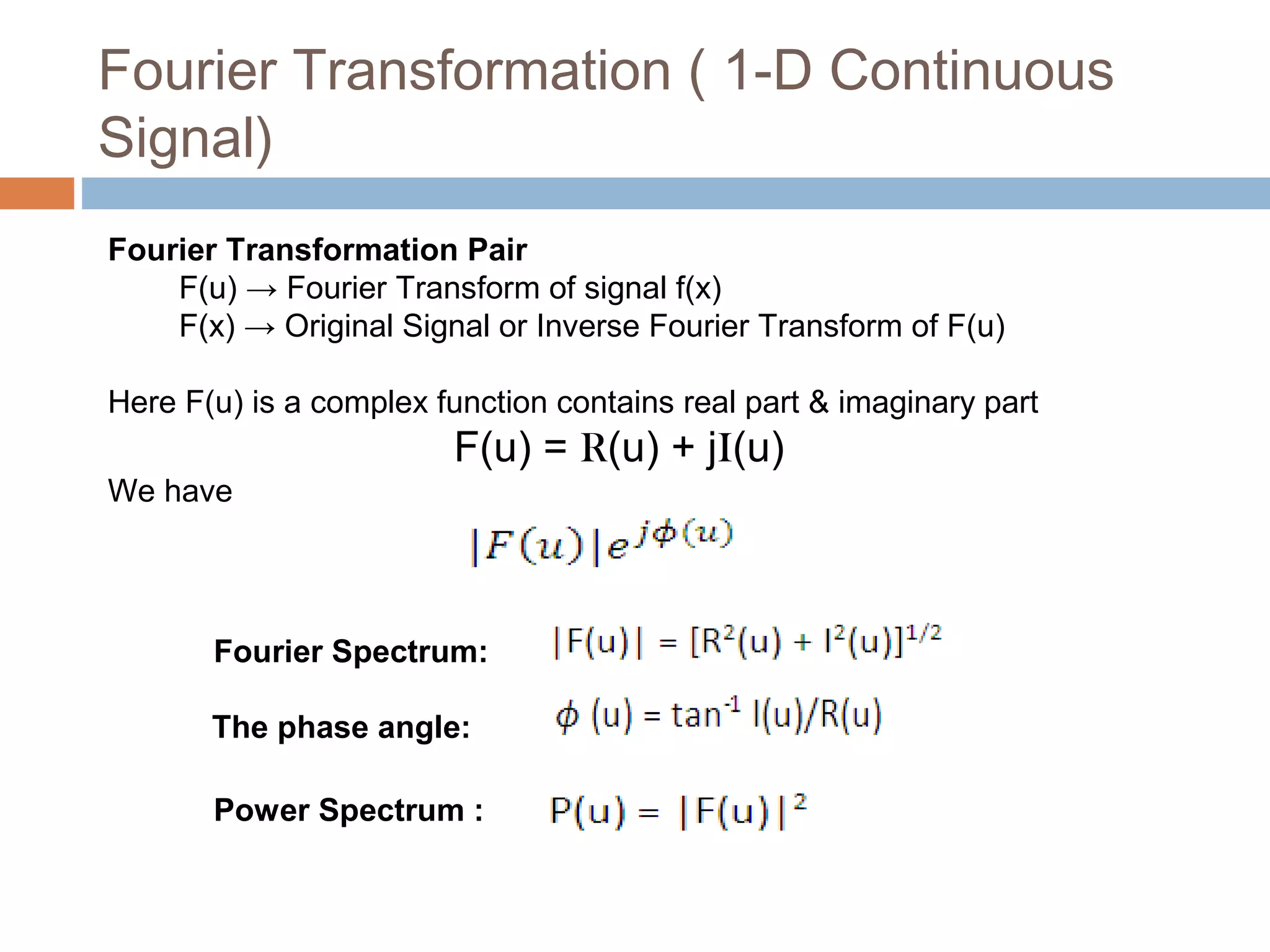
Here F(u) is a complex function contains real part & imaginary part
F(u) = R(u) + jI(u)
We have
Fourier Spectrum:
The phase angle:
Power Spectrum :
Fourier Transformation ( 2-D Continuous
Signal)
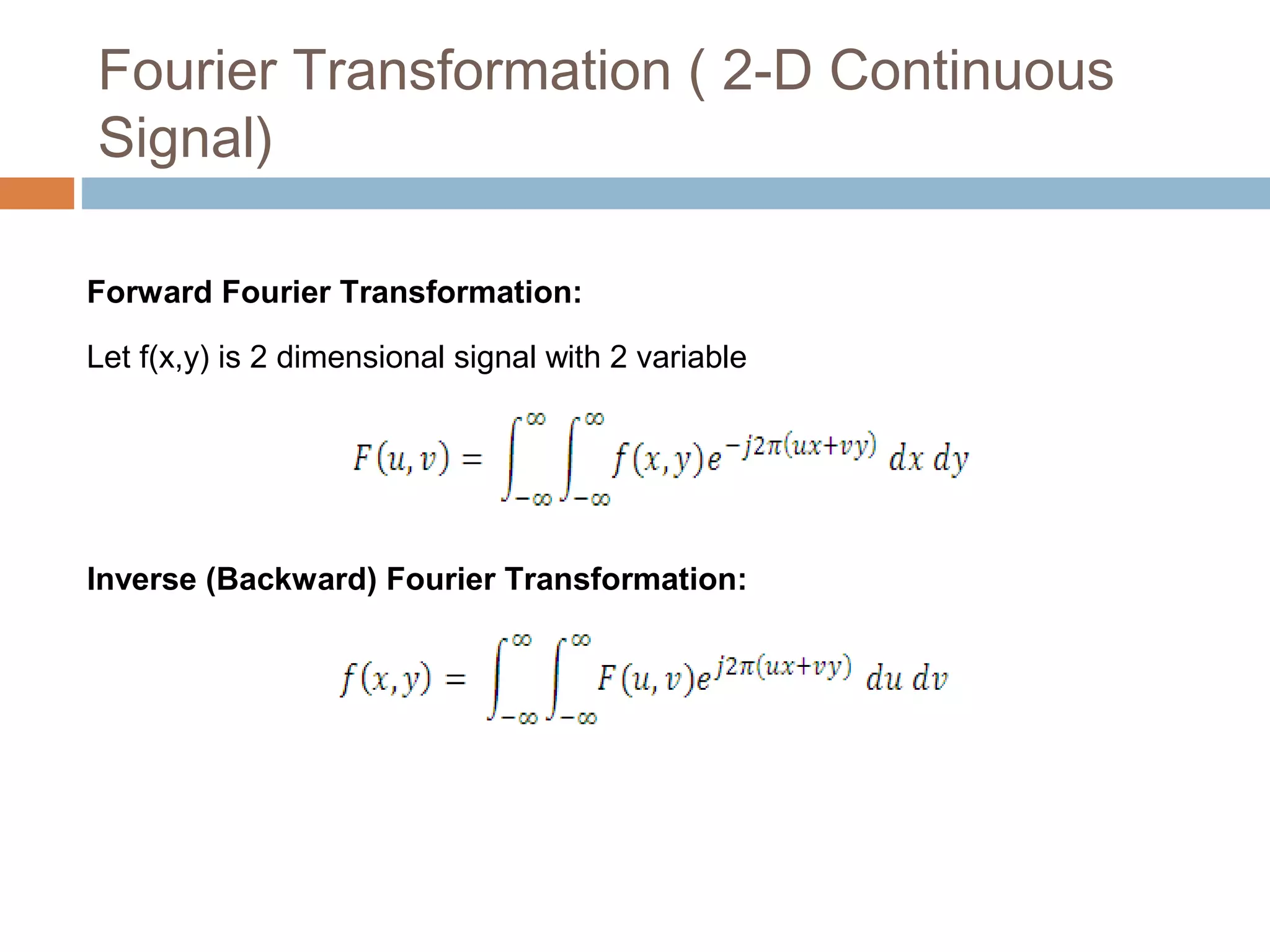
Forward Fourier Transformation:
Let f(x,y) is 2 dimensional signal with 2 variable
Inverse (Backward) Fourier Transformation:
Fourier Transformation ( 2-D Continuous
Signal)
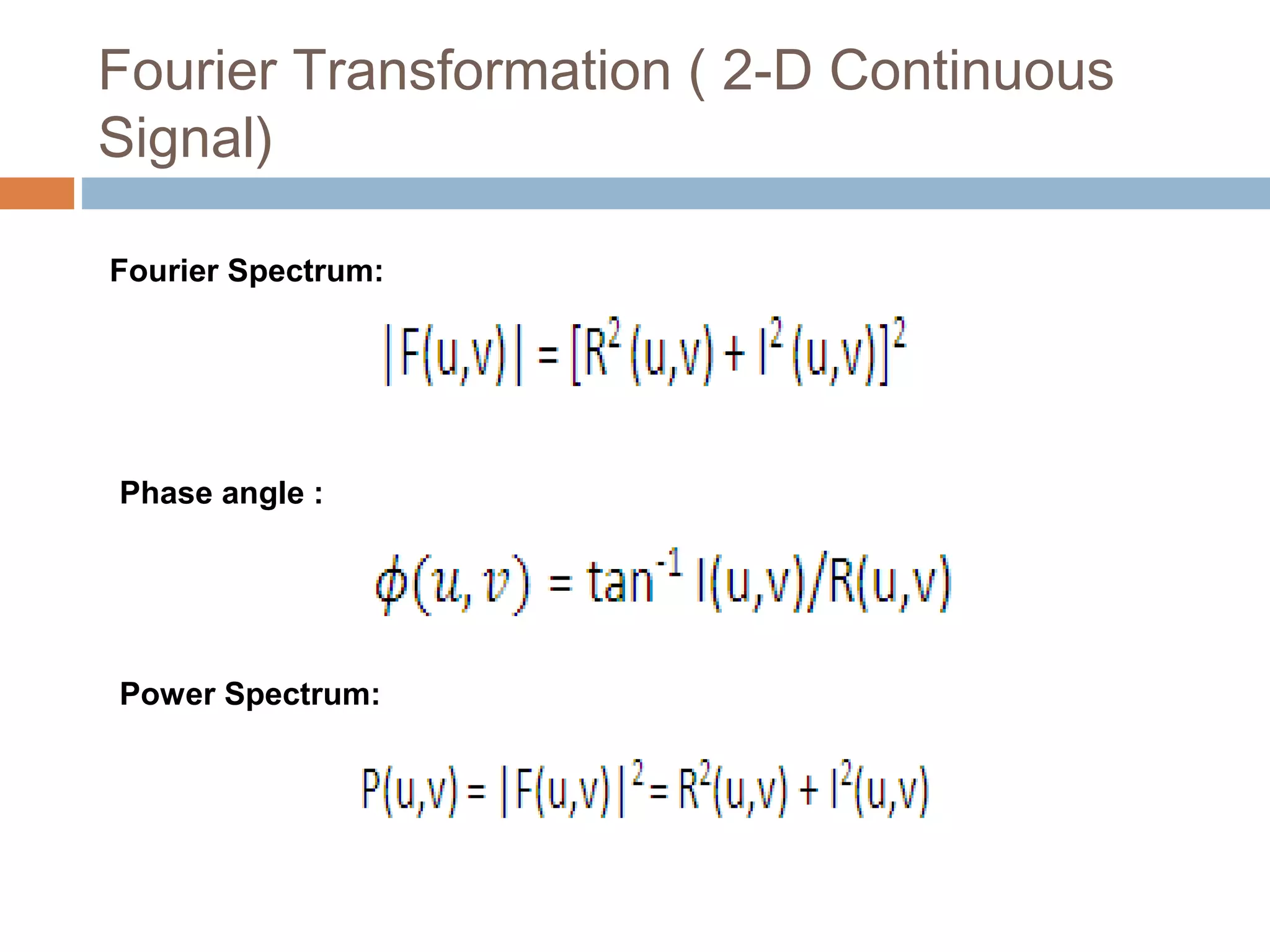
Fourier Spectrum:
Phase angle :
Power Spectrum:
2-D Discrete Fourier
Transformation
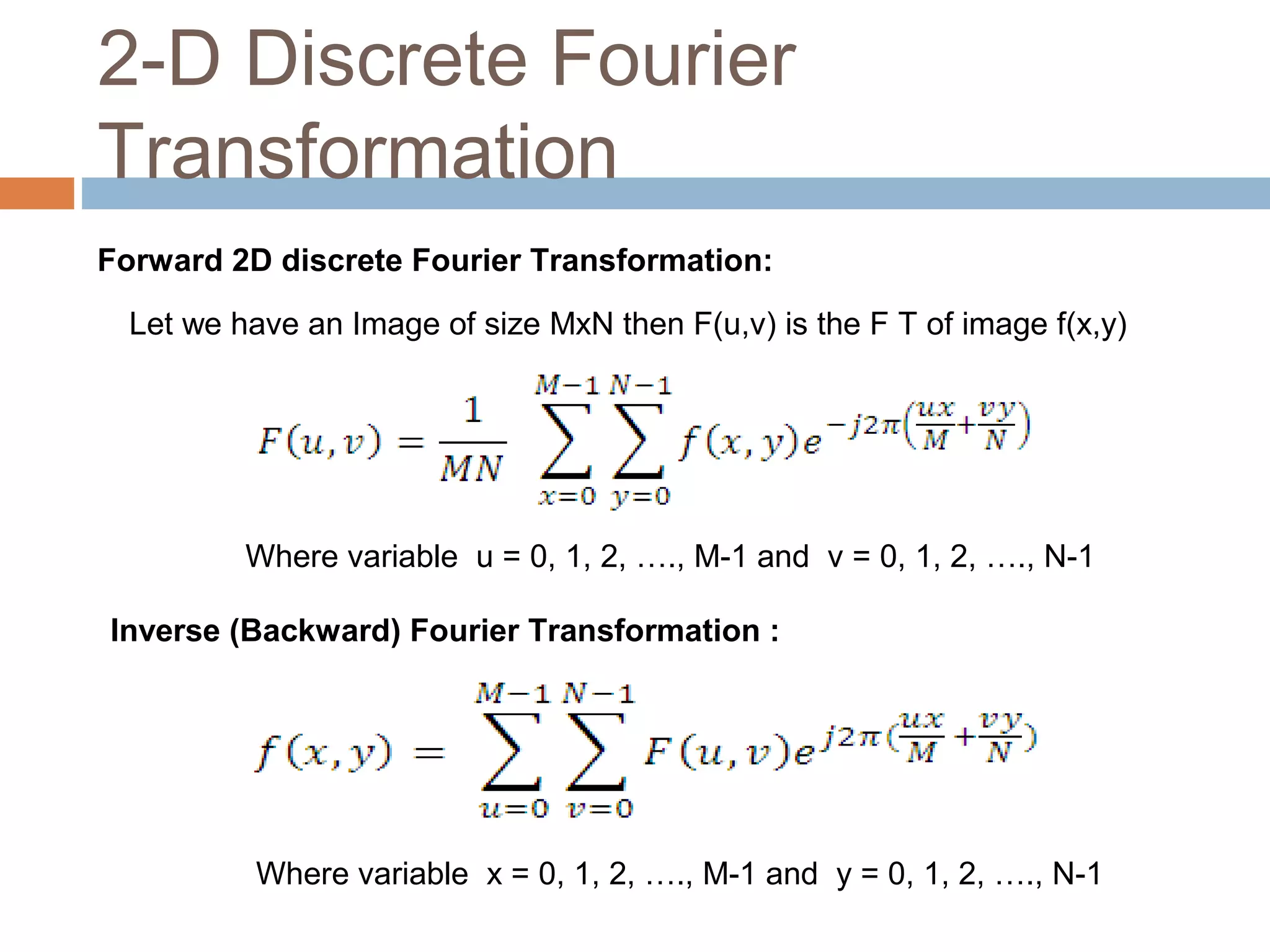
Forward 2D discrete Fourier Transformation:
Let we have an Image of size MxN then F(u,v) is the F T of image f(x,y)
Where variable u = 0, 1, 2, …., M-1 and v = 0, 1, 2, …., N-1
Inverse (Backward) Fourier Transformation :
Where variable x = 0, 1, 2, …., M-1 and y = 0, 1, 2, …., N-1
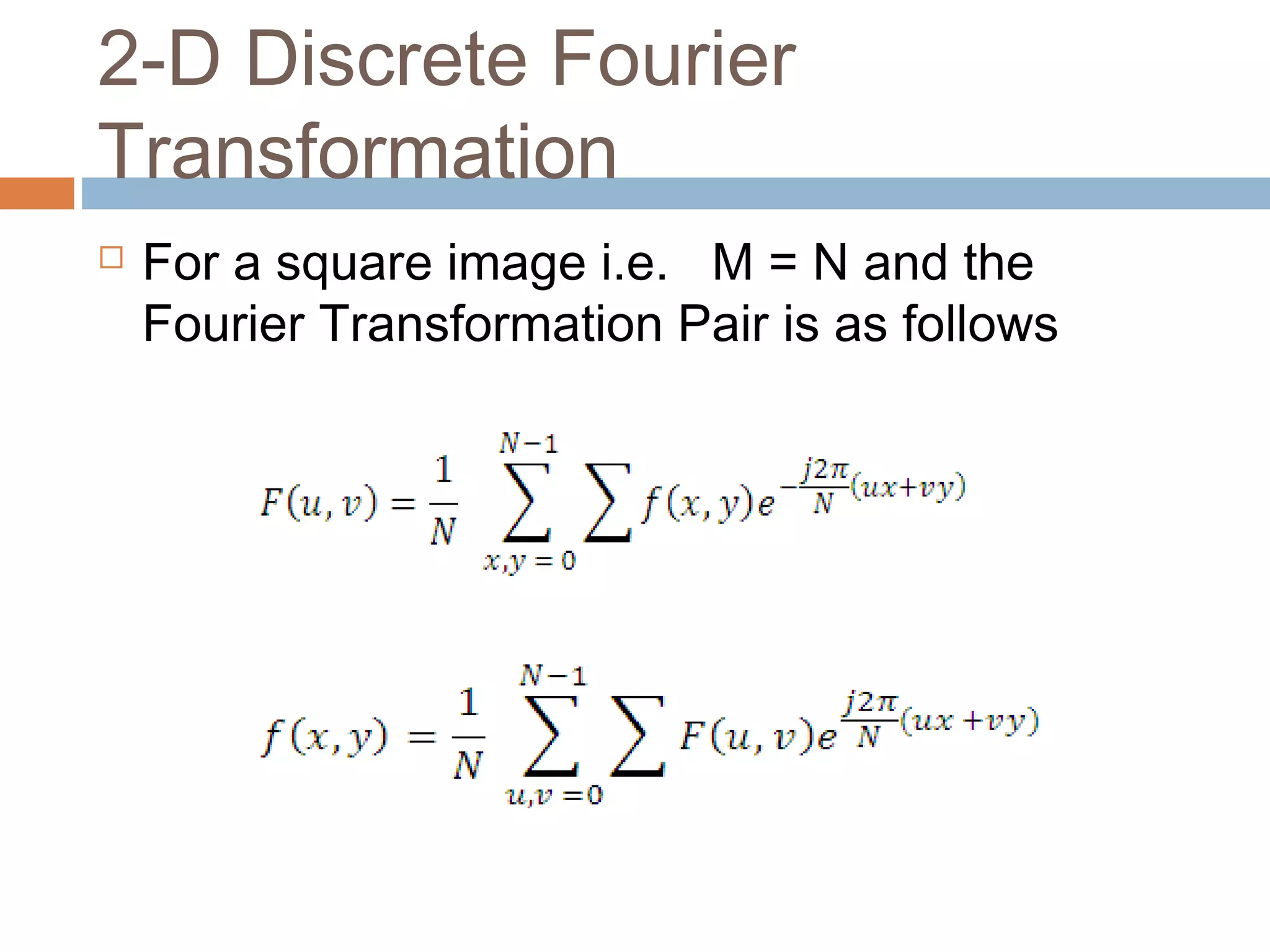
 For a square image i.e. M = N and the
Fourier Transformation Pair is as follows
2-D Discrete Fourier
Transformation
Discrete F T Result
Original
Image
Transformed
Image
DFT
IDFT
Back to the chapter content
Click Here
Properties of Fourier
Transformation
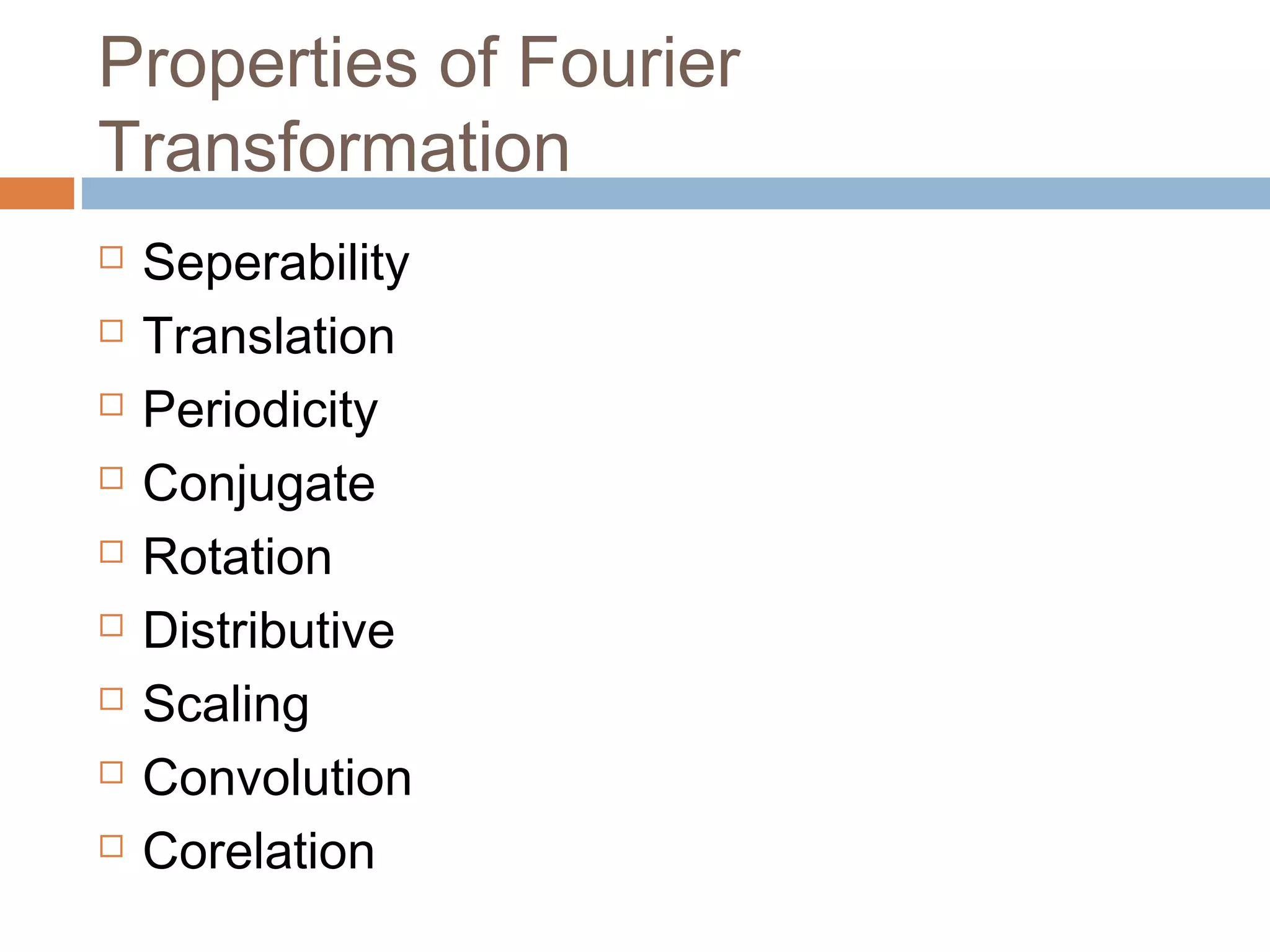
 Seperability
 Translation
 Periodicity
 Conjugate
 Rotation
 Distributive
 Scaling
 Convolution
 Corelation
Seperability
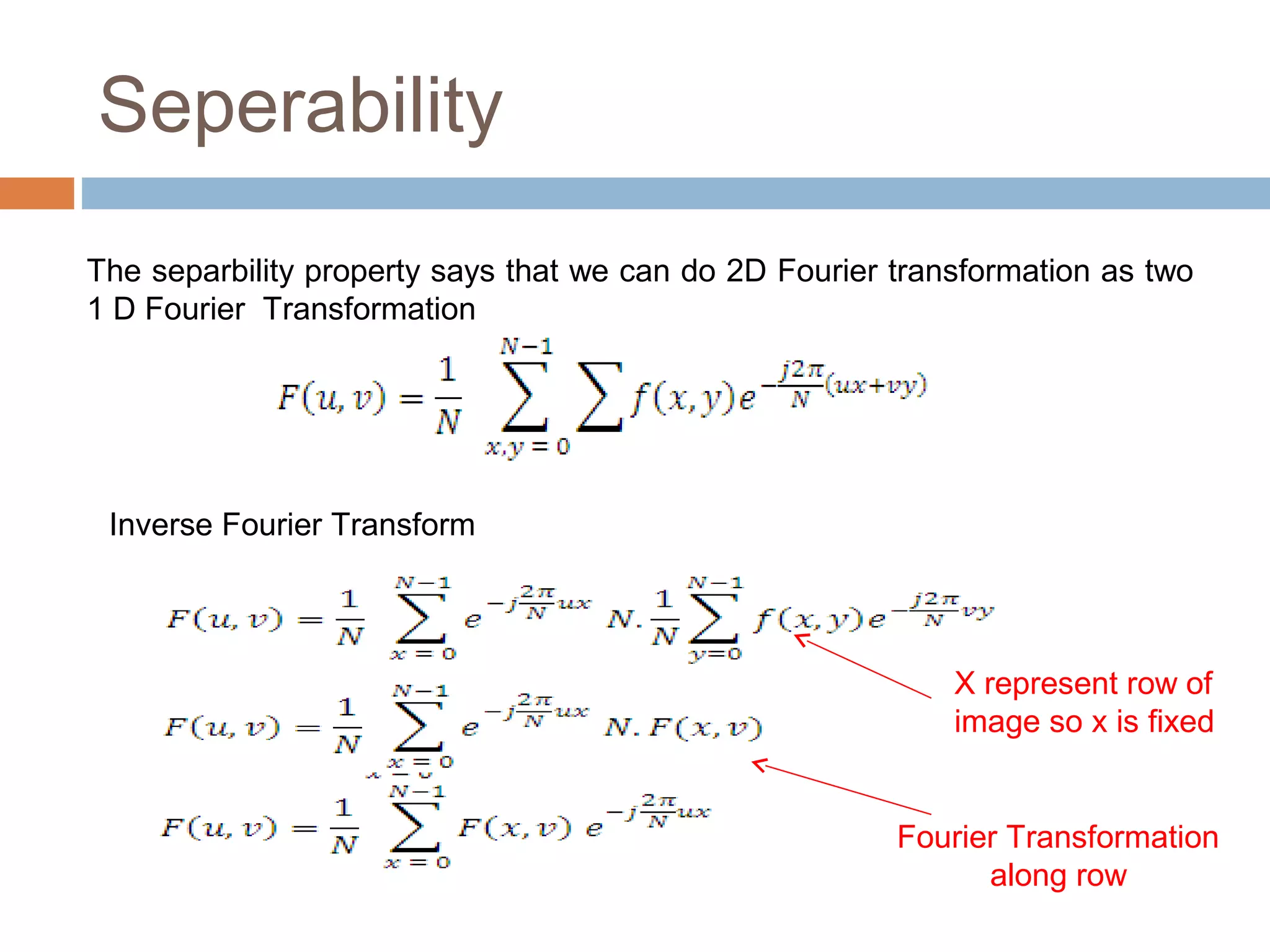
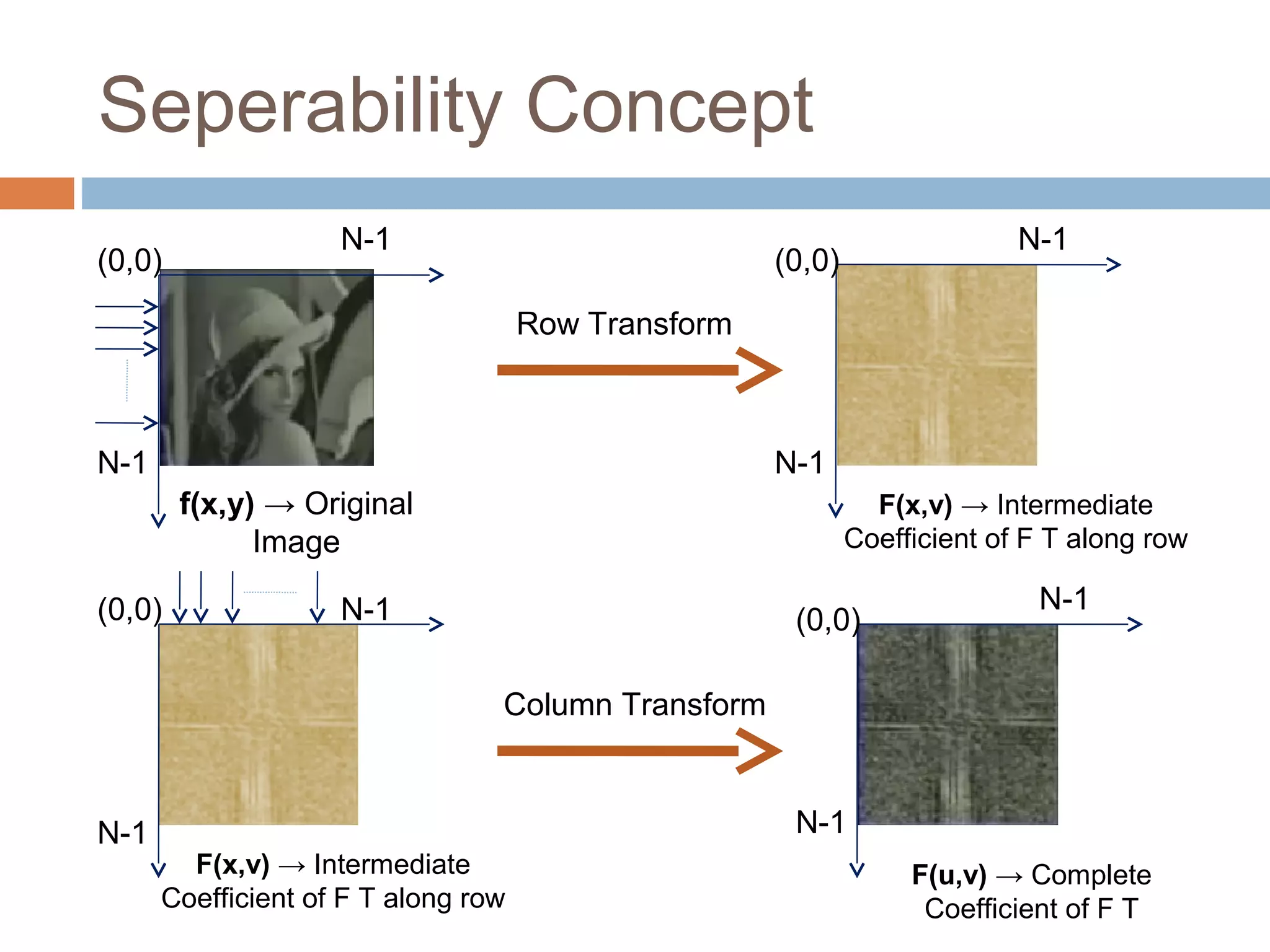
The separbility property says that we can do 2D Fourier transformation as two
1 D Fourier Transformation
Inverse Fourier Transform
X represent row of
image so x is fixed
Fourier Transformation
along row
Seperability Cont…
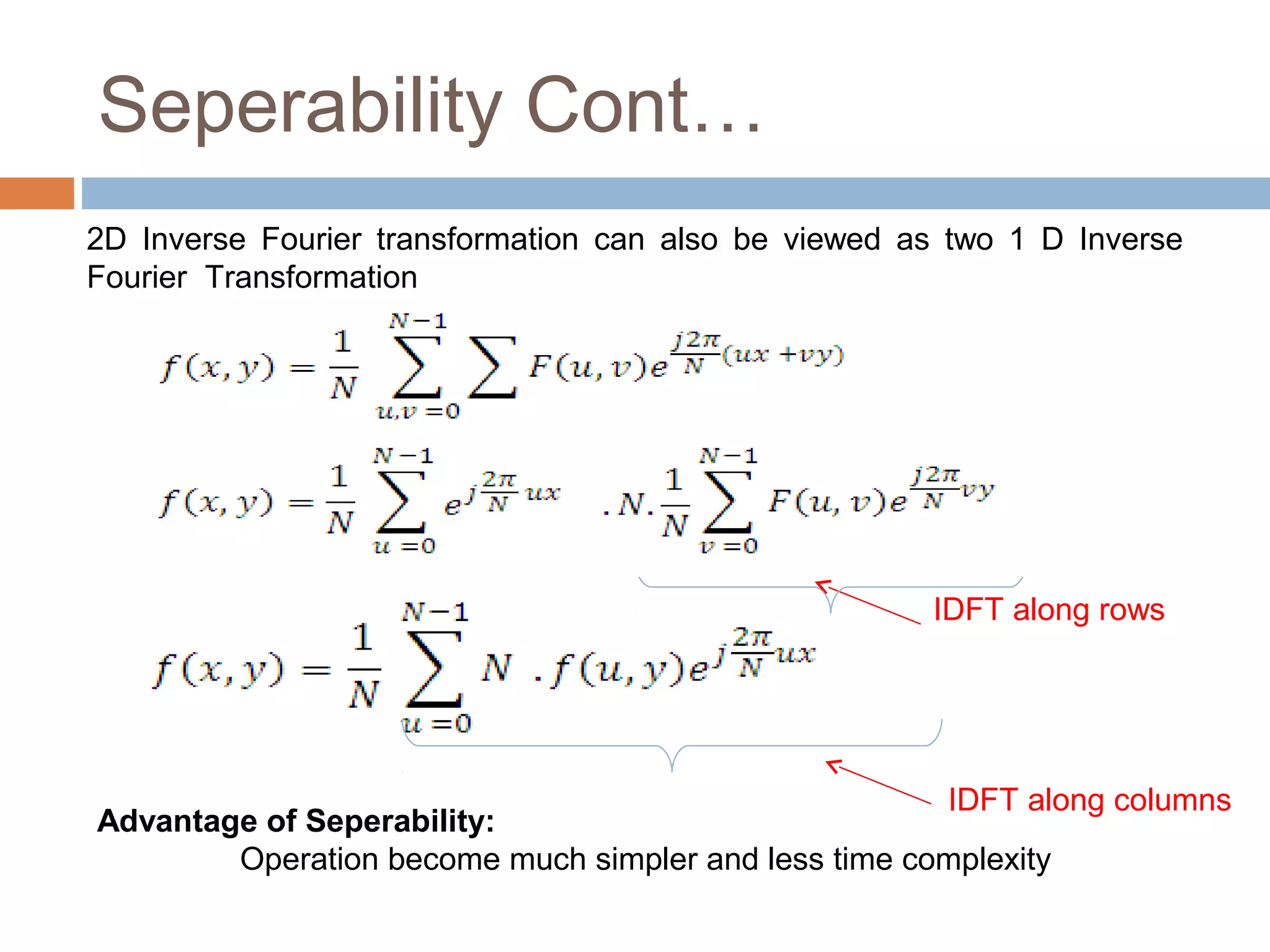
2D Inverse Fourier transformation can also be viewed as two 1 D Inverse
Fourier Transformation
IDFT along rows
IDFT along columns
Advantage of Seperability:
Operation become much simpler and less time complexity
Seperability Concept
f(x,y) → Original
Image
F(x,v) → Intermediate
Coefficient of F T along row
F(x,v) → Intermediate
Coefficient of F T along row
Row Transform
Column Transform
F(u,v) → Complete
Coefficient of F T
N-1
N-1
(0,0)
N-1
N-1
(0,0)
N-1
N-1
(0,0)N-1
N-1
(0,0)
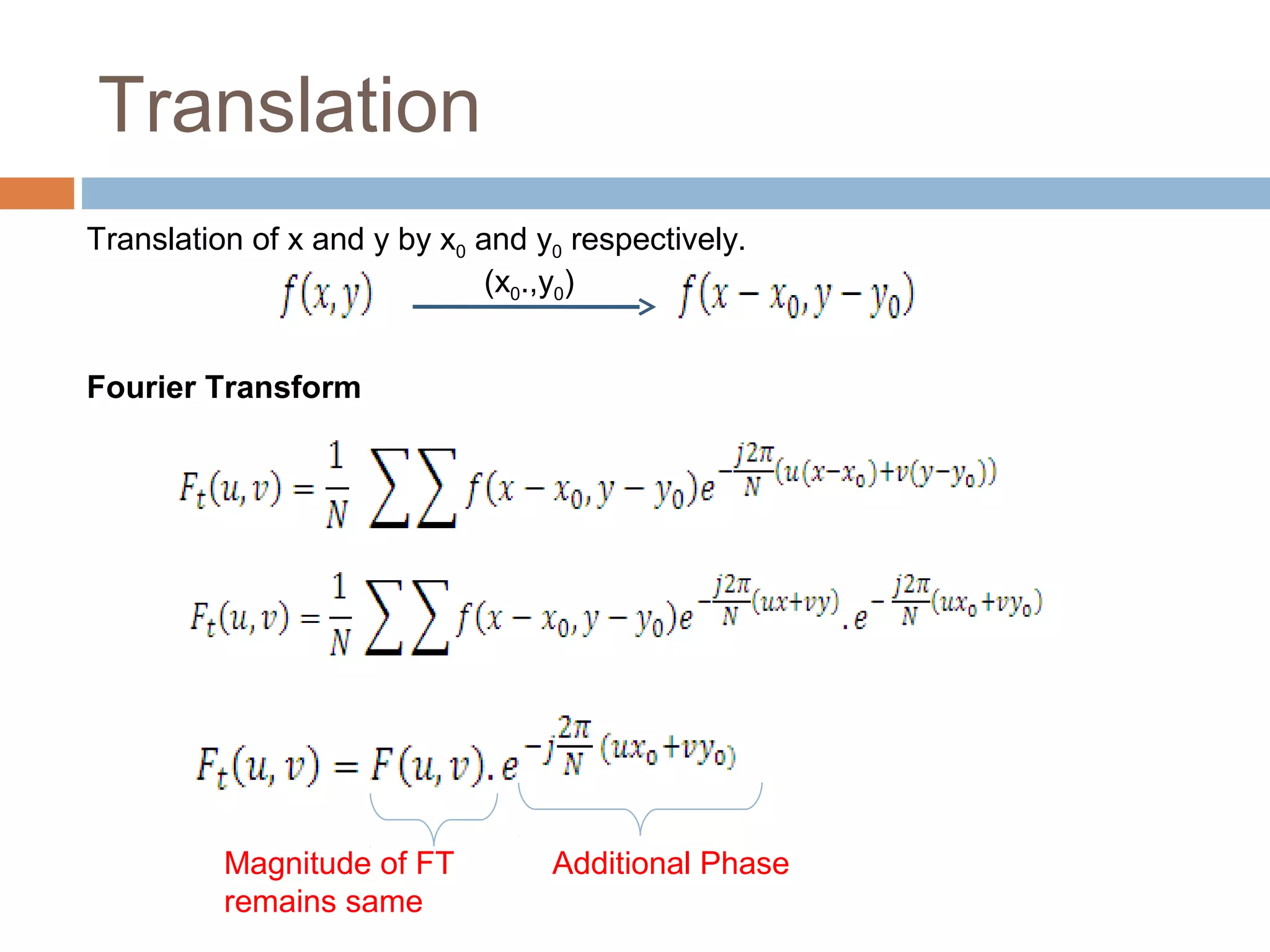
Translation
(x0.,y0)
Magnitude of FT
remains same
Additional Phase
Translation of x and y by x0 and y0 respectively.
Fourier Transform
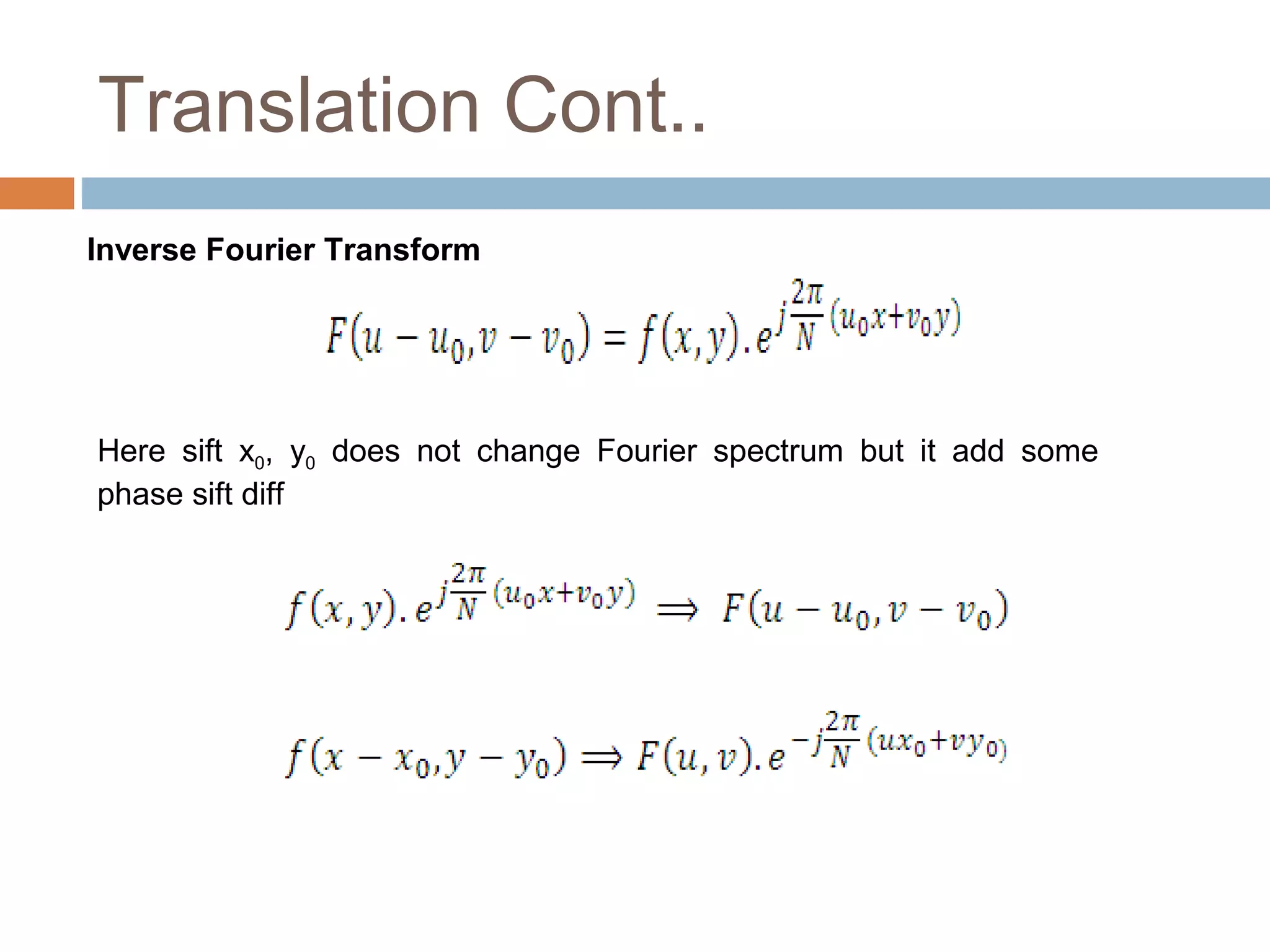
Translation Cont..
Inverse Fourier Transform
Here sift x0, y0 does not change Fourier spectrum but it add some
phase sift diff
Periodicity
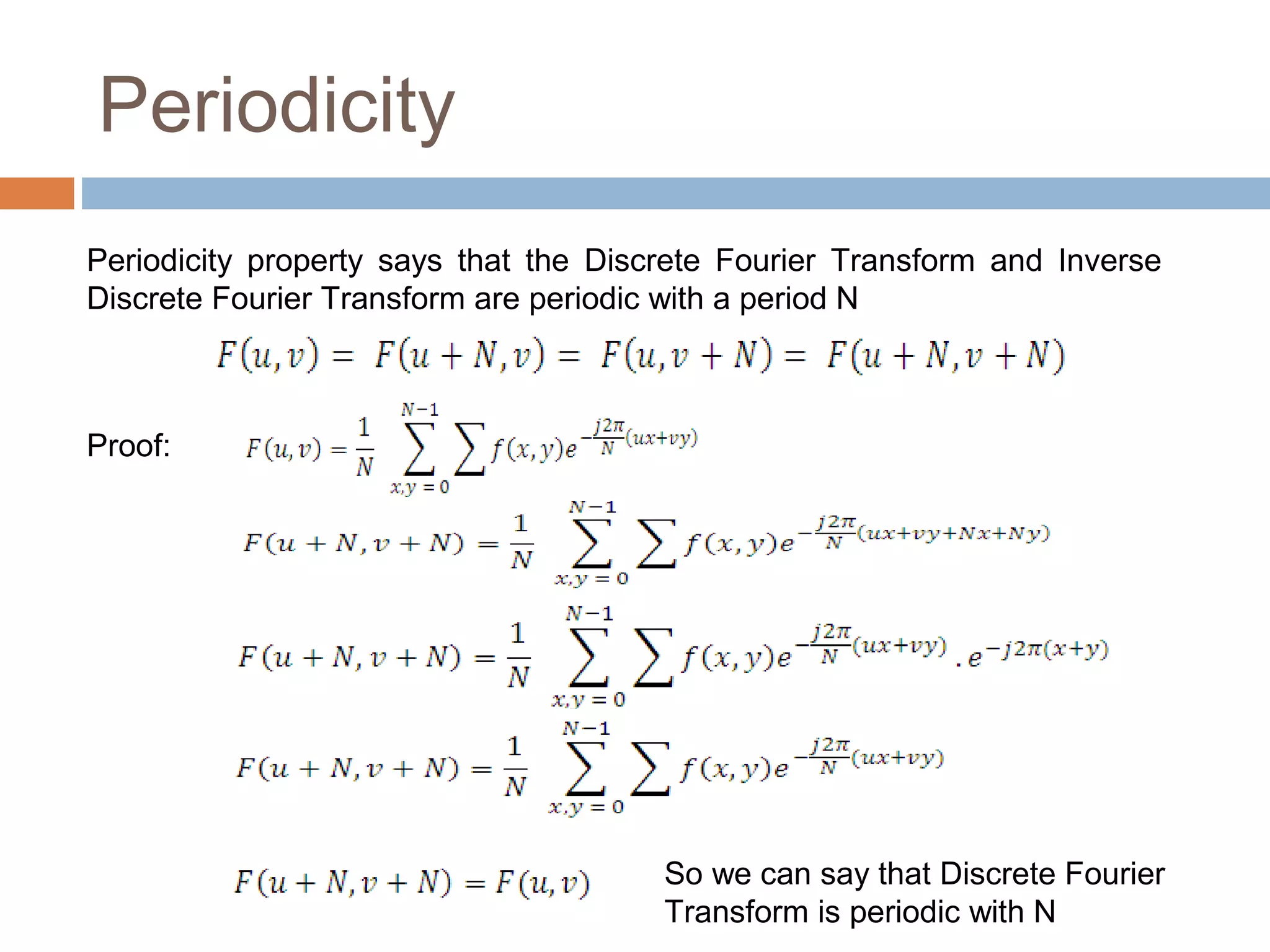
Periodicity property says that the Discrete Fourier Transform and Inverse
Discrete Fourier Transform are periodic with a period N
Proof:
So we can say that Discrete Fourier
Transform is periodic with N
Conjugate
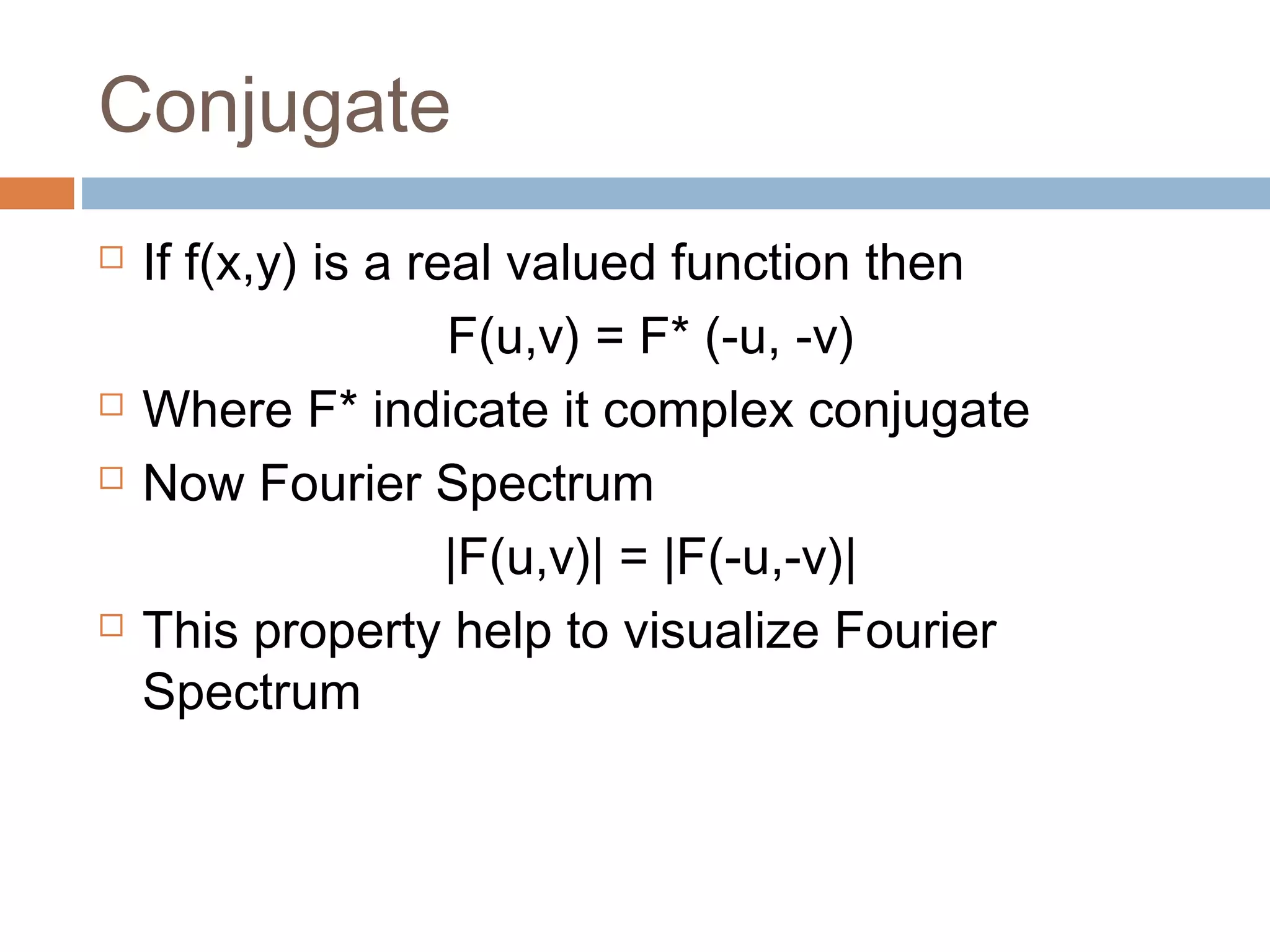
 If f(x,y) is a real valued function then
F(u,v) = F* (-u, -v)
 Where F* indicate it complex conjugate
 Now Fourier Spectrum
|F(u,v)| = |F(-u,-v)|
 This property help to visualize Fourier
Spectrum
Rotation
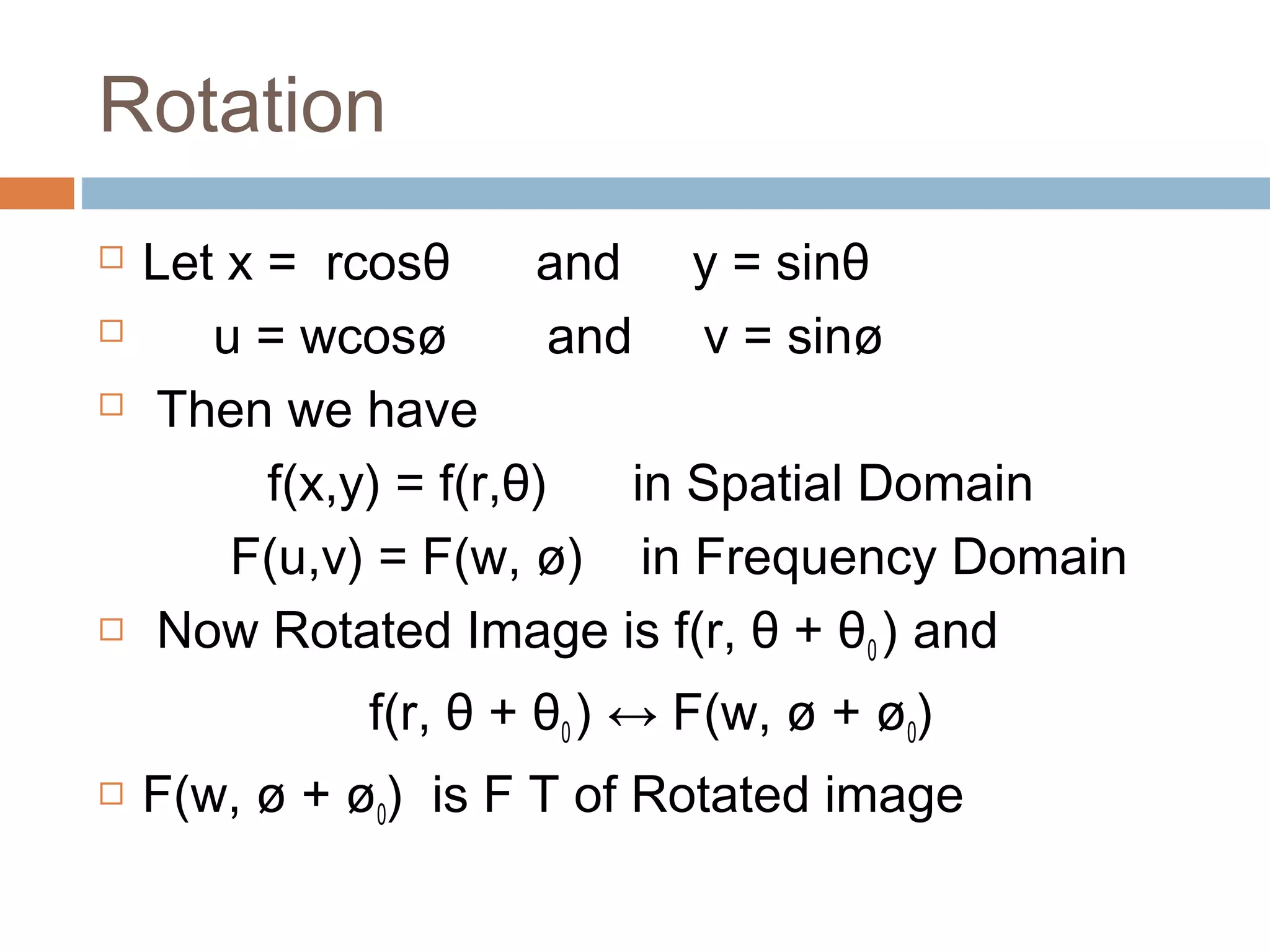
 Let x = rcosθ and y = sinθ
 u = wcosø and v = sinø
  Then we have
f(x,y) = f(r,θ) in Spatial Domain
F(u,v) = F(w, ø) in Frequency Domain
  Now Rotated Image is f(r, θ + θ0 ) and
f(r, θ + θ0 ) ↔ F(w, ø + ø0)
 F(w, ø + ø0) is F T of Rotated image
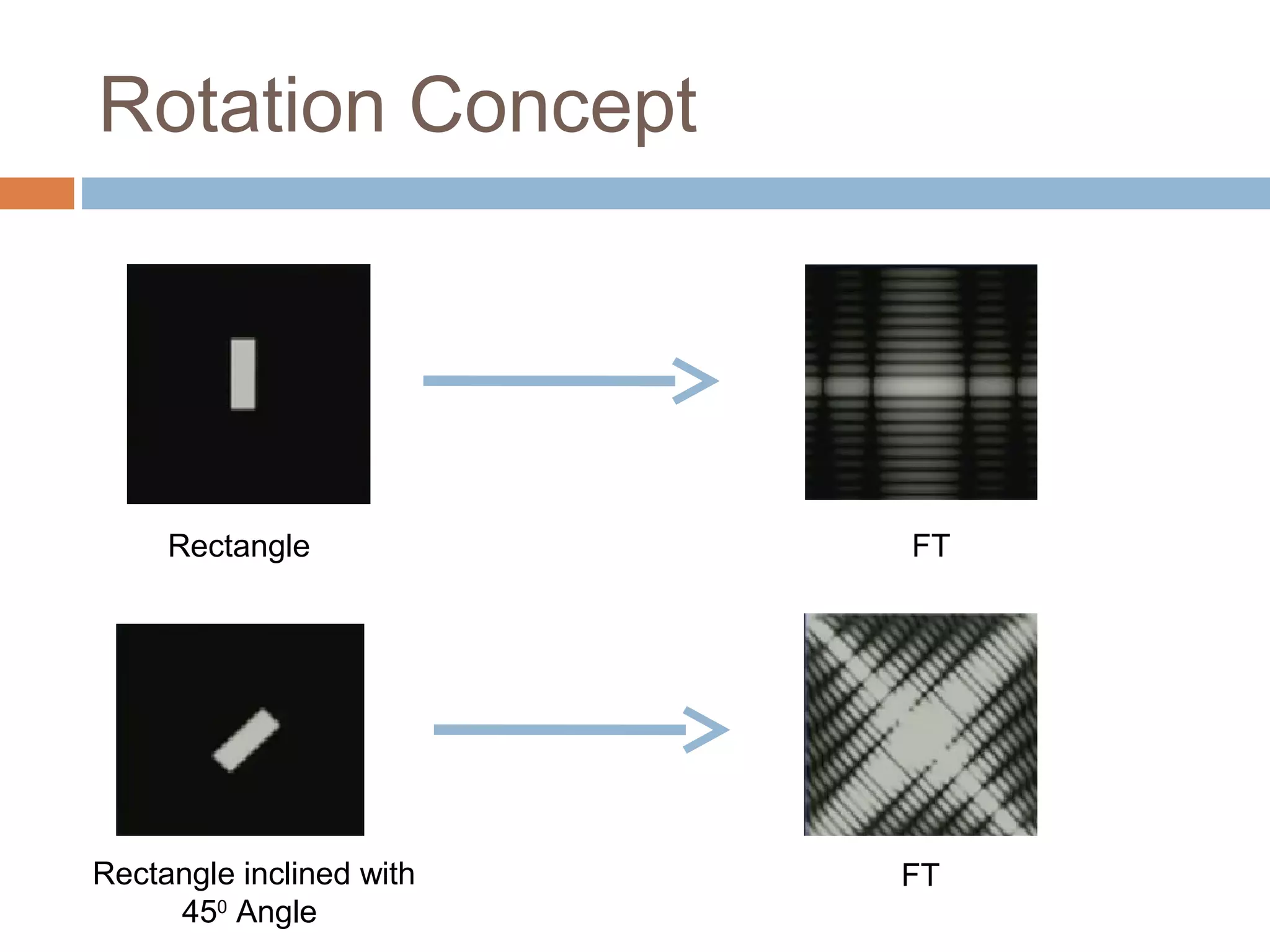
Rotation Concept
Rectangle FT
FTRectangle inclined with
450
Angle
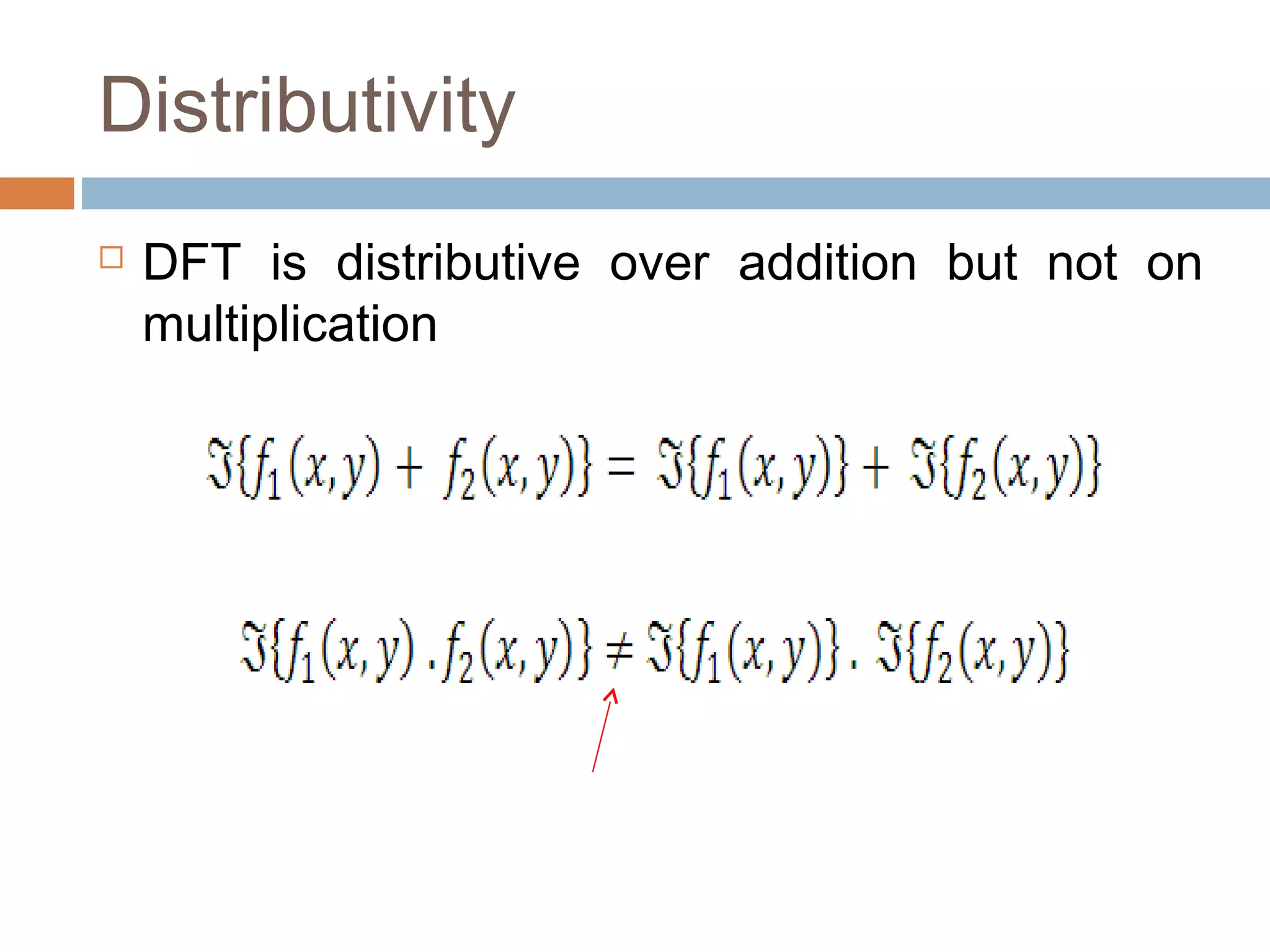
Distributivity
 DFT is distributive over addition but not on
multiplication
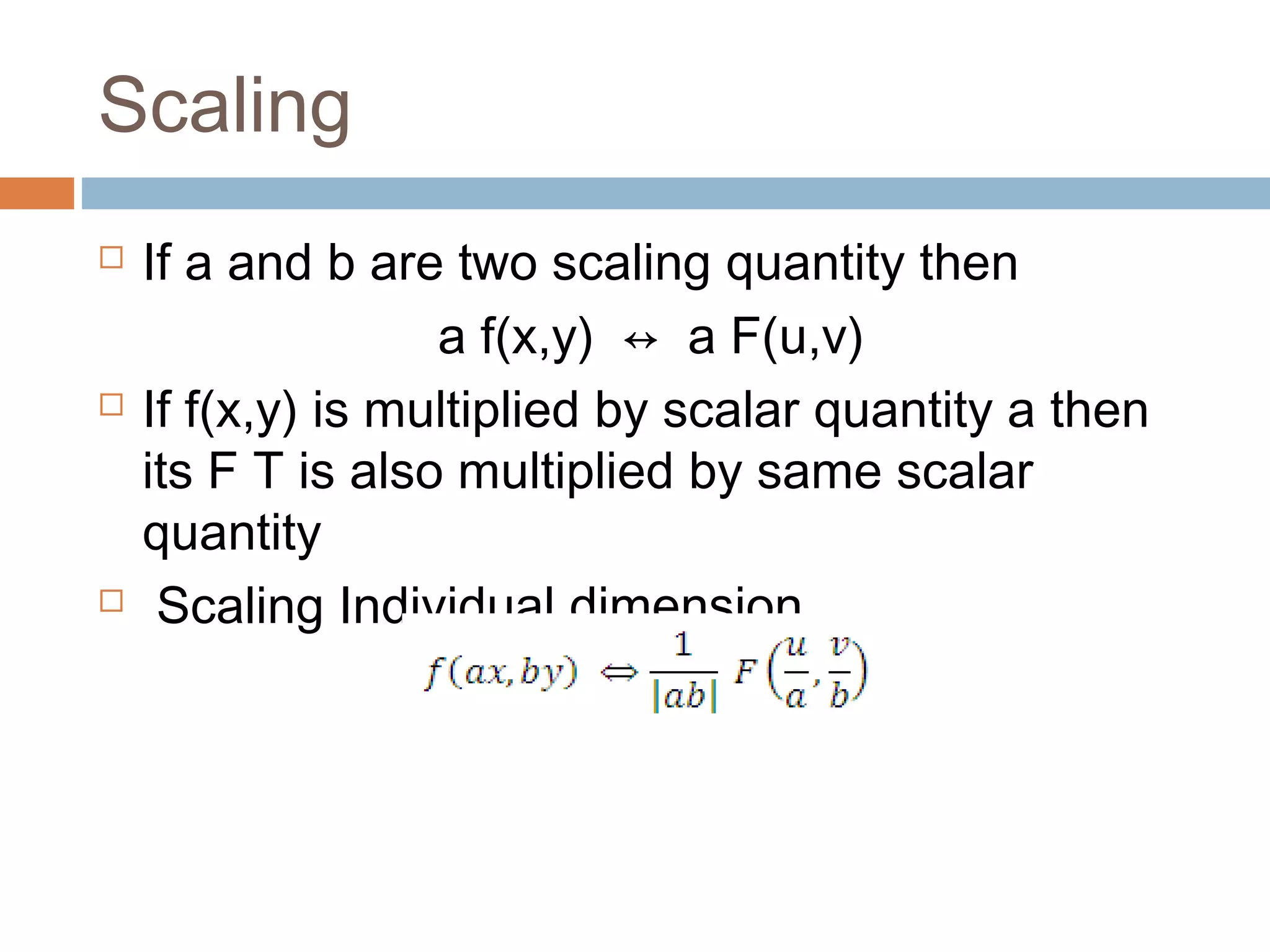
Scaling
 If a and b are two scaling quantity then
a f(x,y) ↔ a F(u,v)
 If f(x,y) is multiplied by scalar quantity a then
its F T is also multiplied by same scalar
quantity
  Scaling Individual dimension
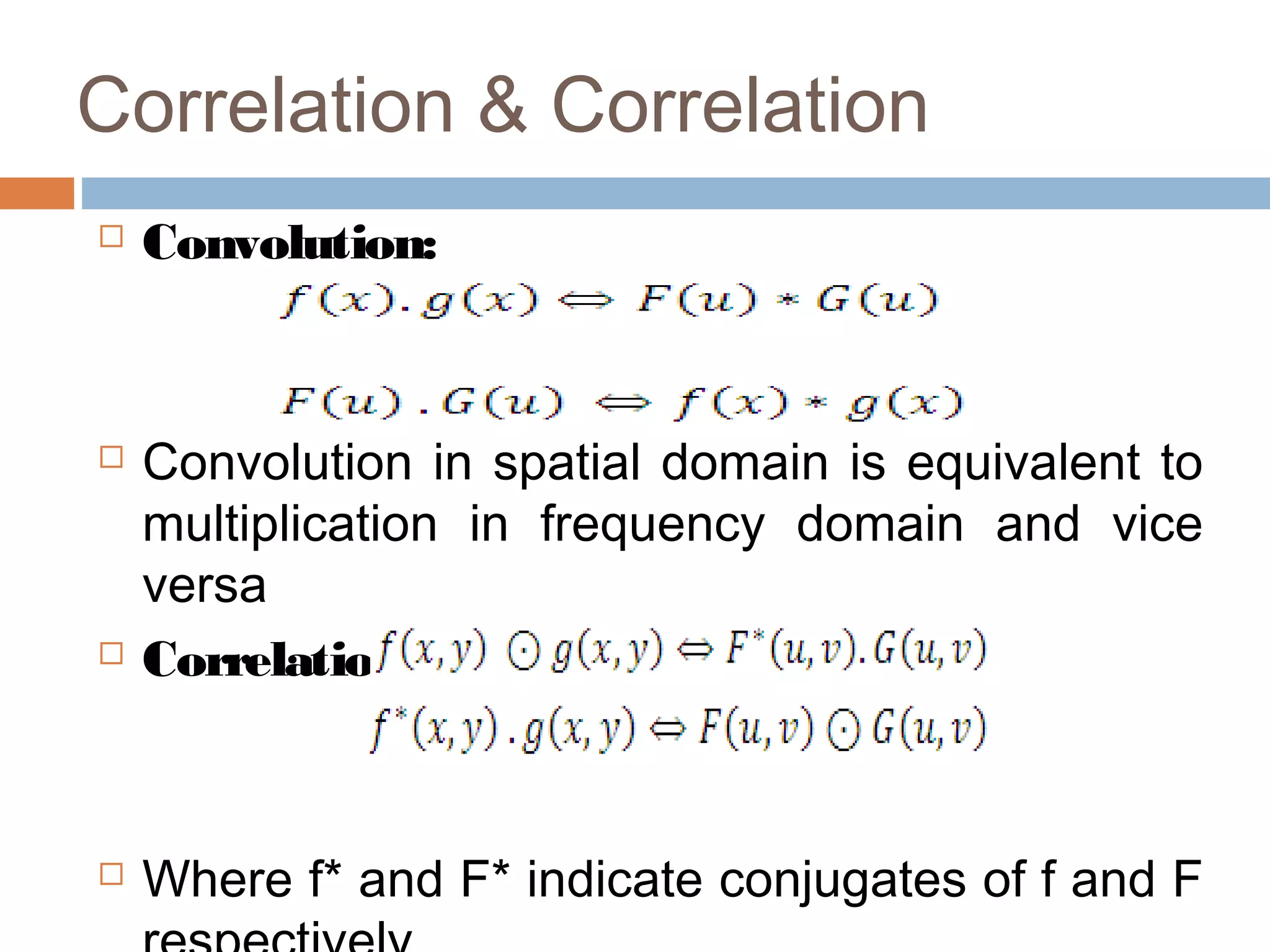
 Convolution:
 Convolution in spatial domain is equivalent to
multiplication in frequency domain and vice
versa
 Correlation:
 Where f* and F* indicate conjugates of f and F
Correlation & Correlation
Back to the chapter content
Click Here
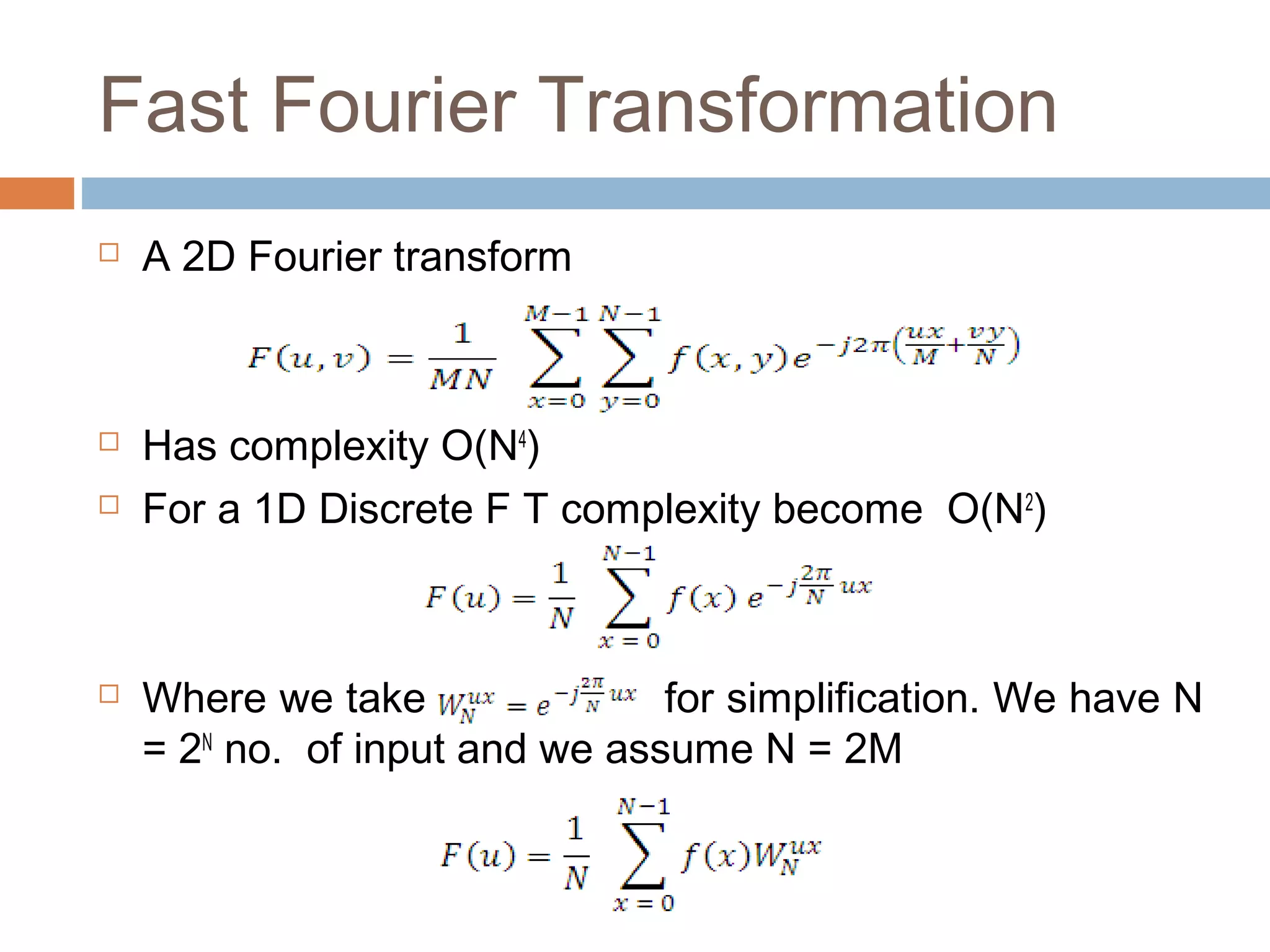
Fast Fourier Transformation
 A 2D Fourier transform
 Has complexity O(N4
)
 For a 1D Discrete F T complexity become O(N2
)
 Where we take for simplification. We have N
= 2N
no. of input and we assume N = 2M
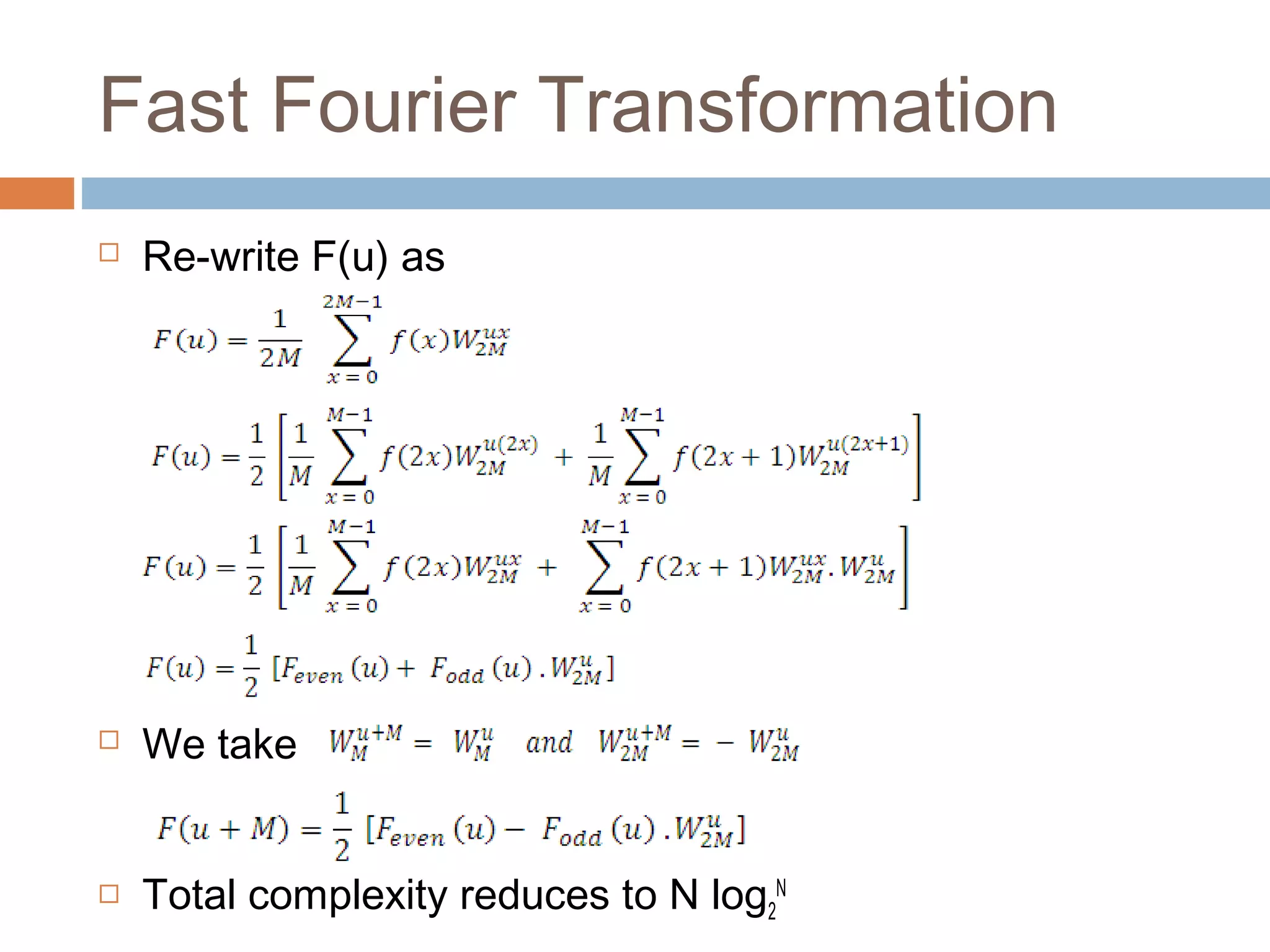
Fast Fourier Transformation
 Re-write F(u) as
 We take
 Total complexity reduces to N log2
N
Back to the chapter content
Click Here

Chapter 5 Image Processing: Fourier Transformation

  • 1.
    CHAPTER5 FOURIERTRANSFORMATION Dr. Varun KumarOjha and Prof. (Dr.) Paramartha Dutta Visva Bharati University Santiniketan, West Bengal, India
  • 2.
    Fourier Transformation  Continuous& Discrete Fourier Transformation  Properties of Fourier Transformation  Fast Fourier Transformation Back to Course Content Page Click Here
  • 3.
    Fourier Transformation (1-D Continuous Signal) Let f(x) is a continuous function of some variable then the Fourier transformation of f(x) is F(u) Here f(x) must be continuous & integralable Inverse Fourier Transformation: F(u) is a Fourier transform of signal f(x) so after inverse Fourier transformation of F(u) we get f(x) Fourier Transformation :
  • 4.
    Fourier Transformation (1-D Continuous Signal) Fourier Transformation Pair F(u) → Fourier Transform of signal f(x) F(x) → Original Signal or Inverse Fourier Transform of F(u) Here F(u) is a complex function contains real part & imaginary part F(u) = R(u) + jI(u) We have Fourier Spectrum: The phase angle: Power Spectrum :
  • 5.
    Fourier Transformation (2-D Continuous Signal) Forward Fourier Transformation: Let f(x,y) is 2 dimensional signal with 2 variable Inverse (Backward) Fourier Transformation:
  • 6.
    Fourier Transformation (2-D Continuous Signal) Fourier Spectrum: Phase angle : Power Spectrum:
  • 7.
    2-D Discrete Fourier Transformation Forward2D discrete Fourier Transformation: Let we have an Image of size MxN then F(u,v) is the F T of image f(x,y) Where variable u = 0, 1, 2, …., M-1 and v = 0, 1, 2, …., N-1 Inverse (Backward) Fourier Transformation : Where variable x = 0, 1, 2, …., M-1 and y = 0, 1, 2, …., N-1
  • 8.
     For asquare image i.e. M = N and the Fourier Transformation Pair is as follows 2-D Discrete Fourier Transformation
  • 9.
    Discrete F TResult Original Image Transformed Image DFT IDFT
  • 10.
    Back to thechapter content Click Here
  • 11.
    Properties of Fourier Transformation Seperability  Translation  Periodicity  Conjugate  Rotation  Distributive  Scaling  Convolution  Corelation
  • 12.
    Seperability The separbility propertysays that we can do 2D Fourier transformation as two 1 D Fourier Transformation Inverse Fourier Transform X represent row of image so x is fixed Fourier Transformation along row
  • 13.
    Seperability Cont… 2D InverseFourier transformation can also be viewed as two 1 D Inverse Fourier Transformation IDFT along rows IDFT along columns Advantage of Seperability: Operation become much simpler and less time complexity
  • 14.
    Seperability Concept f(x,y) →Original Image F(x,v) → Intermediate Coefficient of F T along row F(x,v) → Intermediate Coefficient of F T along row Row Transform Column Transform F(u,v) → Complete Coefficient of F T N-1 N-1 (0,0) N-1 N-1 (0,0) N-1 N-1 (0,0)N-1 N-1 (0,0)
  • 15.
    Translation (x0.,y0) Magnitude of FT remainssame Additional Phase Translation of x and y by x0 and y0 respectively. Fourier Transform
  • 16.
    Translation Cont.. Inverse FourierTransform Here sift x0, y0 does not change Fourier spectrum but it add some phase sift diff
  • 17.
    Periodicity Periodicity property saysthat the Discrete Fourier Transform and Inverse Discrete Fourier Transform are periodic with a period N Proof: So we can say that Discrete Fourier Transform is periodic with N
  • 18.
    Conjugate  If f(x,y)is a real valued function then F(u,v) = F* (-u, -v)  Where F* indicate it complex conjugate  Now Fourier Spectrum |F(u,v)| = |F(-u,-v)|  This property help to visualize Fourier Spectrum
  • 19.
    Rotation  Let x= rcosθ and y = sinθ  u = wcosø and v = sinø   Then we have f(x,y) = f(r,θ) in Spatial Domain F(u,v) = F(w, ø) in Frequency Domain   Now Rotated Image is f(r, θ + θ0 ) and f(r, θ + θ0 ) ↔ F(w, ø + ø0)  F(w, ø + ø0) is F T of Rotated image
  • 20.
  • 21.
    Distributivity  DFT isdistributive over addition but not on multiplication
  • 22.
    Scaling  If aand b are two scaling quantity then a f(x,y) ↔ a F(u,v)  If f(x,y) is multiplied by scalar quantity a then its F T is also multiplied by same scalar quantity   Scaling Individual dimension
  • 23.
     Convolution:  Convolutionin spatial domain is equivalent to multiplication in frequency domain and vice versa  Correlation:  Where f* and F* indicate conjugates of f and F Correlation & Correlation
  • 24.
    Back to thechapter content Click Here
  • 25.
    Fast Fourier Transformation A 2D Fourier transform  Has complexity O(N4 )  For a 1D Discrete F T complexity become O(N2 )  Where we take for simplification. We have N = 2N no. of input and we assume N = 2M
  • 26.
    Fast Fourier Transformation Re-write F(u) as  We take  Total complexity reduces to N log2 N
  • 27.
    Back to thechapter content Click Here