
A DWT- DCT- SVD
WATERMARKING SCHEME
CONTENTS:
• Watermarking
• Discrete Wavelet Transform
• Discrete Cosine Transform
• Singular Value Decomposition
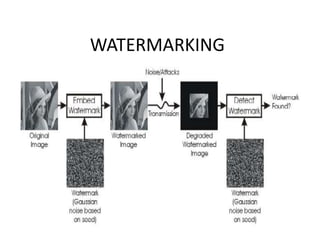
WATERMARKING
A digital watermark is a kind of marker covertly
embedded in a noise-tolerant signal such as an
audio, video or image data. It is typically used to
identify ownership of the copyright of such signal.
"Watermarking" is the process of hiding digital
information in a carrier signal; the hidden
information should, but does not need to, contain
a relation to the carrier signal. Digital watermarks
may be used to verify the authenticity or integrity
of the carrier signal or to show the identity of its
owners. It is prominently used for tracing
copyright infringements and for banknote
authentication.
Important requirements to be satisfied
by watermarking scheme:
• Fidelity-perceptual similarity between original
and watermarked image
• Robustness- even though an unauthorized
person performs some modifications to the
watermarked image, but still it can be
extracted.
• Non-invertibility – unable to generate same
watermarked image with different
combinations of images.
DISCRETE WAVELET TRANSFORM
• A wavelet is a wave-like oscillation with
an amplitude that begins at zero, increases, and
then decreases back to zero.
• A discrete wavelet transform (DWT) is
any wavelet transform for which the wavelets are
discretely sampled. As with other wavelet
transforms, a key advantage it has over Fourier
transforms is temporal resolution: it captures
both frequency and location information
(location in time).
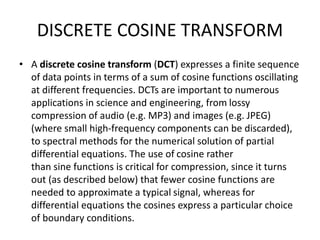
DISCRETE COSINE TRANSFORM
• A discrete cosine transform (DCT) expresses a finite sequence
of data points in terms of a sum of cosine functions oscillating
at different frequencies. DCTs are important to numerous
applications in science and engineering, from lossy
compression of audio (e.g. MP3) and images (e.g. JPEG)
(where small high-frequency components can be discarded),
to spectral methods for the numerical solution of partial
differential equations. The use of cosine rather
than sine functions is critical for compression, since it turns
out (as described below) that fewer cosine functions are
needed to approximate a typical signal, whereas for
differential equations the cosines express a particular choice
of boundary conditions.
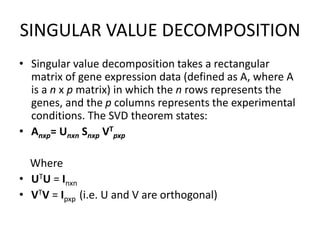
SINGULAR VALUE DECOMPOSITION
• Singular value decomposition takes a rectangular
matrix of gene expression data (defined as A, where A
is a n x p matrix) in which the n rows represents the
genes, and the p columns represents the experimental
conditions. The SVD theorem states:
• Anxp= Unxn Snxp VT
pxp
Where
• UTU = Inxn
• VTV = Ipxp (i.e. U and V are orthogonal)
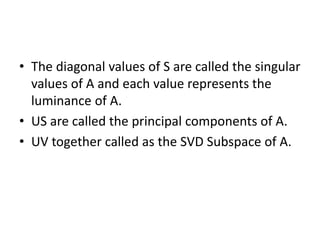
• The diagonal values of S are called the singular
values of A and each value represents the
luminance of A.
• US are called the principal components of A.
• UV together called as the SVD Subspace of A.
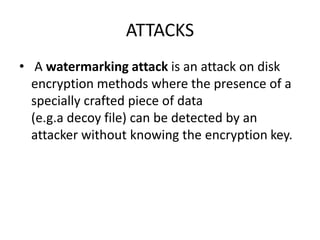
ATTACKS
• A watermarking attack is an attack on disk
encryption methods where the presence of a
specially crafted piece of data
(e.g.a decoy file) can be detected by an
attacker without knowing the encryption key.

Watermarking

  • 1.
    A DWT- DCT-SVD WATERMARKING SCHEME CONTENTS: • Watermarking • Discrete Wavelet Transform • Discrete Cosine Transform • Singular Value Decomposition
  • 2.
  • 3.
    A digital watermarkis a kind of marker covertly embedded in a noise-tolerant signal such as an audio, video or image data. It is typically used to identify ownership of the copyright of such signal. "Watermarking" is the process of hiding digital information in a carrier signal; the hidden information should, but does not need to, contain a relation to the carrier signal. Digital watermarks may be used to verify the authenticity or integrity of the carrier signal or to show the identity of its owners. It is prominently used for tracing copyright infringements and for banknote authentication.
  • 4.
    Important requirements tobe satisfied by watermarking scheme: • Fidelity-perceptual similarity between original and watermarked image • Robustness- even though an unauthorized person performs some modifications to the watermarked image, but still it can be extracted. • Non-invertibility – unable to generate same watermarked image with different combinations of images.
  • 5.
    DISCRETE WAVELET TRANSFORM •A wavelet is a wave-like oscillation with an amplitude that begins at zero, increases, and then decreases back to zero. • A discrete wavelet transform (DWT) is any wavelet transform for which the wavelets are discretely sampled. As with other wavelet transforms, a key advantage it has over Fourier transforms is temporal resolution: it captures both frequency and location information (location in time).
  • 6.
    DISCRETE COSINE TRANSFORM •A discrete cosine transform (DCT) expresses a finite sequence of data points in terms of a sum of cosine functions oscillating at different frequencies. DCTs are important to numerous applications in science and engineering, from lossy compression of audio (e.g. MP3) and images (e.g. JPEG) (where small high-frequency components can be discarded), to spectral methods for the numerical solution of partial differential equations. The use of cosine rather than sine functions is critical for compression, since it turns out (as described below) that fewer cosine functions are needed to approximate a typical signal, whereas for differential equations the cosines express a particular choice of boundary conditions.
  • 7.
    SINGULAR VALUE DECOMPOSITION •Singular value decomposition takes a rectangular matrix of gene expression data (defined as A, where A is a n x p matrix) in which the n rows represents the genes, and the p columns represents the experimental conditions. The SVD theorem states: • Anxp= Unxn Snxp VT pxp Where • UTU = Inxn • VTV = Ipxp (i.e. U and V are orthogonal)
  • 8.
    • The diagonalvalues of S are called the singular values of A and each value represents the luminance of A. • US are called the principal components of A. • UV together called as the SVD Subspace of A.
  • 9.
    ATTACKS • A watermarkingattack is an attack on disk encryption methods where the presence of a specially crafted piece of data (e.g.a decoy file) can be detected by an attacker without knowing the encryption key.