WELCOME
Presented by,
S.Rajendiran,
2013504016,
MIT-Anna University,
Chennai-44.
Introduction to Wavelet
Transform.
OUTLINE
Overview
Limitations of Fourier Transform
Historical Development
Principle of Wavelet Transform
Examples of Applications
Conclusion
References
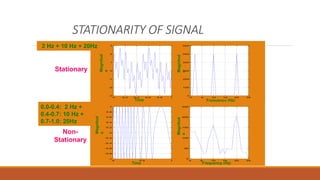
STATIONARITY OF SIGNAL
0 0.2 0.4 0.6 0.8 1
-3
-2
-1
0
1
2
3
0 5 10 15 20 25
0
100
200
300
400
500
600
TimeMagnitud
e
Magnitud
e
Frequency (Hz)
2 Hz + 10 Hz + 20Hz
Stationary
0 0.5 1
-1
-0.8
-0.6
-0.4
-0.2
0
0.2
0.4
0.6
0.8
1
0 5 10 15 20 25
0
50
100
150
200
250
Time
Magnitud
e
Magnitud
e
Frequency (Hz)
Non-
Stationary
0.0-0.4: 2 Hz +
0.4-0.7: 10 Hz +
0.7-1.0: 20Hz
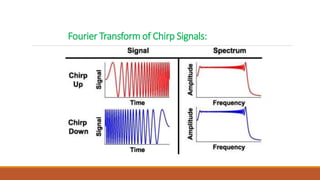
Limitations of Fourier Transform:
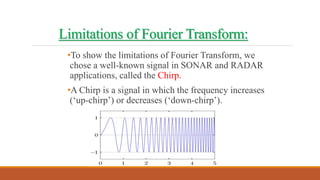
•To show the limitations of Fourier Transform, we
chose a well-known signal in SONAR and RADAR
applications, called the Chirp.
•A Chirp is a signal in which the frequency increases
(‘up-chirp’) or decreases (‘down-chirp’).
Fourier Transform of Chirp Signals:
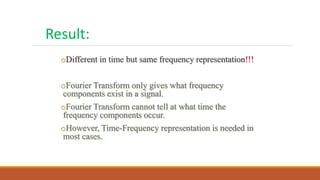
oDifferent in time but same frequency representation!!!
oFourier Transform only gives what frequency
components exist in a signal.
oFourier Transform cannot tell at what time the
frequency components occur.
oHowever, Time-Frequency representation is needed in
most cases.
Result:
SOLUTION
?
SOLUTION
1
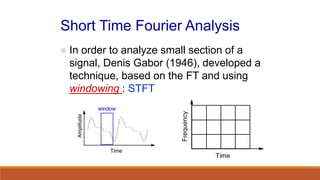
Short Time Fourier Analysis
 In order to analyze small section of a
signal, Denis Gabor (1946), developed a
technique, based on the FT and using
windowing : STFT
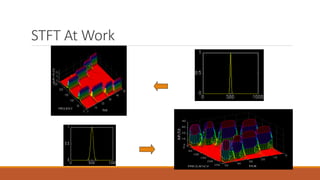
STFT At Work
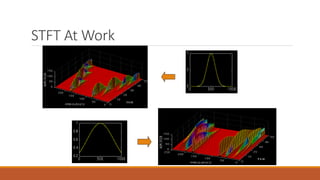
STFT At Work
What’s wrong with Gabor?
 Many signals require a more flexible
approach - so we can vary the window
size to determine more accurately either
time or frequency.
SOLUTION
2
WAVELET TRANSFORM
Overview of wavelet:
What does Wavelet mean?
Oxford Dictionary: A wavelet is a small wave.
Wikipedia: A wavelet is a mathematical function used to
divide a given function or continuous-time signal into
different scale components.
A Wavelet Transform is the representation of a function by wavelets.
Historical Development:
1909 : Alfred Haar – Dissertation “On the Orthogonal Function
Systems” for his Doctoral Degree. The first wavelet related theory .
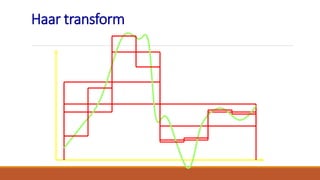
1910 : Alfred Haar : Development of a set of rectangular basis
functions.
1930s : - Paul Levy investigated “The Brownian Motion”.
- Littlewood and Paley worked on localizing the contributing
energies of a function.
1946 : Dennis Gabor : Used Short Time Fourier Transform .
1975 : George Zweig : The first Continuous Wavelet Transform CWT.
1985 : Yves Meyer : Construction of orthogonal wavelet basis functions with very good time and
frequency localization.
1986 : Stephane Mallat : Developing the Idea of Multiresolution Analysis “MRA” for Discrete
Wavelet Transform “DWT”.
1988 : The Modern Wavelet Theory with Daubechies and Mallat.
1992 : Albert Cohen, Jean fauveaux and Daubechies constructed the compactly supported
biorthogonal wavelets.
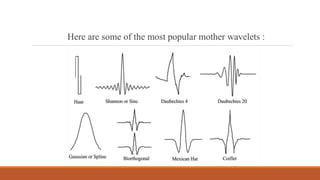
Here are some of the most popular mother wavelets :
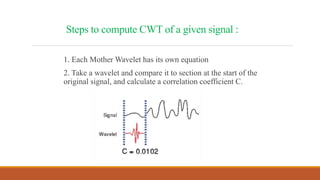
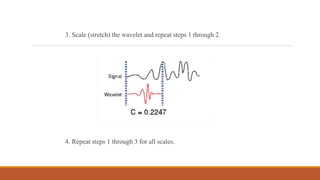
Steps to compute CWT of a given signal :
1. Each Mother Wavelet has its own equation
2. Take a wavelet and compare it to section at the start of the
original signal, and calculate a correlation coefficient C.
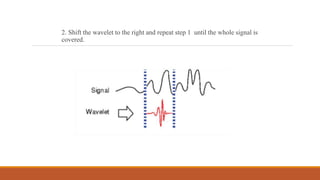
2. Shift the wavelet to the right and repeat step 1 until the whole signal is
covered.
3. Scale (stretch) the wavelet and repeat steps 1 through 2.
4. Repeat steps 1 through 3 for all scales.
Haar transform
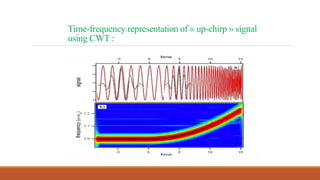
Time-frequency representation of « up-chirp » signal
using CWT :
Applications:
FBI Fingerprints Compression:
oSince 1924, the FBI Collected about 200 Million
cards of fingerprints.
oEach fingerprints card turns into about 10 MB,
which makes 2,000 TB for the whole collection. Thus,
automatic fingerprints identification takes a huge
amount of time to identify individuals during criminal
investigations.
The FBI decided to adopt a wavelet-based
image coding algorithm as a national standard
for digitized fingerprint records.
The WSQ (Wavelet/Scalar Quantization) developed and
maintained by the FBI, Los Alamos National Lab, and the
National Institute for Standards and Technology involves:
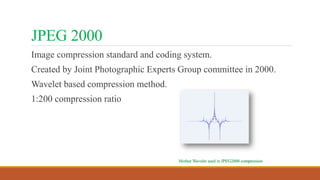
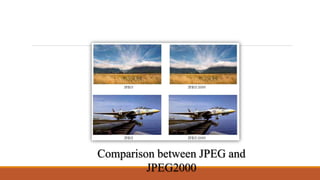
JPEG 2000
Image compression standard and coding system.
Created by Joint Photographic Experts Group committee in 2000.
Wavelet based compression method.
1:200 compression ratio
Mother Wavelet used in JPEG2000 compression
Comparison between JPEG and
JPEG2000
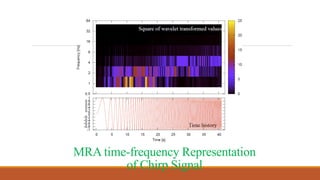
MRA time-frequency Representation
of Chirp Signal
31EE LAB.530
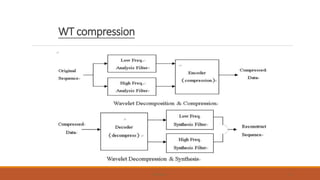
WT compression
SUBBABD CODING ALGORITHM
0-1000 Hz
D2: 250-500 Hz
D3: 125-250 Hz
Filter 1
Filter 2
Filter 3
D1: 500-1000 Hz
A3: 0-125 Hz
A1
A2
X[n]
512
256
128
64
64
128
256
SS
A1
A2 D2
A3 D3
D1
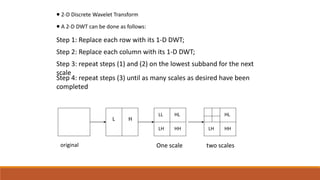
 2-D Discrete Wavelet Transform
 A 2-D DWT can be done as follows:
Step 1: Replace each row with its 1-D DWT;
Step 2: Replace each column with its 1-D DWT;
Step 3: repeat steps (1) and (2) on the lowest subband for the next
scale
Step 4: repeat steps (3) until as many scales as desired have been
completed
original
L H
LH HH
HLLL
LH HH
HL
One scale two scales
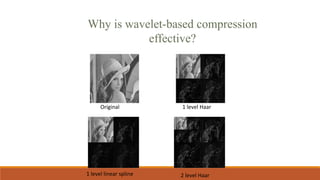
1 level Haar
1 level linear spline 2 level Haar
Original
Why is wavelet-based compression
effective?
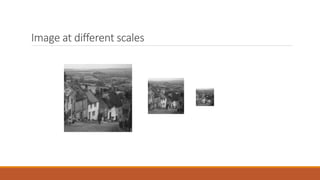
Image at different scales
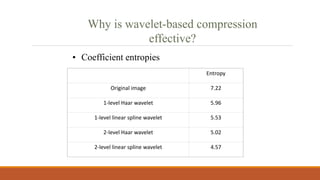
Entropy
Original image 7.22
1-level Haar wavelet 5.96
1-level linear spline wavelet 5.53
2-level Haar wavelet 5.02
2-level linear spline wavelet 4.57
Why is wavelet-based compression
effective?
• Coefficient entropies
Introduction to image compression
For human eyes, the image will still seems to be the same even when the
Compression ratio is equal 10
Human eyes are less sensitive to those high frequency signals
Our eyes will average fine details within the small area and record only the
overall intensity of the area, which is regarded as a lowpass filter.
EE LAB.530 38
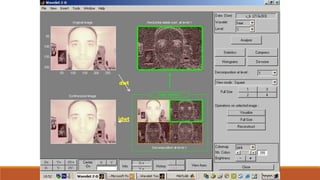
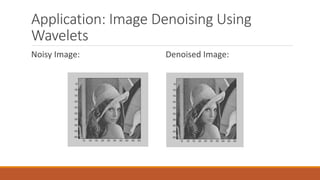
Application: Image Denoising Using
Wavelets
Noisy Image: Denoised Image:
Image Denoising Using Wavelets
Calculate the DWT of the image.
Threshold the wavelet coefficients. The threshold may be universal
or subband adaptive.
Compute the IDWT to get the denoised estimate.
Soft thresholding is used in the different thresholding methods.
Visually more pleasing images.
Advantages of using Wavelets:
Provide a way for analysing waveforms in both frequency
and duration.
Representation of functions that have discontinuities and
sharp peaks.
Accurately deconstructing and reconstructing finite, non-
periodic and/or non-stationary signals.
Allow signals to be stored more efficiently than by Fourier
transform.
Wavelets can be applied for many different
purposes :
Audio compression.
Speech recognition.
Image and video compression
Denoising Signals
Motion Detection and tracking
 Wavelet is a relatively new theory, it has enjoyed
a tremendous attention and success over the last
decade, and for a good reason.
 Almost all signals encountred in practice call for
a time-frequency analysis, and wavelets provide a
very simple and efficient way to perform such an
analysis.
 Still, there’s a lot to discover in this new theory,
due to the infinite variety of non-stationary signals
encountred in real life.
Conclusion :
Questions?
For any queries: rajendiran301@gmail.com

Introduction to wavelet transform

  • 1.
  • 2.
    OUTLINE Overview Limitations of FourierTransform Historical Development Principle of Wavelet Transform Examples of Applications Conclusion References
  • 3.
    STATIONARITY OF SIGNAL 00.2 0.4 0.6 0.8 1 -3 -2 -1 0 1 2 3 0 5 10 15 20 25 0 100 200 300 400 500 600 TimeMagnitud e Magnitud e Frequency (Hz) 2 Hz + 10 Hz + 20Hz Stationary 0 0.5 1 -1 -0.8 -0.6 -0.4 -0.2 0 0.2 0.4 0.6 0.8 1 0 5 10 15 20 25 0 50 100 150 200 250 Time Magnitud e Magnitud e Frequency (Hz) Non- Stationary 0.0-0.4: 2 Hz + 0.4-0.7: 10 Hz + 0.7-1.0: 20Hz
  • 4.
    Limitations of FourierTransform: •To show the limitations of Fourier Transform, we chose a well-known signal in SONAR and RADAR applications, called the Chirp. •A Chirp is a signal in which the frequency increases (‘up-chirp’) or decreases (‘down-chirp’).
  • 5.
    Fourier Transform ofChirp Signals:
  • 6.
    oDifferent in timebut same frequency representation!!! oFourier Transform only gives what frequency components exist in a signal. oFourier Transform cannot tell at what time the frequency components occur. oHowever, Time-Frequency representation is needed in most cases. Result:
  • 7.
  • 8.
  • 9.
    Short Time FourierAnalysis  In order to analyze small section of a signal, Denis Gabor (1946), developed a technique, based on the FT and using windowing : STFT
  • 10.
  • 11.
  • 12.
    What’s wrong withGabor?  Many signals require a more flexible approach - so we can vary the window size to determine more accurately either time or frequency.
  • 13.
  • 14.
  • 15.
    Overview of wavelet: Whatdoes Wavelet mean? Oxford Dictionary: A wavelet is a small wave. Wikipedia: A wavelet is a mathematical function used to divide a given function or continuous-time signal into different scale components. A Wavelet Transform is the representation of a function by wavelets.
  • 16.
    Historical Development: 1909 :Alfred Haar – Dissertation “On the Orthogonal Function Systems” for his Doctoral Degree. The first wavelet related theory . 1910 : Alfred Haar : Development of a set of rectangular basis functions. 1930s : - Paul Levy investigated “The Brownian Motion”. - Littlewood and Paley worked on localizing the contributing energies of a function. 1946 : Dennis Gabor : Used Short Time Fourier Transform . 1975 : George Zweig : The first Continuous Wavelet Transform CWT.
  • 17.
    1985 : YvesMeyer : Construction of orthogonal wavelet basis functions with very good time and frequency localization. 1986 : Stephane Mallat : Developing the Idea of Multiresolution Analysis “MRA” for Discrete Wavelet Transform “DWT”. 1988 : The Modern Wavelet Theory with Daubechies and Mallat. 1992 : Albert Cohen, Jean fauveaux and Daubechies constructed the compactly supported biorthogonal wavelets.
  • 18.
    Here are someof the most popular mother wavelets :
  • 19.
    Steps to computeCWT of a given signal : 1. Each Mother Wavelet has its own equation 2. Take a wavelet and compare it to section at the start of the original signal, and calculate a correlation coefficient C.
  • 20.
    2. Shift thewavelet to the right and repeat step 1 until the whole signal is covered.
  • 21.
    3. Scale (stretch)the wavelet and repeat steps 1 through 2. 4. Repeat steps 1 through 3 for all scales.
  • 22.
  • 23.
    Time-frequency representation of« up-chirp » signal using CWT :
  • 24.
  • 26.
    FBI Fingerprints Compression: oSince1924, the FBI Collected about 200 Million cards of fingerprints. oEach fingerprints card turns into about 10 MB, which makes 2,000 TB for the whole collection. Thus, automatic fingerprints identification takes a huge amount of time to identify individuals during criminal investigations.
  • 27.
    The FBI decidedto adopt a wavelet-based image coding algorithm as a national standard for digitized fingerprint records. The WSQ (Wavelet/Scalar Quantization) developed and maintained by the FBI, Los Alamos National Lab, and the National Institute for Standards and Technology involves:
  • 28.
    JPEG 2000 Image compressionstandard and coding system. Created by Joint Photographic Experts Group committee in 2000. Wavelet based compression method. 1:200 compression ratio Mother Wavelet used in JPEG2000 compression
  • 29.
  • 30.
  • 31.
  • 32.
    SUBBABD CODING ALGORITHM 0-1000Hz D2: 250-500 Hz D3: 125-250 Hz Filter 1 Filter 2 Filter 3 D1: 500-1000 Hz A3: 0-125 Hz A1 A2 X[n] 512 256 128 64 64 128 256 SS A1 A2 D2 A3 D3 D1
  • 33.
     2-D DiscreteWavelet Transform  A 2-D DWT can be done as follows: Step 1: Replace each row with its 1-D DWT; Step 2: Replace each column with its 1-D DWT; Step 3: repeat steps (1) and (2) on the lowest subband for the next scale Step 4: repeat steps (3) until as many scales as desired have been completed original L H LH HH HLLL LH HH HL One scale two scales
  • 35.
    1 level Haar 1level linear spline 2 level Haar Original Why is wavelet-based compression effective?
  • 36.
  • 37.
    Entropy Original image 7.22 1-levelHaar wavelet 5.96 1-level linear spline wavelet 5.53 2-level Haar wavelet 5.02 2-level linear spline wavelet 4.57 Why is wavelet-based compression effective? • Coefficient entropies
  • 38.
    Introduction to imagecompression For human eyes, the image will still seems to be the same even when the Compression ratio is equal 10 Human eyes are less sensitive to those high frequency signals Our eyes will average fine details within the small area and record only the overall intensity of the area, which is regarded as a lowpass filter. EE LAB.530 38
  • 39.
    Application: Image DenoisingUsing Wavelets Noisy Image: Denoised Image:
  • 40.
    Image Denoising UsingWavelets Calculate the DWT of the image. Threshold the wavelet coefficients. The threshold may be universal or subband adaptive. Compute the IDWT to get the denoised estimate. Soft thresholding is used in the different thresholding methods. Visually more pleasing images.
  • 41.
    Advantages of usingWavelets: Provide a way for analysing waveforms in both frequency and duration. Representation of functions that have discontinuities and sharp peaks. Accurately deconstructing and reconstructing finite, non- periodic and/or non-stationary signals. Allow signals to be stored more efficiently than by Fourier transform.
  • 42.
    Wavelets can beapplied for many different purposes : Audio compression. Speech recognition. Image and video compression Denoising Signals Motion Detection and tracking
  • 43.
     Wavelet isa relatively new theory, it has enjoyed a tremendous attention and success over the last decade, and for a good reason.  Almost all signals encountred in practice call for a time-frequency analysis, and wavelets provide a very simple and efficient way to perform such an analysis.  Still, there’s a lot to discover in this new theory, due to the infinite variety of non-stationary signals encountred in real life. Conclusion :
  • 44.
  • 45.
    For any queries:rajendiran301@gmail.com