WAVELET TRANSFORM
IN
IMAGE COMPRESSION
Presented By,
E . JEEVITHA
16MMAT05
M.Phil Mathematics
OVERVIEW
Introduction
Historical developments
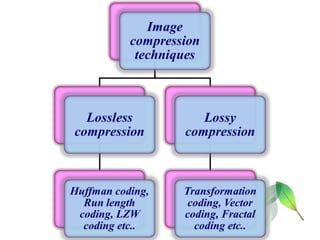
Techniques
Methodology
Applications
Advantages
Conclusion
INTRODUCTION
Wavelets are mathematical functions that splits
up data into different frequency components, and
then study each component with a resolution
matched to its scale.
Wavelet transform decomposes a signal into a
set of basis functions. These basis functions are
called as “ wavelets ”.
HISTORICAL DEVELOPMENTS
1909 : Alfred Haar – Dissertation “On the orthogonal
function systems” for his doctoral degree. The first wavelet
related theory.
1910 : Alfred Haar : Development of a set of rectangular
basis functions.
1930 : Paul Levy investigated “ The brownian motion”.
Littlewood and Paley worked on localizing the
contributing energies of a functon.
1946 : Dennis Gabor : Used short time fourier transform.
1975 : George zweig - The first continuous wavelet
transform.
1985 : Meyer - Construction of orthogonal wavelet basis
functions with very good time and frequency localization.
1986 : Stephen Mallet – Developing the idea of Multi-
resolution analysis for DWT.
1988 : Daubechies and Mallet – The modern wavelet
theory.
1992 : Albert cohen and Daubechies constructed the
compactly supported biorthogonal wavelets.
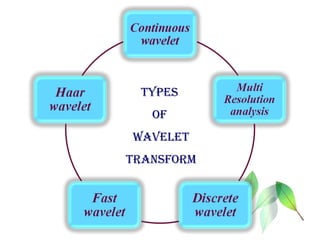
TYPES
OF
WAVELET
TRANSFORM
WHY IMAGE COMPRESSION?
Digital images usually require a very
large number of bits, this causes critical
problem for digital image data
transmission and storage.
It is the art & science of reducing the
amount of data required to represent an
image.
It is one of the most useful and
commercially successful technologies in
the field of digital image processing.
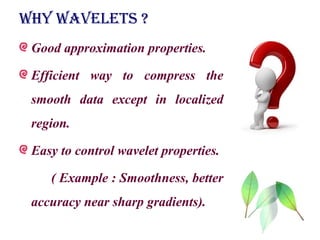
WHY WAVELETS ?
Good approximation properties.
Efficient way to compress the
smooth data except in localized
region.
Easy to control wavelet properties.
( Example : Smoothness, better
accuracy near sharp gradients).
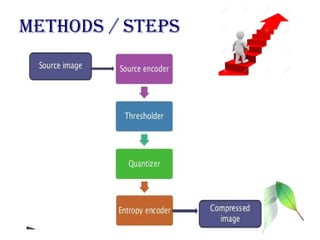
METHODS / STEPS
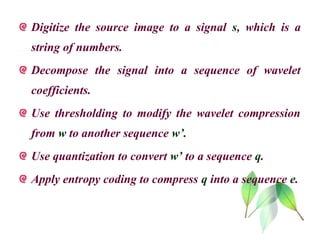
Digitize the source image to a signal s, which is a
string of numbers.
Decompose the signal into a sequence of wavelet
coefficients.
Use thresholding to modify the wavelet compression
from w to another sequence w’.
Use quantization to convert w’ to a sequence q.
Apply entropy coding to compress q into a sequence e.
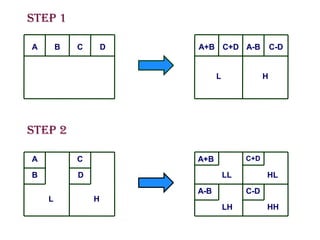
A B C D A+B C+D A-B C-D
L H
STEP 1
STEP 2
A
B
C
D
L H
A+B
A-B
C+D
C-D
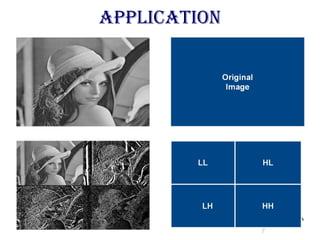
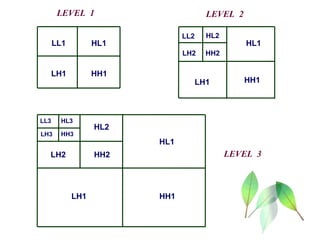
LL
LH
HL
HH
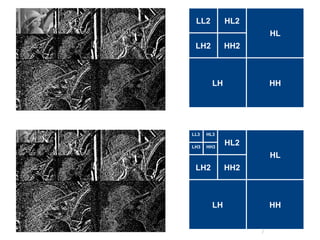
LL1
LH1
HL1
HH1
HL1
HH1LH1
LH1 HH1
HL1
HH2
HL2
LH2
HH2LH2
LL2 HL2
LL3 HL3
LH3 HH3
LEVEL 1 LEVEL 2
LEVEL 3
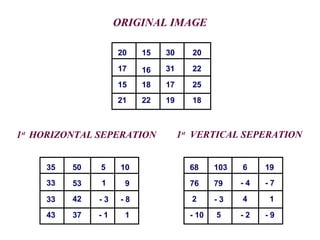
ORIGINAL IMAGE
20 15 30 20
17 16 31 22
15 18 17 25
21 22 19 18
35 50 5 10
33 53 1 9
33 42 - 3 - 8
43 37 - 1 1
68 103 6 19
76 79 - 4 - 7
2 - 3 4 1
- 10 5 - 2 - 9
1st
HORIZONTAL SEPERATION 1st
VERTICAL SEPERATION
APPLICATION
LL2 HL2
LH2 HH2
LH
HL
HH
LH
HL
HH
HL2
LH2 HH2
LL3 HL3
LH3 HH3
OTHER APPLICATIONS
Wavelets are a powerful statistical tool which can
be used for a wide range of applications, namely
Signal processing.
Image processing.
Smoothing and image denoising.
Fingerprint verification.
Biology for cell membrane recognition, to
distinguish the normal from the pathological
membranes.
DNA analysis, protein analysis.
Blood-pressure, heart-rate and ECG analysis.
Finance (which is more surprising), for
detecting the properties of quick variation of values.
In Internet traffic description, for
designing the services size.
Speech recognition.
Computer graphics and multi-fractal
analysis.
ADVANTAGES
The advantage of wavelet compression is that, in contrast
to JPEG, wavelet algorithm does not divide image into
blocks, but analyze the whole image.
Wavelet transform is applied to sub images, so it produces
no blocking artifacts.
Wavelets have the great advantage of being able to
separate the fine details in a signal.
Wavelet allows getting best compression ratio, while
maintaining the quality of the images.
CONCLUSION
Image compression using wavelet transforms results
in an improved compression ratio as well as image quality.
Wavelet transform is the only method that provides both
spatial and frequency domain information. These
properties of wavelet transform greatly help in
identification and selection of significant and non-
significant coefficient. Wavelet transform techniques
currently provide the most promising approach to high
quality image compression, which is essential for many
real world applications.
THANK YOU

Wavelet transform in image compression

  • 1.
    WAVELET TRANSFORM IN IMAGE COMPRESSION PresentedBy, E . JEEVITHA 16MMAT05 M.Phil Mathematics
  • 2.
  • 3.
    INTRODUCTION Wavelets are mathematicalfunctions that splits up data into different frequency components, and then study each component with a resolution matched to its scale. Wavelet transform decomposes a signal into a set of basis functions. These basis functions are called as “ wavelets ”.
  • 4.
    HISTORICAL DEVELOPMENTS 1909 :Alfred Haar – Dissertation “On the orthogonal function systems” for his doctoral degree. The first wavelet related theory. 1910 : Alfred Haar : Development of a set of rectangular basis functions. 1930 : Paul Levy investigated “ The brownian motion”. Littlewood and Paley worked on localizing the contributing energies of a functon. 1946 : Dennis Gabor : Used short time fourier transform.
  • 5.
    1975 : Georgezweig - The first continuous wavelet transform. 1985 : Meyer - Construction of orthogonal wavelet basis functions with very good time and frequency localization. 1986 : Stephen Mallet – Developing the idea of Multi- resolution analysis for DWT. 1988 : Daubechies and Mallet – The modern wavelet theory. 1992 : Albert cohen and Daubechies constructed the compactly supported biorthogonal wavelets.
  • 6.
  • 7.
    WHY IMAGE COMPRESSION? Digitalimages usually require a very large number of bits, this causes critical problem for digital image data transmission and storage. It is the art & science of reducing the amount of data required to represent an image. It is one of the most useful and commercially successful technologies in the field of digital image processing.
  • 9.
    WHY WAVELETS ? Goodapproximation properties. Efficient way to compress the smooth data except in localized region. Easy to control wavelet properties. ( Example : Smoothness, better accuracy near sharp gradients).
  • 10.
  • 11.
    Digitize the sourceimage to a signal s, which is a string of numbers. Decompose the signal into a sequence of wavelet coefficients. Use thresholding to modify the wavelet compression from w to another sequence w’. Use quantization to convert w’ to a sequence q. Apply entropy coding to compress q into a sequence e.
  • 12.
    A B CD A+B C+D A-B C-D L H STEP 1 STEP 2 A B C D L H A+B A-B C+D C-D LL LH HL HH
  • 13.
  • 14.
    ORIGINAL IMAGE 20 1530 20 17 16 31 22 15 18 17 25 21 22 19 18 35 50 5 10 33 53 1 9 33 42 - 3 - 8 43 37 - 1 1 68 103 6 19 76 79 - 4 - 7 2 - 3 4 1 - 10 5 - 2 - 9 1st HORIZONTAL SEPERATION 1st VERTICAL SEPERATION
  • 15.
  • 16.
  • 17.
    OTHER APPLICATIONS Wavelets area powerful statistical tool which can be used for a wide range of applications, namely Signal processing. Image processing. Smoothing and image denoising. Fingerprint verification. Biology for cell membrane recognition, to distinguish the normal from the pathological membranes.
  • 18.
    DNA analysis, proteinanalysis. Blood-pressure, heart-rate and ECG analysis. Finance (which is more surprising), for detecting the properties of quick variation of values. In Internet traffic description, for designing the services size. Speech recognition. Computer graphics and multi-fractal analysis.
  • 19.
    ADVANTAGES The advantage ofwavelet compression is that, in contrast to JPEG, wavelet algorithm does not divide image into blocks, but analyze the whole image. Wavelet transform is applied to sub images, so it produces no blocking artifacts. Wavelets have the great advantage of being able to separate the fine details in a signal. Wavelet allows getting best compression ratio, while maintaining the quality of the images.
  • 20.
    CONCLUSION Image compression usingwavelet transforms results in an improved compression ratio as well as image quality. Wavelet transform is the only method that provides both spatial and frequency domain information. These properties of wavelet transform greatly help in identification and selection of significant and non- significant coefficient. Wavelet transform techniques currently provide the most promising approach to high quality image compression, which is essential for many real world applications.
  • 21.