Disc Brake Systems
1
Brake System Design
• The front brakes have 75-90% of the
stopping power
• Systems are split in 2 ways
– Diagonal
– Front/Rear
3
Master Cylinder
• The master
Cylinder is bolted
to the Brake
Booster and is
located on the
bulkhead
• Pressurizes brake
fluid when service
brake pedal is
depressed
• The reservoir
holds the brake
fluid
4
Master Cylinder
5
Brake Fluid
• Brake fluid comes in several types
– DOT 3, 4, 5
– Most common today is Polyglycol
DOT 3 and DOT 4
– Both collect water because their
Hydroscopic
– DOT 3 Min boil point 410 dry 284 wet
– DOT 4 Min boil point 446 dry 311 wet
– DOT 5 Min boil point 500 dry 356 wet
• Silicone type should not be mixed
with 3 or 4
NEVER MIX PETROLEUM BASED
PRODUCTS WITH BRAKE
SYSTEMS!
Always add fluid
from unopened
container!
6
Power Assist Units
• Vacuum Booster most
common
• Some cars and trucks
have HydroBoost
brake boosters
7
Vacuum Booster
• The Vacuum Booster
is supplied vacuum
from the engine
• A “Check Valve”
keeps vacuum in
booster when engine
is off
8
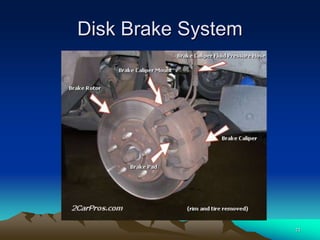
Disk Brake System
11
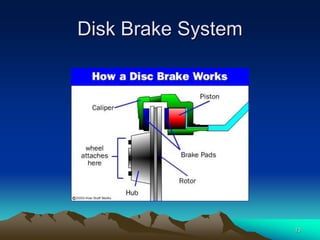
Two Types of Calipers
• Fixed Caliper
– Caliper attached
directly to the knuckle
• Floating Caliper
– Caliper “Floats” on
slide pins
12
Disk Brake System
13
Drum and Rotor Issues
• Metal to Metal Drums and Rotors
– Friction material completely worn out
– Usually requires replacement of component
• Out of Round Drum or Warped Rotor
– Drum and Rotor can be “Turned” true
• Hot Spots or cracking
– Component should be replaced and cause of
overheat diagnosed
16
Brake Issues
• Low, but hard brake pedal
– Worn brake shoe linings
– Misadjusted brake shoe linings
• Inspect and adjust
• Spongy brake pedal, may “pump” up
– Possible bent parts from accident
– Air in lines / calipers or wheel cylinders
• Bleed System
17
Brake Issues
• No or Low brake pedal - LOOK OUT!!! I’m
coming through…
– Hydraulic leak in system
– Bypassing master cylinder
– Low brake fluid
• Check fluid level
• Check for leaks
• Check master cylinder
18
Brake Issues
• Pulsating brake pedal
– Warped drums or rotors
• Machine rotors and drums
• Brake noise
– Linings worn down
– Loose parts
– Cheap brake linings
• Brake pull
– Mismatched pads
– Sticking caliper
– Alignment concerns
19

Disc brakes

  • 1.
  • 2.
    Brake System Design •The front brakes have 75-90% of the stopping power • Systems are split in 2 ways – Diagonal – Front/Rear 3
  • 3.
    Master Cylinder • Themaster Cylinder is bolted to the Brake Booster and is located on the bulkhead • Pressurizes brake fluid when service brake pedal is depressed • The reservoir holds the brake fluid 4
  • 4.
  • 5.
    Brake Fluid • Brakefluid comes in several types – DOT 3, 4, 5 – Most common today is Polyglycol DOT 3 and DOT 4 – Both collect water because their Hydroscopic – DOT 3 Min boil point 410 dry 284 wet – DOT 4 Min boil point 446 dry 311 wet – DOT 5 Min boil point 500 dry 356 wet • Silicone type should not be mixed with 3 or 4 NEVER MIX PETROLEUM BASED PRODUCTS WITH BRAKE SYSTEMS! Always add fluid from unopened container! 6
  • 6.
    Power Assist Units •Vacuum Booster most common • Some cars and trucks have HydroBoost brake boosters 7
  • 7.
    Vacuum Booster • TheVacuum Booster is supplied vacuum from the engine • A “Check Valve” keeps vacuum in booster when engine is off 8
  • 8.
  • 9.
    Two Types ofCalipers • Fixed Caliper – Caliper attached directly to the knuckle • Floating Caliper – Caliper “Floats” on slide pins 12
  • 10.
  • 11.
    Drum and RotorIssues • Metal to Metal Drums and Rotors – Friction material completely worn out – Usually requires replacement of component • Out of Round Drum or Warped Rotor – Drum and Rotor can be “Turned” true • Hot Spots or cracking – Component should be replaced and cause of overheat diagnosed 16
  • 12.
    Brake Issues • Low,but hard brake pedal – Worn brake shoe linings – Misadjusted brake shoe linings • Inspect and adjust • Spongy brake pedal, may “pump” up – Possible bent parts from accident – Air in lines / calipers or wheel cylinders • Bleed System 17
  • 13.
    Brake Issues • Noor Low brake pedal - LOOK OUT!!! I’m coming through… – Hydraulic leak in system – Bypassing master cylinder – Low brake fluid • Check fluid level • Check for leaks • Check master cylinder 18
  • 14.
    Brake Issues • Pulsatingbrake pedal – Warped drums or rotors • Machine rotors and drums • Brake noise – Linings worn down – Loose parts – Cheap brake linings • Brake pull – Mismatched pads – Sticking caliper – Alignment concerns 19