ABHISHEK KUMAR
13/ME/9024
MECHANICAL ENGINEERING
FUTURE INSTITUTE OF
ENGG. & MANAGEMENT
The technology of controlling pressurized fluids to create
force and motion is known as Hydraulics .
HYDRAULIC PRINCIPLES:
 Fluids cannot be compressed
 Fluids can transmit Movement
 Acts “Like a steel rod” in a closed container
 Master cylinder transmits fluid to wheel cylinder or
caliper piston bore.
 Fluids can transmit and increase force
PRESSURE =FORCE / AREA
Of course ,the final contact between vehicle and road made through tyres
hence it is of great importance in braking system.
Bald or defective tyres will even make the best brakes ineffective.
The braking systems which works with the help of hydraulic
principles is known as hydraulic braking systems.
HYRAULIC BRAKING SYSTEM CAN BE OPERATED BY
 Vacuum, Hydro or Motor assisted
 Disc System
 Drum System
 Dual System
DRUM BRAKE
MASTER
CYLINDER
DISK BRAKE
BRAKE PEDAL
HYDRAULIC PRESSURE IS DISTRIBUTED EQUALLY IN ALL DIRECTIONS
BY THE SAME PRINCIPLE ……….
SAME LINE OF PRESSURE WILL BE EXERTED ON ALL WHEELS
The Hydraulic pressure is the same, but the applied force can
be changed by the piston size.
The applied
pressure can be
raised or
lowered by
piston size
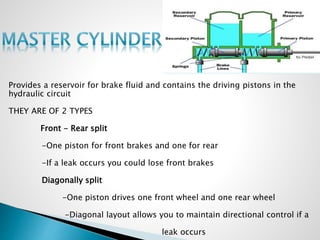
Provides a reservoir for brake fluid and contains the driving pistons in the
hydraulic circuit
THEY ARE OF 2 TYPES
Front - Rear split
-One piston for front brakes and one for rear
-If a leak occurs you could lose front brakes
Diagonally split
-One piston drives one front wheel and one rear wheel
-Diagonal layout allows you to maintain directional control if a
leak occurs
Expanding shoes create force on the inner surface of the drum
Used on the rear of some trucks and SUV’s
Self-energizing design requires less activation force
Require periodic adjustment
DISK BRAKES WORKS WITH THE HELP OF CALIPERS
FIXED CALIPERS
Calipers are disc brakes that use a caliper that is
fixed in position and does not slide.
They have pistons on both sides of the disc.
There may be 2 or 4 pistons per caliper
FLOATING CALIPERS
 Much more common
 Single Piston
 Easier to work with
 On “inboard” side of caliper
Calipers are of two types
Applies two pistons to opposite sides of rotor
Caliper stays stationary
Disc Brakes require higher hydraulic pressure
 Motorcycles and some import trucks and cars use
this type Similar to bicycle brakes.
 Applies pressure to two pads on opposite
sides of rotor
 Caliper
 Sliding
 Fixed
THIS CONDITION WILL OCCUR IF THERE IS MORE FRONT BRAKE TORQUE
THAN DYNAMIC FRONT WEIGHT
THIS CONDITION WILL OCCUR IF THERE IS MORE REAR TORQUE THAN
DYNAMIC REAR WEIGHT
Optimum braking is achieved when brake torque distribution matches
dynamic weight distribution
TO ACHIEVE THIS CONDITION PROPORTIONATING VALVES ARE USED
When a vehicle brakes , weight is transferred to the front. The nose will
dip as it gets heavier and rear will rise as it gets lighter. The rear needs less
hydraulic pressure.
 Proportionating valves are used to provide balanced braking
by reducing hydraulic pressure to rear wheel
 When a large variation at axle loading takes place, such as
railway wagons ,trucks ,load or height sensitive proportionating
valves regulate more hydraulic pressure to the rear axle in the
amount needed.
 Some vehicles with front/ rear split braking systems have a
proportionating valve by-pass which allows full pressure to
rear axle if front brakes fails.
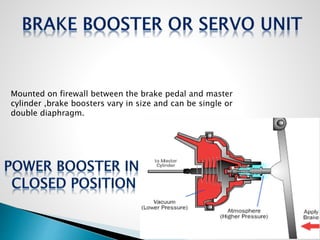
Mounted on firewall between the brake pedal and master
cylinder ,brake boosters vary in size and can be single or
double diaphragm.
Brake booster have two chambers :one at front which is always at
constant and another at the rear where pressure varies they are by a
pressure plate and are sealed from one another by a rubber diaphragm.
There is a vacuum in the manifold of all 4-stroke petrol engines .Boosters use
this increase the force applied to master cylinder from 3- 5 times without
loosing brake sensitivity or response and with reduced pedal effort.
On diesel engines, an auxiliary vacuum pump is utilized to supply vacuum.
If the engine stops this will retain enough vacuum in the booster for upto 3
brake applications.
Properties of Brake Fluid
 Does not thicken or then with changing heat
 Must not boil
 Must be compatible with brake parts material
 Must lubricate internal parts
 Must not evaporate easily
The fluid through which the energy is passed in hydraulic braking systems is
known as BRAKE FLUID.
Hydraulic & disc braking systems

Hydraulic & disc braking systems

  • 1.
  • 2.
    The technology ofcontrolling pressurized fluids to create force and motion is known as Hydraulics . HYDRAULIC PRINCIPLES:  Fluids cannot be compressed  Fluids can transmit Movement  Acts “Like a steel rod” in a closed container  Master cylinder transmits fluid to wheel cylinder or caliper piston bore.  Fluids can transmit and increase force PRESSURE =FORCE / AREA
  • 4.
    Of course ,thefinal contact between vehicle and road made through tyres hence it is of great importance in braking system. Bald or defective tyres will even make the best brakes ineffective. The braking systems which works with the help of hydraulic principles is known as hydraulic braking systems.
  • 5.
    HYRAULIC BRAKING SYSTEMCAN BE OPERATED BY  Vacuum, Hydro or Motor assisted  Disc System  Drum System  Dual System
  • 6.
  • 7.
    HYDRAULIC PRESSURE ISDISTRIBUTED EQUALLY IN ALL DIRECTIONS BY THE SAME PRINCIPLE ……….
  • 8.
    SAME LINE OFPRESSURE WILL BE EXERTED ON ALL WHEELS
  • 9.
    The Hydraulic pressureis the same, but the applied force can be changed by the piston size.
  • 10.
    The applied pressure canbe raised or lowered by piston size
  • 11.
    Provides a reservoirfor brake fluid and contains the driving pistons in the hydraulic circuit THEY ARE OF 2 TYPES Front - Rear split -One piston for front brakes and one for rear -If a leak occurs you could lose front brakes Diagonally split -One piston drives one front wheel and one rear wheel -Diagonal layout allows you to maintain directional control if a leak occurs
  • 12.
    Expanding shoes createforce on the inner surface of the drum Used on the rear of some trucks and SUV’s Self-energizing design requires less activation force Require periodic adjustment
  • 14.
    DISK BRAKES WORKSWITH THE HELP OF CALIPERS
  • 15.
    FIXED CALIPERS Calipers aredisc brakes that use a caliper that is fixed in position and does not slide. They have pistons on both sides of the disc. There may be 2 or 4 pistons per caliper FLOATING CALIPERS  Much more common  Single Piston  Easier to work with  On “inboard” side of caliper Calipers are of two types
  • 16.
    Applies two pistonsto opposite sides of rotor Caliper stays stationary Disc Brakes require higher hydraulic pressure  Motorcycles and some import trucks and cars use this type Similar to bicycle brakes.
  • 17.
     Applies pressureto two pads on opposite sides of rotor  Caliper  Sliding  Fixed
  • 19.
    THIS CONDITION WILLOCCUR IF THERE IS MORE FRONT BRAKE TORQUE THAN DYNAMIC FRONT WEIGHT THIS CONDITION WILL OCCUR IF THERE IS MORE REAR TORQUE THAN DYNAMIC REAR WEIGHT
  • 20.
    Optimum braking isachieved when brake torque distribution matches dynamic weight distribution TO ACHIEVE THIS CONDITION PROPORTIONATING VALVES ARE USED When a vehicle brakes , weight is transferred to the front. The nose will dip as it gets heavier and rear will rise as it gets lighter. The rear needs less hydraulic pressure.  Proportionating valves are used to provide balanced braking by reducing hydraulic pressure to rear wheel
  • 21.
     When alarge variation at axle loading takes place, such as railway wagons ,trucks ,load or height sensitive proportionating valves regulate more hydraulic pressure to the rear axle in the amount needed.  Some vehicles with front/ rear split braking systems have a proportionating valve by-pass which allows full pressure to rear axle if front brakes fails.
  • 23.
    Mounted on firewallbetween the brake pedal and master cylinder ,brake boosters vary in size and can be single or double diaphragm.
  • 24.
    Brake booster havetwo chambers :one at front which is always at constant and another at the rear where pressure varies they are by a pressure plate and are sealed from one another by a rubber diaphragm. There is a vacuum in the manifold of all 4-stroke petrol engines .Boosters use this increase the force applied to master cylinder from 3- 5 times without loosing brake sensitivity or response and with reduced pedal effort. On diesel engines, an auxiliary vacuum pump is utilized to supply vacuum. If the engine stops this will retain enough vacuum in the booster for upto 3 brake applications.
  • 26.
    Properties of BrakeFluid  Does not thicken or then with changing heat  Must not boil  Must be compatible with brake parts material  Must lubricate internal parts  Must not evaporate easily The fluid through which the energy is passed in hydraulic braking systems is known as BRAKE FLUID.