A Presentation on
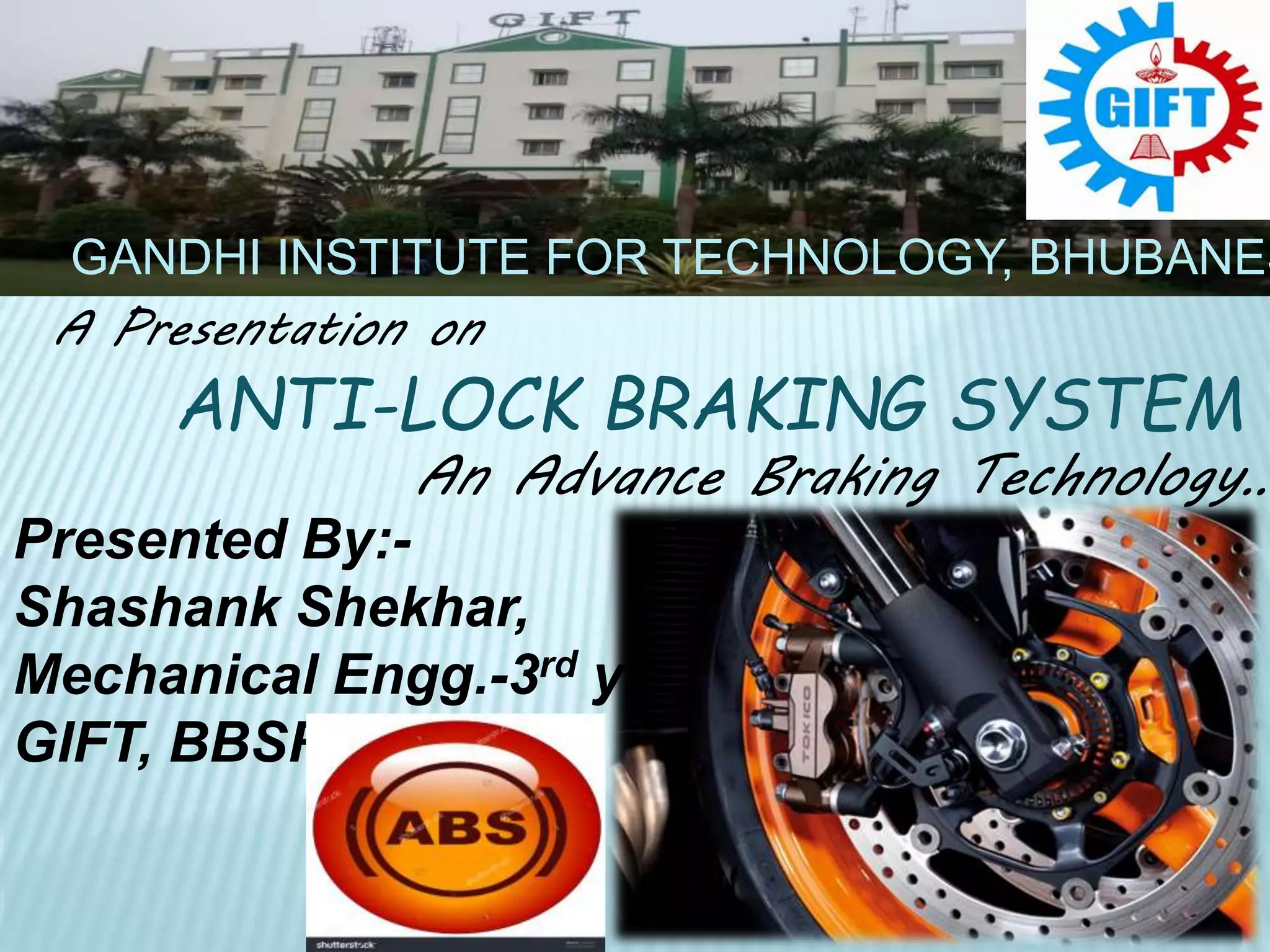
ANTI-LOCK BRAKING SYSTEM
An Advance Braking Technology…
Presented By:-
Shashank Shekhar,
Mechanical Engg.-3rd yr,
GIFT, BBSR.
GANDHI INSTITUTE FOR TECHNOLOGY, BHUBANES
INTRODUCTION TO ABS
Antilock braking systems (ABSs) are electronic
systems that monitor and control wheel slip
during vehicle braking.
ABSs can improve vehicle control during braking,
and reduce stopping distances on slippery road
surfaces by limiting wheel slip and minimizing
lockup.
Reducing wheel slip improves vehicle stability and
control during braking, since stability increases as
wheel slip decreases.
HISTORY OF ABS…
 ABS was first developed for AirCrafts in1929 by
French Automobile & Aircraft Pioneer Gabriel
Voisin.
 The German Companies BOSCH & Mercedes-Benz
pioneered the first electronic version for use on
Mercedes-Benz Cars in1936.
 In 1960 A fully mechanical system used in the
Ferguson P99 racing car, the Jensen FF and the
Ford Zodiac, but saw no further use; the system
proved expensive and, in automobile use,
somewhat unreliable.
 In 1975 Ford also introduced ABS on the Lincoln
Continental Mark III and the Ford LTD station
wagon, called “Sure Trak”.
HISTORY OF ABS Contd…
 In 1978 Bosch And Mercedes-Benz Introduced
the first completely Electronic 4-Wheel Multi-
Channel ABS system in trucks and the Mercedes-
Benz S-Class.
 In 1988 BMW became the world's first
motorcycle manufacturer to introduce an
electronic/hydraulic ABS system, this on
their BMW K100.
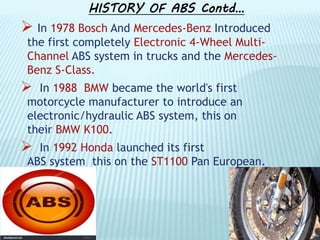
 In 1992 Honda launched its first
ABS system this on the ST1100 Pan European.
Comparison…
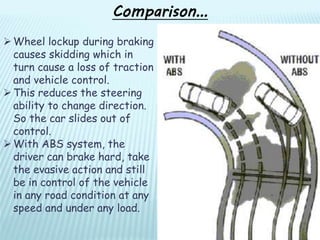
Wheel lockup during braking
causes skidding which in
turn cause a loss of traction
and vehicle control.
This reduces the steering
ability to change direction.
So the car slides out of
control.
With ABS system, the
driver can brake hard, take
the evasive action and still
be in control of the vehicle
in any road condition at any
speed and under any load.
WORKING PRINCIPLE OF ABS
 system consists of a central (ECU) Electronic
Control Unit and four wheel speed sensors
connected to each wheel and two hydraulic valves.
 There is a valve in the brake line of
each brake controlled by the ABS.the valve has
three positions:
1st- The valve is open; pressure from
the master cylinder is passed right through to the
brake.
2nd- The valve blocks the line, isolating that
brake from the master cylinder.
III. In position three, the valve releases some
of the pressure from the brake.
 When the ECU finds that any wheel is turning
faster than the other wheel, automatically brake
hydraulic pressure to the affected wheel is
increased by the ABS system so that braking
force is reapplied and the wheel slows down.
 This complete process performed by the ABS
is repeated continuously throughout the drive on
mostly uneven roads and can be easily detected
by the driver of the car with the help of brake
pedal pulsation.
WORKING PRINCIPLE OF ABS Contd…
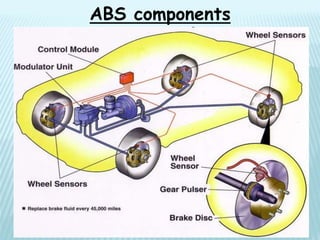
ABS components
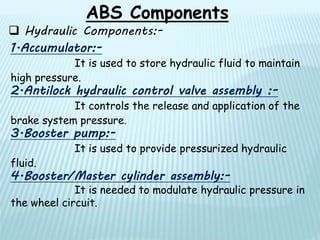
ABS Components
 Hydraulic Components:-
1.Accumulator:-
It is used to store hydraulic fluid to maintain
high pressure.
2.Antilock hydraulic control valve assembly :-
It controls the release and application of the
brake system pressure.
3.Booster pump:-
It is used to provide pressurized hydraulic
fluid.
4.Booster/Master cylinder assembly:-
It is needed to modulate hydraulic pressure in
the wheel circuit.
5.Fluid accumulator:-
It temporarily stores brake fluid that is
removed from the wheel brake.
6.Main Valve:-
This is a two position valve and is open only in
the ABS mode.
7.Modulator unit:-
It controls the flow of pressurized brake fluid
to the individual wheel circuits.
8.Solenoid valves:-
It is located in the modulator unit and are
electrically operated by signals from the control module.
Electrical / Electronic components
1.ABS control module:-
It monitors system operation and controls antilock function
when needed.
2.Brake pedal sensor:-
Its function is to switch on the brake lights to alert other
vehicles that the car is slowing down and/or is going to
stop.
3.Wheel speed sensor:-
These are generally used for sensing the wheel speed.
Types Of Anti-Lock Braking System
 Four channel, four sensor ABS:- This is the best
scheme, there is speed sensor and a separate valve for
all the four wheels.
 Three channel, three sensor ABS:- This scheme is
commonly found on pick up trucks with four wheels ABS,
has a speed sensor and a valve for each of the front
wheels, with one for both rear wheels.
 One channel, one sensor ABS:- it has one valve ,which
controls both rear wheels , and one speed sensor,
located in the rear axle.
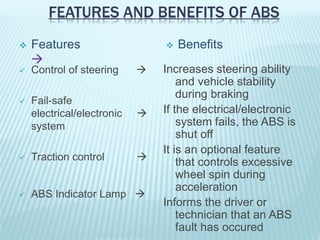
FEATURES AND BENEFITS OF ABS
 Features

 Benefits
 Control of steering 
 Fail-safe
electrical/electronic 
system
 Traction control 
 ABS Indicator Lamp 
Increases steering ability
and vehicle stability
during braking
If the electrical/electronic
system fails, the ABS is
shut off
It is an optional feature
that controls excessive
wheel spin during
acceleration
Informs the driver or
technician that an ABS
fault has occured
 ADVANTAGES…
 It allows the driver to maintain directional
stability and control over steering during braking.
 Safe and effective.
 Automatically changes the brake fluid pressure at
each wheel to maintain optimum brake
performance.
 ABS absorbs the unwanted turbulence shock
waves and modulates the pulses thus permitting
the wheel to continue turning.
 DISADVANTAGES…
 It is very costly.
 Maintenance cost of a car equipped with ABS is
more.
CONCLUSION
Statistics show that approximately 40 % of
automobile accidents are due to skidding.
These problems commonly occur on vehicle with
conventional brake system which can be avoided
by adding devices called ABS.
If there is an ABS failure, the system will
revert to normal brake operation. Normally the
ABS warning light will turn on and let the driver
know there is a fault.
REFERENCES…
1. www.Google.com
2.www.Images.google.com
3.www.Wikipedia.org
4.Antilock Brakes, Traction, and Stability
Control.(chapter 59) Delmar cengage learning,
2012.
5.www.Slideshare.net
6.www.autorepair.about.com/od/glossary/a/def_
ABS.htm
QUESTIONS??
Antilock Braking System

Antilock Braking System

  • 1.
    A Presentation on ANTI-LOCKBRAKING SYSTEM An Advance Braking Technology… Presented By:- Shashank Shekhar, Mechanical Engg.-3rd yr, GIFT, BBSR. GANDHI INSTITUTE FOR TECHNOLOGY, BHUBANES
  • 2.
    INTRODUCTION TO ABS Antilockbraking systems (ABSs) are electronic systems that monitor and control wheel slip during vehicle braking. ABSs can improve vehicle control during braking, and reduce stopping distances on slippery road surfaces by limiting wheel slip and minimizing lockup. Reducing wheel slip improves vehicle stability and control during braking, since stability increases as wheel slip decreases.
  • 3.
    HISTORY OF ABS… ABS was first developed for AirCrafts in1929 by French Automobile & Aircraft Pioneer Gabriel Voisin.  The German Companies BOSCH & Mercedes-Benz pioneered the first electronic version for use on Mercedes-Benz Cars in1936.  In 1960 A fully mechanical system used in the Ferguson P99 racing car, the Jensen FF and the Ford Zodiac, but saw no further use; the system proved expensive and, in automobile use, somewhat unreliable.  In 1975 Ford also introduced ABS on the Lincoln Continental Mark III and the Ford LTD station wagon, called “Sure Trak”.
  • 4.
    HISTORY OF ABSContd…  In 1978 Bosch And Mercedes-Benz Introduced the first completely Electronic 4-Wheel Multi- Channel ABS system in trucks and the Mercedes- Benz S-Class.  In 1988 BMW became the world's first motorcycle manufacturer to introduce an electronic/hydraulic ABS system, this on their BMW K100.  In 1992 Honda launched its first ABS system this on the ST1100 Pan European.
  • 5.
    Comparison… Wheel lockup duringbraking causes skidding which in turn cause a loss of traction and vehicle control. This reduces the steering ability to change direction. So the car slides out of control. With ABS system, the driver can brake hard, take the evasive action and still be in control of the vehicle in any road condition at any speed and under any load.
  • 6.
    WORKING PRINCIPLE OFABS  system consists of a central (ECU) Electronic Control Unit and four wheel speed sensors connected to each wheel and two hydraulic valves.  There is a valve in the brake line of each brake controlled by the ABS.the valve has three positions: 1st- The valve is open; pressure from the master cylinder is passed right through to the brake. 2nd- The valve blocks the line, isolating that brake from the master cylinder.
  • 7.
    III. In positionthree, the valve releases some of the pressure from the brake.  When the ECU finds that any wheel is turning faster than the other wheel, automatically brake hydraulic pressure to the affected wheel is increased by the ABS system so that braking force is reapplied and the wheel slows down.  This complete process performed by the ABS is repeated continuously throughout the drive on mostly uneven roads and can be easily detected by the driver of the car with the help of brake pedal pulsation. WORKING PRINCIPLE OF ABS Contd…
  • 8.
  • 9.
    ABS Components  HydraulicComponents:- 1.Accumulator:- It is used to store hydraulic fluid to maintain high pressure. 2.Antilock hydraulic control valve assembly :- It controls the release and application of the brake system pressure. 3.Booster pump:- It is used to provide pressurized hydraulic fluid. 4.Booster/Master cylinder assembly:- It is needed to modulate hydraulic pressure in the wheel circuit.
  • 10.
    5.Fluid accumulator:- It temporarilystores brake fluid that is removed from the wheel brake. 6.Main Valve:- This is a two position valve and is open only in the ABS mode. 7.Modulator unit:- It controls the flow of pressurized brake fluid to the individual wheel circuits. 8.Solenoid valves:- It is located in the modulator unit and are electrically operated by signals from the control module.
  • 11.
    Electrical / Electroniccomponents 1.ABS control module:- It monitors system operation and controls antilock function when needed. 2.Brake pedal sensor:- Its function is to switch on the brake lights to alert other vehicles that the car is slowing down and/or is going to stop. 3.Wheel speed sensor:- These are generally used for sensing the wheel speed.
  • 12.
    Types Of Anti-LockBraking System  Four channel, four sensor ABS:- This is the best scheme, there is speed sensor and a separate valve for all the four wheels.  Three channel, three sensor ABS:- This scheme is commonly found on pick up trucks with four wheels ABS, has a speed sensor and a valve for each of the front wheels, with one for both rear wheels.  One channel, one sensor ABS:- it has one valve ,which controls both rear wheels , and one speed sensor, located in the rear axle.
  • 13.
    FEATURES AND BENEFITSOF ABS  Features   Benefits  Control of steering   Fail-safe electrical/electronic  system  Traction control   ABS Indicator Lamp  Increases steering ability and vehicle stability during braking If the electrical/electronic system fails, the ABS is shut off It is an optional feature that controls excessive wheel spin during acceleration Informs the driver or technician that an ABS fault has occured
  • 14.
     ADVANTAGES…  Itallows the driver to maintain directional stability and control over steering during braking.  Safe and effective.  Automatically changes the brake fluid pressure at each wheel to maintain optimum brake performance.  ABS absorbs the unwanted turbulence shock waves and modulates the pulses thus permitting the wheel to continue turning.  DISADVANTAGES…  It is very costly.  Maintenance cost of a car equipped with ABS is more.
  • 15.
    CONCLUSION Statistics show thatapproximately 40 % of automobile accidents are due to skidding. These problems commonly occur on vehicle with conventional brake system which can be avoided by adding devices called ABS. If there is an ABS failure, the system will revert to normal brake operation. Normally the ABS warning light will turn on and let the driver know there is a fault.
  • 16.
    REFERENCES… 1. www.Google.com 2.www.Images.google.com 3.www.Wikipedia.org 4.Antilock Brakes,Traction, and Stability Control.(chapter 59) Delmar cengage learning, 2012. 5.www.Slideshare.net 6.www.autorepair.about.com/od/glossary/a/def_ ABS.htm
  • 17.