PRESENTATION ON
REAR AXLE DRIVE
      AND
REAR AXLE SHAFTS
TO : UDAY RAJ SIR
 BY
       NAWAL KISHORE BABUL   100109034


       NEELESH MAHESHWARI    100109035


       PRAYAS NAVAL          100109040
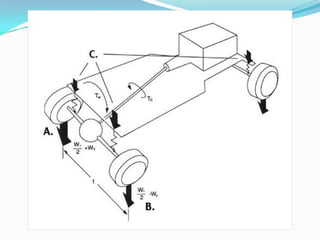
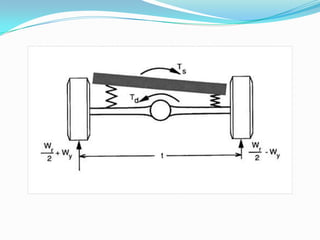
Forces on rear axle
 Wt. of the body
 Driving trust
 Torque reaction
 Side thrust
Automakers have developed a number of common methods of
locating a live axle


 First approach
                uses four trailing arms, two above the
  axle, two below it, angled inward so that they resist
  lateral motion of the axle.
 Another approach,
 used by Buick in the 1960 .
 uses two lower control arms and a single upper arm,
  mounted next to the differential, with a lateral track bar
  (a Panhard rod) or parallelogram linkage (Watts linkage) to
  limit lateral motion. Both the three-link and four-link
  layouts are reasonably effective, but the control arms and
  track bars make the rear suspension more complex, and
  thus more expensive to build .
THIRD
OPTION IS
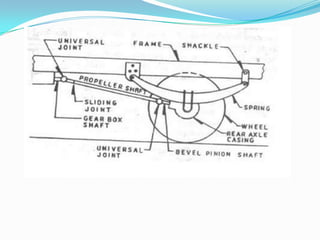
 The Hotchkiss drive is a system of power
  transmission .
 It was the dominant form of power transmission
  for front-engine, rear-wheel drive layout cars in the
  20th century
 Simplest and most widely used type of rear axle drive .
 The spring besides taking weight of the body also take the
  torque reaction , driving thrust and side thrust .
 propellar shaft is provied with two universal joints also a
  sliding joint .
 The front end of the spring is fixed rigidly on the frame
  while the rear end and is supported in the shackle .
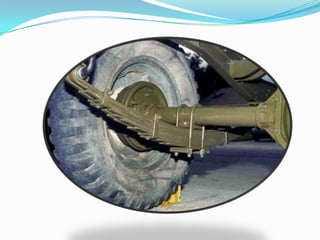
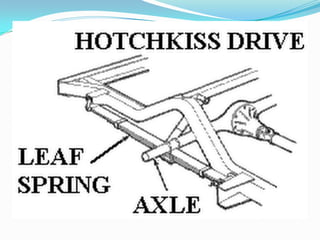
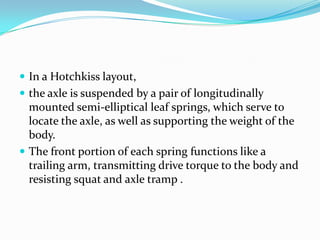
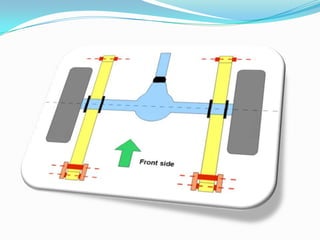
 In a Hotchkiss layout,
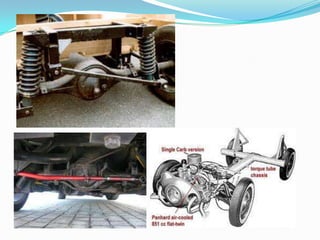
 the axle is suspended by a pair of longitudinally
  mounted semi-elliptical leaf springs, which serve to
  locate the axle, as well as supporting the weight of the
  body.
 The front portion of each spring functions like a
  trailing arm, transmitting drive torque to the body and
  resisting squat and axle tramp .
 The rear portion of the spring acts as a leading arm,
  resisting wheel hop under braking.
 The stiffness of the springs also serves to resist lateral
  motions. By making the springs perform multiple
  duties, Hotchkiss drive is very simple, and thus very
  cheap.
 Since it has few parts, it's also very sturdy, which is
  useful for heavy-duty vehicles like trucks.
The HOTCHKISS drive requires that the springs be rigid
enough to withstand the twisting action (torque) of the
rear axle and the driving and braking forces that the
springs transmit to the frame. This type of drive is
common to the equipment you will encounter in the
Navy .
 The differentiating characteristic of the Hotchkiss
  drive is the fact that it uses universal
  joints at both ends of the driveshaft, which is not
  enclosed .
 The use of two universal joints, properly phased and
  with parallel alignment of the drive and driven shafts,
  allows the use of simple cross-type universals .
 Used in pick-up trucks and sport utility vehicles .
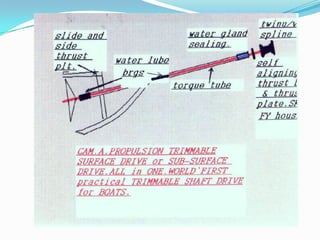
 The design problem that the torque tube solves is how
  to get the traction forces generated by the wheels to
  the car frame .
 The "torque tube" transmits this force by directly
  coupling the axle differential to the transmission and
  therefore propels the car forward by pushing on the
  engine and then through the engine mounts to the car
  frame .
 In contrast, the Hotchkiss drive has the traction forces
  transmitted to the car frame by using other suspension
  components such as leaf springs or trailing arms .
 A ball and socket type of joint called a "torque ball" is
  used at one end of the torque tube to allow relative
  motion between the axle and transmission due to
  suspension travel
 Since the torque tube does not constrain the axle in
  the lateral (side-to-side) direction a panhard rod is
  often used for this purpose.
 The combination of the panhard rod and the torque
  tube allows the easy implementation of soft coil
  springs in the rear to give good ride quality .
Torque tubes differ from the Hotchkiss design in
that                   a                     solid
drive shaft is enclosed in a hollow torque tub
e and rotates within a support bearing to prevent
whipping
 In both types of drive shafts the side thrust is taken the
  leaf springs .
 A separate member is employed to overcome this
  situation : Panhard Rod
 it si fixed parallel to wheel axis with one end pivoted to
  the axle and other to chassis frame
EXAMPLES OF THE TORQUE
TUBE
 American cars of the Ford brand up through 1948,
  which used the less expensive transverse springs that
  could not take the thrust.
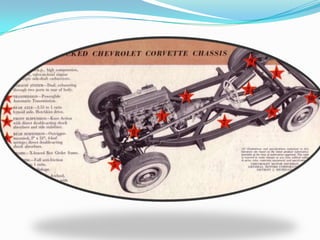
 The C5 and C6 Chevrolet Corvette , Mercedes-Benz
  SLS AMG
Loads on rear axle shafts
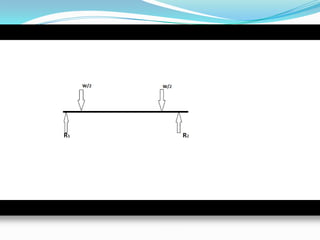
 Shearing force due to wt. of vehicle .
 Bending moment on account of load applied through
  spring seats .
 End thrust caused by side forces on account of
  cornering , side wind
 Bending moment by end thrust and its reation offered
  by tyres on ground
 Driving torque
Types of rear axle shaft
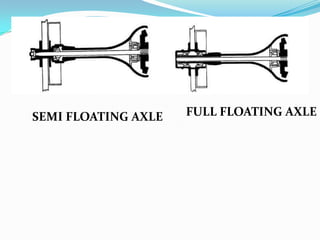
 Semi floating axle .
 Full floating axle .
 Three quarter floating type.
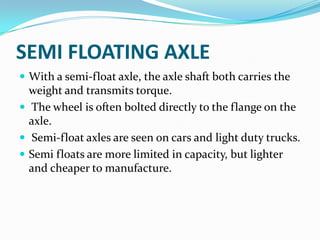
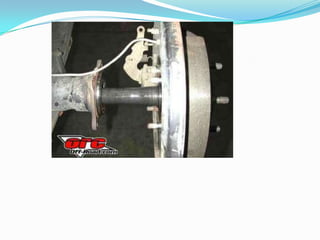
SEMI FLOATING AXLE
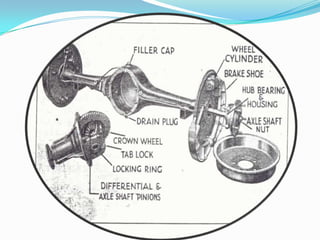
 With a semi-float axle, the axle shaft both carries the
  weight and transmits torque.
 The wheel is often bolted directly to the flange on the
  axle.
 Semi-float axles are seen on cars and light duty trucks.
 Semi floats are more limited in capacity, but lighter
  and cheaper to manufacture.
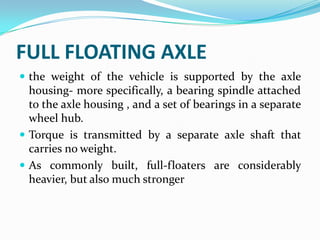
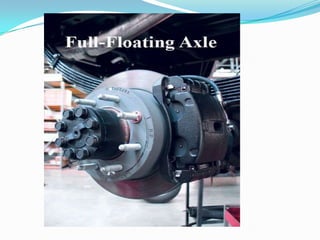
FULL FLOATING AXLE
 the weight of the vehicle is supported by the axle
  housing- more specifically, a bearing spindle attached
  to the axle housing , and a set of bearings in a separate
  wheel hub.
 Torque is transmitted by a separate axle shaft that
  carries no weight.
 As commonly built, full-floaters are considerably
  heavier, but also much stronger
SEMI FLOATING AXLE   FULL FLOATING AXLE
THREE QUARTER FLOATING
TYPE
THREE QUARTER FLOATING
TYPE
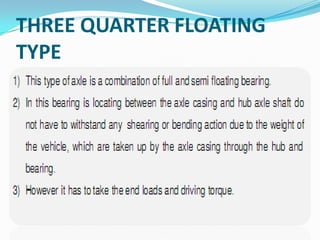
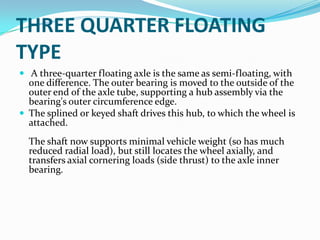
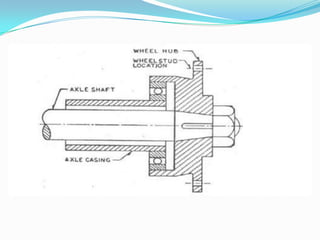
 A three-quarter floating axle is the same as semi-floating, with
  one difference. The outer bearing is moved to the outside of the
  outer end of the axle tube, supporting a hub assembly via the
  bearing's outer circumference edge.
 The splined or keyed shaft drives this hub, to which the wheel is
  attached.
  The shaft now supports minimal vehicle weight (so has much
  reduced radial load), but still locates the wheel axially, and
  transfers axial cornering loads (side thrust) to the axle inner
  bearing.
rear axle  ppt

rear axle ppt

  • 1.
    PRESENTATION ON REAR AXLEDRIVE AND REAR AXLE SHAFTS
  • 2.
    TO : UDAYRAJ SIR  BY NAWAL KISHORE BABUL 100109034 NEELESH MAHESHWARI 100109035 PRAYAS NAVAL 100109040
  • 4.
    Forces on rearaxle  Wt. of the body  Driving trust  Torque reaction  Side thrust
  • 11.
    Automakers have developeda number of common methods of locating a live axle  First approach uses four trailing arms, two above the axle, two below it, angled inward so that they resist lateral motion of the axle.
  • 12.
     Another approach, used by Buick in the 1960 .  uses two lower control arms and a single upper arm, mounted next to the differential, with a lateral track bar (a Panhard rod) or parallelogram linkage (Watts linkage) to limit lateral motion. Both the three-link and four-link layouts are reasonably effective, but the control arms and track bars make the rear suspension more complex, and thus more expensive to build .
  • 13.
  • 14.
     The Hotchkissdrive is a system of power transmission .  It was the dominant form of power transmission for front-engine, rear-wheel drive layout cars in the 20th century
  • 17.
     Simplest andmost widely used type of rear axle drive .  The spring besides taking weight of the body also take the torque reaction , driving thrust and side thrust .  propellar shaft is provied with two universal joints also a sliding joint .  The front end of the spring is fixed rigidly on the frame while the rear end and is supported in the shackle .
  • 19.
     In aHotchkiss layout,  the axle is suspended by a pair of longitudinally mounted semi-elliptical leaf springs, which serve to locate the axle, as well as supporting the weight of the body.  The front portion of each spring functions like a trailing arm, transmitting drive torque to the body and resisting squat and axle tramp .
  • 22.
     The rearportion of the spring acts as a leading arm, resisting wheel hop under braking.  The stiffness of the springs also serves to resist lateral motions. By making the springs perform multiple duties, Hotchkiss drive is very simple, and thus very cheap.  Since it has few parts, it's also very sturdy, which is useful for heavy-duty vehicles like trucks.
  • 24.
    The HOTCHKISS driverequires that the springs be rigid enough to withstand the twisting action (torque) of the rear axle and the driving and braking forces that the springs transmit to the frame. This type of drive is common to the equipment you will encounter in the Navy .
  • 25.
     The differentiatingcharacteristic of the Hotchkiss drive is the fact that it uses universal joints at both ends of the driveshaft, which is not enclosed .  The use of two universal joints, properly phased and with parallel alignment of the drive and driven shafts, allows the use of simple cross-type universals .
  • 26.
     Used inpick-up trucks and sport utility vehicles .
  • 28.
     The designproblem that the torque tube solves is how to get the traction forces generated by the wheels to the car frame .  The "torque tube" transmits this force by directly coupling the axle differential to the transmission and therefore propels the car forward by pushing on the engine and then through the engine mounts to the car frame .
  • 29.
     In contrast,the Hotchkiss drive has the traction forces transmitted to the car frame by using other suspension components such as leaf springs or trailing arms .  A ball and socket type of joint called a "torque ball" is used at one end of the torque tube to allow relative motion between the axle and transmission due to suspension travel
  • 30.
     Since thetorque tube does not constrain the axle in the lateral (side-to-side) direction a panhard rod is often used for this purpose.  The combination of the panhard rod and the torque tube allows the easy implementation of soft coil springs in the rear to give good ride quality .
  • 31.
    Torque tubes differfrom the Hotchkiss design in that a solid drive shaft is enclosed in a hollow torque tub e and rotates within a support bearing to prevent whipping
  • 33.
     In bothtypes of drive shafts the side thrust is taken the leaf springs .  A separate member is employed to overcome this situation : Panhard Rod  it si fixed parallel to wheel axis with one end pivoted to the axle and other to chassis frame
  • 36.
    EXAMPLES OF THETORQUE TUBE  American cars of the Ford brand up through 1948, which used the less expensive transverse springs that could not take the thrust.  The C5 and C6 Chevrolet Corvette , Mercedes-Benz SLS AMG
  • 38.
    Loads on rearaxle shafts  Shearing force due to wt. of vehicle .  Bending moment on account of load applied through spring seats .  End thrust caused by side forces on account of cornering , side wind  Bending moment by end thrust and its reation offered by tyres on ground  Driving torque
  • 39.
    Types of rearaxle shaft  Semi floating axle .  Full floating axle .  Three quarter floating type.
  • 40.
    SEMI FLOATING AXLE With a semi-float axle, the axle shaft both carries the weight and transmits torque.  The wheel is often bolted directly to the flange on the axle.  Semi-float axles are seen on cars and light duty trucks.  Semi floats are more limited in capacity, but lighter and cheaper to manufacture.
  • 42.
    FULL FLOATING AXLE the weight of the vehicle is supported by the axle housing- more specifically, a bearing spindle attached to the axle housing , and a set of bearings in a separate wheel hub.  Torque is transmitted by a separate axle shaft that carries no weight.  As commonly built, full-floaters are considerably heavier, but also much stronger
  • 44.
    SEMI FLOATING AXLE FULL FLOATING AXLE
  • 45.
  • 46.
    THREE QUARTER FLOATING TYPE A three-quarter floating axle is the same as semi-floating, with one difference. The outer bearing is moved to the outside of the outer end of the axle tube, supporting a hub assembly via the bearing's outer circumference edge.  The splined or keyed shaft drives this hub, to which the wheel is attached. The shaft now supports minimal vehicle weight (so has much reduced radial load), but still locates the wheel axially, and transfers axial cornering loads (side thrust) to the axle inner bearing.

Editor's Notes

  • #9 A full system view of the torque reaction between rear axle and the chassis reveals how weight on the drive tires transfers from one side to the other. With the driveshaft spinning counter clockwise, it puts a torque on the rear axle in the same direction. This has the effect of increasing the weight on the left-side drive tire (A.) as it reduces weight on the right-side drive tire (B.) even though the chassis surges to the right (C.) compressing the springs.Read more: http://www.hotrod.com/techarticles/chassis/chassis_tuning_tire_traction/photo_03.html#ixzz2BY8Y7ht3
  • #10 This diagram illustrates the torque reaction of a vehicle with a solid axle rear suspension. The torque from the driveshaft imparts a torque to the rear axle in the same direction as the driveshaft is spinning. The chassis twists the other way as a reaction to the torque from the driveshaft and axle because the engine and transmission are fixed to the chassis.