Brakes
Types Parking Brake Service Brake Hydraulic Disc Brakes Drum Brakes Dual System Antilock Brake System (ABS)
Play Principles of Braking
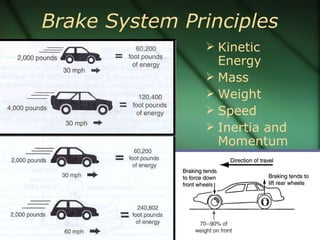
Brake System Principles Kinetic Energy Mass Weight Speed Inertia and Momentum
Coefficient of Friction Video
Parking Brake Not an “Emergency” Brake Used specifically to keep a parked vehicle from moving Usually on rear wheels only Mechanically operated Static Friction: at rest friction- More friction Kinetic Friction: in motion friction- less friction
Typical Parking Brake
Play Parking Break Video
Play Parking Brake Adjustment Video
Service Brakes Primary Braking System Should be stronger than the engine Hydraulic Operated Can be Vacuum, Hydro or Motor assisted Disc System Drum System Dual System
Typical System
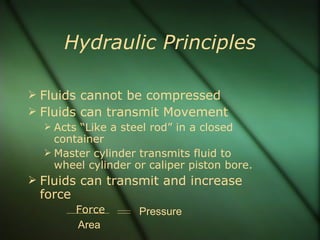
Hydraulic Principles Fluids cannot be compressed Fluids can transmit Movement Acts “Like a steel rod” in a closed container Master cylinder transmits fluid to wheel cylinder or caliper piston bore. Fluids can transmit and increase force Force Area Pressure
Hydraulics Simplified Hydraulic Brake System Drum Brake Master Cylinder Disk Brake
Hydraulic pressure is distributed equally in all directions
Same line pressure to all wheels
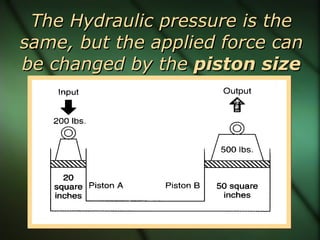
The Hydraulic pressure is the same, but the applied force can be changed by the  piston size
 
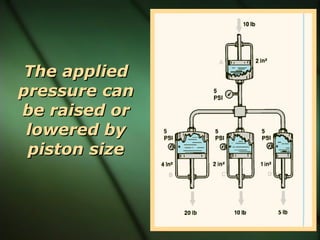
The applied pressure can be raised or lowered by piston size
Play Hydraulic Pressure Video
Brake Pedal Design Advantage by Leverage First Mechanical Advantage is Driver’s foot Length of Lever determines force applied  Uses Fulcrum Pedal Ratio 10 2 5:1 2.5 inches 5 0.5 inch
Play Break Pedal  Leverage Video
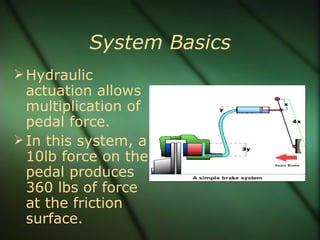
System Basics Hydraulic actuation allows multiplication of pedal force. In this system, a 10lb force on the pedal produces 360 lbs of force at the friction surface.
Play Break Lines & Hose Video
Brake Fluid Properties of Brake Fluid Does not thicken or then with changing heat Must not boil Must be compatible with brake parts material Must lubricate internal parts Must not evaporate easily
Brake Fluid types DOT 3 and 4-  Polyglycol based Most common Compatible with one another Inexpensive Destroys paint Ruined by moister DOT 5-   Silicone Based Used only for heavy  duty applications Not Compatible with  4&5 Very Expensive Does not damage  paint DOT= Department of Transportation High #= High stands, quality and boiling point
Fluid Contaminates Moister- Lowers boiling point water boils @ 212*F DOT 3 boils @ 401*F  Petroleum Based Product-  soften rubber parts causing swelling Dirt & Debris-  causes corrosion and clogs Air and Vapors- Compressible prevents pressure from reaching brakes
Play Break Fluid Video
Master Cylinder Provides a reservoir for brake fluid and contains the driving pistons in the hydraulic circuit 2 Types Front - Rear split   -One piston for front brakes and one for rear -If a leak occurs you could lose front brakes Diagonally split   -One piston drives one front wheel and one rear wheel -Diagonal layout allows you to maintain directional control if a leak occurs
Play Tandem Master Cylinder Video
Play Divide System Video
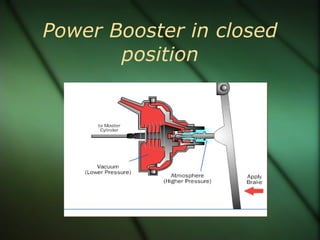
Power Booster in closed position
Play Power Booster Video
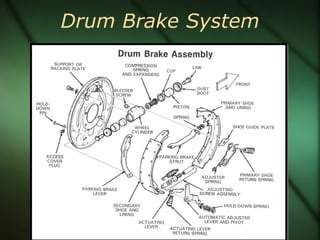
Drum Brakes Expanding shoes create force on the inner surface of the drum Used on the rear of some trucks and SUV’s Self-energizing design requires less activation force Require periodic adjustment
Drum Brake System
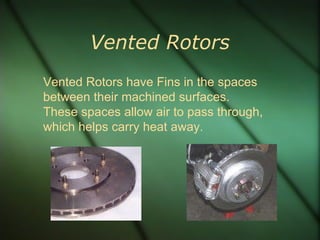
Vented Rotors Vented Rotors have Fins in the spaces between their machined surfaces.  These spaces allow air to pass through, which helps carry heat away.
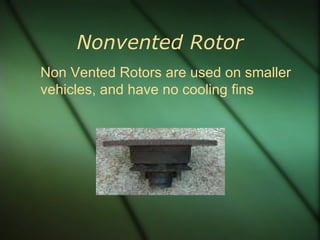
Nonvented Rotor Non Vented Rotors are used on smaller vehicles, and have no cooling fins
Play Brake Disc Video
Disc Brake Caliper Assembly
Caliper Types There are 2 types of Calipers Fixed   Calipers are disc brakes that use a caliper that is FIXED in position and does not slide.  They have pistons on both sides of the disc.  There may be 2 or 4 pistons per caliper Floating   Much more common Single Piston Easier to work with On “inboard” side of caliper
Fixed Caliper Motorcycles and some import trucks and cars use this type Similar to bicycle brakes
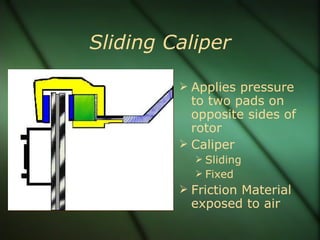
Sliding Caliper Applies pressure to two pads on opposite sides of rotor Caliper Sliding  Fixed Friction Material exposed to air
Fixed Caliper Applies two pistons to opposite sides of rotor Caliper stays stationary Disc Brakes require higher hydraulic pressure
Play Disc Brake Calipers Video
Diagnosis Several different types of Complaints Noise Pulsation Pedal travel More later…
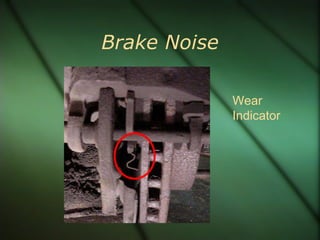
Brake Noise Wear Indicator
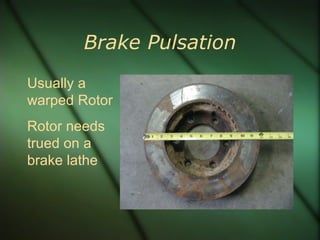
Brake Pulsation Usually a warped Rotor Rotor needs trued on a brake lathe
Pedal  Travel NO BRAKES!!!! Excessive pedal travel Pedal feels soft and squishy Requires excessive effort to  stop vehicle or my cause  brakes to not function at  all
Play Drum Brake Inspection Video
Play Disc Brake  Inspection Video
Anti-Lock Brakes A locked (sliding) wheel offers less braking force than a decelerating rolling wheel The locked wheel also produces little lateral force, preventing steering control Anti-Lock systems (ABS) monitor wheel lock-up and modulate brake pressure to provide controlled braking under most circumstances
Play ABS Principles Video
Anti-Lock Brakes System can have 2, 3 or 4 channels Trucks typically use 3 channel with only one sensor for the rear axle Most modern cars use 4 channel system Wheel speed sensors monitor each wheel speed ABS controller and high-pressure pump increase or reduce pressure to wheels in order to maintain consistent wheel speeds
Play ABS video
Play Drum, Disc, & ABS Video
Other Braking Systems Air Brakes Exhaust Brakes Electric or Trailer Brake
Play Disc Brake Replacement Video
Play Replacing  The Rotor Video
Play Drum Brake Replacement Video

Brakes

  • 1.
  • 2.
    Types Parking BrakeService Brake Hydraulic Disc Brakes Drum Brakes Dual System Antilock Brake System (ABS)
  • 3.
  • 4.
    Brake System PrinciplesKinetic Energy Mass Weight Speed Inertia and Momentum
  • 5.
  • 6.
    Parking Brake Notan “Emergency” Brake Used specifically to keep a parked vehicle from moving Usually on rear wheels only Mechanically operated Static Friction: at rest friction- More friction Kinetic Friction: in motion friction- less friction
  • 7.
  • 8.
  • 9.
    Play Parking BrakeAdjustment Video
  • 10.
    Service Brakes PrimaryBraking System Should be stronger than the engine Hydraulic Operated Can be Vacuum, Hydro or Motor assisted Disc System Drum System Dual System
  • 11.
  • 12.
    Hydraulic Principles Fluidscannot be compressed Fluids can transmit Movement Acts “Like a steel rod” in a closed container Master cylinder transmits fluid to wheel cylinder or caliper piston bore. Fluids can transmit and increase force Force Area Pressure
  • 13.
    Hydraulics Simplified HydraulicBrake System Drum Brake Master Cylinder Disk Brake
  • 14.
    Hydraulic pressure isdistributed equally in all directions
  • 15.
    Same line pressureto all wheels
  • 16.
    The Hydraulic pressureis the same, but the applied force can be changed by the piston size
  • 17.
  • 18.
    The applied pressurecan be raised or lowered by piston size
  • 19.
  • 20.
    Brake Pedal DesignAdvantage by Leverage First Mechanical Advantage is Driver’s foot Length of Lever determines force applied Uses Fulcrum Pedal Ratio 10 2 5:1 2.5 inches 5 0.5 inch
  • 21.
    Play Break Pedal Leverage Video
  • 22.
    System Basics Hydraulicactuation allows multiplication of pedal force. In this system, a 10lb force on the pedal produces 360 lbs of force at the friction surface.
  • 23.
    Play Break Lines& Hose Video
  • 24.
    Brake Fluid Propertiesof Brake Fluid Does not thicken or then with changing heat Must not boil Must be compatible with brake parts material Must lubricate internal parts Must not evaporate easily
  • 25.
    Brake Fluid typesDOT 3 and 4- Polyglycol based Most common Compatible with one another Inexpensive Destroys paint Ruined by moister DOT 5- Silicone Based Used only for heavy duty applications Not Compatible with 4&5 Very Expensive Does not damage paint DOT= Department of Transportation High #= High stands, quality and boiling point
  • 26.
    Fluid Contaminates Moister-Lowers boiling point water boils @ 212*F DOT 3 boils @ 401*F Petroleum Based Product- soften rubber parts causing swelling Dirt & Debris- causes corrosion and clogs Air and Vapors- Compressible prevents pressure from reaching brakes
  • 27.
  • 28.
    Master Cylinder Providesa reservoir for brake fluid and contains the driving pistons in the hydraulic circuit 2 Types Front - Rear split -One piston for front brakes and one for rear -If a leak occurs you could lose front brakes Diagonally split -One piston drives one front wheel and one rear wheel -Diagonal layout allows you to maintain directional control if a leak occurs
  • 29.
    Play Tandem MasterCylinder Video
  • 30.
  • 31.
    Power Booster inclosed position
  • 32.
  • 33.
    Drum Brakes Expandingshoes create force on the inner surface of the drum Used on the rear of some trucks and SUV’s Self-energizing design requires less activation force Require periodic adjustment
  • 34.
  • 35.
    Vented Rotors VentedRotors have Fins in the spaces between their machined surfaces. These spaces allow air to pass through, which helps carry heat away.
  • 36.
    Nonvented Rotor NonVented Rotors are used on smaller vehicles, and have no cooling fins
  • 37.
  • 38.
  • 39.
    Caliper Types Thereare 2 types of Calipers Fixed Calipers are disc brakes that use a caliper that is FIXED in position and does not slide. They have pistons on both sides of the disc. There may be 2 or 4 pistons per caliper Floating Much more common Single Piston Easier to work with On “inboard” side of caliper
  • 40.
    Fixed Caliper Motorcyclesand some import trucks and cars use this type Similar to bicycle brakes
  • 41.
    Sliding Caliper Appliespressure to two pads on opposite sides of rotor Caliper Sliding Fixed Friction Material exposed to air
  • 42.
    Fixed Caliper Appliestwo pistons to opposite sides of rotor Caliper stays stationary Disc Brakes require higher hydraulic pressure
  • 43.
    Play Disc BrakeCalipers Video
  • 44.
    Diagnosis Several differenttypes of Complaints Noise Pulsation Pedal travel More later…
  • 45.
  • 46.
    Brake Pulsation Usuallya warped Rotor Rotor needs trued on a brake lathe
  • 47.
    Pedal TravelNO BRAKES!!!! Excessive pedal travel Pedal feels soft and squishy Requires excessive effort to stop vehicle or my cause brakes to not function at all
  • 48.
    Play Drum BrakeInspection Video
  • 49.
    Play Disc Brake Inspection Video
  • 50.
    Anti-Lock Brakes Alocked (sliding) wheel offers less braking force than a decelerating rolling wheel The locked wheel also produces little lateral force, preventing steering control Anti-Lock systems (ABS) monitor wheel lock-up and modulate brake pressure to provide controlled braking under most circumstances
  • 51.
  • 52.
    Anti-Lock Brakes Systemcan have 2, 3 or 4 channels Trucks typically use 3 channel with only one sensor for the rear axle Most modern cars use 4 channel system Wheel speed sensors monitor each wheel speed ABS controller and high-pressure pump increase or reduce pressure to wheels in order to maintain consistent wheel speeds
  • 53.
  • 54.
    Play Drum, Disc,& ABS Video
  • 55.
    Other Braking SystemsAir Brakes Exhaust Brakes Electric or Trailer Brake
  • 56.
    Play Disc BrakeReplacement Video
  • 57.
    Play Replacing The Rotor Video
  • 58.
    Play Drum BrakeReplacement Video