STRUCTURAL ANALYSIS OF
A BRAKE DISC
By
A. Pravalika (12N31A2101)
Vedprakash Arya (12N31A2105)
B. Ravi Kumar(12N31A2106)
B. Prudhvi Raj (12N31A2110)
Under the guidance of
Mr. SHAILESH BABU
Asst. Professor
Department of Aeronautical Engineering, MRCET.
ABSTRACT
The present investigation is aimed to study the given disc
brake rotor of its stability and rigidity, for this structural analysis is
carried out on a given disc brake rotor. In this project the specified
dimensions of the disc brake are taken for modeling in the software
ANSYS. Static analysis was carried out on the disc brake
considering the significant support structures with respective of
disc. In analysis part, the finite element of portion of the disc is
created, appropriate boundary conditions are applied, material
properties are given and loads are applied as per its design. The
resultant deformation and stresses obtained are reported and
discussed.
INTRODUCTION
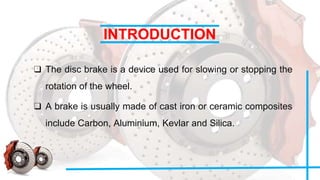
âť‘ The disc brake is a device used for slowing or stopping the
rotation of the wheel.
âť‘ A brake is usually made of cast iron or ceramic composites
include Carbon, Aluminium, Kevlar and Silica.
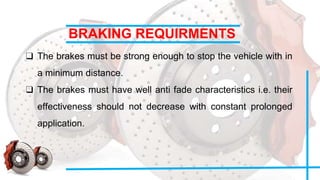
BRAKING REQUIRMENTS
âť‘ The brakes must be strong enough to stop the vehicle with in
a minimum distance.
âť‘ The brakes must have well anti fade characteristics i.e. their
effectiveness should not decrease with constant prolonged
application.
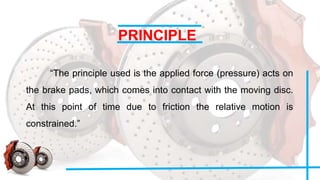
“The principle used is the applied force (pressure) acts on
the brake pads, which comes into contact with the moving disc.
At this point of time due to friction the relative motion is
constrained.”
PRINCIPLE
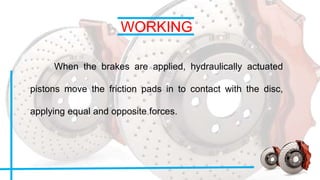
WORKING
When the brakes are applied, hydraulically actuated
pistons move the friction pads in to contact with the disc,
applying equal and opposite forces.
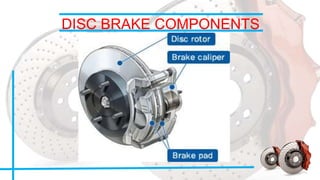
DISC BRAKE COMPONENTS
APPLICATIONS
âť‘ MOTORCYCLES
âť‘ Bicycles
âť‘ Cars
âť‘ OTHER VEHICLES
ADVANTAGES
âť‘ Good braking at both low and high speeds
âť‘ Light weight
âť‘ Anti-skid protection
âť‘ Simple installation
DISADVANTAGES
âť‘ It is expensive compare to drum brake.
âť‘ If any air remains in disk brake system, it can cause accident
as the brake will not work effectively.
âť‘ Disk brake assembly has more moving parts and much
complex than drum brake.
PROCEDURE
Disc Brake has been modelled with the help of
ANSYS v16.0 software. The Orthographic and Solid
Model of Disc Brake is shown in the figures. The following
is the list of steps that are used to create the required
model.
CONSIDERATIONS
Following Considerations are done for our
project.
❑ Young’s modulus=2x10⁵N/m2
âť‘ Poissions ratio=0.3
âť‘ Pressure=500N/m2
âť‘ Density=7800Kg/m3
Model generation
âť‘ STEP 1: From the Main menu select Preferences. Select
structural and press OK.
âť‘ STEP 2: From the main menu select Pre-processor.
Element type → Add / edit/Delete → Add →SOLID-10 node
187 → Apply → Close.
Material properties → material models → Structural →
Linear → Elastic → Isotropic–
Young’s Modulus = 2x10⁵N/m2.
Poissions ratio = 0.3;
Density =7800Kg/m3.
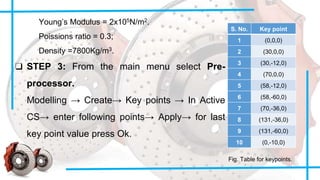
âť‘ STEP 3: From the main menu select Pre-
processor.
Modelling → Create→ Key points → In Active
CS→ enter following points→ Apply→ for last
key point value press Ok.
S. No. Key point
1 (0,0,0)
2 (30,0,0)
3 (30,-12,0)
4 (70,0,0)
5 (58,-12,0)
6 (58,-60,0)
7 (70,-36,0)
8 (131,-36,0)
9 (131,-60,0)
10 (0,-10,0)
Fig. Table for keypoints.
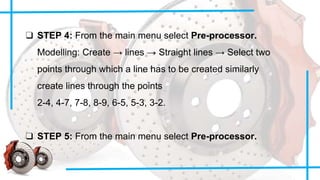
âť‘ STEP 4: From the main menu select Pre-processor.
Modelling: Create → lines → Straight lines → Select two
points through which a line has to be created similarly
create lines through the points
2-4, 4-7, 7-8, 8-9, 6-5, 5-3, 3-2.
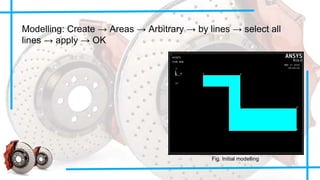
âť‘ STEP 5: From the main menu select Pre-processor.
Fig. Initial modelling
Modelling: Create → Areas → Arbitrary → by lines → select all
lines → apply → OK
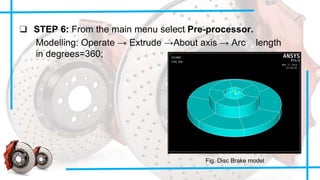
âť‘ STEP 6: From the main menu select Pre-processor.
Modelling: Operate → Extrude →About axis → Arc length
in degrees=360;
Fig. Disc Brake model
MESHING OF THE MODEL
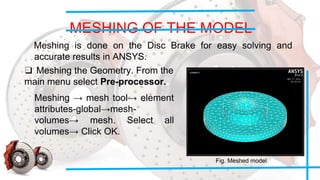
Meshing is done on the Disc Brake for easy solving and
accurate results in ANSYS.
âť‘ Meshing the Geometry. From the
main menu select Pre-processor.
Meshing → mesh tool→ element
attributes-global→mesh-
volumes→ mesh. Select all
volumes→ Click OK.
Fig. Meshed model
APPLYING BOUNDARY CONDITIONS
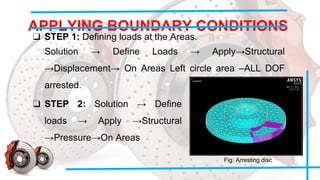
âť‘ STEP 1: Defining loads at the Areas.
Solution → Define Loads → Apply→Structural
→Displacement→ On Areas Left circle area –ALL DOF
arrested.
❑ STEP 2: Solution → Define
loads → Apply →Structural
→Pressure→On Areas
Fig. Arresting disc
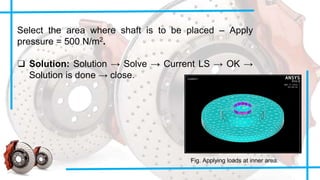
Select the area where shaft is to be placed – Apply
pressure = 500 N/m2.
❑ Solution: Solution → Solve → Current LS → OK →
Solution is done → close.
Fig. Applying loads at inner area.
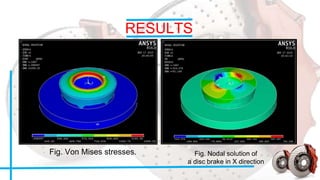
RESULTS
Fig. Von Mises stresses. Fig. Nodal solution of
a disc brake in X direction
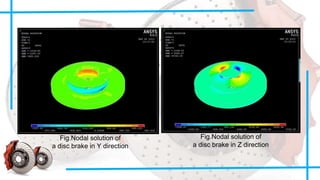
Fig.Nodal solution of
a disc brake in Y direction
Fig.Nodal solution of
a disc brake in Z direction
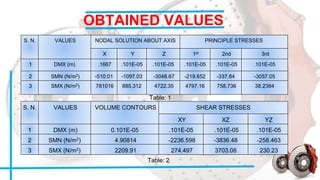
OBTAINED VALUES
S. N. VALUES NODAL SOLUTION ABOUT AXIS PRINCIPLE STRESSES
X Y Z 1st 2nd 3rd
1 DMX (m) .1667 .101E-05 .101E-05 .101E-05 .101E-05 .101E-05
2 SMN (N/m2) -510.01 -1097.03 -3048.67 -219.652 -337.84 -3057.05
3 SMX (N/m2) 781016 885.312 4722.35 4797.16 758.736 38.2384
S. N. VALUES VOLUME CONTOURS SHEAR STRESSES
XY XZ YZ
1 DMX (m) 0.101E-05 .101E-05 .101E-05 .101E-05
2 SMN (N/m2) 4.90814 -2236.598 -3836.48 -258.463
3 SMX (N/m2) 2209.91 274.497 3703.08 230.23
Table: 1
Table: 2
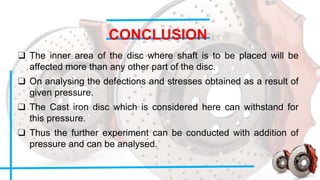
CONCLUSION
âť‘ The inner area of the disc where shaft is to be placed will be
affected more than any other part of the disc.
âť‘ On analysing the defections and stresses obtained as a result of
given pressure.
âť‘ The Cast iron disc which is considered here can withstand for
this pressure.
âť‘ Thus the further experiment can be conducted with addition of
pressure and can be analysed.
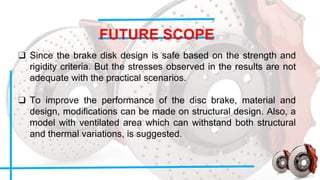
FUTURE SCOPE
âť‘ Since the brake disk design is safe based on the strength and
rigidity criteria. But the stresses observed in the results are not
adequate with the practical scenarios.
âť‘ To improve the performance of the disc brake, material and
design, modifications can be made on structural design. Also, a
model with ventilated area which can withstand both structural
and thermal variations, is suggested.
…THANK YOU…

Structural analysis of a brake disc.pptm

  • 1.
    STRUCTURAL ANALYSIS OF ABRAKE DISC By A. Pravalika (12N31A2101) Vedprakash Arya (12N31A2105) B. Ravi Kumar(12N31A2106) B. Prudhvi Raj (12N31A2110) Under the guidance of Mr. SHAILESH BABU Asst. Professor Department of Aeronautical Engineering, MRCET.
  • 2.
    ABSTRACT The present investigationis aimed to study the given disc brake rotor of its stability and rigidity, for this structural analysis is carried out on a given disc brake rotor. In this project the specified dimensions of the disc brake are taken for modeling in the software ANSYS. Static analysis was carried out on the disc brake considering the significant support structures with respective of disc. In analysis part, the finite element of portion of the disc is created, appropriate boundary conditions are applied, material properties are given and loads are applied as per its design. The resultant deformation and stresses obtained are reported and discussed.
  • 3.
    INTRODUCTION âť‘ The discbrake is a device used for slowing or stopping the rotation of the wheel. âť‘ A brake is usually made of cast iron or ceramic composites include Carbon, Aluminium, Kevlar and Silica.
  • 4.
    BRAKING REQUIRMENTS âť‘ Thebrakes must be strong enough to stop the vehicle with in a minimum distance. âť‘ The brakes must have well anti fade characteristics i.e. their effectiveness should not decrease with constant prolonged application.
  • 5.
    “The principle usedis the applied force (pressure) acts on the brake pads, which comes into contact with the moving disc. At this point of time due to friction the relative motion is constrained.” PRINCIPLE
  • 6.
    WORKING When the brakesare applied, hydraulically actuated pistons move the friction pads in to contact with the disc, applying equal and opposite forces.
  • 7.
  • 8.
  • 9.
    ADVANTAGES âť‘ Good brakingat both low and high speeds âť‘ Light weight âť‘ Anti-skid protection âť‘ Simple installation
  • 10.
    DISADVANTAGES âť‘ It isexpensive compare to drum brake. âť‘ If any air remains in disk brake system, it can cause accident as the brake will not work effectively. âť‘ Disk brake assembly has more moving parts and much complex than drum brake.
  • 11.
    PROCEDURE Disc Brake hasbeen modelled with the help of ANSYS v16.0 software. The Orthographic and Solid Model of Disc Brake is shown in the figures. The following is the list of steps that are used to create the required model.
  • 12.
    CONSIDERATIONS Following Considerations aredone for our project. ❑ Young’s modulus=2x10⁵N/m2 ❑ Poissions ratio=0.3 ❑ Pressure=500N/m2 ❑ Density=7800Kg/m3
  • 13.
    Model generation ❑ STEP1: From the Main menu select Preferences. Select structural and press OK. ❑ STEP 2: From the main menu select Pre-processor. Element type → Add / edit/Delete → Add →SOLID-10 node 187 → Apply → Close. Material properties → material models → Structural → Linear → Elastic → Isotropic–
  • 14.
    Young’s Modulus =2x10⁵N/m2. Poissions ratio = 0.3; Density =7800Kg/m3. ❑ STEP 3: From the main menu select Pre- processor. Modelling → Create→ Key points → In Active CS→ enter following points→ Apply→ for last key point value press Ok. S. No. Key point 1 (0,0,0) 2 (30,0,0) 3 (30,-12,0) 4 (70,0,0) 5 (58,-12,0) 6 (58,-60,0) 7 (70,-36,0) 8 (131,-36,0) 9 (131,-60,0) 10 (0,-10,0) Fig. Table for keypoints.
  • 15.
    ❑ STEP 4:From the main menu select Pre-processor. Modelling: Create → lines → Straight lines → Select two points through which a line has to be created similarly create lines through the points 2-4, 4-7, 7-8, 8-9, 6-5, 5-3, 3-2. ❑ STEP 5: From the main menu select Pre-processor.
  • 16.
    Fig. Initial modelling Modelling:Create → Areas → Arbitrary → by lines → select all lines → apply → OK
  • 17.
    ❑ STEP 6:From the main menu select Pre-processor. Modelling: Operate → Extrude →About axis → Arc length in degrees=360; Fig. Disc Brake model
  • 18.
    MESHING OF THEMODEL Meshing is done on the Disc Brake for easy solving and accurate results in ANSYS. ❑ Meshing the Geometry. From the main menu select Pre-processor. Meshing → mesh tool→ element attributes-global→mesh- volumes→ mesh. Select all volumes→ Click OK. Fig. Meshed model
  • 19.
    APPLYING BOUNDARY CONDITIONS ❑STEP 1: Defining loads at the Areas. Solution → Define Loads → Apply→Structural →Displacement→ On Areas Left circle area –ALL DOF arrested. ❑ STEP 2: Solution → Define loads → Apply →Structural →Pressure→On Areas Fig. Arresting disc
  • 20.
    Select the areawhere shaft is to be placed – Apply pressure = 500 N/m2. ❑ Solution: Solution → Solve → Current LS → OK → Solution is done → close. Fig. Applying loads at inner area.
  • 21.
    RESULTS Fig. Von Misesstresses. Fig. Nodal solution of a disc brake in X direction
  • 22.
    Fig.Nodal solution of adisc brake in Y direction Fig.Nodal solution of a disc brake in Z direction
  • 23.
    OBTAINED VALUES S. N.VALUES NODAL SOLUTION ABOUT AXIS PRINCIPLE STRESSES X Y Z 1st 2nd 3rd 1 DMX (m) .1667 .101E-05 .101E-05 .101E-05 .101E-05 .101E-05 2 SMN (N/m2) -510.01 -1097.03 -3048.67 -219.652 -337.84 -3057.05 3 SMX (N/m2) 781016 885.312 4722.35 4797.16 758.736 38.2384 S. N. VALUES VOLUME CONTOURS SHEAR STRESSES XY XZ YZ 1 DMX (m) 0.101E-05 .101E-05 .101E-05 .101E-05 2 SMN (N/m2) 4.90814 -2236.598 -3836.48 -258.463 3 SMX (N/m2) 2209.91 274.497 3703.08 230.23 Table: 1 Table: 2
  • 24.
    CONCLUSION âť‘ The innerarea of the disc where shaft is to be placed will be affected more than any other part of the disc. âť‘ On analysing the defections and stresses obtained as a result of given pressure. âť‘ The Cast iron disc which is considered here can withstand for this pressure. âť‘ Thus the further experiment can be conducted with addition of pressure and can be analysed.
  • 25.
    FUTURE SCOPE âť‘ Sincethe brake disk design is safe based on the strength and rigidity criteria. But the stresses observed in the results are not adequate with the practical scenarios. âť‘ To improve the performance of the disc brake, material and design, modifications can be made on structural design. Also, a model with ventilated area which can withstand both structural and thermal variations, is suggested.
  • 26.