DEPARTMENT OF MECHANICAL ENGINEERING
A TECHNICAL SEMINAR ON
A STUDY ON AUTOMOBILE
DIFFERENTIAL SYSTEM
Presented by:
ABHIJITH VIJAYAKUMAR
CONTENTS
1. INTRODUCTION
2. PARTS OF DIFFERNTIAL SYSTEM
3. WORKING OF DIFFERENTIAL
4. CASE STUDIES
5. OTHER FUNCTIONS OF DIFFERNTIAL
6. DRAWBACK OF STANDARD DIFFERENTIAL
7. LIMITED SLIP DIFFERENTIAL
8. CONCLUSION
9. REFERENCE
INTRODUCTION
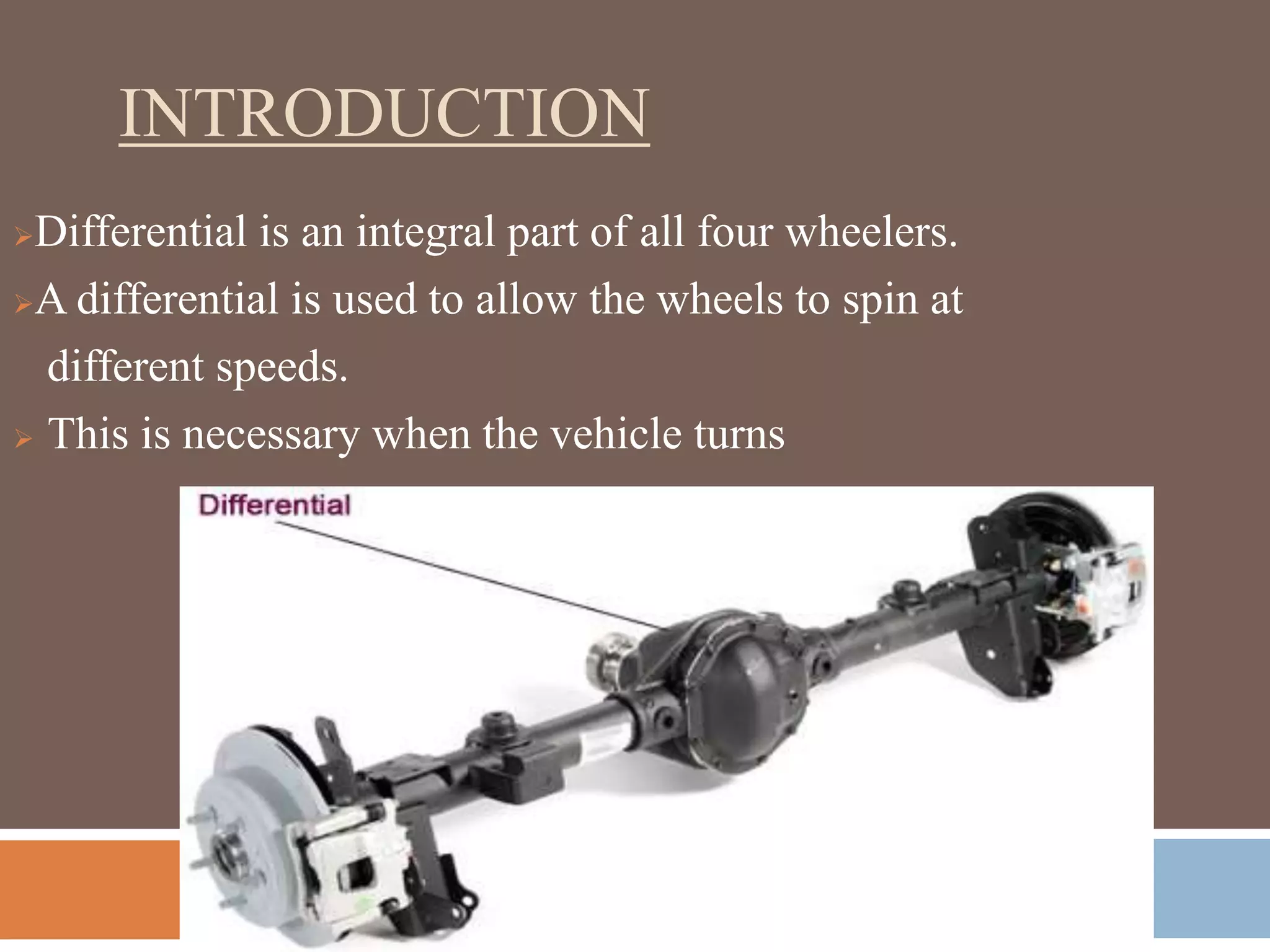
Differential is an integral part of all four wheelers.
A differential is used to allow the wheels to spin at
different speeds.
 This is necessary when the vehicle turns
1
PART’S OF DIFFERENTIAL SYSTEM
2
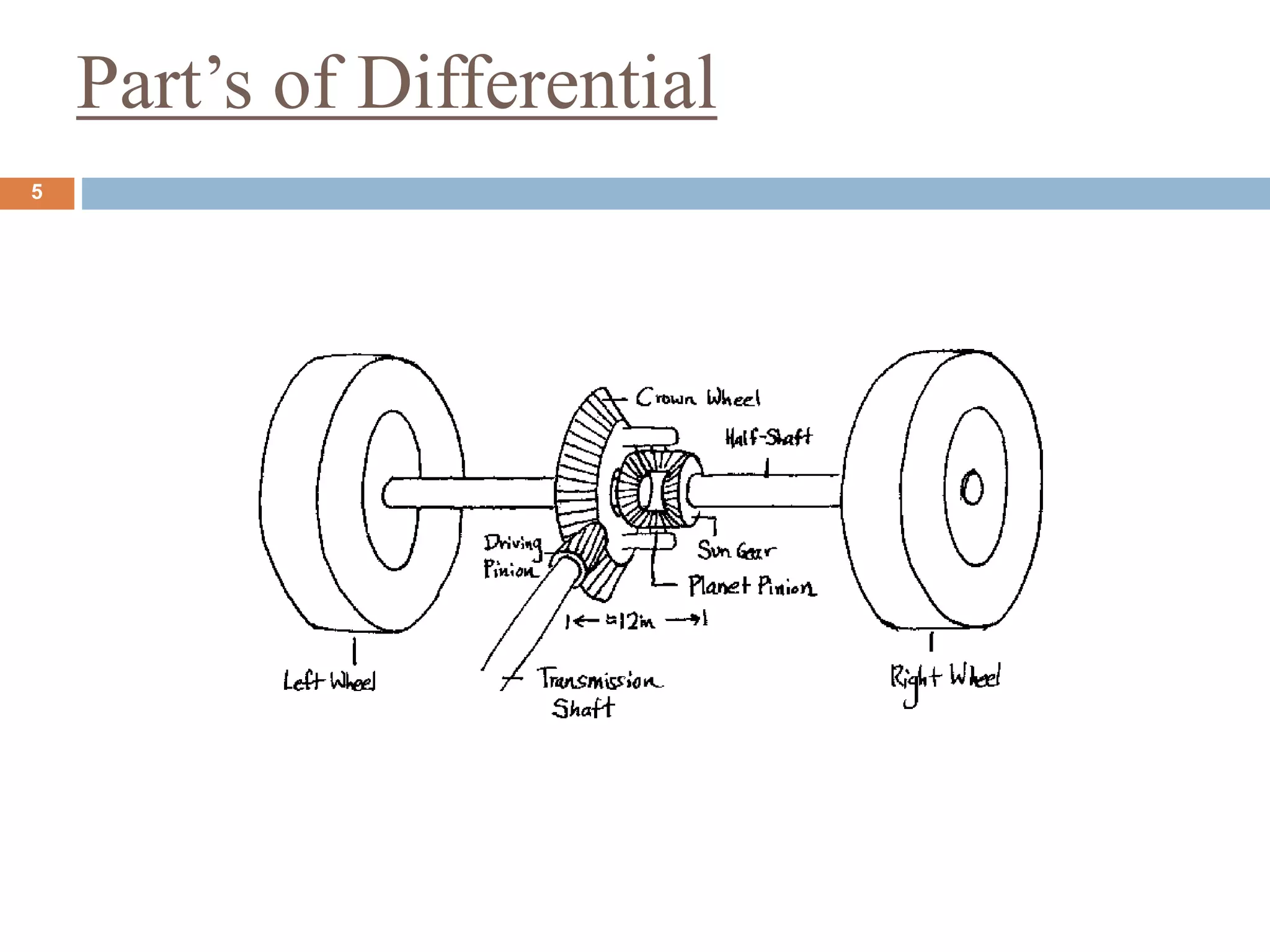
 Pinion drive gear: transfer power from the drive shaft
to the ring gear.
 Ring gear: will transfer power to differential case
assembly.
 Spider gears: The spider gear lies at the heart of the
differential and special mention should be made about
its rotation.
 Differential case assembly: Hold the gear and drive
the axel.
 Rear drive axel: Transfer torque from differential
assembly to the drive wheels.
Part’s of Differential
5
WORKING OF DIFFERENTIAL
3
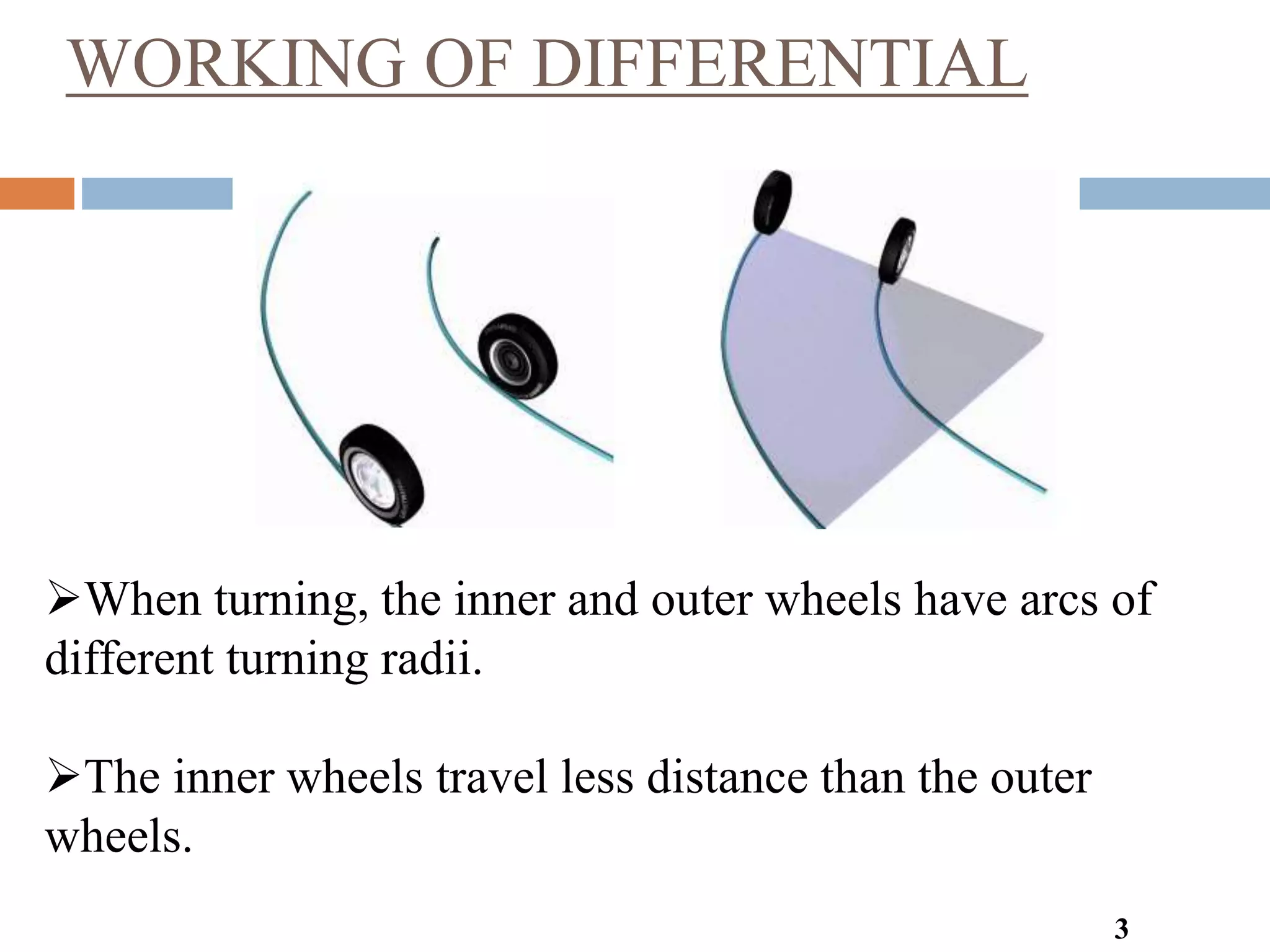
When turning, the inner and outer wheels have arcs of
different turning radii.
The inner wheels travel less distance than the outer
wheels.
4
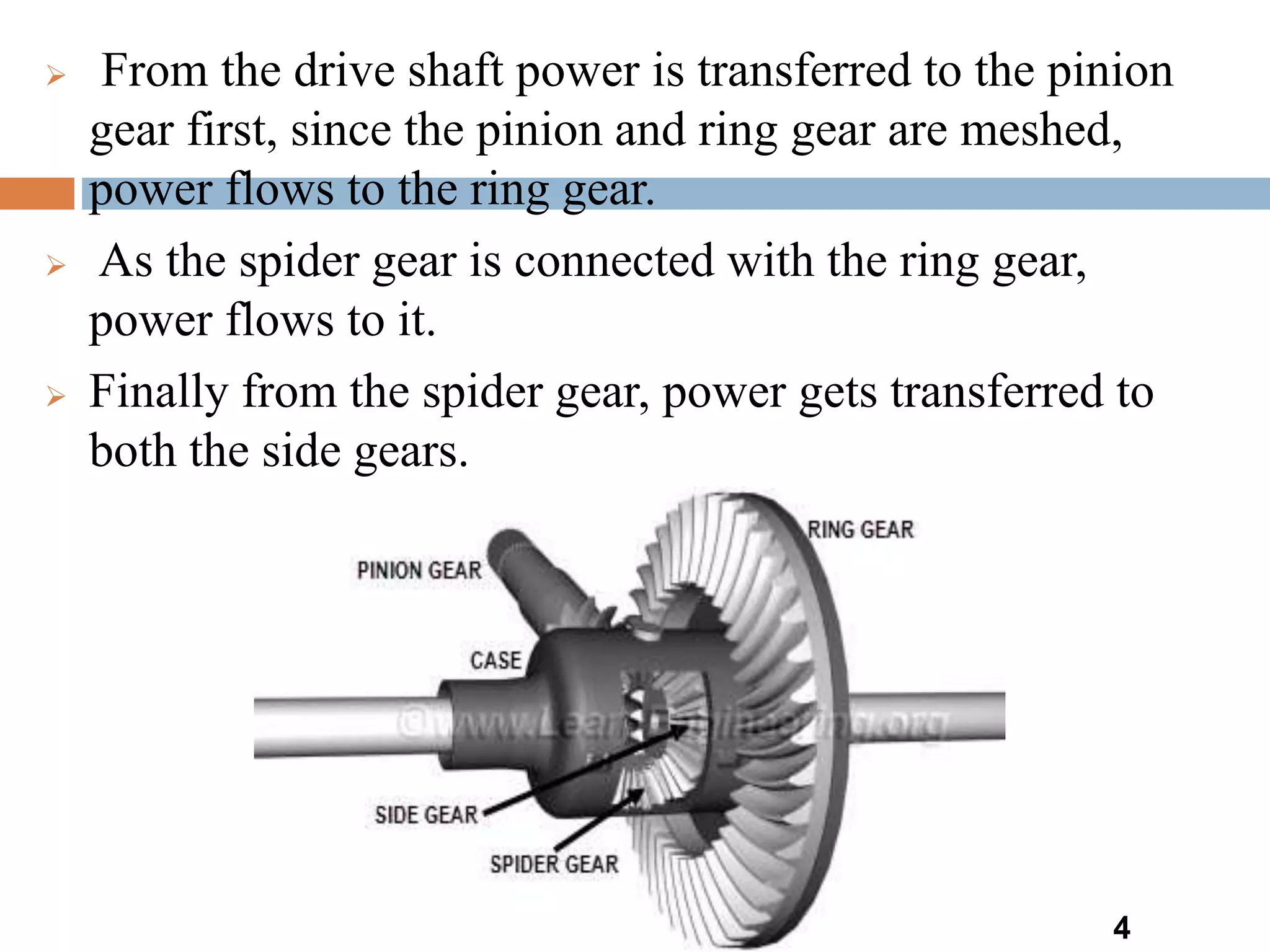
 From the drive shaft power is transferred to the pinion
gear first, since the pinion and ring gear are meshed,
power flows to the ring gear.
 As the spider gear is connected with the ring gear,
power flows to it.
 Finally from the spider gear, power gets transferred to
both the side gears.
DIFFERENT CASES
5
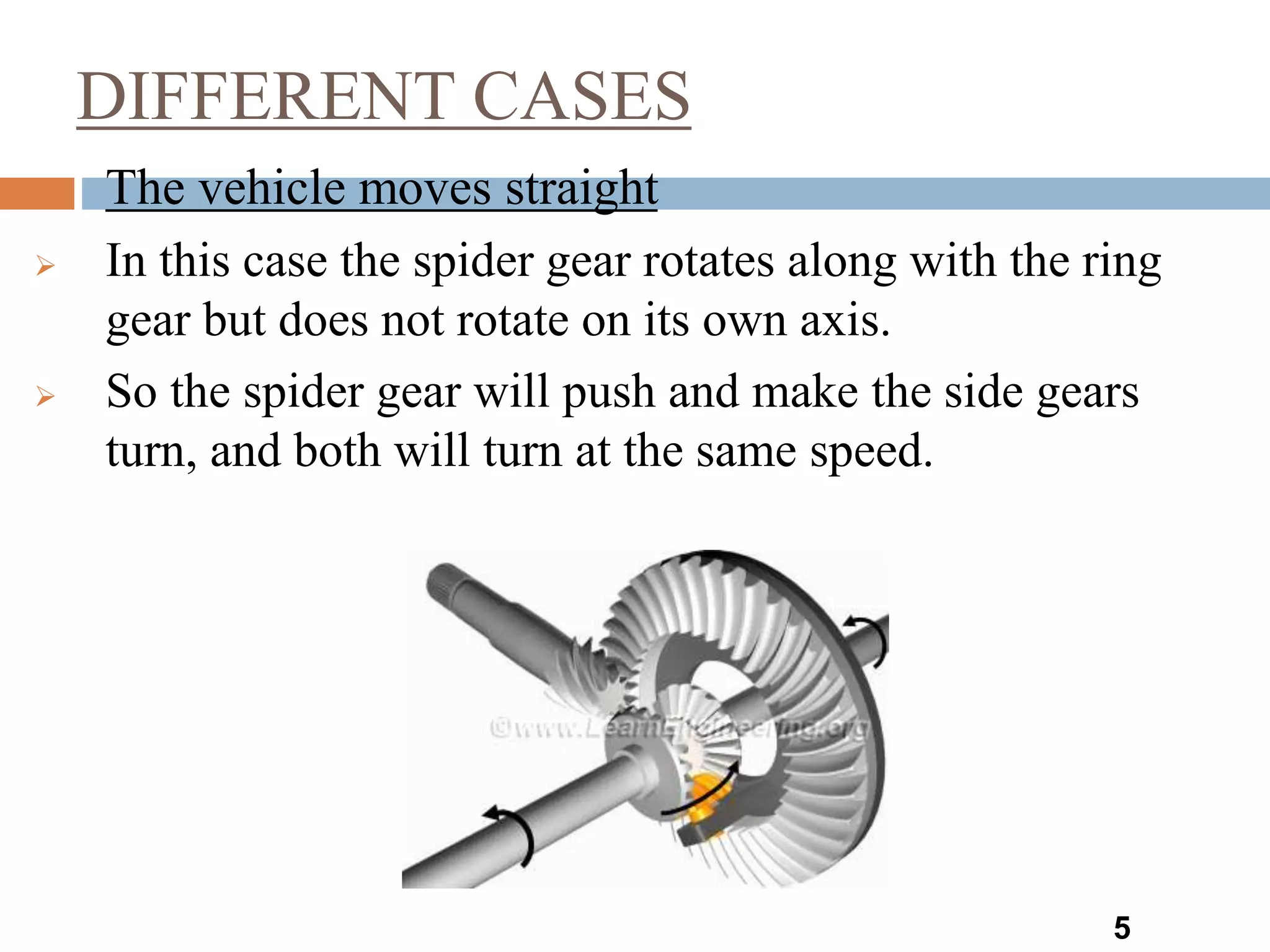
1. The vehicle moves straight
 In this case the spider gear rotates along with the ring
gear but does not rotate on its own axis.
 So the spider gear will push and make the side gears
turn, and both will turn at the same speed.
6
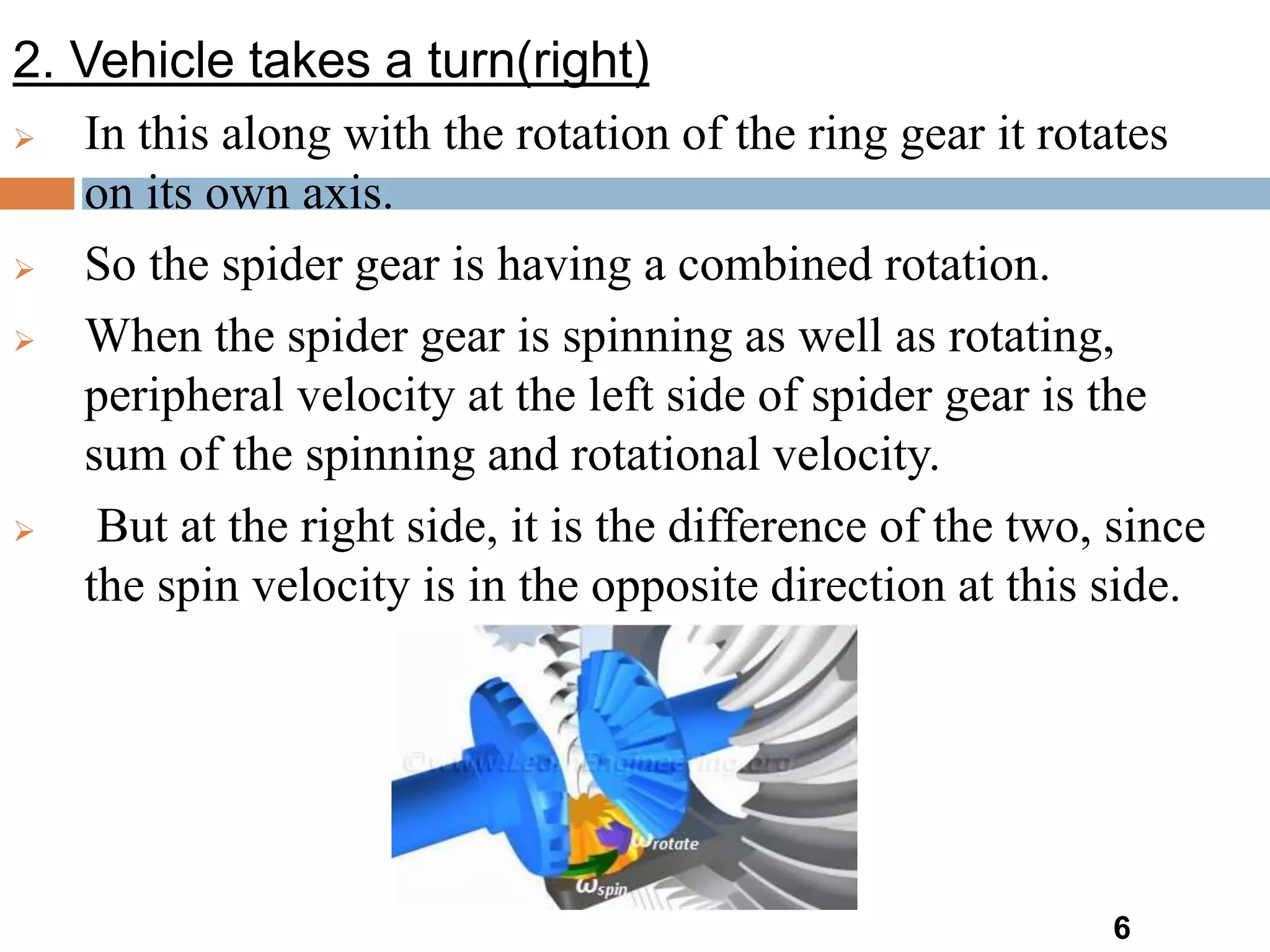
2. Vehicle takes a turn(right)
 In this along with the rotation of the ring gear it rotates
on its own axis.
 So the spider gear is having a combined rotation.
 When the spider gear is spinning as well as rotating,
peripheral velocity at the left side of spider gear is the
sum of the spinning and rotational velocity.
 But at the right side, it is the difference of the two, since
the spin velocity is in the opposite direction at this side.
OTHER FUNCTIONS OF
DIFFERENTIAL
7
1) First is speed reduction at the pinion-ring gear assembly.
since the power flow at the pinion and ring gear are the
same, such a speed reduction will result in a high torque
multiplication.
2) can also note one specialty of the ring gear, they are
hypoid gears. Hypoid gears have more contact area
compared to the other gear pairs.
3) The other function of the differential is to turn the power
flow direction by 90 degree.
DRAWBACK OF STANDARD
DIFFERENTIAL
8
 The problem is an open diff always tries to balance
the torque.
 Almost no torque is needed to spin one wheel, and
since the open differential always sends the same
amount of torque to both output shafts.
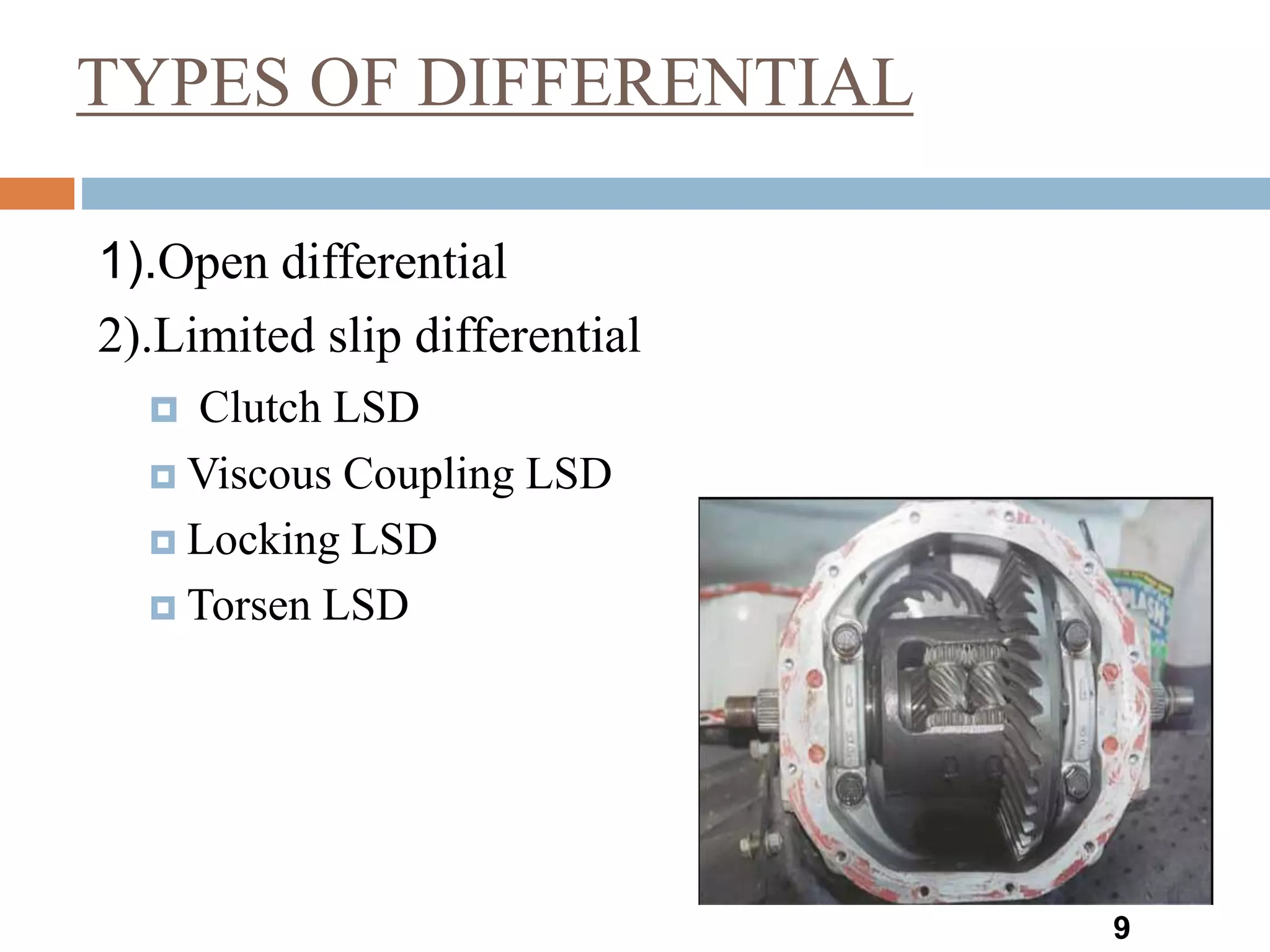
TYPES OF DIFFERENTIAL
9
1).Open differential
2).Limited slip differential
 Clutch LSD
 Viscous Coupling LSD
 Locking LSD
 Torsen LSD
LIMITED SLIP DIFFERNTIAL
10
 In the case of a standard differential in off-
roading or snow situations where one wheel begins to
slip or lose contact with the ground.
 In this situation, a limited-slip differential prevents
excessive power from being allocated to one wheel,
and thereby keeping both wheels in powered rotation.
CONCLUSION
11
 In automobile and other wheeled vehicles, the
differential allows each of the driving wheels to rotate
at different speeds, while supplying equal torque to
each of them.
 Limited slip differential prevents excessive power
from being allocated to one wheel, and thereby
keeping both wheels in powered rotation.
REFERNCE
12
 A study on vehicle differential system: : Chandrakant singh,
Lalit kumarInternational Journal of scientific research and
management (IJSRM) ||Volume||2||Issue||11||Pages||1680-
1683||2014||.
 The development of a differential for the improvement of
traction control; Th Institution of Mechanical Engineers,
C368/88 © IMechE 1988.
THANK YOU
13

Automobile Differential System

  • 1.
    DEPARTMENT OF MECHANICALENGINEERING A TECHNICAL SEMINAR ON A STUDY ON AUTOMOBILE DIFFERENTIAL SYSTEM Presented by: ABHIJITH VIJAYAKUMAR
  • 2.
    CONTENTS 1. INTRODUCTION 2. PARTSOF DIFFERNTIAL SYSTEM 3. WORKING OF DIFFERENTIAL 4. CASE STUDIES 5. OTHER FUNCTIONS OF DIFFERNTIAL 6. DRAWBACK OF STANDARD DIFFERENTIAL 7. LIMITED SLIP DIFFERENTIAL 8. CONCLUSION 9. REFERENCE
  • 3.
    INTRODUCTION Differential is anintegral part of all four wheelers. A differential is used to allow the wheels to spin at different speeds.  This is necessary when the vehicle turns 1
  • 4.
    PART’S OF DIFFERENTIALSYSTEM 2  Pinion drive gear: transfer power from the drive shaft to the ring gear.  Ring gear: will transfer power to differential case assembly.  Spider gears: The spider gear lies at the heart of the differential and special mention should be made about its rotation.  Differential case assembly: Hold the gear and drive the axel.  Rear drive axel: Transfer torque from differential assembly to the drive wheels.
  • 5.
  • 6.
    WORKING OF DIFFERENTIAL 3 Whenturning, the inner and outer wheels have arcs of different turning radii. The inner wheels travel less distance than the outer wheels.
  • 7.
    4  From thedrive shaft power is transferred to the pinion gear first, since the pinion and ring gear are meshed, power flows to the ring gear.  As the spider gear is connected with the ring gear, power flows to it.  Finally from the spider gear, power gets transferred to both the side gears.
  • 8.
    DIFFERENT CASES 5 1. Thevehicle moves straight  In this case the spider gear rotates along with the ring gear but does not rotate on its own axis.  So the spider gear will push and make the side gears turn, and both will turn at the same speed.
  • 9.
    6 2. Vehicle takesa turn(right)  In this along with the rotation of the ring gear it rotates on its own axis.  So the spider gear is having a combined rotation.  When the spider gear is spinning as well as rotating, peripheral velocity at the left side of spider gear is the sum of the spinning and rotational velocity.  But at the right side, it is the difference of the two, since the spin velocity is in the opposite direction at this side.
  • 10.
    OTHER FUNCTIONS OF DIFFERENTIAL 7 1)First is speed reduction at the pinion-ring gear assembly. since the power flow at the pinion and ring gear are the same, such a speed reduction will result in a high torque multiplication. 2) can also note one specialty of the ring gear, they are hypoid gears. Hypoid gears have more contact area compared to the other gear pairs. 3) The other function of the differential is to turn the power flow direction by 90 degree.
  • 11.
    DRAWBACK OF STANDARD DIFFERENTIAL 8 The problem is an open diff always tries to balance the torque.  Almost no torque is needed to spin one wheel, and since the open differential always sends the same amount of torque to both output shafts.
  • 12.
    TYPES OF DIFFERENTIAL 9 1).Opendifferential 2).Limited slip differential  Clutch LSD  Viscous Coupling LSD  Locking LSD  Torsen LSD
  • 13.
    LIMITED SLIP DIFFERNTIAL 10 In the case of a standard differential in off- roading or snow situations where one wheel begins to slip or lose contact with the ground.  In this situation, a limited-slip differential prevents excessive power from being allocated to one wheel, and thereby keeping both wheels in powered rotation.
  • 14.
    CONCLUSION 11  In automobileand other wheeled vehicles, the differential allows each of the driving wheels to rotate at different speeds, while supplying equal torque to each of them.  Limited slip differential prevents excessive power from being allocated to one wheel, and thereby keeping both wheels in powered rotation.
  • 15.
    REFERNCE 12  A studyon vehicle differential system: : Chandrakant singh, Lalit kumarInternational Journal of scientific research and management (IJSRM) ||Volume||2||Issue||11||Pages||1680- 1683||2014||.  The development of a differential for the improvement of traction control; Th Institution of Mechanical Engineers, C368/88 © IMechE 1988.
  • 16.