Hypothesis
Testing - II
Directional Hypothesis:
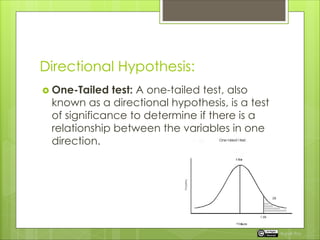
 One-Tailed test: A one-tailed test, also
known as a directional hypothesis, is a test
of significance to determine if there is a
relationship between the variables in one
direction.
Rupak Roy
Non-Directional Hypothesis Test
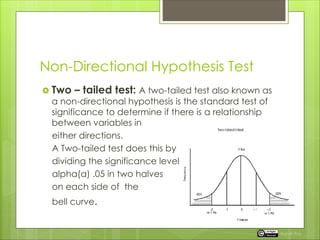
 Two – tailed test: A two-tailed test also known as
a non-directional hypothesis is the standard test of
significance to determine if there is a relationship
between variables in
either directions.
A Two-tailed test does this by
dividing the significance level
alpha(a) .05 in two halves
on each side of the
bell curve.
Rupak Roy
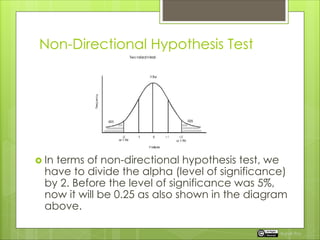
 In terms of non-directional hypothesis test, we
have to divide the alpha (level of significance)
by 2. Before the level of significance was 5%,
now it will be 0.25 as also shown in the diagram
above.
Non-Directional Hypothesis Test
Rupak Roy
Two tailed test is more stricter because we
need more level of confidence to reject the
null hypothesis as compare to one tail test.
Let’s, use some examples to understand one
tail and two tail tests.
Rupak Roy
Assume:
Null Hypothesis (Ho): no difference in mileage if we
replace the battery of the car.
Alternative Hypothesis (Ha): difference in mileage if we
replace the battery of the car
If we don’t have a strong believe that there will be a
difference in mileage if we replace the battery of the
car then we should use a two tail test.
Or
if we have a strong believe that the car will give a
better mileage then we will use one tail test.
Rupak Roy
Example
 A manufacturing plant have to produce exactly 1000
units of product each day.
Now if we want to check if the manufacturing plant is
able to produce exactly 1000 units per day or different
(more or less)?
Ha: Alternative Hypothesis: Plant producing different
from 1000 units. It can be more or less per day.
In this example in our alternative hypothesis we are not
sure if they can produce more or less per day.
Therefore we will use a two – tail test.
Rupak Roy
More simplified
Case1:
Ho: Null Hypothesis: Plant is not producing exactly 1000 units or different.
Ha: Alternative Hypothesis: Plant Producing exactly 1000 units or different
(higher/lower).
i.e. Plant Producing = 1000 units
Plant Producing ≠ 1000 units ( it can be higher or lower)
Case 2:
Ho: Null Hypothesis: plant not producing more than 1000 units.
Ha: Alternative Hypothesis: plant producing more than 1000 units
i.e. Plant producing > 1000 units.
 If you compare Case 1 & 2 we will find in Case 2 we have a strong believe that
the plant is producing more than 1000 units so we will use one tail test
(Directional Hypothesis) as it depicts one direction > or < (greater or smaller
than).
 For Case 1 we don’t have a strong believe that the plant is producing 1000
units or more/less, therefore we will use two-tail test (non-directional
hypothesis)
Rupak Roy
2 sample t-test
 The two sample t-test is used to determine if
the two population means/averages are equal.
A common application is to test if a new
process/event is better to the current
process/event.
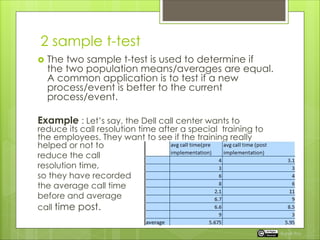
Example : Let’s say, the Dell call center wants to
reduce its call resolution time after a special training to
the employees. They want to see if the training really
helped or not to
reduce the call
resolution time,
so they have recorded
the average call time
before and average
call time post.
Rupak Roy
2-sample t -test
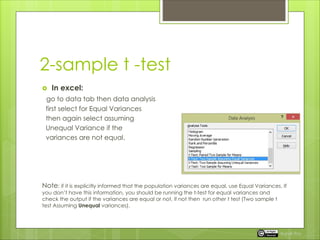
 In excel:
go to data tab then data analysis
first select for Equal Variances
then again select assuming
Unequal Variance if the
variances are not equal.
Note: if it is explicitly informed that the population variances are equal, use Equal Variances. If
you don’t have this information, you should be running the t-test for equal variances and
check the output if the variances are equal or not, if not then run other t test (Two sample t
test Assuming Unequal variances).
Rupak Roy
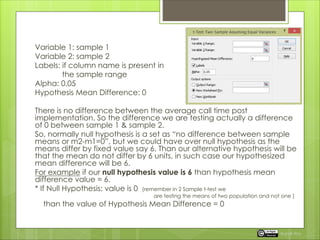
Variable 1: sample 1
Variable 2: sample 2
Labels: if column name is present in
the sample range
Alpha: 0.05
Hypothesis Mean Difference: 0
There is no difference between the average call time post
implementation. So the difference we are testing actually a difference
of 0 between sample 1 & sample 2.
So, normally null hypothesis is a set as “no difference between sample
means or m2-m1=0”, but we could have over null hypothesis as the
means differ by fixed value say 6. Than our alternative hypothesis will be
that the mean do not differ by 6 units, in such case our hypothesized
mean difference will be 6.
For example if our null hypothesis value is 6 than hypothesis mean
difference value = 6.
* If Null Hypothesis: value is 0 (remember in 2 Sample t-test we
are testing the means of two population and not one )
than the value of Hypothesis Mean Difference = 0
Rupak Roy
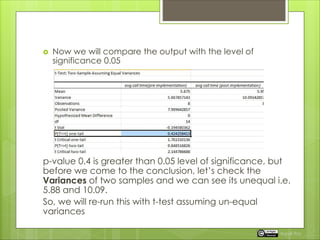
 Now we will compare the output with the level of
significance 0.05
p-value 0.4 is greater than 0.05 level of significance, but
before we come to the conclusion, let’s check the
Variances of two samples and we can see its unequal i.e.
5.88 and 10.09.
So, we will re-run this with t-test assuming un-equal
variances
Rupak Roy
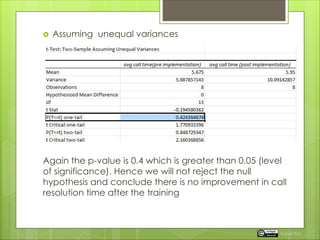
 Assuming unequal variances
Again the p-value is 0.4 which is greater than 0.05 (level
of significance). Hence we will not reject the null
hypothesis and conclude there is no improvement in call
resolution time after the training
Rupak Roy
Paired difference T-tests
 The paired t – test calculates the difference
within each before and after pair of
measurements, determines the mean of these
changes and reports whether this mean of the
differences is statistically significant or not.
 Or in simple words we can say a paired t-test is
used to compare two population means where
we have two pair of observations with after
and before samples and identifies the
observations are statistically significant or not.
Rupak Roy
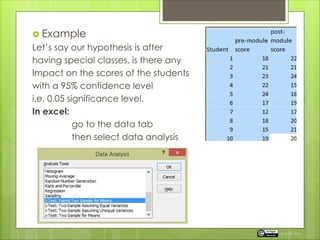
 Example
Let’s say our hypothesis is after
having special classes, is there any
Impact on the scores of the students
with a 95% confidence level
i.e. 0.05 significance level.
In excel:
go to the data tab
then select data analysis
Rupak Roy
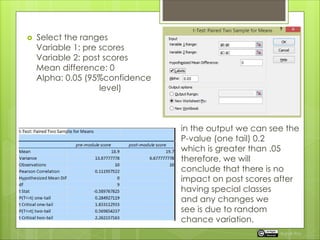
 Select the ranges
Variable 1: pre scores
Variable 2: post scores
Mean difference: 0
Alpha: 0.05 (95%confidence
level)
in the output we can see the
P-value (one tail) 0.2
which is greater than .05
therefore, we will
conclude that there is no
impact on post scores after
having special classes
and any changes we
see is due to random
chance variation.
Rupak Roy
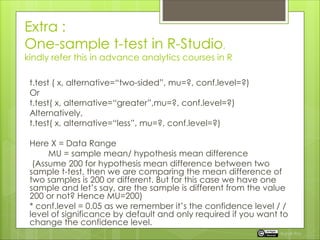
Extra :
One-sample t-test in R-Studio,
kindly refer this in advance analytics courses in R
t.test ( x, alternative=“two-sided”, mu=?, conf.level=?)
Or
t.test( x, alternative=“greater”,mu=?, conf.level=?)
Alternatively,
t.test( x, alternative=“less”, mu=?, conf.level=?)
Here X = Data Range
MU = sample mean/ hypothesis mean difference
(Assume 200 for hypothesis mean difference between two
sample t-test, then we are comparing the mean difference of
two samples is 200 or different. But for this case we have one
sample and let’s say, are the sample is different from the value
200 or not? Hence MU=200)
* conf.level = 0.05 as we remember it’s the confidence level / /
level of significance by default and only required if you want to
change the confidence level.
Rupak Roy
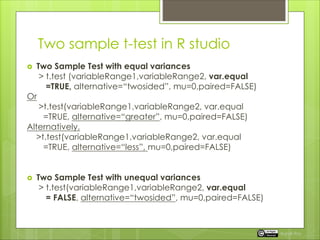
Two sample t-test in R studio
 Two Sample Test with equal variances
> t.test (variableRange1,variableRange2, var.equal
=TRUE, alternative=“twosided”, mu=0,paired=FALSE)
Or
>t.test(variableRange1,variableRange2, var.equal
=TRUE, alternative=“greater”, mu=0,paired=FALSE)
Alternatively,
>t.test(variableRange1,variableRange2, var.equal
=TRUE, alternative=“less”, mu=0,paired=FALSE)
 Two Sample Test with unequal variances
> t.test(variableRange1,variableRange2, var.equal
= FALSE, alternative=“twosided”, mu=0,paired=FALSE)
Rupak Roy
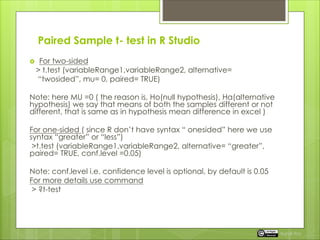
Paired Sample t- test in R Studio
 For two-sided
> t.test (variableRange1,variableRange2, alternative=
“twosided”, mu= 0, paired= TRUE)
Note: here MU =0 ( the reason is, Ho(null hypothesis), Ha(alternative
hypothesis) we say that means of both the samples different or not
different, that is same as in hypothesis mean difference in excel )
For one-sided ( since R don’t have syntax “ onesided” here we use
syntax “greater” or “less”)
>t.test (variableRange1,variableRange2, alternative= “greater”,
paired= TRUE, conf.level =0.05)
Note: conf.level i.e. confidence level is optional, by default is 0.05
For more details use command
> ?t-test
Rupak Roy
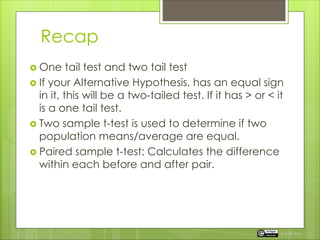
Recap
 One tail test and two tail test
 If your Alternative Hypothesis, has an equal sign
in it, this will be a two-tailed test. If it has > or < it
is a one tail test.
 Two sample t-test is used to determine if two
population means/average are equal.
 Paired sample t-test: Calculates the difference
within each before and after pair.
Rupak Roy
Next
 In real life we maybe have to compare
means of more than 2 samples.
For this we will use Anova, Chi –square.
Rupak Roy
To be continued.
Rupak Roy

Directional Hypothesis testing

  • 1.
  • 2.
    Directional Hypothesis:  One-Tailedtest: A one-tailed test, also known as a directional hypothesis, is a test of significance to determine if there is a relationship between the variables in one direction. Rupak Roy
  • 3.
    Non-Directional Hypothesis Test Two – tailed test: A two-tailed test also known as a non-directional hypothesis is the standard test of significance to determine if there is a relationship between variables in either directions. A Two-tailed test does this by dividing the significance level alpha(a) .05 in two halves on each side of the bell curve. Rupak Roy
  • 4.
     In termsof non-directional hypothesis test, we have to divide the alpha (level of significance) by 2. Before the level of significance was 5%, now it will be 0.25 as also shown in the diagram above. Non-Directional Hypothesis Test Rupak Roy
  • 5.
    Two tailed testis more stricter because we need more level of confidence to reject the null hypothesis as compare to one tail test. Let’s, use some examples to understand one tail and two tail tests. Rupak Roy
  • 6.
    Assume: Null Hypothesis (Ho):no difference in mileage if we replace the battery of the car. Alternative Hypothesis (Ha): difference in mileage if we replace the battery of the car If we don’t have a strong believe that there will be a difference in mileage if we replace the battery of the car then we should use a two tail test. Or if we have a strong believe that the car will give a better mileage then we will use one tail test. Rupak Roy
  • 7.
    Example  A manufacturingplant have to produce exactly 1000 units of product each day. Now if we want to check if the manufacturing plant is able to produce exactly 1000 units per day or different (more or less)? Ha: Alternative Hypothesis: Plant producing different from 1000 units. It can be more or less per day. In this example in our alternative hypothesis we are not sure if they can produce more or less per day. Therefore we will use a two – tail test. Rupak Roy
  • 8.
    More simplified Case1: Ho: NullHypothesis: Plant is not producing exactly 1000 units or different. Ha: Alternative Hypothesis: Plant Producing exactly 1000 units or different (higher/lower). i.e. Plant Producing = 1000 units Plant Producing ≠ 1000 units ( it can be higher or lower) Case 2: Ho: Null Hypothesis: plant not producing more than 1000 units. Ha: Alternative Hypothesis: plant producing more than 1000 units i.e. Plant producing > 1000 units.  If you compare Case 1 & 2 we will find in Case 2 we have a strong believe that the plant is producing more than 1000 units so we will use one tail test (Directional Hypothesis) as it depicts one direction > or < (greater or smaller than).  For Case 1 we don’t have a strong believe that the plant is producing 1000 units or more/less, therefore we will use two-tail test (non-directional hypothesis) Rupak Roy
  • 9.
    2 sample t-test The two sample t-test is used to determine if the two population means/averages are equal. A common application is to test if a new process/event is better to the current process/event. Example : Let’s say, the Dell call center wants to reduce its call resolution time after a special training to the employees. They want to see if the training really helped or not to reduce the call resolution time, so they have recorded the average call time before and average call time post. Rupak Roy
  • 10.
    2-sample t -test In excel: go to data tab then data analysis first select for Equal Variances then again select assuming Unequal Variance if the variances are not equal. Note: if it is explicitly informed that the population variances are equal, use Equal Variances. If you don’t have this information, you should be running the t-test for equal variances and check the output if the variances are equal or not, if not then run other t test (Two sample t test Assuming Unequal variances). Rupak Roy
  • 11.
    Variable 1: sample1 Variable 2: sample 2 Labels: if column name is present in the sample range Alpha: 0.05 Hypothesis Mean Difference: 0 There is no difference between the average call time post implementation. So the difference we are testing actually a difference of 0 between sample 1 & sample 2. So, normally null hypothesis is a set as “no difference between sample means or m2-m1=0”, but we could have over null hypothesis as the means differ by fixed value say 6. Than our alternative hypothesis will be that the mean do not differ by 6 units, in such case our hypothesized mean difference will be 6. For example if our null hypothesis value is 6 than hypothesis mean difference value = 6. * If Null Hypothesis: value is 0 (remember in 2 Sample t-test we are testing the means of two population and not one ) than the value of Hypothesis Mean Difference = 0 Rupak Roy
  • 12.
     Now wewill compare the output with the level of significance 0.05 p-value 0.4 is greater than 0.05 level of significance, but before we come to the conclusion, let’s check the Variances of two samples and we can see its unequal i.e. 5.88 and 10.09. So, we will re-run this with t-test assuming un-equal variances Rupak Roy
  • 13.
     Assuming unequalvariances Again the p-value is 0.4 which is greater than 0.05 (level of significance). Hence we will not reject the null hypothesis and conclude there is no improvement in call resolution time after the training Rupak Roy
  • 14.
    Paired difference T-tests The paired t – test calculates the difference within each before and after pair of measurements, determines the mean of these changes and reports whether this mean of the differences is statistically significant or not.  Or in simple words we can say a paired t-test is used to compare two population means where we have two pair of observations with after and before samples and identifies the observations are statistically significant or not. Rupak Roy
  • 15.
     Example Let’s sayour hypothesis is after having special classes, is there any Impact on the scores of the students with a 95% confidence level i.e. 0.05 significance level. In excel: go to the data tab then select data analysis Rupak Roy
  • 16.
     Select theranges Variable 1: pre scores Variable 2: post scores Mean difference: 0 Alpha: 0.05 (95%confidence level) in the output we can see the P-value (one tail) 0.2 which is greater than .05 therefore, we will conclude that there is no impact on post scores after having special classes and any changes we see is due to random chance variation. Rupak Roy
  • 17.
    Extra : One-sample t-testin R-Studio, kindly refer this in advance analytics courses in R t.test ( x, alternative=“two-sided”, mu=?, conf.level=?) Or t.test( x, alternative=“greater”,mu=?, conf.level=?) Alternatively, t.test( x, alternative=“less”, mu=?, conf.level=?) Here X = Data Range MU = sample mean/ hypothesis mean difference (Assume 200 for hypothesis mean difference between two sample t-test, then we are comparing the mean difference of two samples is 200 or different. But for this case we have one sample and let’s say, are the sample is different from the value 200 or not? Hence MU=200) * conf.level = 0.05 as we remember it’s the confidence level / / level of significance by default and only required if you want to change the confidence level. Rupak Roy
  • 18.
    Two sample t-testin R studio  Two Sample Test with equal variances > t.test (variableRange1,variableRange2, var.equal =TRUE, alternative=“twosided”, mu=0,paired=FALSE) Or >t.test(variableRange1,variableRange2, var.equal =TRUE, alternative=“greater”, mu=0,paired=FALSE) Alternatively, >t.test(variableRange1,variableRange2, var.equal =TRUE, alternative=“less”, mu=0,paired=FALSE)  Two Sample Test with unequal variances > t.test(variableRange1,variableRange2, var.equal = FALSE, alternative=“twosided”, mu=0,paired=FALSE) Rupak Roy
  • 19.
    Paired Sample t-test in R Studio  For two-sided > t.test (variableRange1,variableRange2, alternative= “twosided”, mu= 0, paired= TRUE) Note: here MU =0 ( the reason is, Ho(null hypothesis), Ha(alternative hypothesis) we say that means of both the samples different or not different, that is same as in hypothesis mean difference in excel ) For one-sided ( since R don’t have syntax “ onesided” here we use syntax “greater” or “less”) >t.test (variableRange1,variableRange2, alternative= “greater”, paired= TRUE, conf.level =0.05) Note: conf.level i.e. confidence level is optional, by default is 0.05 For more details use command > ?t-test Rupak Roy
  • 20.
    Recap  One tailtest and two tail test  If your Alternative Hypothesis, has an equal sign in it, this will be a two-tailed test. If it has > or < it is a one tail test.  Two sample t-test is used to determine if two population means/average are equal.  Paired sample t-test: Calculates the difference within each before and after pair. Rupak Roy
  • 21.
    Next  In reallife we maybe have to compare means of more than 2 samples. For this we will use Anova, Chi –square. Rupak Roy
  • 22.