Gonenc DALGIC 
Yasar University 
PhD in Business Administration
When to use which statistical tests: 
Parametric or nonparametric?? 
14.10.2014 2
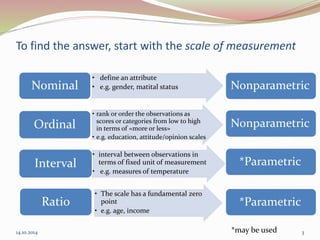
To find the answer, start with the scale of measurement 
• define an attribute 
Nominal • e.g. gender, matital status 
• rank or order the observations as 
scores or categories from low to high 
in terms of «more or less» 
• e.g. education, attitude/opinion scales 
Ordinal 
• interval between observations in 
terms of fixed unit of measurement 
• e.g. measures of temperature 
Interval 
• The scale has a fundamental zero 
point 
• e.g. age, income 
Ratio 
Nonparametric 
Nonparametric 
*Parametric 
*Parametric 
*may be used 
14.10.2014 3
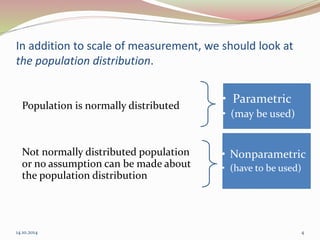
In addition to scale of measurement, we should look at 
the population distribution. 
Population is normally distributed 
• Nonparametric 
• (have to be used) 
Not normally distributed population 
or no assumption can be made about 
the population distribution 
• Parametric 
• (may be used) 
14.10.2014 4
Normal Distribution 
 a very common continuous probability distribution 
 All normal distributions are symmetric. 
 bell-shaped curve with a single peak. 
 68% of the observations fall within 1 standard deviation of 
the mean 
 95% of the observations fall within 2 standard deviations of 
the mean 
 99.7% of the observations fall within 3 standard deviations 
of the mean 
 for a normal distribution, almost all values lie within 3 
standard deviations of the mean
To use parametric tests, stay tuned… 
 Interval or ratio data are required. 
 Normal distribution is required. 
+ 
Homogeneity of variance 
14.10.2014 6
Homogeneity of Variance 
 The variance is a measure of the dispersion of the 
random variable about the mean. In other words, it 
indicates how far the values spread out. 
 It refers to that variance within each of population is 
equal. 
 Homogeneity of Variances is assessed by Levene’s test. 
(T-test and ANOVA use Levene’s test.)
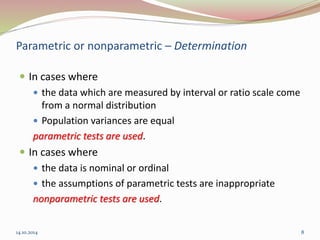
Parametric or nonparametric – Determination 
 In cases where 
 the data which are measured by interval or ratio scale come 
from a normal distribution 
 Population variances are equal 
parametric tests are used. 
 In cases where 
 the data is nominal or ordinal 
 the assumptions of parametric tests are inappropriate 
nonparametric tests are used. 
14.10.2014 8
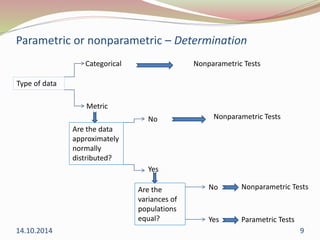
Parametric or nonparametric – Determination 
Type of data 
Categorical 
Metric 
Are the data 
approximately 
normally 
distributed? 
No 
Yes 
Are the 
variances of 
populations 
equal? 
Nonparametric Tests 
Nonparametric Tests 
No Nonparametric Tests 
Parametric Tests 
Yes 
14.10.2014 9
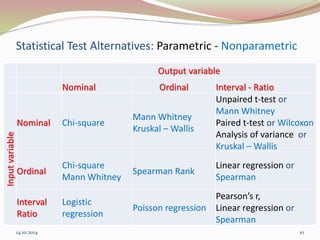
Statistical Test Alternatives: Parametric - Nonparametric 
Output variable 
Nominal Ordinal Interval - Ratio 
14.10.2014 10 
Input variable 
Nominal Chi-square 
Mann Whitney 
Kruskal – Wallis 
Unpaired t-test or 
Mann Whitney 
Paired t-test or Wilcoxon 
Analysis of variance or 
Kruskal – Wallis 
Ordinal 
Chi-square 
Mann Whitney 
Spearman Rank 
Linear regression or 
Spearman 
Interval 
Ratio 
Logistic 
regression 
Poisson regression 
Pearson’s r, 
Linear regression or 
Spearman
Thank you for your attention. 
14.10.2014 11

Parametric vs Nonparametric Tests: When to use which

  • 1.
    Gonenc DALGIC YasarUniversity PhD in Business Administration
  • 2.
    When to usewhich statistical tests: Parametric or nonparametric?? 14.10.2014 2
  • 3.
    To find theanswer, start with the scale of measurement • define an attribute Nominal • e.g. gender, matital status • rank or order the observations as scores or categories from low to high in terms of «more or less» • e.g. education, attitude/opinion scales Ordinal • interval between observations in terms of fixed unit of measurement • e.g. measures of temperature Interval • The scale has a fundamental zero point • e.g. age, income Ratio Nonparametric Nonparametric *Parametric *Parametric *may be used 14.10.2014 3
  • 4.
    In addition toscale of measurement, we should look at the population distribution. Population is normally distributed • Nonparametric • (have to be used) Not normally distributed population or no assumption can be made about the population distribution • Parametric • (may be used) 14.10.2014 4
  • 5.
    Normal Distribution a very common continuous probability distribution  All normal distributions are symmetric.  bell-shaped curve with a single peak.  68% of the observations fall within 1 standard deviation of the mean  95% of the observations fall within 2 standard deviations of the mean  99.7% of the observations fall within 3 standard deviations of the mean  for a normal distribution, almost all values lie within 3 standard deviations of the mean
  • 6.
    To use parametrictests, stay tuned…  Interval or ratio data are required.  Normal distribution is required. + Homogeneity of variance 14.10.2014 6
  • 7.
    Homogeneity of Variance  The variance is a measure of the dispersion of the random variable about the mean. In other words, it indicates how far the values spread out.  It refers to that variance within each of population is equal.  Homogeneity of Variances is assessed by Levene’s test. (T-test and ANOVA use Levene’s test.)
  • 8.
    Parametric or nonparametric– Determination  In cases where  the data which are measured by interval or ratio scale come from a normal distribution  Population variances are equal parametric tests are used.  In cases where  the data is nominal or ordinal  the assumptions of parametric tests are inappropriate nonparametric tests are used. 14.10.2014 8
  • 9.
    Parametric or nonparametric– Determination Type of data Categorical Metric Are the data approximately normally distributed? No Yes Are the variances of populations equal? Nonparametric Tests Nonparametric Tests No Nonparametric Tests Parametric Tests Yes 14.10.2014 9
  • 10.
    Statistical Test Alternatives:Parametric - Nonparametric Output variable Nominal Ordinal Interval - Ratio 14.10.2014 10 Input variable Nominal Chi-square Mann Whitney Kruskal – Wallis Unpaired t-test or Mann Whitney Paired t-test or Wilcoxon Analysis of variance or Kruskal – Wallis Ordinal Chi-square Mann Whitney Spearman Rank Linear regression or Spearman Interval Ratio Logistic regression Poisson regression Pearson’s r, Linear regression or Spearman
  • 11.
    Thank you foryour attention. 14.10.2014 11