BASIC CONCEPTS ON
ESTIMATION
In this module, you will be able to
 Discuss the properties of a good estimator;
 Illustrate point and interval estimations;
 Distinguish between a point and an interval estimation;
 Identify point estimator for the population mean and
population variance; and
 Compute the point estimate of the population mean and
the population variance.
INTRODUCTION
 Inferential statistics focuses on estimating and predicting
the results of a research study.
 Through the process of estimation, a parameter value is
obtained using the information gathered from a particular
sample.
 This process is not always accepted since interpretations
and generalizations must be made from the data collected
from the whole population.
INTRODUCTION
 You have learned from the past lesson that a parameter is a
numerical description of the entire population.
 Thus, parameters are usually unknown because it is
infeasible to survey the whole population.
DEFINITION OF TERMS
 ESTIMATION is the process used to calculate these
population parameters by analyzing only a small random
sample from the population.
 ESTIMATE is the value or range of values used to
approximate a parameter.
TWO TYPES OF PARAMETER ESTIMATES
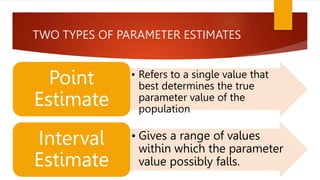
• Refers to a single value that
best determines the true
parameter value of the
population
Point
Estimate
• Gives a range of values
within which the parameter
value possibly falls.
Interval
Estimate
TWO TYPES OF PARAMETER ESTIMATES
(Example)
 Suppose you work for a manufacturer of light bulbs and you want
to predict the average life expectancy of all the light bulbs you
produced.
 Using a sample of 100 light bulbs, you claim that the light bulbs last
for an average of five months. (This is a point estimate of the
population parameter)
 However, if you state that the true life expectancy of the light bulbs
is between 4 and 6 months, then you are giving an interval
estimate of the parameter.
PROPERTIES OF A GOOD ESTIMATOR
Sample measures, such as the sample mean, can be
used to estimate population parameters, say the
sample mean.
These sample measures are called estimators.
The following are the properties of good estimator:
PROPERTIES OF A GOOD ESTIMATOR
 UNBIASEDNESS
Any parameter estimate can be considered a random variable
since its value may change depending on certain factors
including the selection of the members of the sample.
Like all random variables, you can compute its expected value.
An estimate is said to be unbiased when the expectation (i.e. the
mean) of all estimates taken from samples with size n is shown to
be equal to the parameter being estimated.
PROPERTIES OF A GOOD ESTIMATOR
CONSISTENCY
In the past module, you understood that the standard
deviation of the sample statistics taken from the
population is also called the standard error.
Thus, the standard deviation of an estimate is the
standard error of that estimate and, thus, it gives the
possible amount of error of predicting the population
parameter.
PROPERTIES OF A GOOD ESTIMATOR
CONSISTENCY
Consistency of an estimator is achieved when the
estimate produced a relatively smaller standard error.
This may be done by increasing the sample used to
estimate the population parameter. As the sample size
increases, the value of the estimator approaches the
value of the parameter being estimated.
PROPERTIES OF A GOOD ESTIMATOR
EFFICIENCY
From all the unbiased estimators of the population
parameter, the efficient estimator is one that gives the
smallest variance.
Activity
Should you always believe in
guessing/predicting? Why or why not? (10
points)
Differentiate point estimate from interval
estimate. (10 points)

BASIC CONCEPTS OF ESTIMATION STATISTICS AND PROBABILITY.pptx

  • 1.
  • 2.
    In this module,you will be able to  Discuss the properties of a good estimator;  Illustrate point and interval estimations;  Distinguish between a point and an interval estimation;  Identify point estimator for the population mean and population variance; and  Compute the point estimate of the population mean and the population variance.
  • 3.
    INTRODUCTION  Inferential statisticsfocuses on estimating and predicting the results of a research study.  Through the process of estimation, a parameter value is obtained using the information gathered from a particular sample.  This process is not always accepted since interpretations and generalizations must be made from the data collected from the whole population.
  • 4.
    INTRODUCTION  You havelearned from the past lesson that a parameter is a numerical description of the entire population.  Thus, parameters are usually unknown because it is infeasible to survey the whole population.
  • 5.
    DEFINITION OF TERMS ESTIMATION is the process used to calculate these population parameters by analyzing only a small random sample from the population.  ESTIMATE is the value or range of values used to approximate a parameter.
  • 6.
    TWO TYPES OFPARAMETER ESTIMATES • Refers to a single value that best determines the true parameter value of the population Point Estimate • Gives a range of values within which the parameter value possibly falls. Interval Estimate
  • 7.
    TWO TYPES OFPARAMETER ESTIMATES (Example)  Suppose you work for a manufacturer of light bulbs and you want to predict the average life expectancy of all the light bulbs you produced.  Using a sample of 100 light bulbs, you claim that the light bulbs last for an average of five months. (This is a point estimate of the population parameter)  However, if you state that the true life expectancy of the light bulbs is between 4 and 6 months, then you are giving an interval estimate of the parameter.
  • 8.
    PROPERTIES OF AGOOD ESTIMATOR Sample measures, such as the sample mean, can be used to estimate population parameters, say the sample mean. These sample measures are called estimators. The following are the properties of good estimator:
  • 9.
    PROPERTIES OF AGOOD ESTIMATOR  UNBIASEDNESS Any parameter estimate can be considered a random variable since its value may change depending on certain factors including the selection of the members of the sample. Like all random variables, you can compute its expected value. An estimate is said to be unbiased when the expectation (i.e. the mean) of all estimates taken from samples with size n is shown to be equal to the parameter being estimated.
  • 10.
    PROPERTIES OF AGOOD ESTIMATOR CONSISTENCY In the past module, you understood that the standard deviation of the sample statistics taken from the population is also called the standard error. Thus, the standard deviation of an estimate is the standard error of that estimate and, thus, it gives the possible amount of error of predicting the population parameter.
  • 11.
    PROPERTIES OF AGOOD ESTIMATOR CONSISTENCY Consistency of an estimator is achieved when the estimate produced a relatively smaller standard error. This may be done by increasing the sample used to estimate the population parameter. As the sample size increases, the value of the estimator approaches the value of the parameter being estimated.
  • 12.
    PROPERTIES OF AGOOD ESTIMATOR EFFICIENCY From all the unbiased estimators of the population parameter, the efficient estimator is one that gives the smallest variance.
  • 13.
    Activity Should you alwaysbelieve in guessing/predicting? Why or why not? (10 points) Differentiate point estimate from interval estimate. (10 points)

Editor's Notes

  • #2 What is estimation? Estimation is the act of guessing the size, amount, cost, etc., of something
  • #10 There are 3 properties of a good estimator Number 1 is …