Technology Training that Workswww.idc-online.com/slideshare
Digital Signal Processing
Technology Training that Workswww.idc-online.com/slideshare
Welcome to this webinar with
Dr Steve Mackay
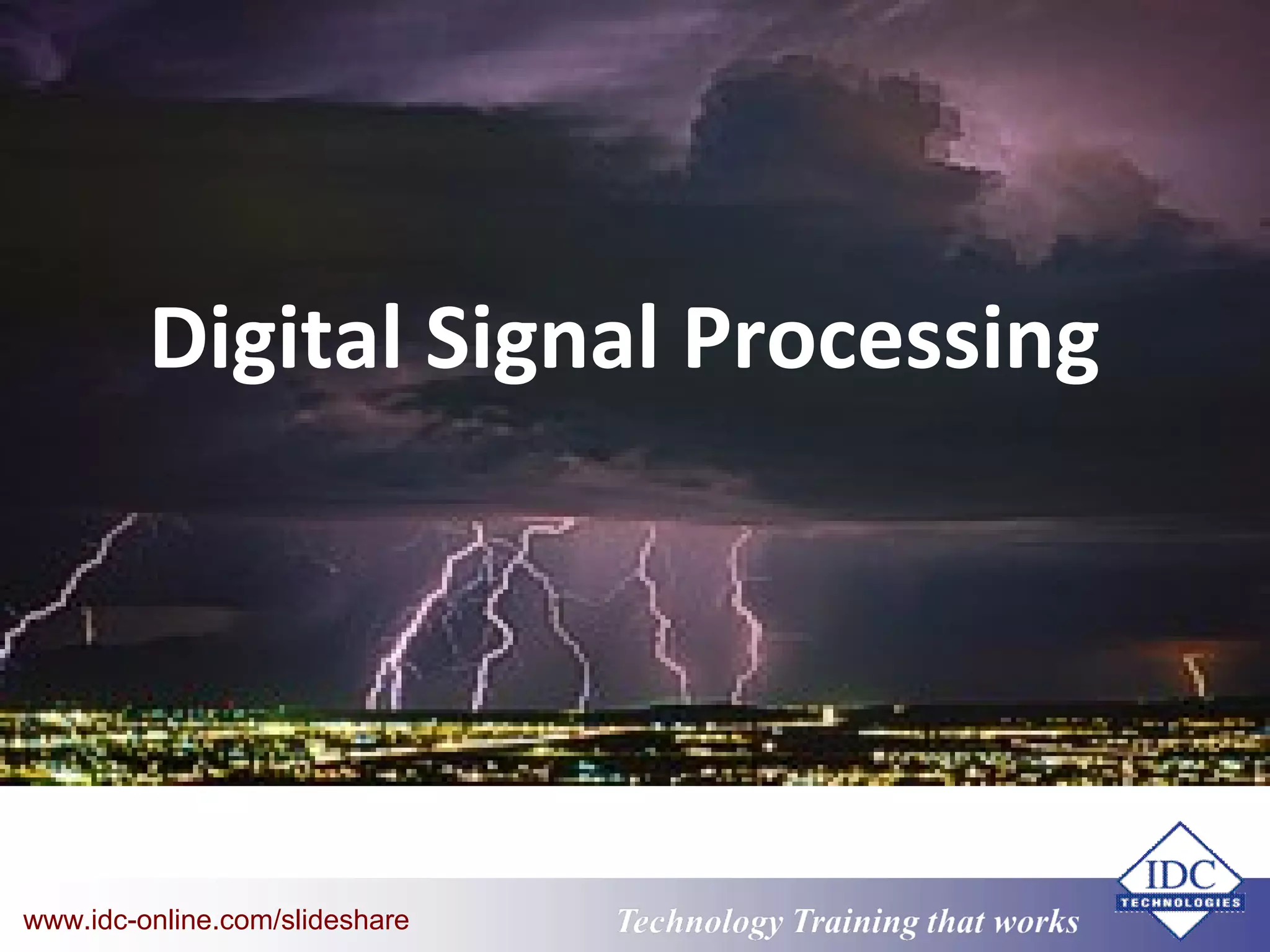
There are at least 3 ways to interact with your presenter today.
1. Use the Text tab, near bottom left of your screen. Type the
message in the space next to the “Send” button,
then enter or click Send. (Ensure “All” is selected in the
drop-down menu under the typing area)
2. Use the Emoticons selection in the text window – choose an
emoticon then click send or enter.
3. Talk! Click the Push To Talk button. The button will change to
yellow when you are queued, then green to show that your
microphone is live.
Remember to click it again when you have spoken
This 45 minute session will commence shortly!
RH
Technology Training that Workswww.idc-online.com/slideshare
Steve Mackay
• Dean of Engineering
• Worked for 30 years in Industrial Automation
• 30 years experience in mining, oil and gas,
electrical and manufacturing industries
Technology Training that Workswww.idc-online.com/slideshare
DSP
• Digital - finite set of distinct values.
• Analog - continuous range of values.
• DSP Processing means processing of signals
which are:
– Discrete in time.
– Discrete in amplitude.
Technology Training that Workswww.idc-online.com/slideshare
Two sources of discrete signals
•Ones that are discrete in nature.
•Sampled version of a continuous-time signal.
Technology Training that Workswww.idc-online.com/slideshare
Why Process Signals Digitally?
• The signals are inherently discrete in nature.
• Consistency -- compared with analog methods.
Technology Training that Workswww.idc-online.com/slideshare
Definition of Terms
• Signals: A quantity that can be measured over
time.
• Frequency: A signal is said to have a frequency
of 50 or 60 Hz.
• Spectrum: Some signals have a combination of
frequencies.
Technology Training that Workswww.idc-online.com/slideshare
• Low Pass Filter: This lets through the low pass
component.
• Bandpass Filter: Only a range of frequencies is
passed through intact.
• High-pass Filter: Allows frequencies above a
certain frequency to pass through intact.
Technology Training that Workswww.idc-online.com/slideshare
Some Application Areas
• Speech and Audio Processing.
– Coding.
– Synthesis.
– Recognition.
Technology Training that Workswww.idc-online.com/slideshare
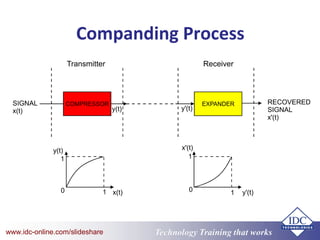
Companding Process
Technology Training that Workswww.idc-online.com/slideshare
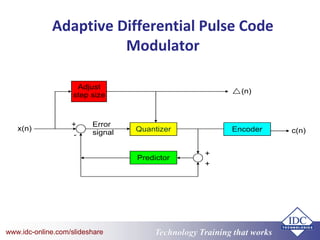
Adaptive Differential Pulse Code
Modulator
Technology Training that Workswww.idc-online.com/slideshare
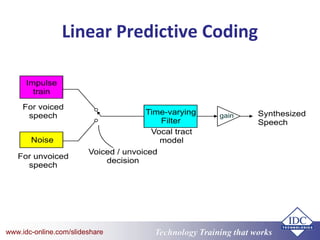
Linear Predictive Coding
Technology Training that Workswww.idc-online.com/slideshare
Image and Video Processing
• Image Enhancement.
• Image Restoration.
• Image Compression and Coding.
Technology Training that Workswww.idc-online.com/slideshare
Adaptive Filtering
• Noise Cancellation.
• Echo Cancellation.
• Channel Equalisation.
Technology Training that Workswww.idc-online.com/slideshare
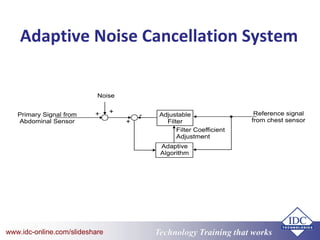
Adaptive Noise Cancellation System
Technology Training that Workswww.idc-online.com/slideshare
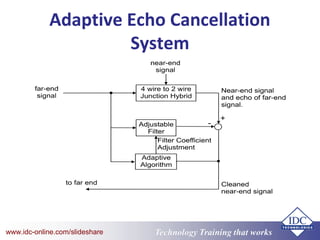
Adaptive Echo Cancellation
System
Technology Training that Workswww.idc-online.com/slideshare
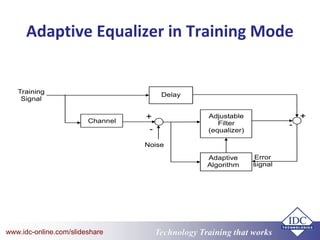
Adaptive Equalizer in Training Mode
Technology Training that Workswww.idc-online.com/slideshare
Control Applications
• Controlling closed-loop feedback systems.
• Controller implements algebraic algorithms
such as filters and compensators.
Technology Training that Workswww.idc-online.com/slideshare
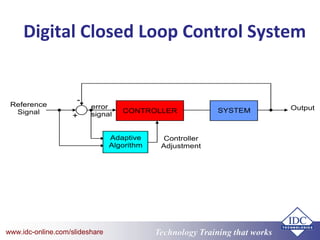
Digital Closed Loop Control System
Technology Training that Workswww.idc-online.com/slideshare
Sensor or Antenna Array
Processing
• Spatially distributed sensors are used for
receiving signals from some sources.
• Coherent summing of outputs from these
sensors referred to as beamforming.
• One can “listen” preferentially to wavefronts
originating from one direction over another.
Technology Training that Workswww.idc-online.com/slideshare
Digital Communication
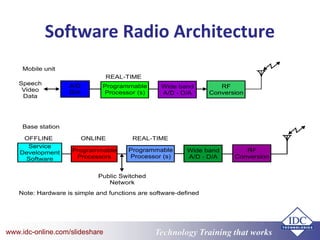
• New Architecture called software radio.
• Use of wideband A/D and D/A converters to
convert RF or IF signals directly.
Technology Training that Workswww.idc-online.com/slideshare
Software Radio Architecture
Technology Training that Workswww.idc-online.com/slideshare
Converting Analog to Digital
Signals and Vice Versa
Technology Training that Workswww.idc-online.com/slideshare
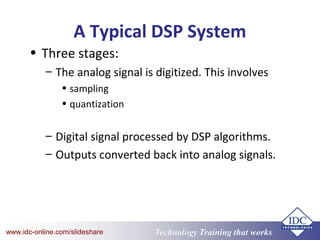
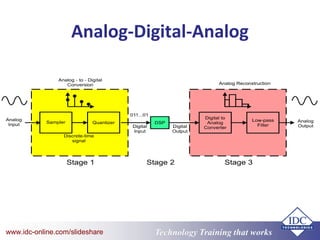
A Typical DSP System
• Three stages:
– The analog signal is digitized. This involves
• sampling
• quantization
– Digital signal processed by DSP algorithms.
– Outputs converted back into analog signals.
Technology Training that Workswww.idc-online.com/slideshare
Analog-Digital-Analog
Technology Training that Workswww.idc-online.com/slideshare
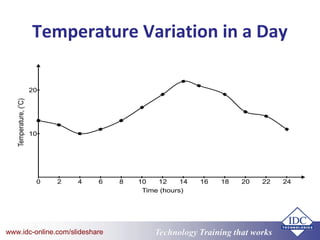
Temperature Variation in a Day
Technology Training that Workswww.idc-online.com/slideshare
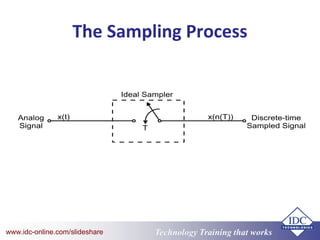
The Sampling Process
Technology Training that Workswww.idc-online.com/slideshare
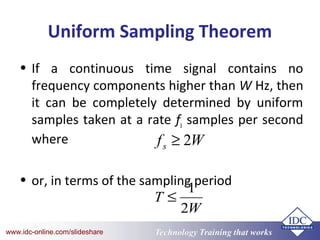
Uniform Sampling Theorem
• If a continuous time signal contains no
frequency components higher than W Hz, then
it can be completely determined by uniform
samples taken at a rate fs samples per second
where
• or, in terms of the sampling period
f Ws ≥ 2
T
W
≤
1
2
Technology Training that Workswww.idc-online.com/slideshare
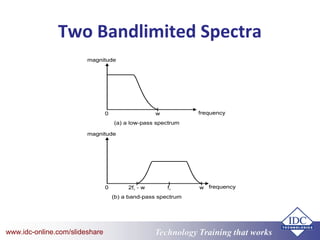
Two Bandlimited Spectra
Technology Training that Workswww.idc-online.com/slideshare
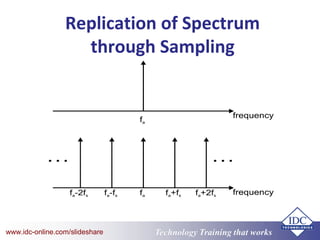
Replication of Spectrum
through Sampling
Technology Training that Workswww.idc-online.com/slideshare
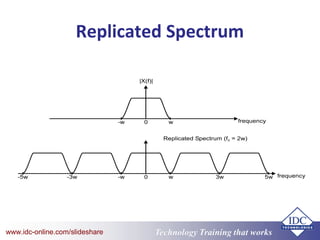
Replicated Spectrum
Technology Training that Workswww.idc-online.com/slideshare
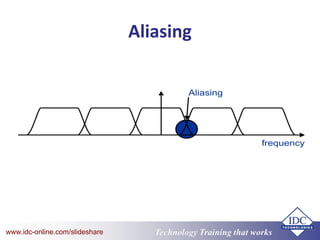
Aliasing
Technology Training that Workswww.idc-online.com/slideshare
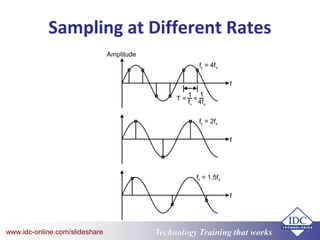
Sampling at Different Rates
Technology Training that Workswww.idc-online.com/slideshare
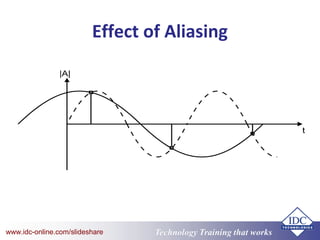
Effect of Aliasing
Technology Training that Workswww.idc-online.com/slideshare
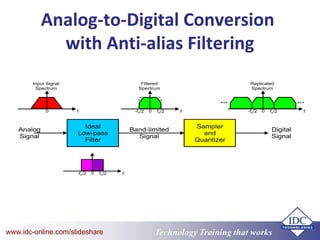
Anti-aliasing Filters
• Process the signal before it is sampled
so they are always analog filters.
• Usually low-pass filters unless
bandpass sampling techniques are
used.
Technology Training that Workswww.idc-online.com/slideshare
Analog-to-Digital Conversion
with Anti-alias Filtering
Technology Training that Workswww.idc-online.com/slideshare
Implications of Non-ideal
Anti-alias Filters
• Sample at higher than Nyquist rate.
• If sampling rate cannot be changed, then a
filter with sharper cut-off (implying a higher
order filter) has to be used.
Technology Training that Workswww.idc-online.com/slideshare
Limits on Sampling Rates
• Practical choice of sampling rate is
determined by two factors:
– Sampling theorem places lower bound
on the allowed values of sampling
frequency.
– Economics of hardware imposes upper
bound on sampling frequency.
Technology Training that Workswww.idc-online.com/slideshare
Thank You For Your Interest
If you are interested in further training, please visit:
http://www.idc-online.com/slideshare

Digital signal processing

  • 1.
    Technology Training thatWorkswww.idc-online.com/slideshare Digital Signal Processing
  • 2.
    Technology Training thatWorkswww.idc-online.com/slideshare Welcome to this webinar with Dr Steve Mackay There are at least 3 ways to interact with your presenter today. 1. Use the Text tab, near bottom left of your screen. Type the message in the space next to the “Send” button, then enter or click Send. (Ensure “All” is selected in the drop-down menu under the typing area) 2. Use the Emoticons selection in the text window – choose an emoticon then click send or enter. 3. Talk! Click the Push To Talk button. The button will change to yellow when you are queued, then green to show that your microphone is live. Remember to click it again when you have spoken This 45 minute session will commence shortly! RH
  • 3.
    Technology Training thatWorkswww.idc-online.com/slideshare Steve Mackay • Dean of Engineering • Worked for 30 years in Industrial Automation • 30 years experience in mining, oil and gas, electrical and manufacturing industries
  • 4.
    Technology Training thatWorkswww.idc-online.com/slideshare DSP • Digital - finite set of distinct values. • Analog - continuous range of values. • DSP Processing means processing of signals which are: – Discrete in time. – Discrete in amplitude.
  • 5.
    Technology Training thatWorkswww.idc-online.com/slideshare Two sources of discrete signals •Ones that are discrete in nature. •Sampled version of a continuous-time signal.
  • 6.
    Technology Training thatWorkswww.idc-online.com/slideshare Why Process Signals Digitally? • The signals are inherently discrete in nature. • Consistency -- compared with analog methods.
  • 7.
    Technology Training thatWorkswww.idc-online.com/slideshare Definition of Terms • Signals: A quantity that can be measured over time. • Frequency: A signal is said to have a frequency of 50 or 60 Hz. • Spectrum: Some signals have a combination of frequencies.
  • 8.
    Technology Training thatWorkswww.idc-online.com/slideshare • Low Pass Filter: This lets through the low pass component. • Bandpass Filter: Only a range of frequencies is passed through intact. • High-pass Filter: Allows frequencies above a certain frequency to pass through intact.
  • 9.
    Technology Training thatWorkswww.idc-online.com/slideshare Some Application Areas • Speech and Audio Processing. – Coding. – Synthesis. – Recognition.
  • 10.
    Technology Training thatWorkswww.idc-online.com/slideshare Companding Process
  • 11.
    Technology Training thatWorkswww.idc-online.com/slideshare Adaptive Differential Pulse Code Modulator
  • 12.
    Technology Training thatWorkswww.idc-online.com/slideshare Linear Predictive Coding
  • 13.
    Technology Training thatWorkswww.idc-online.com/slideshare Image and Video Processing • Image Enhancement. • Image Restoration. • Image Compression and Coding.
  • 14.
    Technology Training thatWorkswww.idc-online.com/slideshare Adaptive Filtering • Noise Cancellation. • Echo Cancellation. • Channel Equalisation.
  • 15.
    Technology Training thatWorkswww.idc-online.com/slideshare Adaptive Noise Cancellation System
  • 16.
    Technology Training thatWorkswww.idc-online.com/slideshare Adaptive Echo Cancellation System
  • 17.
    Technology Training thatWorkswww.idc-online.com/slideshare Adaptive Equalizer in Training Mode
  • 18.
    Technology Training thatWorkswww.idc-online.com/slideshare Control Applications • Controlling closed-loop feedback systems. • Controller implements algebraic algorithms such as filters and compensators.
  • 19.
    Technology Training thatWorkswww.idc-online.com/slideshare Digital Closed Loop Control System
  • 20.
    Technology Training thatWorkswww.idc-online.com/slideshare Sensor or Antenna Array Processing • Spatially distributed sensors are used for receiving signals from some sources. • Coherent summing of outputs from these sensors referred to as beamforming. • One can “listen” preferentially to wavefronts originating from one direction over another.
  • 21.
    Technology Training thatWorkswww.idc-online.com/slideshare Digital Communication • New Architecture called software radio. • Use of wideband A/D and D/A converters to convert RF or IF signals directly.
  • 22.
    Technology Training thatWorkswww.idc-online.com/slideshare Software Radio Architecture
  • 23.
    Technology Training thatWorkswww.idc-online.com/slideshare Converting Analog to Digital Signals and Vice Versa
  • 24.
    Technology Training thatWorkswww.idc-online.com/slideshare A Typical DSP System • Three stages: – The analog signal is digitized. This involves • sampling • quantization – Digital signal processed by DSP algorithms. – Outputs converted back into analog signals.
  • 25.
    Technology Training thatWorkswww.idc-online.com/slideshare Analog-Digital-Analog
  • 26.
    Technology Training thatWorkswww.idc-online.com/slideshare Temperature Variation in a Day
  • 27.
    Technology Training thatWorkswww.idc-online.com/slideshare The Sampling Process
  • 28.
    Technology Training thatWorkswww.idc-online.com/slideshare Uniform Sampling Theorem • If a continuous time signal contains no frequency components higher than W Hz, then it can be completely determined by uniform samples taken at a rate fs samples per second where • or, in terms of the sampling period f Ws ≥ 2 T W ≤ 1 2
  • 29.
    Technology Training thatWorkswww.idc-online.com/slideshare Two Bandlimited Spectra
  • 30.
    Technology Training thatWorkswww.idc-online.com/slideshare Replication of Spectrum through Sampling
  • 31.
    Technology Training thatWorkswww.idc-online.com/slideshare Replicated Spectrum
  • 32.
    Technology Training thatWorkswww.idc-online.com/slideshare Aliasing
  • 33.
    Technology Training thatWorkswww.idc-online.com/slideshare Sampling at Different Rates
  • 34.
    Technology Training thatWorkswww.idc-online.com/slideshare Effect of Aliasing
  • 35.
    Technology Training thatWorkswww.idc-online.com/slideshare Anti-aliasing Filters • Process the signal before it is sampled so they are always analog filters. • Usually low-pass filters unless bandpass sampling techniques are used.
  • 36.
    Technology Training thatWorkswww.idc-online.com/slideshare Analog-to-Digital Conversion with Anti-alias Filtering
  • 37.
    Technology Training thatWorkswww.idc-online.com/slideshare Implications of Non-ideal Anti-alias Filters • Sample at higher than Nyquist rate. • If sampling rate cannot be changed, then a filter with sharper cut-off (implying a higher order filter) has to be used.
  • 38.
    Technology Training thatWorkswww.idc-online.com/slideshare Limits on Sampling Rates • Practical choice of sampling rate is determined by two factors: – Sampling theorem places lower bound on the allowed values of sampling frequency. – Economics of hardware imposes upper bound on sampling frequency.
  • 39.
    Technology Training thatWorkswww.idc-online.com/slideshare Thank You For Your Interest If you are interested in further training, please visit: http://www.idc-online.com/slideshare