Advanced Digital Signal Processing
Introduction to DSP
Prof. Dr. Mohammed Najm Abdullah
https://itswtech.academia.edu/MohammedAlSalam
Introduction to DSP
Digital Signal Processing (DSP) is used in a wide variety of
applications, and it is hard to find a good definition that is general.
We can start by dictionary definitions of the words:
Digital: operating by the use of discrete signals to represent data in
the form of numbers
Signal: a variable parameter by which information is conveyed
through an electronic circuit
Processing: to perform operations on data according to programmed
instructions
Which leads us to a simple definition of:
Digital Signal processing: changing or analyzing information which is
measured as discrete sequences of numbers
Note two unique features of Digital Signal processing as opposed to plain old
ordinary digital processing:
Signals come from the real world - this intimate connection with the real
world leads to many unique needs such as the need to react in real time and
a need to measure signals and convert them to digital numbers
Signals are discrete - which means the information in between discrete
samples is lost
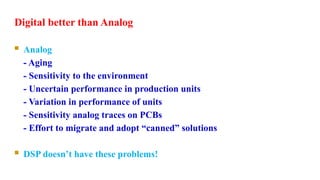
Digital better than Analog
 Analog
- Aging
- Sensitivity to the environment
- Uncertain performance in production units
- Variation in performance of units
- Sensitivity analog traces on PCBs
- Effort to migrate and adopt “canned” solutions
 DSP doesn’t have these problems!
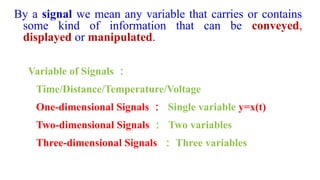
Variable of Signals :
Time/Distance/Temperature/Voltage
One-dimensional Signals : Single variable y=x(t)
Two-dimensional Signals : Two variables
Three-dimensional Signals : Three variables
By a signal we mean any variable that carries or contains
some kind of information that can be conveyed,
displayed or manipulated.
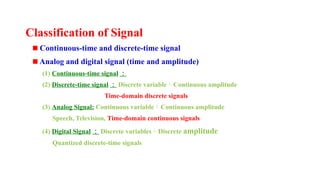
Classification of Signal
Continuous-time and discrete-time signal
Analog and digital signal (time and amplitude)
(1) Continuous-time signal :
(2) Discrete-time signal : Discrete variableContinuous amplitude
Time-domain discrete signals
(3) Analog Signal: Continuous variableContinuous amplitude
Speech, Television, Time-domain continuous signals
(4) Digital Signal : Discrete variablesDiscrete amplitude
Quantized discrete-time signals
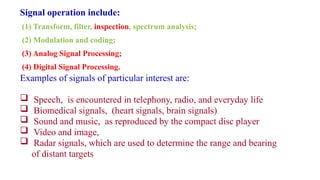
Examples of signals of particular interest are:
 Speech, is encountered in telephony, radio, and everyday life
 Biomedical signals, (heart signals, brain signals)
 Sound and music, as reproduced by the compact disc player
 Video and image,
 Radar signals, which are used to determine the range and bearing
of distant targets
Signal operation include:
(1) Transform, filter, inspection, spectrum analysis;
(2) Modulation and coding;
(3) Analog Signal Processing;
(4) Digital Signal Processing.
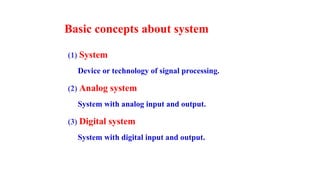
Basic concepts about system
(1) System
Device or technology of signal processing.
(2) Analog system
System with analog input and output.
(3) Digital system
System with digital input and output.
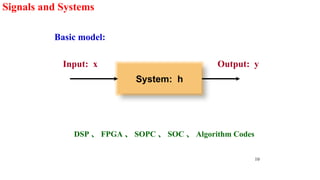
Signals and Systems
Basic model:
Input: x Output: y
10
System: h
DSP 、 FPGA 、 SOPC 、 SOC 、 Algorithm Codes
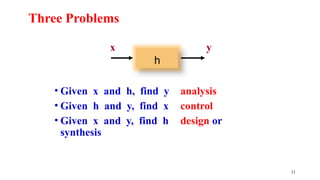
x y
• Given x and h, find y analysis
• Given h and y, find x control
• Given x and y, find h design or
synthesis
11
h
Three Problems
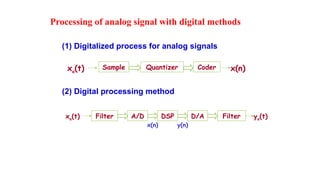
Processing of analog signal with digital methods
(1) Digitalized process for analog signals
Sample Quantizer Coder
xa(t) x(n)
(2) Digital processing method
A/D DSP D/A
xa(t) ya(t)
Filter
x(n) y(n)
Filter
SIGNAL PROCESSING METHODS
Signal processing methods have evolved in algorithmic complexity, aiming for
optimal utilization of the information in order to achieve the best performance. In
general the computational requirement of signal processing methods increases,
often exponentially, with the algorithmic complexity. However, the
implementation cost of advanced signal processing methods has been offset and
made affordable by the consistent trend in recent years of a continuing increase in
the performance, coupled with a simultaneous decrease in the cost, of signal
processing hardware.
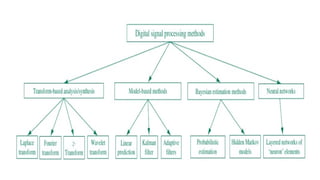
Depending on the method used, digital signal processing algorithms can be
categorized into one or a combination of four broad categories. These are
transform-based signal processing, model-based signal processing, Bayesian
statistical signal processing and neural networks, as illustrated in Figure
The advantages of DSP are common to many digital systems and include:
Versatility:
• Digital systems can be reprogrammed for other applications (at least where
programmable DSP chips are used)
• Digital systems can be ported to different hardware (for example a different DSP chip
or board level product)
Repeatability:
• Digital systems can be easily duplicated
• Digital systems do not depend on strict component tolerances
• Digital system responses do not drift with temperature
Simplicity:
• Some things can be done more easily digitally than with analogue systems
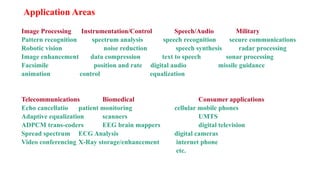
Application Areas
Image Processing Instrumentation/Control Speech/Audio Military
Pattern recognition spectrum analysis speech recognition secure communications
Robotic vision noise reduction speech synthesis radar processing
Image enhancement data compression text to speech sonar processing
Facsimile position and rate digital audio missile guidance
animation control equalization
Telecommunications Biomedical Consumer applications
Echo cancellatio patient monitoring cellular mobile phones
Adaptive equalization scanners UMTS
ADPCM trans-coders EEG brain mappers digital television
Spread spectrum ECG Analysis digital cameras
Video conferencing X-Ray storage/enhancement internet phone
etc.
IMAGE PROCESSING
Pattern recognition
Robotic vision
Image enhancement
Satellite weather map
animation
INSTRUMENTATION & CONTROL
Spectrum analysis
Position and rate control
Noise reduction
Data compression
SPEECH & AUDIO
Speech recognition
Speech synthesis
Text to speech
digital audio
MILITARY
Secure communication
Radar processing
Sonar processing
Missile guidance
TELECOMMUNICATION
Echo cancellation
Adaptive equalization
Video conferencing
data communication
Biomedical
Patient monitoring
Scanners
ECG (Electrocardiograph)
X-ray storage/enhancement
Consumer applications
digital, cellar mobile phones
universal mobile telecommunication system
digital television
digital camera
internet music, phones and video
digital answer machines, fax and modems
voice mail system
interactive entertainment systems
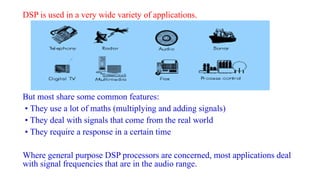
DSP is used in a very wide variety of applications.
But most share some common features:
• They use a lot of maths (multiplying and adding signals)
• They deal with signals that come from the real world
• They require a response in a certain time
Where general purpose DSP processors are concerned, most applications deal
with signal frequencies that are in the audio range.
Converting Analogue Signals
Most DSP applications deal with analogue signals.
• The analogue signal has to be converted to digital form
The analogue signal - a continuous variable defined with infinite precision -
is converted to a discrete sequence of measured values which are
represented digitally.
Information is lost in converting from analogue to digital, due to:
• Inaccuracies in the measurement
• Uncertainty in timing
• Limits on the duration of the measurement
These effects are called quantization errors.
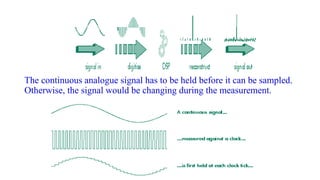
The continuous analogue signal has to be held before it can be sampled.
Otherwise, the signal would be changing during the measurement.
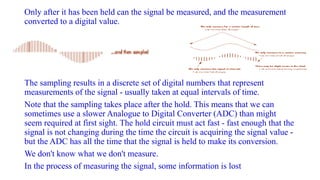
Only after it has been held can the signal be measured, and the measurement
converted to a digital value.
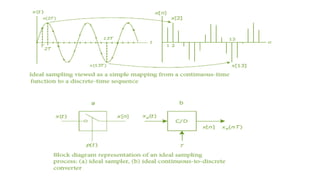
The sampling results in a discrete set of digital numbers that represent
measurements of the signal - usually taken at equal intervals of time.
Note that the sampling takes place after the hold. This means that we can
sometimes use a slower Analogue to Digital Converter (ADC) than might
seem required at first sight. The hold circuit must act fast - fast enough that the
signal is not changing during the time the circuit is acquiring the signal value -
but the ADC has all the time that the signal is held to make its conversion.
We don't know what we don't measure.
In the process of measuring the signal, some information is lost
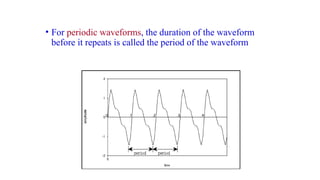
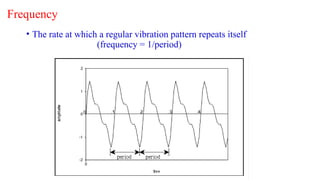
• For periodic waveforms, the duration of the waveform
before it repeats is called the period of the waveform
Frequency
• The rate at which a regular vibration pattern repeats itself
(frequency = 1/period)
Frequency of a Waveform
• The unit for frequency is cycles/second, also called
Hertz (Hz).
• The frequency of a waveform is equal to the reciprocal
of the period.
frequency = 1/period
Frequency of a Waveform
• Examples:
frequency = 10 Hz
period = .1 (1/10) seconds
frequency = 100 Hz
period = .01 (1/100) seconds
frequency = 261.6 Hz
period = .0038226 (1/ 261.6) seconds
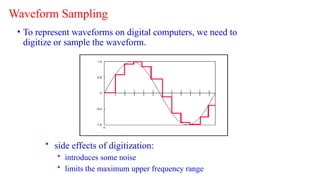
Waveform Sampling
• To represent waveforms on digital computers, we need to
digitize or sample the waveform.
• side effects of digitization:
• introduces some noise
• limits the maximum upper frequency range
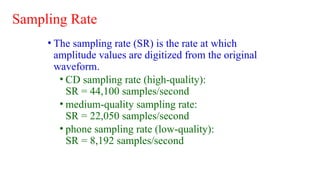
Sampling Rate
• The sampling rate (SR) is the rate at which
amplitude values are digitized from the original
waveform.
• CD sampling rate (high-quality):
SR = 44,100 samples/second
• medium-quality sampling rate:
SR = 22,050 samples/second
• phone sampling rate (low-quality):
SR = 8,192 samples/second
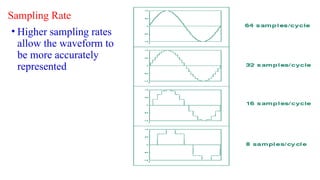
Sampling Rate
• Higher sampling rates
allow the waveform to
be more accurately
represented
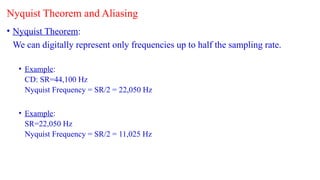
Nyquist Theorem and Aliasing
• Nyquist Theorem:
We can digitally represent only frequencies up to half the sampling rate.
• Example:
CD: SR=44,100 Hz
Nyquist Frequency = SR/2 = 22,050 Hz
• Example:
SR=22,050 Hz
Nyquist Frequency = SR/2 = 11,025 Hz
Nyquist Theorem and Aliasing
• Frequencies above Nyquist frequency "fold over"
to sound like lower frequencies.
• This fold over is called aliasing.
• Aliased frequency f in range [SR/2, SR] becomes
f':
f' = |f - SR|
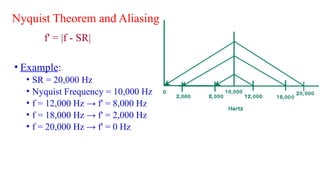
Nyquist Theorem and Aliasing
f' = |f - SR|
• Example:
• SR = 20,000 Hz
• Nyquist Frequency = 10,000 Hz
• f = 12,000 Hz → f' = 8,000 Hz
• f = 18,000 Hz → f' = 2,000 Hz
• f = 20,000 Hz → f' = 0 Hz
Nyquist Theorem and Aliasing
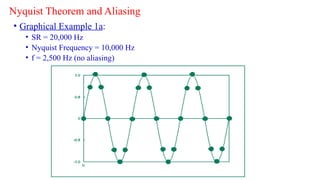
• Graphical Example 1a:
• SR = 20,000 Hz
• Nyquist Frequency = 10,000 Hz
• f = 2,500 Hz (no aliasing)
Nyquist Theorem and Aliasing
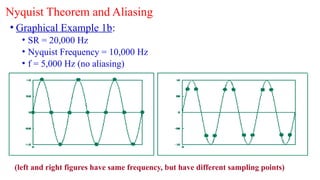
• Graphical Example 1b:
• SR = 20,000 Hz
• Nyquist Frequency = 10,000 Hz
• f = 5,000 Hz (no aliasing)
(left and right figures have same frequency, but have different sampling points)
Nyquist Theorem and Aliasing
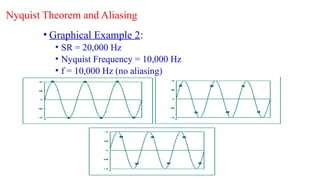
• Graphical Example 2:
• SR = 20,000 Hz
• Nyquist Frequency = 10,000 Hz
• f = 10,000 Hz (no aliasing)
Nyquist Theorem and Aliasing
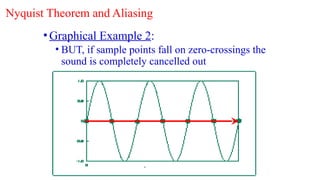
•Graphical Example 2:
• BUT, if sample points fall on zero-crossings the
sound is completely cancelled out
Nyquist Theorem and Aliasing
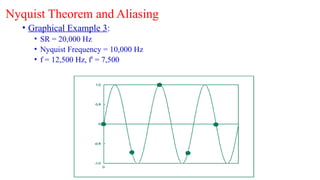
• Graphical Example 3:
• SR = 20,000 Hz
• Nyquist Frequency = 10,000 Hz
• f = 12,500 Hz, f' = 7,500
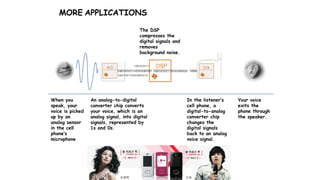
When you
speak, your
voice is picked
up by an
analog sensor
in the cell
phone’s
microphone
An analog-to-digital
converter chip converts
your voice, which is an
analog signal, into digital
signals, represented by
1s and 0s.
The DSP
compresses the
digital signals and
removes
background noise.
In the listener’s
cell phone, a
digital-to-analog
converter chip
changes the
digital signals
back to an analog
voice signal.
Your voice
exits the
phone through
the speaker.
MORE APPLICATIONS
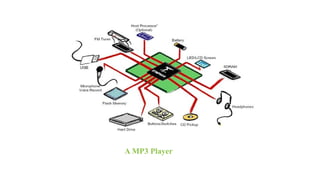
A MP3 Player
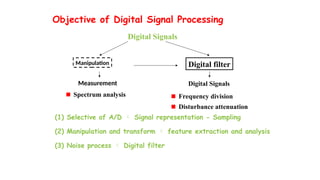
(3) Noise process  Digital filter
(1) Selective of A/D  Signal representation - Sampling
(2) Manipulation and transform  feature extraction and analysis
Objective of Digital Signal Processing
Digital Signals
Manipulation Digital filter
Measurement Digital Signals
Spectrum analysis Frequency division
Disturbance attenuation
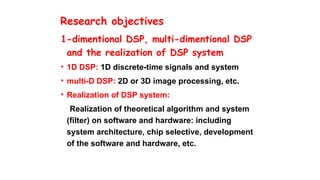
Research objectives
1-dimentional DSP, multi-dimentional DSP
and the realization of DSP system
• 1D DSP: 1D discrete-time signals and system
• multi-D DSP: 2D or 3D image processing, etc.
• Realization of DSP system:
Realization of theoretical algorithm and system
(filter) on software and hardware: including
system architecture, chip selective, development
of the software and hardware, etc.
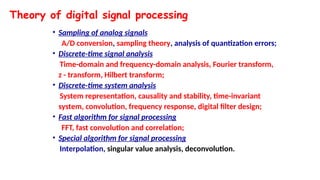
Theory of digital signal processing
• Sampling of analog signals
A/D conversion, sampling theory, analysis of quantization errors;
• Discrete-time signal analysis
Time-domain and frequency-domain analysis, Fourier transform,
z - transform, Hilbert transform;
• Discrete-time system analysis
System representation, causality and stability, time-invariant
system, convolution, frequency response, digital filter design;
• Fast algorithm for signal processing
FFT, fast convolution and correlation;
• Special algorithm for signal processing
Interpolation, singular value analysis, deconvolution.
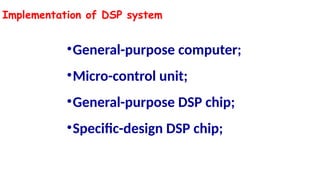
Implementation of DSP system
•General-purpose computer;
•Micro-control unit;
•General-purpose DSP chip;
•Specific-design DSP chip;

Advanced_Digital_Signal_Processing_Lectu(2).pptx

  • 1.
    Advanced Digital SignalProcessing Introduction to DSP Prof. Dr. Mohammed Najm Abdullah https://itswtech.academia.edu/MohammedAlSalam
  • 2.
    Introduction to DSP DigitalSignal Processing (DSP) is used in a wide variety of applications, and it is hard to find a good definition that is general. We can start by dictionary definitions of the words: Digital: operating by the use of discrete signals to represent data in the form of numbers Signal: a variable parameter by which information is conveyed through an electronic circuit Processing: to perform operations on data according to programmed instructions
  • 3.
    Which leads usto a simple definition of: Digital Signal processing: changing or analyzing information which is measured as discrete sequences of numbers Note two unique features of Digital Signal processing as opposed to plain old ordinary digital processing: Signals come from the real world - this intimate connection with the real world leads to many unique needs such as the need to react in real time and a need to measure signals and convert them to digital numbers Signals are discrete - which means the information in between discrete samples is lost
  • 4.
    Digital better thanAnalog  Analog - Aging - Sensitivity to the environment - Uncertain performance in production units - Variation in performance of units - Sensitivity analog traces on PCBs - Effort to migrate and adopt “canned” solutions  DSP doesn’t have these problems!
  • 5.
    Variable of Signals: Time/Distance/Temperature/Voltage One-dimensional Signals : Single variable y=x(t) Two-dimensional Signals : Two variables Three-dimensional Signals : Three variables By a signal we mean any variable that carries or contains some kind of information that can be conveyed, displayed or manipulated.
  • 6.
    Classification of Signal Continuous-timeand discrete-time signal Analog and digital signal (time and amplitude) (1) Continuous-time signal : (2) Discrete-time signal : Discrete variableContinuous amplitude Time-domain discrete signals (3) Analog Signal: Continuous variableContinuous amplitude Speech, Television, Time-domain continuous signals (4) Digital Signal : Discrete variablesDiscrete amplitude Quantized discrete-time signals
  • 8.
    Examples of signalsof particular interest are:  Speech, is encountered in telephony, radio, and everyday life  Biomedical signals, (heart signals, brain signals)  Sound and music, as reproduced by the compact disc player  Video and image,  Radar signals, which are used to determine the range and bearing of distant targets Signal operation include: (1) Transform, filter, inspection, spectrum analysis; (2) Modulation and coding; (3) Analog Signal Processing; (4) Digital Signal Processing.
  • 9.
    Basic concepts aboutsystem (1) System Device or technology of signal processing. (2) Analog system System with analog input and output. (3) Digital system System with digital input and output.
  • 10.
    Signals and Systems Basicmodel: Input: x Output: y 10 System: h DSP 、 FPGA 、 SOPC 、 SOC 、 Algorithm Codes
  • 11.
    x y • Givenx and h, find y analysis • Given h and y, find x control • Given x and y, find h design or synthesis 11 h Three Problems
  • 12.
    Processing of analogsignal with digital methods (1) Digitalized process for analog signals Sample Quantizer Coder xa(t) x(n) (2) Digital processing method A/D DSP D/A xa(t) ya(t) Filter x(n) y(n) Filter
  • 13.
    SIGNAL PROCESSING METHODS Signalprocessing methods have evolved in algorithmic complexity, aiming for optimal utilization of the information in order to achieve the best performance. In general the computational requirement of signal processing methods increases, often exponentially, with the algorithmic complexity. However, the implementation cost of advanced signal processing methods has been offset and made affordable by the consistent trend in recent years of a continuing increase in the performance, coupled with a simultaneous decrease in the cost, of signal processing hardware. Depending on the method used, digital signal processing algorithms can be categorized into one or a combination of four broad categories. These are transform-based signal processing, model-based signal processing, Bayesian statistical signal processing and neural networks, as illustrated in Figure
  • 15.
    The advantages ofDSP are common to many digital systems and include: Versatility: • Digital systems can be reprogrammed for other applications (at least where programmable DSP chips are used) • Digital systems can be ported to different hardware (for example a different DSP chip or board level product) Repeatability: • Digital systems can be easily duplicated • Digital systems do not depend on strict component tolerances • Digital system responses do not drift with temperature Simplicity: • Some things can be done more easily digitally than with analogue systems
  • 16.
    Application Areas Image ProcessingInstrumentation/Control Speech/Audio Military Pattern recognition spectrum analysis speech recognition secure communications Robotic vision noise reduction speech synthesis radar processing Image enhancement data compression text to speech sonar processing Facsimile position and rate digital audio missile guidance animation control equalization Telecommunications Biomedical Consumer applications Echo cancellatio patient monitoring cellular mobile phones Adaptive equalization scanners UMTS ADPCM trans-coders EEG brain mappers digital television Spread spectrum ECG Analysis digital cameras Video conferencing X-Ray storage/enhancement internet phone etc.
  • 17.
    IMAGE PROCESSING Pattern recognition Roboticvision Image enhancement Satellite weather map animation INSTRUMENTATION & CONTROL Spectrum analysis Position and rate control Noise reduction Data compression SPEECH & AUDIO Speech recognition Speech synthesis Text to speech digital audio MILITARY Secure communication Radar processing Sonar processing Missile guidance TELECOMMUNICATION Echo cancellation Adaptive equalization Video conferencing data communication Biomedical Patient monitoring Scanners ECG (Electrocardiograph) X-ray storage/enhancement Consumer applications digital, cellar mobile phones universal mobile telecommunication system digital television digital camera internet music, phones and video digital answer machines, fax and modems voice mail system interactive entertainment systems
  • 18.
    DSP is usedin a very wide variety of applications. But most share some common features: • They use a lot of maths (multiplying and adding signals) • They deal with signals that come from the real world • They require a response in a certain time Where general purpose DSP processors are concerned, most applications deal with signal frequencies that are in the audio range.
  • 19.
    Converting Analogue Signals MostDSP applications deal with analogue signals. • The analogue signal has to be converted to digital form The analogue signal - a continuous variable defined with infinite precision - is converted to a discrete sequence of measured values which are represented digitally. Information is lost in converting from analogue to digital, due to: • Inaccuracies in the measurement • Uncertainty in timing • Limits on the duration of the measurement These effects are called quantization errors.
  • 20.
    The continuous analoguesignal has to be held before it can be sampled. Otherwise, the signal would be changing during the measurement.
  • 21.
    Only after ithas been held can the signal be measured, and the measurement converted to a digital value. The sampling results in a discrete set of digital numbers that represent measurements of the signal - usually taken at equal intervals of time. Note that the sampling takes place after the hold. This means that we can sometimes use a slower Analogue to Digital Converter (ADC) than might seem required at first sight. The hold circuit must act fast - fast enough that the signal is not changing during the time the circuit is acquiring the signal value - but the ADC has all the time that the signal is held to make its conversion. We don't know what we don't measure. In the process of measuring the signal, some information is lost
  • 23.
    • For periodicwaveforms, the duration of the waveform before it repeats is called the period of the waveform
  • 24.
    Frequency • The rateat which a regular vibration pattern repeats itself (frequency = 1/period)
  • 25.
    Frequency of aWaveform • The unit for frequency is cycles/second, also called Hertz (Hz). • The frequency of a waveform is equal to the reciprocal of the period. frequency = 1/period
  • 26.
    Frequency of aWaveform • Examples: frequency = 10 Hz period = .1 (1/10) seconds frequency = 100 Hz period = .01 (1/100) seconds frequency = 261.6 Hz period = .0038226 (1/ 261.6) seconds
  • 27.
    Waveform Sampling • Torepresent waveforms on digital computers, we need to digitize or sample the waveform. • side effects of digitization: • introduces some noise • limits the maximum upper frequency range
  • 28.
    Sampling Rate • Thesampling rate (SR) is the rate at which amplitude values are digitized from the original waveform. • CD sampling rate (high-quality): SR = 44,100 samples/second • medium-quality sampling rate: SR = 22,050 samples/second • phone sampling rate (low-quality): SR = 8,192 samples/second
  • 29.
    Sampling Rate • Highersampling rates allow the waveform to be more accurately represented
  • 30.
    Nyquist Theorem andAliasing • Nyquist Theorem: We can digitally represent only frequencies up to half the sampling rate. • Example: CD: SR=44,100 Hz Nyquist Frequency = SR/2 = 22,050 Hz • Example: SR=22,050 Hz Nyquist Frequency = SR/2 = 11,025 Hz
  • 31.
    Nyquist Theorem andAliasing • Frequencies above Nyquist frequency "fold over" to sound like lower frequencies. • This fold over is called aliasing. • Aliased frequency f in range [SR/2, SR] becomes f': f' = |f - SR|
  • 32.
    Nyquist Theorem andAliasing f' = |f - SR| • Example: • SR = 20,000 Hz • Nyquist Frequency = 10,000 Hz • f = 12,000 Hz → f' = 8,000 Hz • f = 18,000 Hz → f' = 2,000 Hz • f = 20,000 Hz → f' = 0 Hz
  • 33.
    Nyquist Theorem andAliasing • Graphical Example 1a: • SR = 20,000 Hz • Nyquist Frequency = 10,000 Hz • f = 2,500 Hz (no aliasing)
  • 34.
    Nyquist Theorem andAliasing • Graphical Example 1b: • SR = 20,000 Hz • Nyquist Frequency = 10,000 Hz • f = 5,000 Hz (no aliasing) (left and right figures have same frequency, but have different sampling points)
  • 35.
    Nyquist Theorem andAliasing • Graphical Example 2: • SR = 20,000 Hz • Nyquist Frequency = 10,000 Hz • f = 10,000 Hz (no aliasing)
  • 36.
    Nyquist Theorem andAliasing •Graphical Example 2: • BUT, if sample points fall on zero-crossings the sound is completely cancelled out
  • 37.
    Nyquist Theorem andAliasing • Graphical Example 3: • SR = 20,000 Hz • Nyquist Frequency = 10,000 Hz • f = 12,500 Hz, f' = 7,500
  • 43.
    When you speak, your voiceis picked up by an analog sensor in the cell phone’s microphone An analog-to-digital converter chip converts your voice, which is an analog signal, into digital signals, represented by 1s and 0s. The DSP compresses the digital signals and removes background noise. In the listener’s cell phone, a digital-to-analog converter chip changes the digital signals back to an analog voice signal. Your voice exits the phone through the speaker. MORE APPLICATIONS
  • 44.
  • 45.
    (3) Noise process Digital filter (1) Selective of A/D  Signal representation - Sampling (2) Manipulation and transform  feature extraction and analysis Objective of Digital Signal Processing Digital Signals Manipulation Digital filter Measurement Digital Signals Spectrum analysis Frequency division Disturbance attenuation
  • 46.
    Research objectives 1-dimentional DSP,multi-dimentional DSP and the realization of DSP system • 1D DSP: 1D discrete-time signals and system • multi-D DSP: 2D or 3D image processing, etc. • Realization of DSP system: Realization of theoretical algorithm and system (filter) on software and hardware: including system architecture, chip selective, development of the software and hardware, etc.
  • 47.
    Theory of digitalsignal processing • Sampling of analog signals A/D conversion, sampling theory, analysis of quantization errors; • Discrete-time signal analysis Time-domain and frequency-domain analysis, Fourier transform, z - transform, Hilbert transform; • Discrete-time system analysis System representation, causality and stability, time-invariant system, convolution, frequency response, digital filter design; • Fast algorithm for signal processing FFT, fast convolution and correlation; • Special algorithm for signal processing Interpolation, singular value analysis, deconvolution.
  • 48.
    Implementation of DSPsystem •General-purpose computer; •Micro-control unit; •General-purpose DSP chip; •Specific-design DSP chip;