The document provides an overview of digital signal processing (DSP). It defines DSP as the analysis, interpretation, and manipulation of signals that have been digitized. The document discusses the need for signal processing to remove noise, and categorizes signal processing as either analog or digital. It highlights advantages of digital over analog processing, describes common filters and their applications. The document also outlines different DSP processor architectures, applications of DSP, and recommendations books and resources to learn more about DSP.
Introduction to DSP by Dr. Y. Narasimha Murthy outlining organization topics, categories, and importance.
Definition of signal processing; need for signal processing due to noise; and characteristics of signal processing. Categories of signal processing, focusing on analog signal processing and its components.
Digital signal processor components and advantages of digital signal processing over analog.
Limitations in DSP, role of filters in signal separation and restoration, and examples of usage.
Functionality and performance of analog filters, their design, advantages, and limitations.
Overview of digital filters, advantages over analog filters, and disadvantages including quantization error.
Key differences in construction, analysis techniques, and responses of analog versus digital filters.
Introduction to FIR and IIR filters, their definitions, advantages, disadvantages, and examples.
Diverse applications of DSP including digital filtering, speech processing, and biomedical engineering.
Examples of DSP in music, including techniques to manipulate sound for natural effects and artistic styles.
Overview of DSP processors from Texas and Analog devices, including their architectures.
Recommended books and web resources for further learning and understanding of digital signal processing.
Concluding thoughts with a quote by Robert Frost, wishing good luck on learning DSP.
Organization
o What issignal processing
o Need of Processing
o Catagories
o Advantages of Digital over analog
o Filters-Analog & Digital
o Comparison
o Digital filters-Types
2/28/2023 Dr.YNM 2
3.
contd
o FIR &IIR
oAdvantages-Disadvantages
o Applications of DSP
o Simple Illustrations
o Various types of DSPs
o Microprocessor & Signal processor
o Architecture
o Books &Web resources
2/28/2023 Dr.YNM 3
4.
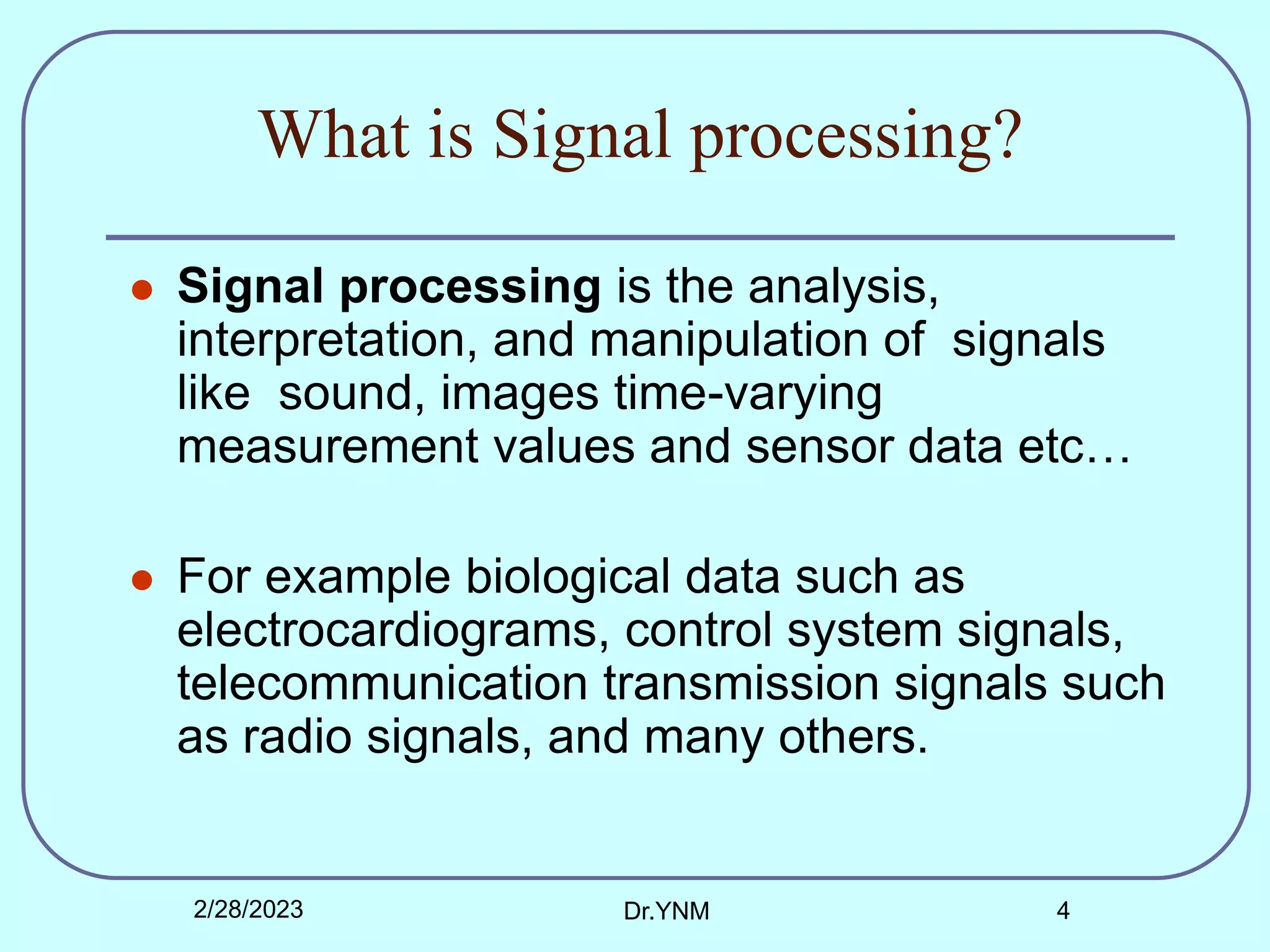
What is Signalprocessing?
Signal processing is the analysis,
interpretation, and manipulation of signals
like sound, images time-varying
measurement values and sensor data etc…
For example biological data such as
electrocardiograms, control system signals,
telecommunication transmission signals such
as radio signals, and many others.
2/28/2023 Dr.YNM 4
5.
Need of SignalProcessing
When a signal is transmitted from one point
to another there is every possibility of
contamination /deformation of the signal
by external noise.
So to retrieve the original signal at the
receiver suitable filters are to be used. i.e
the signal is processed to obtain the pure
signal.
2/28/2023 Dr.YNM 5
6.
Categories of signalprocessing
Analog signal processing — for signals that
have not been digitized, as in classical
radio, telephone, radar, and television
systems.
This involves linear electronic circuits such
as passive filters, active filters, additive
mixers, integrators and delay lines.
2/28/2023 Dr.YNM 6
7.
It alsoinvolves non-linear circuits such as
compandors, multiplicators (frequency mixers
and voltage-controlled amplifiers), voltage-
controlled filters, voltage-controlled oscillators
and phase-locked loops.
Digital signal processing — for signals that have
been digitized, processing is done by general-
purpose computers or by digital circuits such as
ASICs, field-programmable gate arrays or
specialized digital signal processors (DSP chips).
2/28/2023 Dr.YNM 7
8.
So the processingof the signal helps to estimate
characteristic parameters of the signal and also to
transform the signal in to the desired form.
2/28/2023 Dr.YNM 8
9.
Analog signal processing
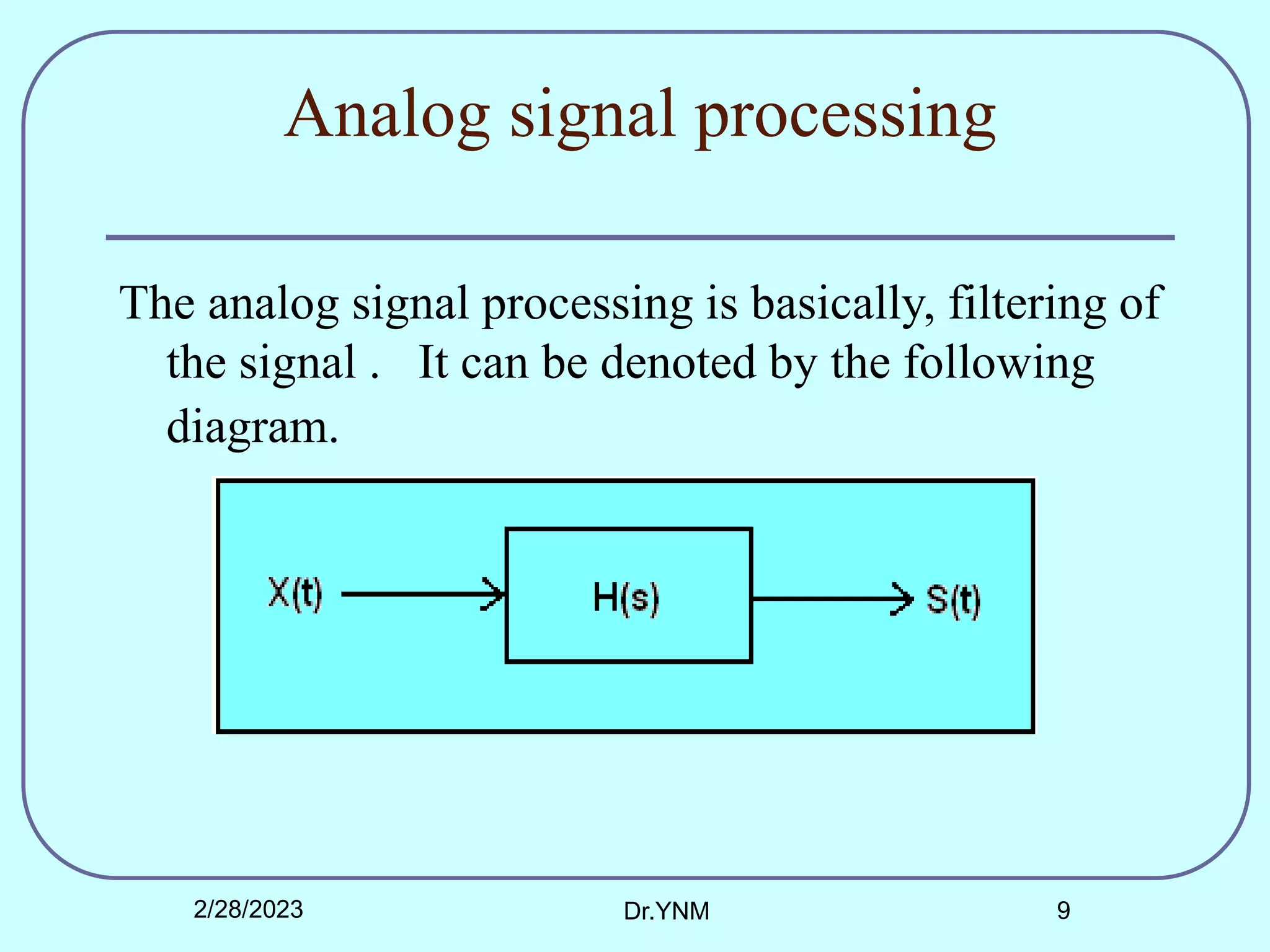
Theanalog signal processing is basically, filtering of
the signal . It can be denoted by the following
diagram.
2/28/2023 Dr.YNM 9
10.
Digital signal processing-Blockdiagram
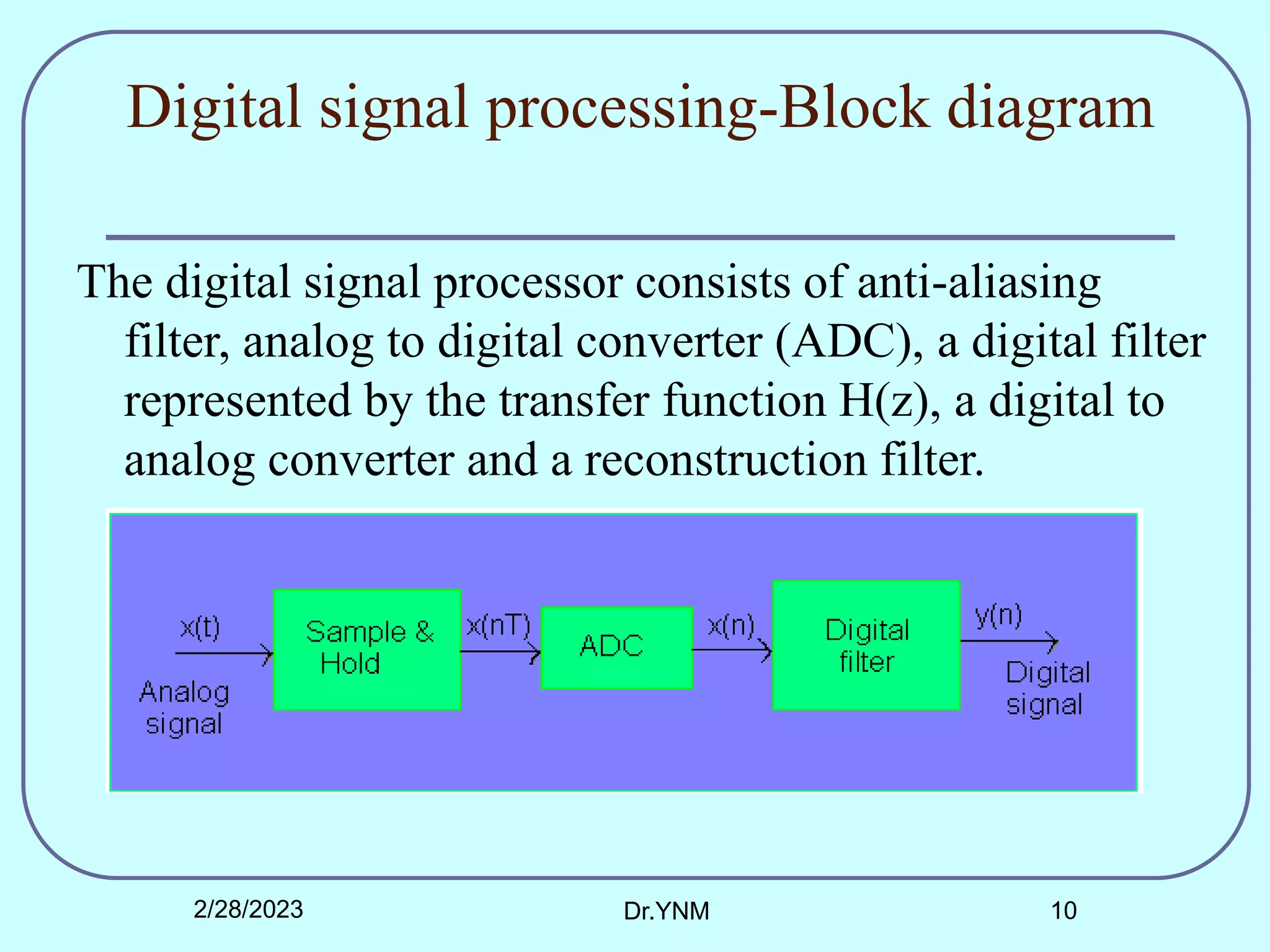
The digital signal processor consists of anti-aliasing
filter, analog to digital converter (ADC), a digital filter
represented by the transfer function H(z), a digital to
analog converter and a reconstruction filter.
2/28/2023 Dr.YNM 10
11.
Advantages of Digitalover analog
signal processing
Accuracy: The analog circuits are prone to
temperature and external effects, but the digital
filters have no such problems.
Flexibility: Reconfiguration of analog filters is
very complex whereas the digital filters can be
reconfigured easily by changing the program
coefficients.
2/28/2023 Dr.YNM 11
12.
Digital signalscan be easily stored on any
magnetic media or optical media are using
semiconductor chips.
Easy operation: Even complex
mathematical operations can be performed
easily using computers, which is not the
case with analog processing.
2/28/2023 Dr.YNM 12
13.
Multiplexing: Digitalsignal processing
provides the way for Integrated service
digital network (ISDN) where digitized
signals can be multiplexed with other
digital data and transmitted through the
same channel.
2/28/2023 Dr.YNM 13
14.
Limitations
There are alsocertain limitations in DSP.
Bandwidth restrictions
Speed limitations
Finite word length problems.
2/28/2023 Dr.YNM 14
15.
Filters
Any one whoobserves the DSP block
diagram finds that the filter is the main
component of DSP.
Filters have two uses
a) Signal separation
b) Signal restoration
2/28/2023 Dr.YNM 15
16.
Signal separationis needed when a signal
has been contaminated with interference,
noise or other signals.
Signal restoration is used when a signal
has been distorted in some way or other.
For example an audio recording made with
poor equipment may be filtered to get the
original sound.
2/28/2023 Dr.YNM 16
17.
Another example ofdeblurring of an image
occurred with an improperly focused lens
or a shaky camera.
So these problems can be solved with either
analog or digital filters.
2/28/2023 Dr.YNM 17
18.
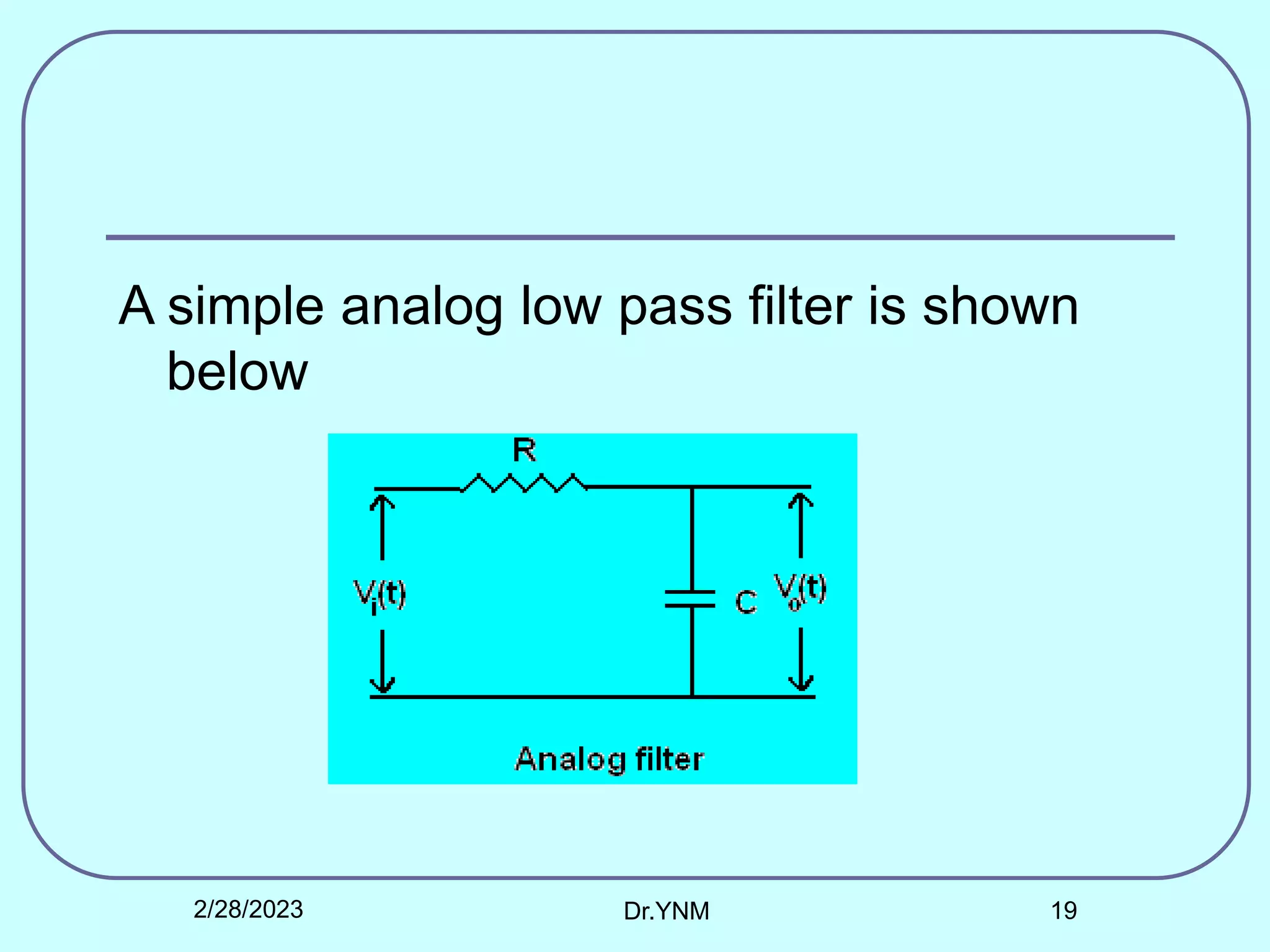
Analog filters
Analog filterstake the analog signal as input
and process the signal and finally gives the
analog output.
An analog filter is constructed using resistors,
capacitors, active components etc…
2/28/2023 Dr.YNM 18
19.
A simple analoglow pass filter is shown
below
2/28/2023 Dr.YNM 19
20.
Coming to advantagesof Analog filters they are
cheap and have a large dynamic range in
both amplitude and frequency. But in terms of
performance they are not superior to digital
filters.
2/28/2023 Dr.YNM 20
21.
Digital filters
A digitalfilter processes and generates digital
data.
A digital filter constitutes elements like adder,
multiplier and delay units.
Digital filters are vastly superior in the level of
performance in comparison to analog filters.
2/28/2023 Dr.YNM 21
Advantages
There are manyadvantages with digital
filters.
Unlike analog filters ,the digital filter
performance is not influenced by
component ageing, temperature and power
variations.
2/28/2023 Dr.YNM 23
24.
A digitalfilter is highly immune to noise and
relatively stable.
Digital filters afford a wide variety of shapes
for the amplitude and phase responses.
Impedance matching problems are minimum.
2/28/2023 Dr.YNM 24
25.
Transportation andreconfiguration is very
easy ,which is not true in the case of analog
filters.
Multiple filtering is possible only in digital
filters.
Computational problems are minimum.
2/28/2023 Dr.YNM 25
26.
Disadvantages:
There are fewdisadvantages also.
Quantization error occurs due to finite word
length in the representation of signals and
parameters.
Digital filters also suffer from Bandwidth
problems.
2/28/2023 Dr.YNM 26
27.
Differences between analogand
digital filters :
An analog filter is constructed using active,
passive components like resistors, capacitors
and op amps etc..
A digital filter constitutes adder, multiplier and
delay elements
An analog filter is denoted by a differential
equation.
A digital filter is denoted by a difference
equation.
2/28/2023 Dr.YNM 27
28.
Laplace transformis used for the analysis of
analog filter.
Z transforms are used for the analysis of digital
filters.
The frequency response of an analog filter can
be modified by changing the components.
The frequency response can be changed by
changing the filter coefficients.
2/28/2023 Dr.YNM 28
29.
Types of Digitalfilters
Broadly speaking ,two types of digital filters
exists.
FIR Filters(Finite impulse response filters)
IIR Filters (Infinite Impulse response filters)
2/28/2023 Dr.YNM 29
30.
FIR Filters
The digitalfilter whose impulse response is of finite
duration is known as Finite impulse response filter.
The response of the FIR filter depends only on the
present and past input samples.
These FIR filters are also called non recursive filters.
So, in FIR the impulse response sequence is of finite
duration, i.e. it has a finite number of non-zero terms.
2/28/2023 Dr.YNM 30
31.
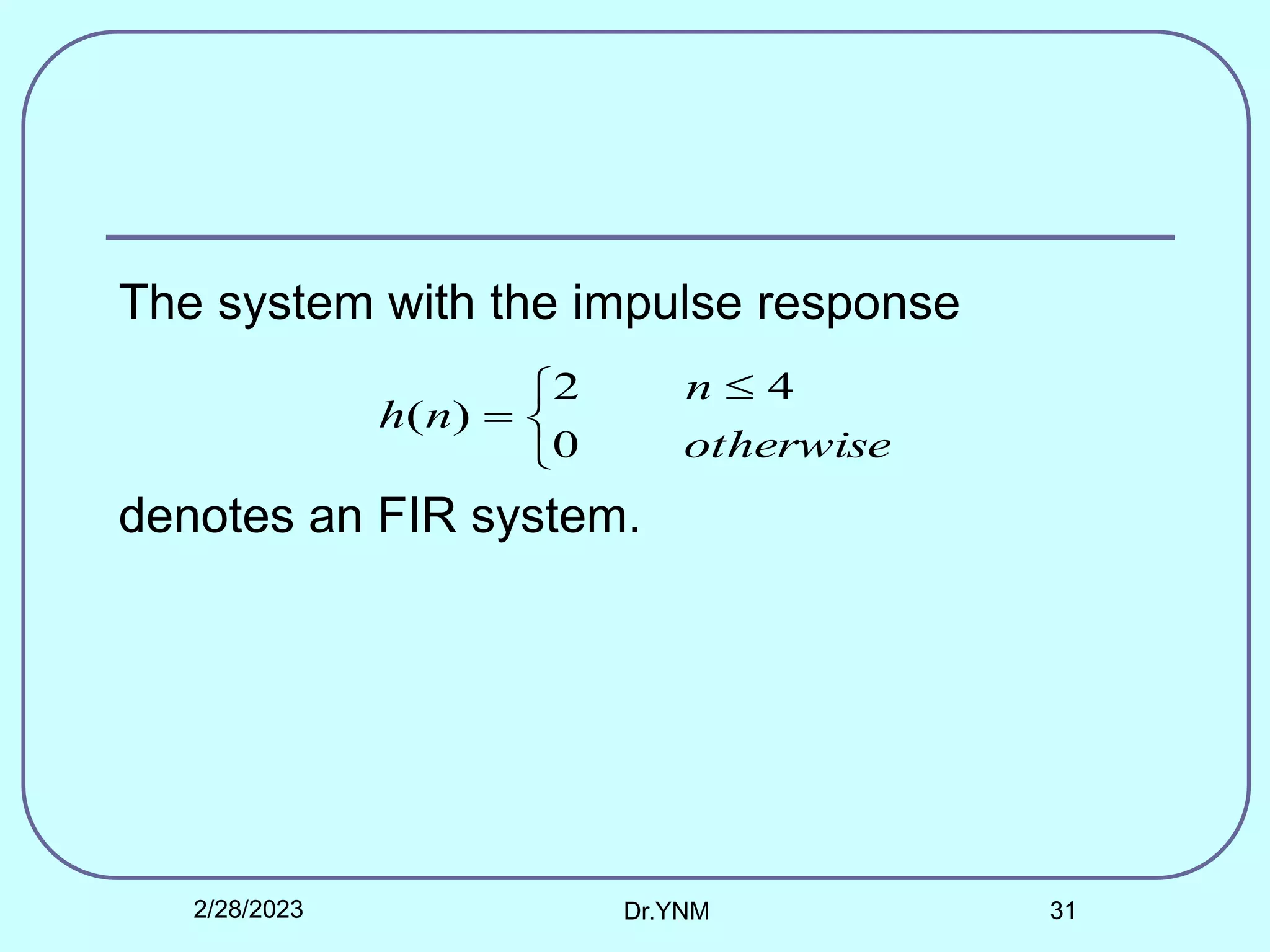
The system withthe impulse response
denotes an FIR system.
otherwise
n
n
h
0
4
2
)
(
2/28/2023 Dr.YNM 31
32.
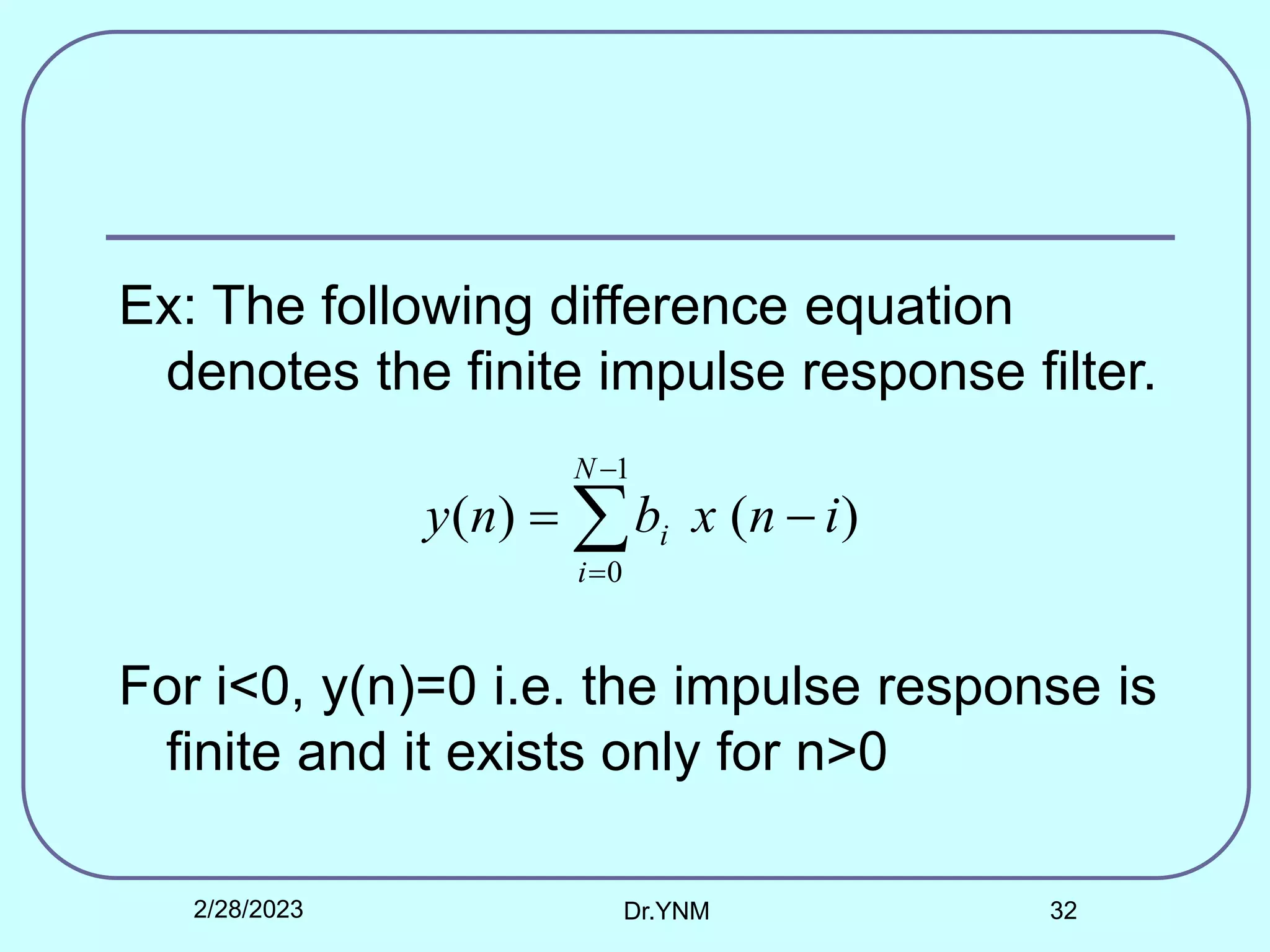
Ex: The followingdifference equation
denotes the finite impulse response filter.
For i<0, y(n)=0 i.e. the impulse response is
finite and it exists only for n>0
)
(
)
(
1
0
i
n
x
b
n
y
N
i
i
2/28/2023 Dr.YNM 32
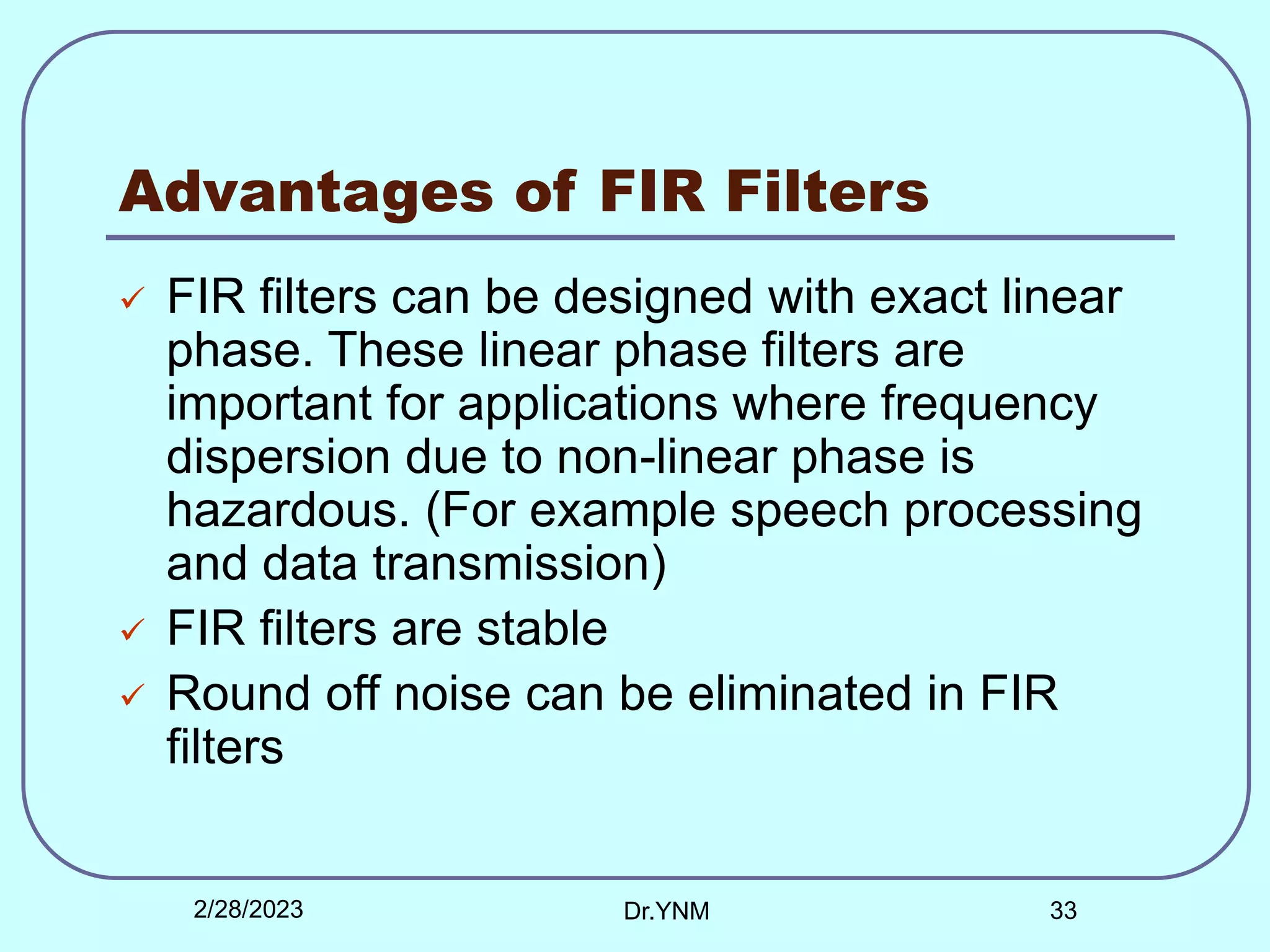
33.
Advantages of FIRFilters
FIR filters can be designed with exact linear
phase. These linear phase filters are
important for applications where frequency
dispersion due to non-linear phase is
hazardous. (For example speech processing
and data transmission)
FIR filters are stable
Round off noise can be eliminated in FIR
filters
2/28/2023 Dr.YNM 33
34.
FIR filterscan be efficiently implemented in
multirate DSP systems
FIR filters reduce the computation complexity
2/28/2023 Dr.YNM 34
35.
Disadvantages
As largenumber of impulse response
samples are required to properly
approximate sharp cutoff FIR filters the
processing will become complex due to slow
convolution.
The delay of linear phase FIR filters can
sometimes create problems in some DSP
applications.
2/28/2023 Dr.YNM 35
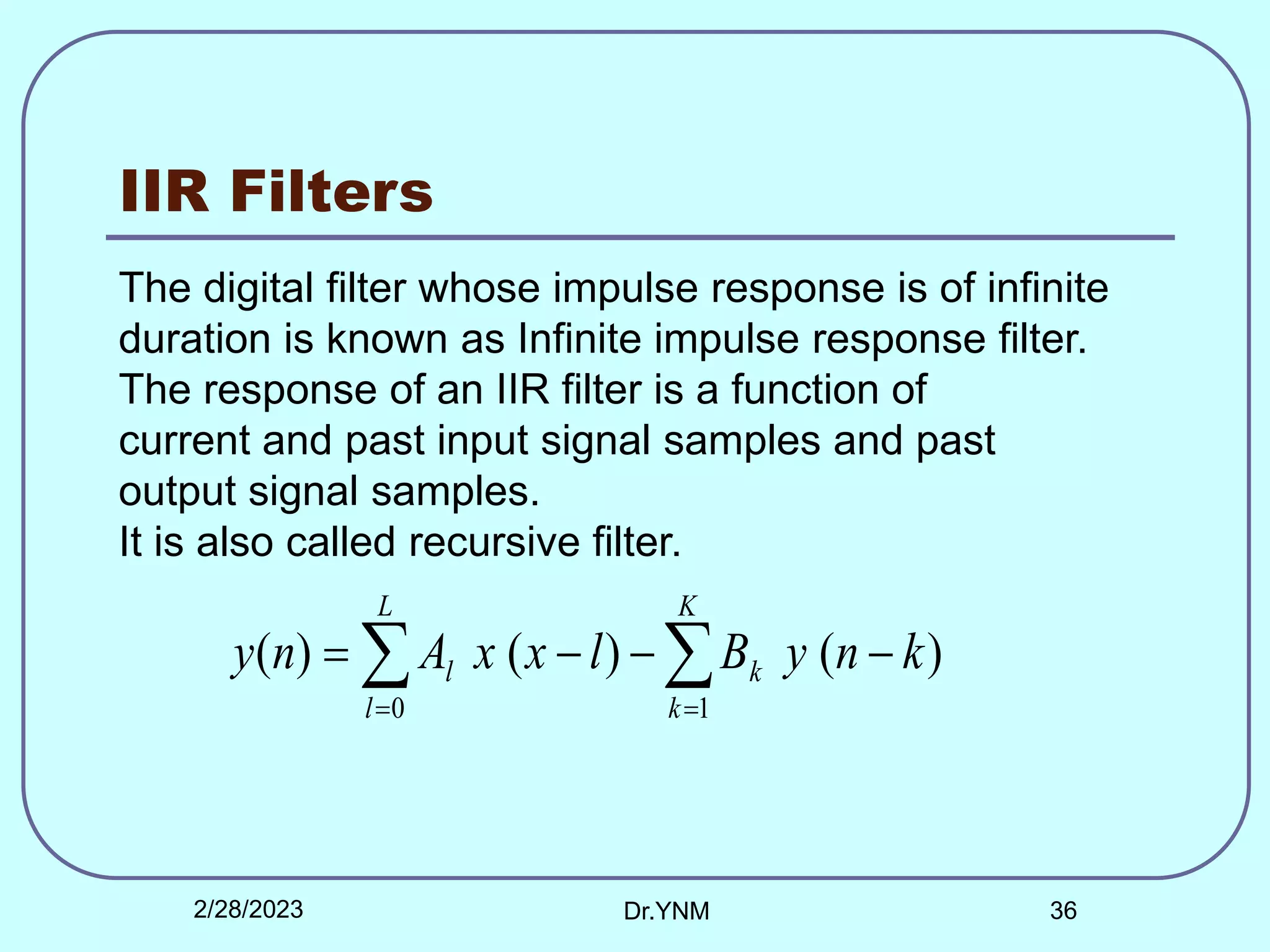
36.
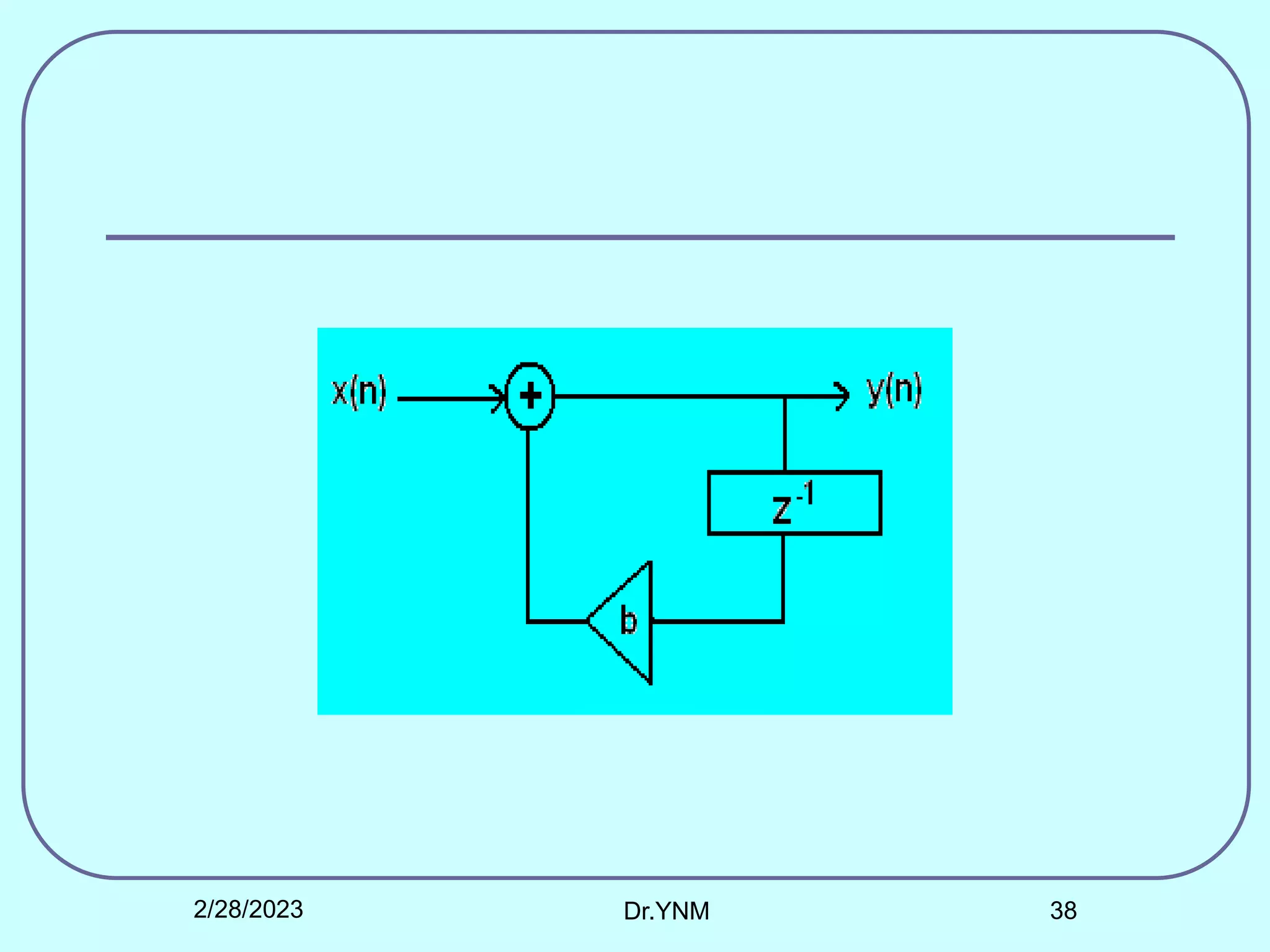
IIR Filters
The digitalfilter whose impulse response is of infinite
duration is known as Infinite impulse response filter.
The response of an IIR filter is a function of
current and past input signal samples and past
output signal samples.
It is also called recursive filter.
K
k
k
L
l
l k
n
y
B
l
x
x
A
n
y
1
0
)
(
)
(
)
(
2/28/2023 Dr.YNM 36
37.
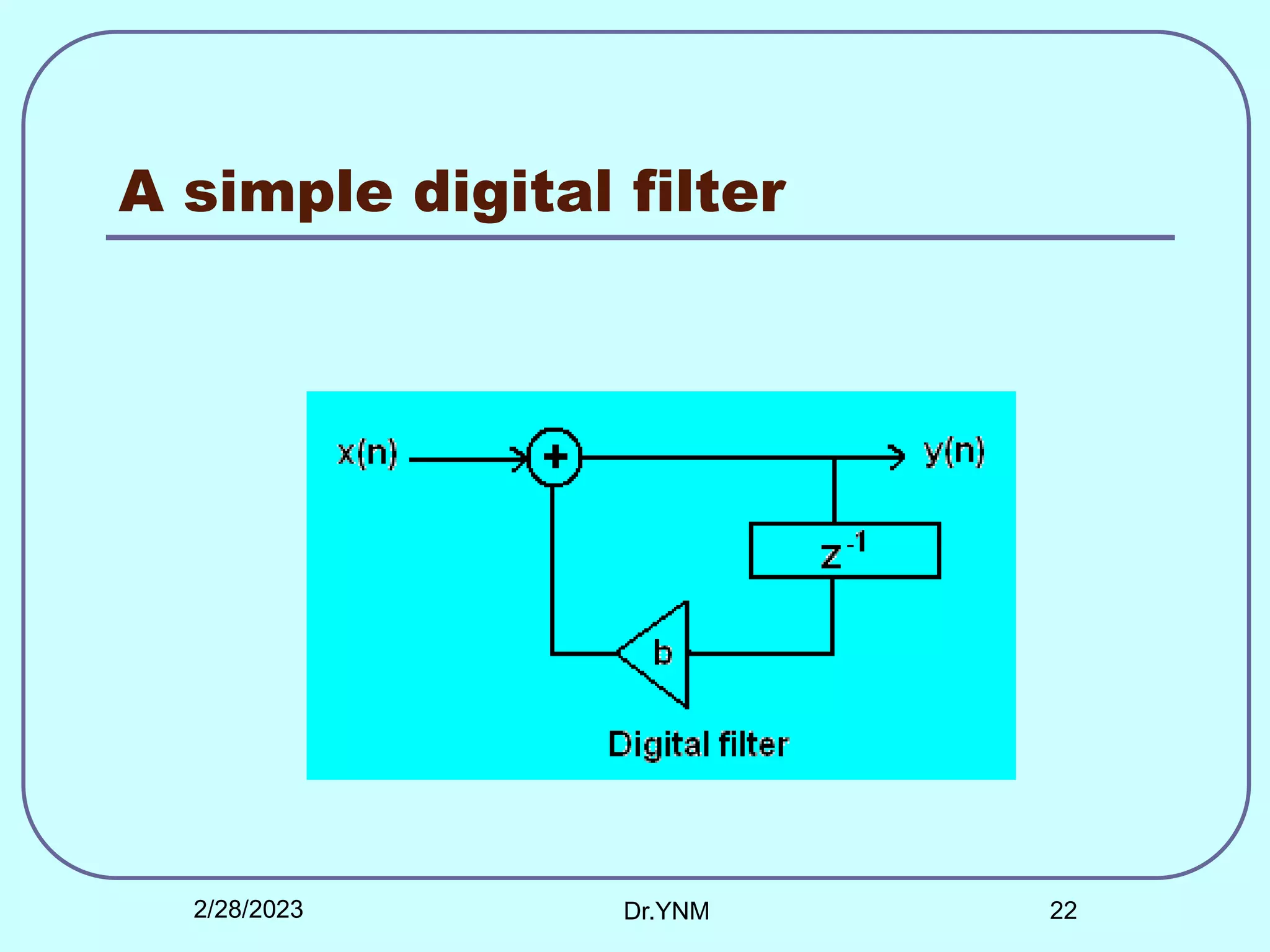
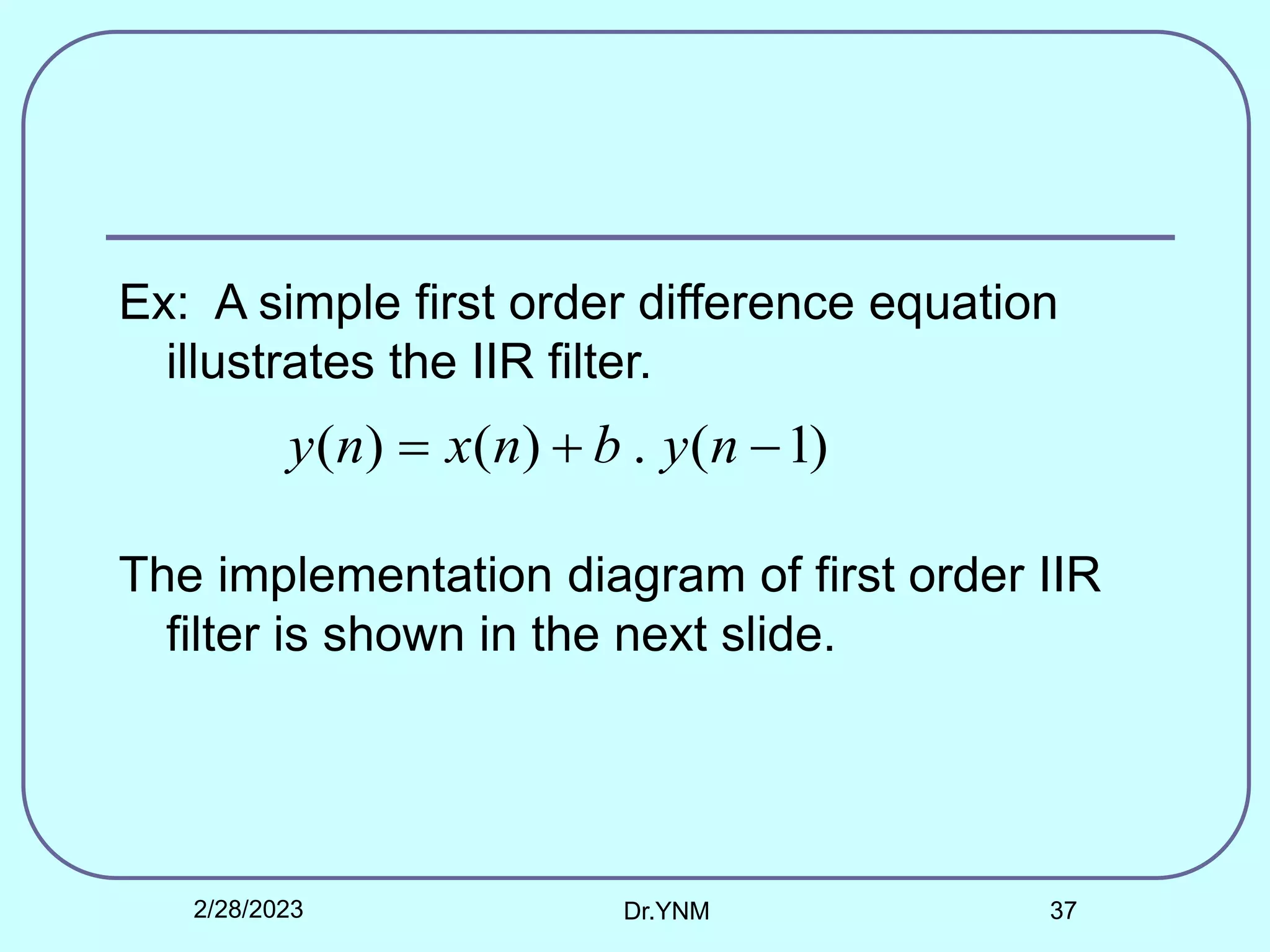
Ex: A simplefirst order difference equation
illustrates the IIR filter.
The implementation diagram of first order IIR
filter is shown in the next slide.
)
1
(
.
)
(
)
(
n
y
b
n
x
n
y
2/28/2023 Dr.YNM 37
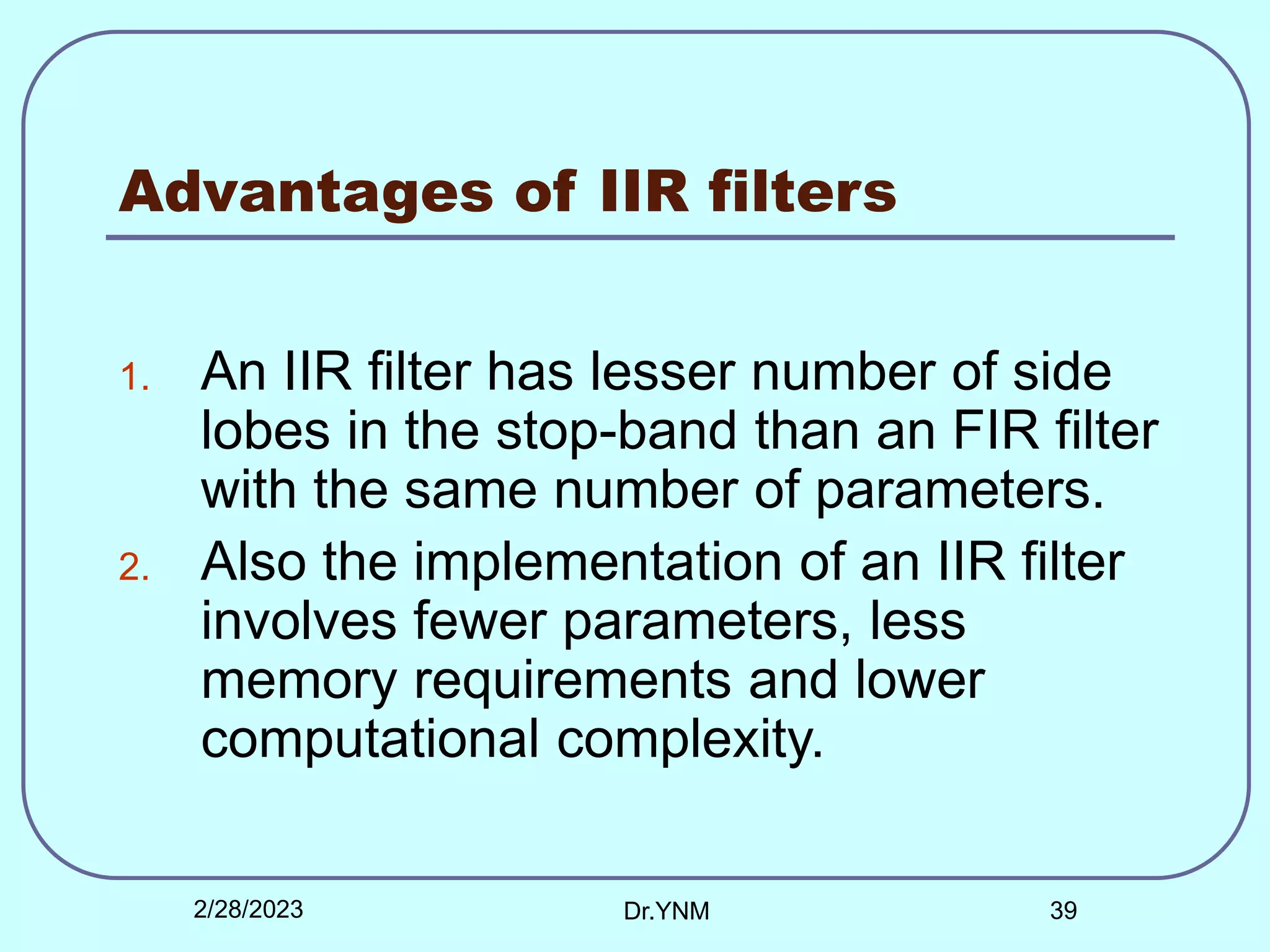
Advantages of IIRfilters
1. An IIR filter has lesser number of side
lobes in the stop-band than an FIR filter
with the same number of parameters.
2. Also the implementation of an IIR filter
involves fewer parameters, less
memory requirements and lower
computational complexity.
2/28/2023 Dr.YNM 39
40.
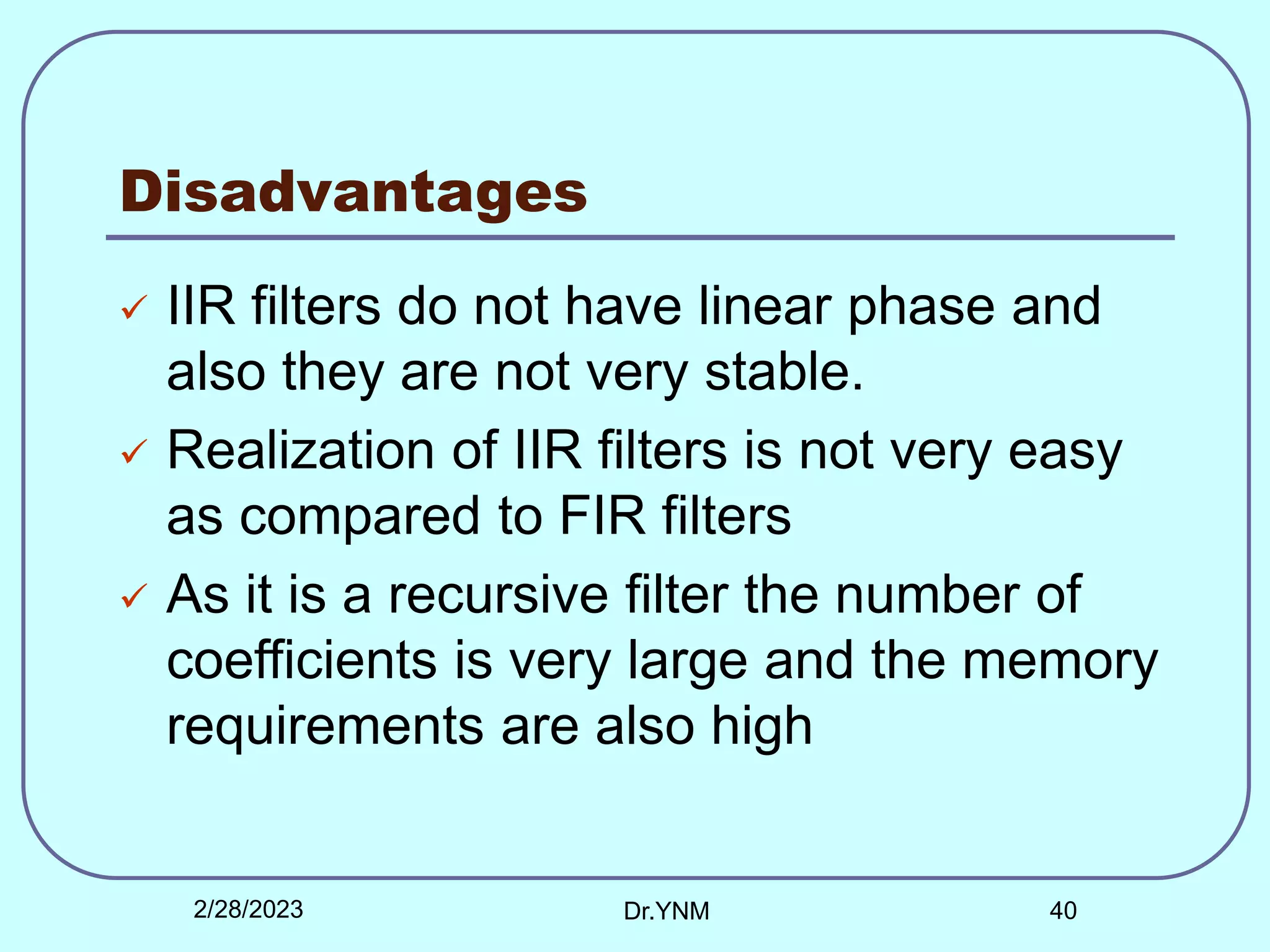
Disadvantages
IIR filtersdo not have linear phase and
also they are not very stable.
Realization of IIR filters is not very easy
as compared to FIR filters
As it is a recursive filter the number of
coefficients is very large and the memory
requirements are also high
2/28/2023 Dr.YNM 40
41.
Applications of DSP
Digitalsignal processing has variety of
applications in diverse fields like
Digital filtering
Spectral analysis
Speech processing
Image processing
Radar and sonar processing
2/28/2023 Dr.YNM 41
42.
Disk androbot control
Telecommunication
Consumer electronics
Biomedical engineering
Military applications
2/28/2023 Dr.YNM 42
43.
Let us discussfew examples of DSP in
musical sound processing.
In all musical recordings, the sound from
instruments is recorded in studio and
then special audio effects are added by
manipulating the recorded musical
sounds. The audio effects are artificially
generated using various DSP
techniques.
2/28/2023 Dr.YNM 43
44.
The sound reachingthe listeners in a
concert hall during a musical programme
consists of direct sound, early reflections
and reverberations (echoes). But the
sound recorded in a studio is different
and it doesn’t sound natural.
2/28/2023 Dr.YNM 44
45.
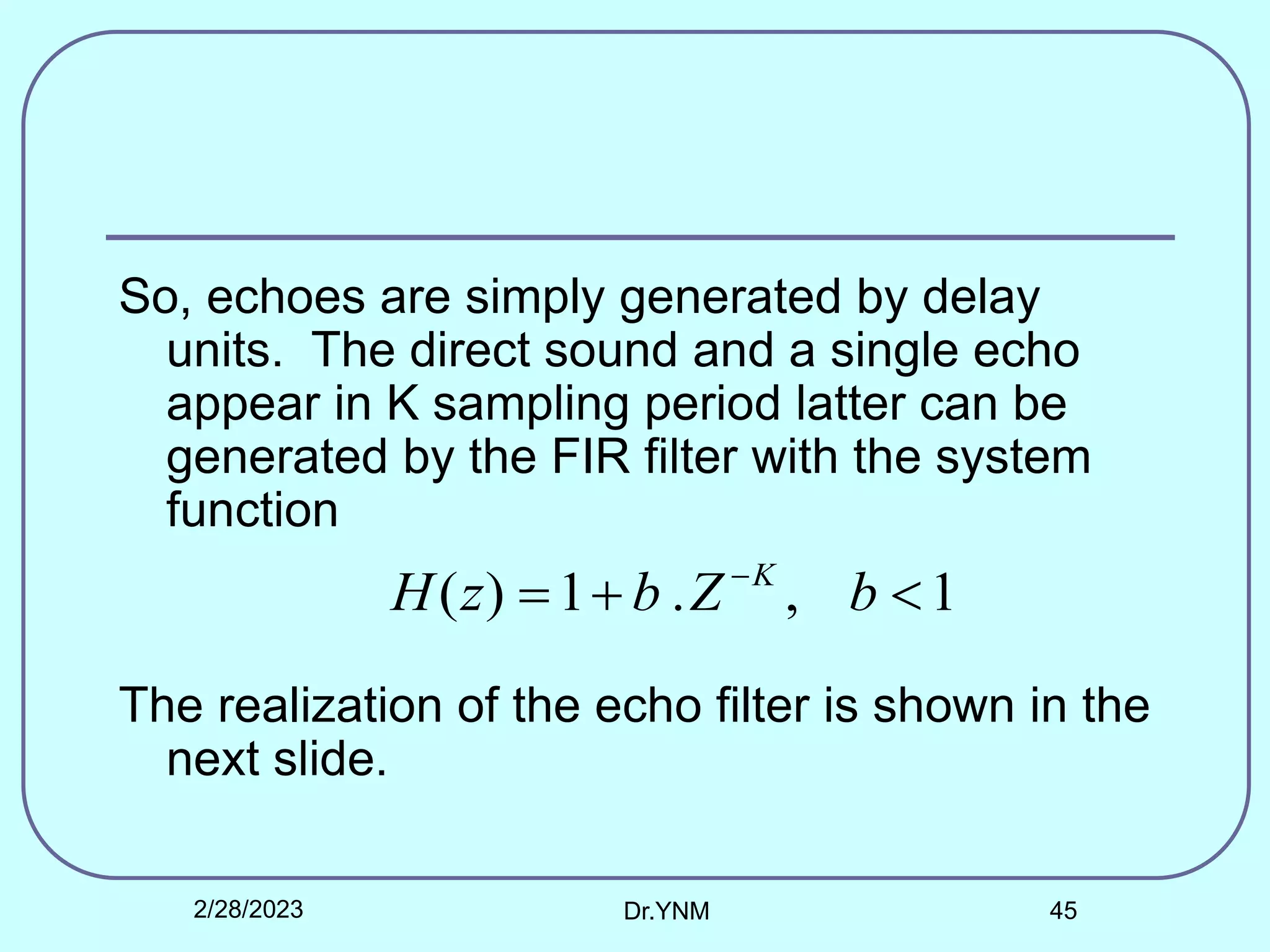
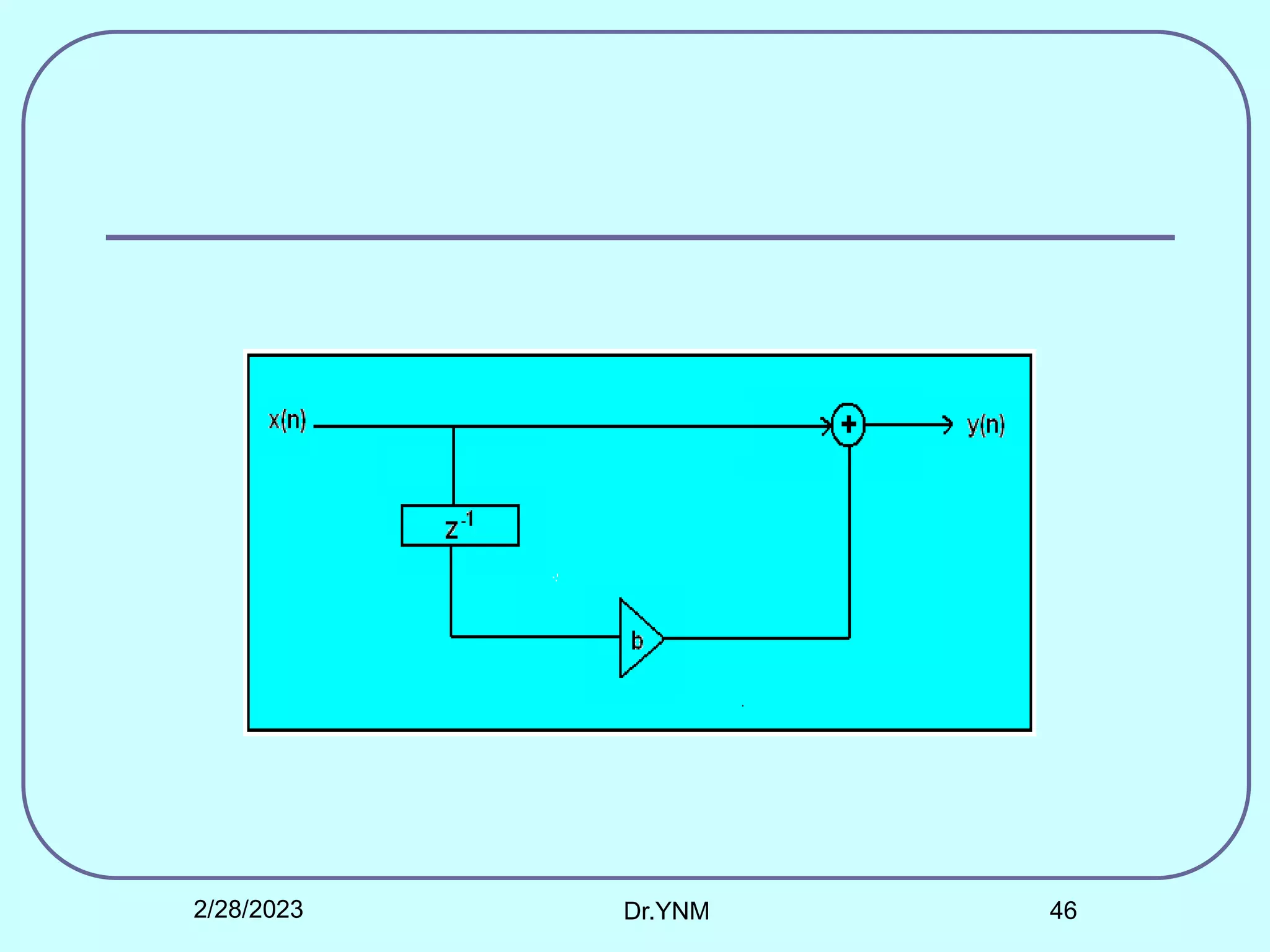
So, echoes aresimply generated by delay
units. The direct sound and a single echo
appear in K sampling period latter can be
generated by the FIR filter with the system
function
The realization of the echo filter is shown in the
next slide.
1
,
.
1
)
(
b
Z
b
z
H K
2/28/2023 Dr.YNM 45
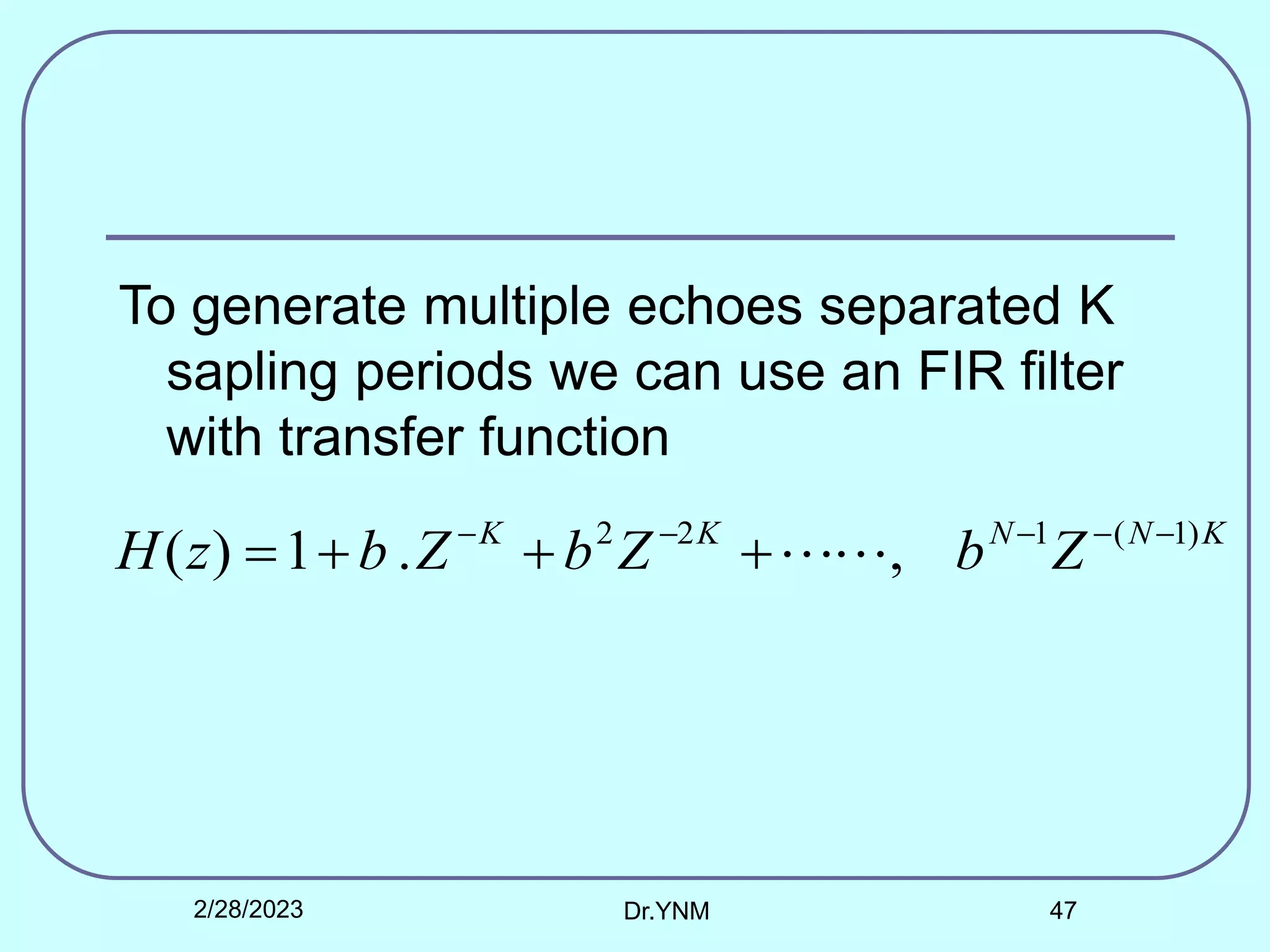
To generate multipleechoes separated K
sapling periods we can use an FIR filter
with transfer function
K
N
N
K
K
Z
b
Z
b
Z
b
z
H )
1
(
1
2
2
,
.
1
)
(
2/28/2023 Dr.YNM 47
48.
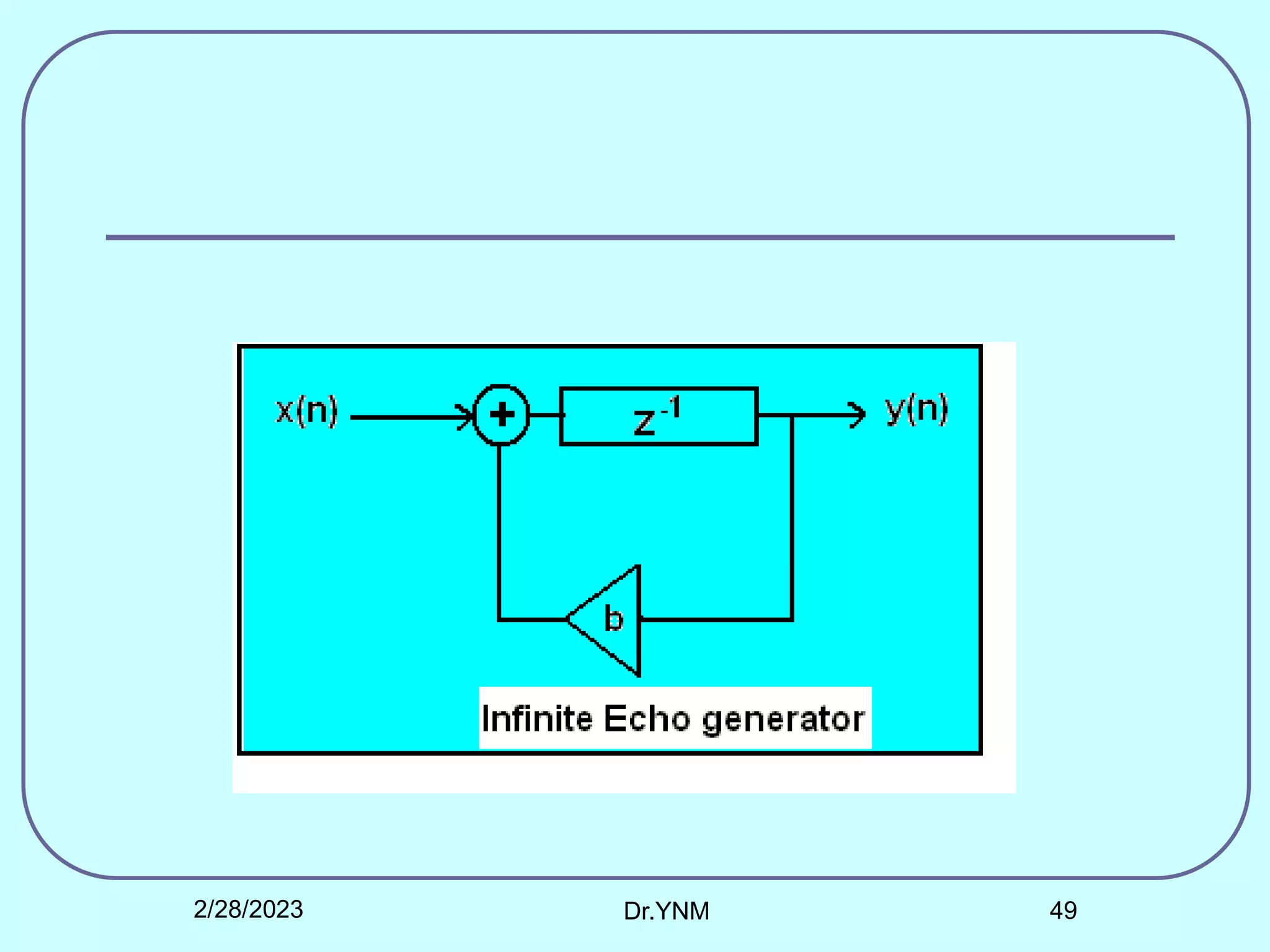
Similarly an infinitenumber of echoes
spaced K sampling periods apart with
exponentially decaying amplitudes can
be created by an IIR filter.
The realization of infinite echo generator is
shown in the next slide.
2/28/2023 Dr.YNM 48
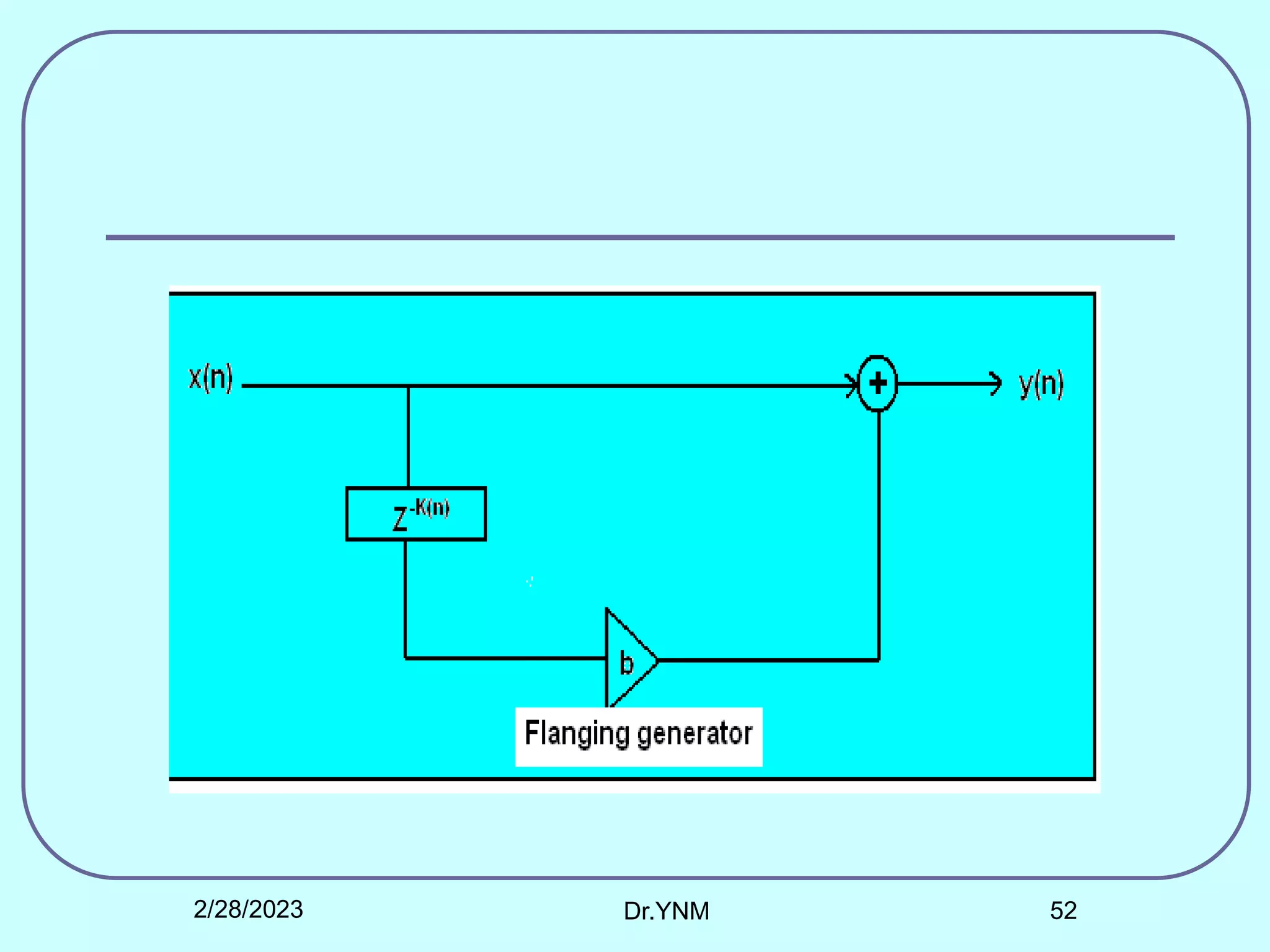
The other specialsound effects are
flanging and chorus. The flanging effect
is created by feeding the same musical
note to two tape recorders and then
combining their delayed outputs. This
effect can be simulated using the FIR
filter by periodically varying the delay
K(n) between 0 and K.
2/28/2023 Dr.YNM 50
51.
The functional diagramof flanging effect
generator is shown in the next slide.
2/28/2023 Dr.YNM 51
The chorus effectis achieved when
several musicians are playing the same
musical note at the same time with small
changes in the amplitudes and small
timing differences between their sounds.
2/28/2023 Dr.YNM 53
54.
A chorus generatorcan be realized by
parallelly connecting few number of
flanging effect filters.
2/28/2023 Dr.YNM 54
55.
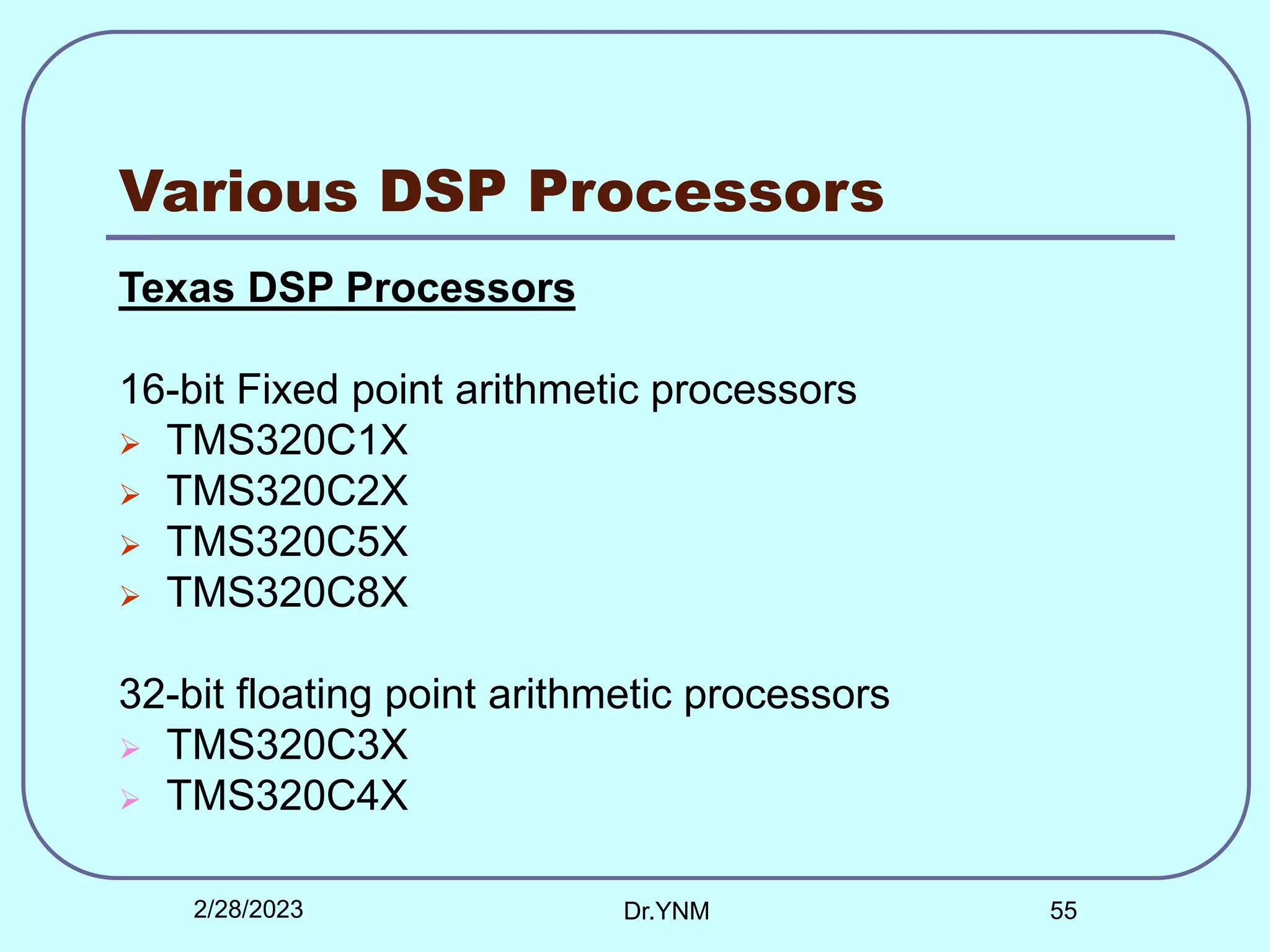
Various DSP Processors
TexasDSP Processors
16-bit Fixed point arithmetic processors
TMS320C1X
TMS320C2X
TMS320C5X
TMS320C8X
32-bit floating point arithmetic processors
TMS320C3X
TMS320C4X
2/28/2023 Dr.YNM 55
56.
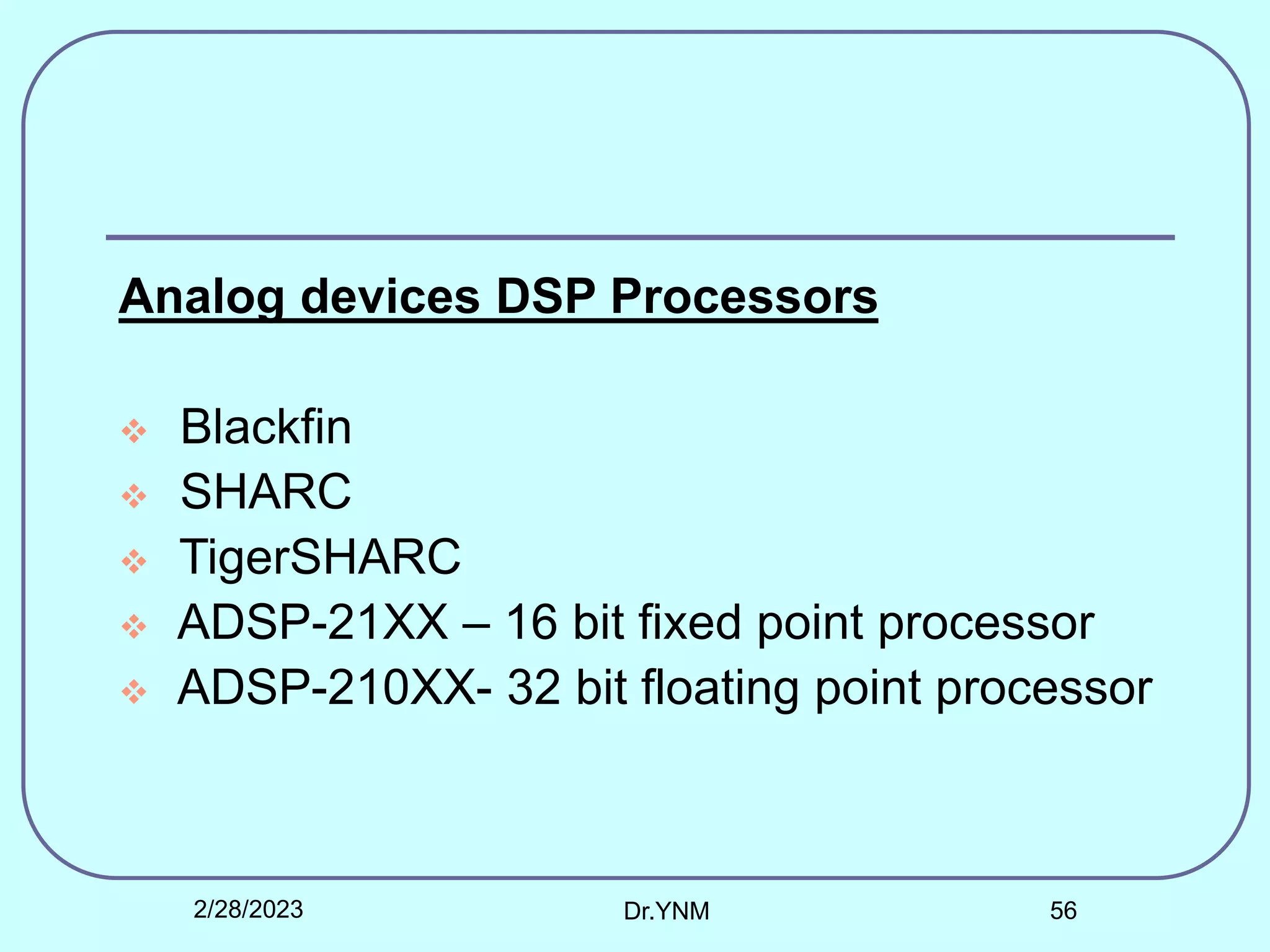
Analog devices DSPProcessors
Blackfin
SHARC
TigerSHARC
ADSP-21XX – 16 bit fixed point processor
ADSP-210XX- 32 bit floating point processor
2/28/2023 Dr.YNM 56
57.
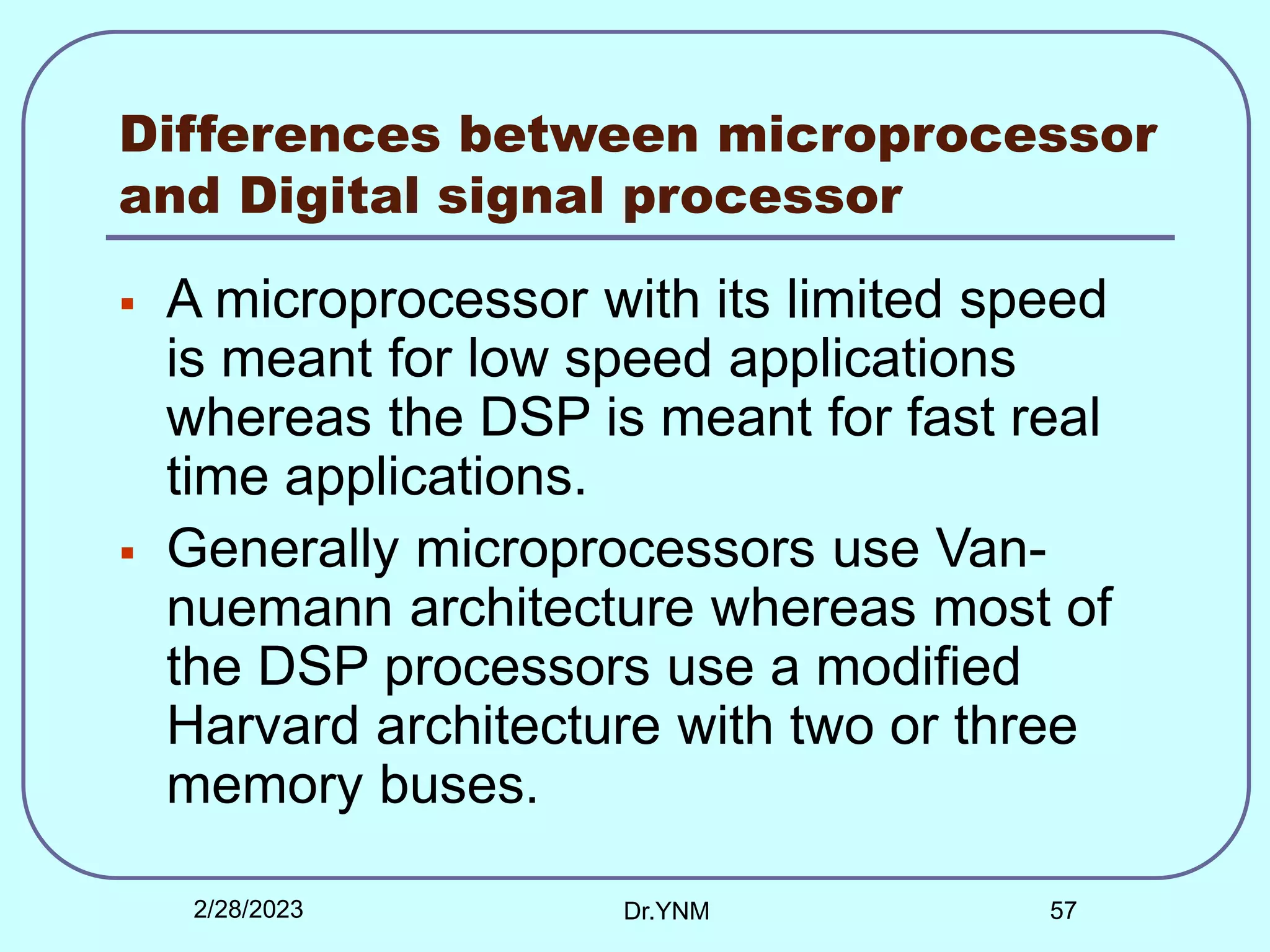
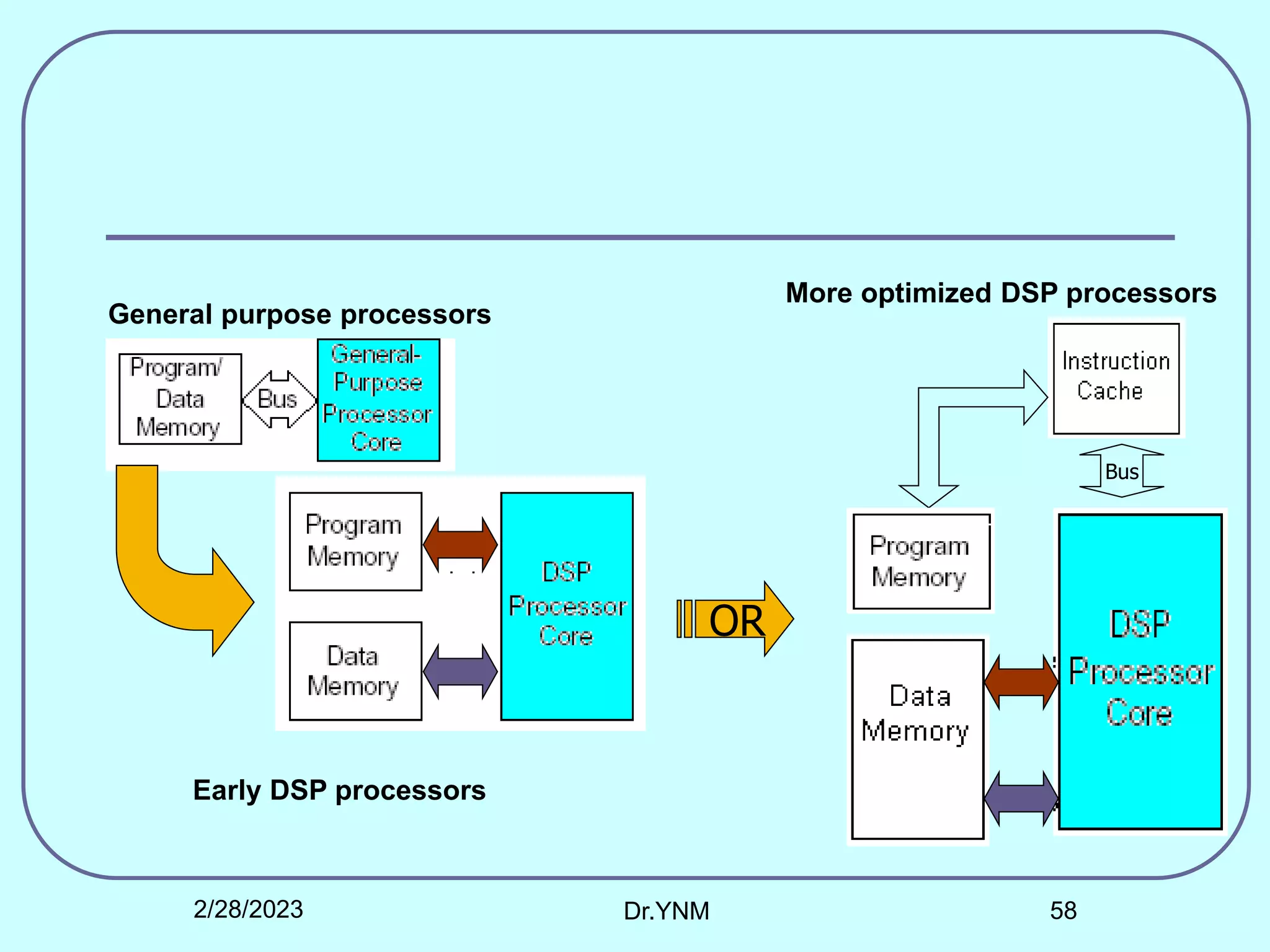
Differences between microprocessor
andDigital signal processor
A microprocessor with its limited speed
is meant for low speed applications
whereas the DSP is meant for fast real
time applications.
Generally microprocessors use Van-
nuemann architecture whereas most of
the DSP processors use a modified
Harvard architecture with two or three
memory buses.
2/28/2023 Dr.YNM 57
The books whichhave helped me to
understand DSP
1. Oppenheim, A.V. and Schefar, Digital signal
processing, PHI
2. Oppenheim, Applications of digital signal
processing, PHI
3. Rabir and Gold, Theory of digital signal
processing, PHI
4. Proakis and Manolakis, Digital signal
processing, Pearson publishers
2/28/2023 Dr.YNM 60
61.
5. Antoniou, A.Digital filters analysis, design
applications, McGraw Hill
6. Johnson, J.R. Introduction to digital signal
processing , PHI
7. Vanvalkenburg.M.V. Analog filter design,
Sanders publishers
8. Vinay K. Ingle, Proakis, Digital signal
processing using MATLAB, Bookware series
2/28/2023 Dr.YNM 61
62.
9. Sajeeth K.Mithra, Digital signal processing,
TMH
10. V.K. Khanna, Digital signal processing,
telecommunication, multimedia technology,
Wheeler publishers
11. P. Rameshbabu, Digital signal processing,
Scitech publishers.
12. Salivana, Digital signal processing, TMH
2/28/2023 Dr.YNM 62
63.
13. Ifeachor andJervis, Digital signal
processing-a practical approach, Addison
Wesley publishers
14. Sarkar N. Elements of digital signal
processing, Kanna publishers
15. Defetta D.J. Digital signal processing, John
Wieley publishers
16. Lyons R.G. Understanding digital signal
processing,Addition Wesley
2/28/2023 Dr.YNM 63
64.
17. B. Venkataramani,Digital signal
processors, TMH
18. Chapman J. Stephen, MATLAB
Programming for engineers, Bookware
Series
19. Ramachandran.B. Digital signal processing,
Anuradha publishers
20. Bose N.K. Digital filters-Theory and applications,
Elsevier publishers
21. The Scientist and Engineer's and Guide to Digital Signal
Processing by Steven W. Smith.(On line text)
2/28/2023 Dr.YNM 64
65.
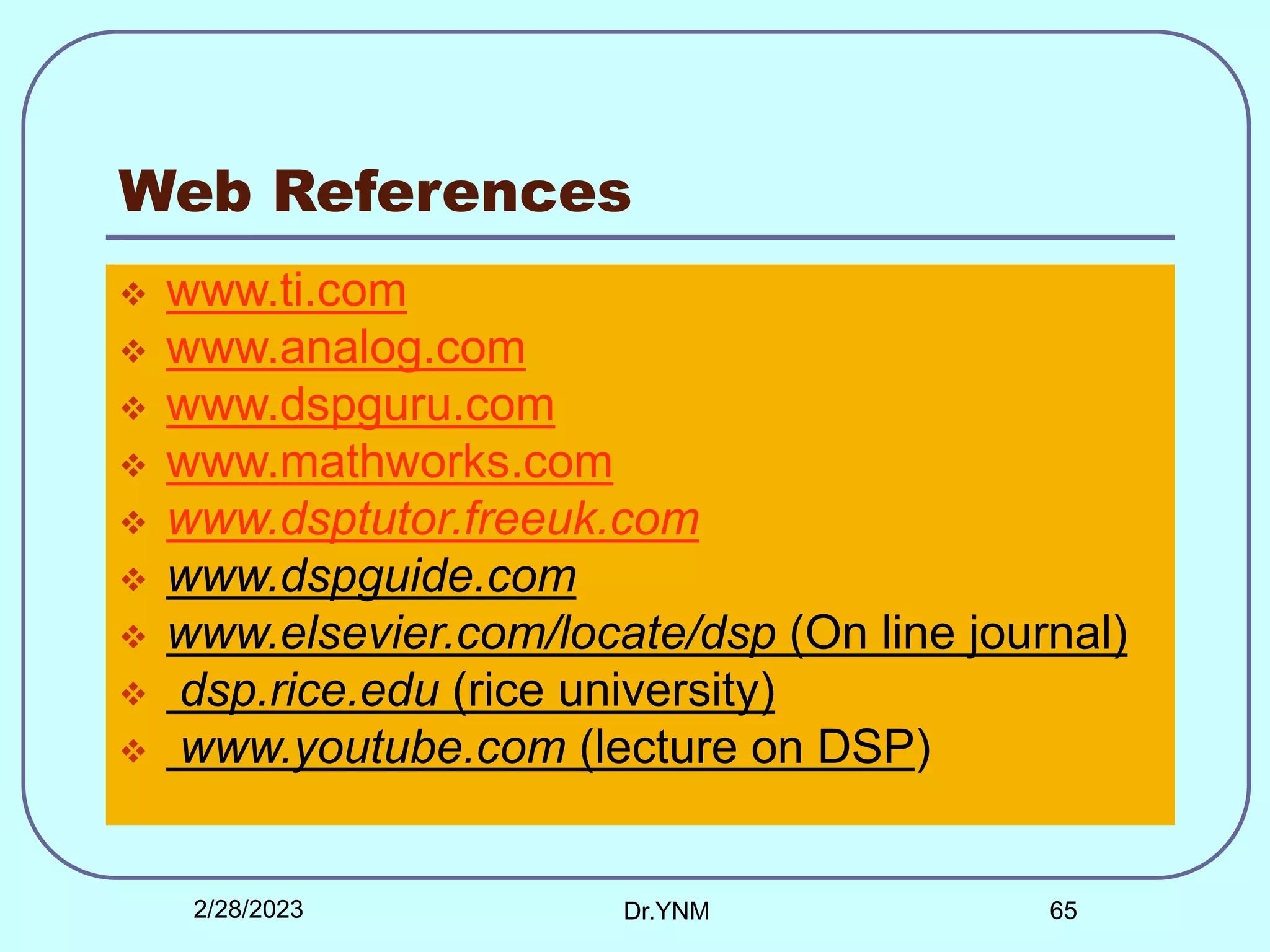
Web References
www.ti.com
www.analog.com
www.dspguru.com
www.mathworks.com
www.dsptutor.freeuk.com
www.dspguide.com
www.elsevier.com/locate/dsp (On line journal)
dsp.rice.edu (rice university)
www.youtube.com (lecture on DSP)
2/28/2023 Dr.YNM 65
66.
Concluding Remarks
The woodsare lovely, dark and deep,
But I have promises to keep,
And miles to go before I sleep,
And miles to go before I sleep.
---- Robert Frost
GOOD LUCK!
2/28/2023 Dr.YNM 66