Downloaded 503 times

![351M Digital Signal Processing 2
The Inverse Z-Transform
• Formal inverse z-transform is based on a Cauchy integral
• Less formal ways sufficient most of the time
– Inspection method
– Partial fraction expansion
– Power series expansion
• Inspection Method
– Make use of known z-transform pairs such as
– Example: The inverse z-transform of
[ ] az
az1
1
nua 1
Zn
>
−
→← −
( ) [ ] [ ]nu
2
1
nx
2
1
z
z
2
1
1
1
zX
n
1
=→>
−
=
−](https://image.slidesharecdn.com/lecture9-150103095117-conversion-gate02/75/Z-TRANSFORM-PROPERTIES-AND-INVERSE-Z-TRANSFORM-2-2048.jpg)
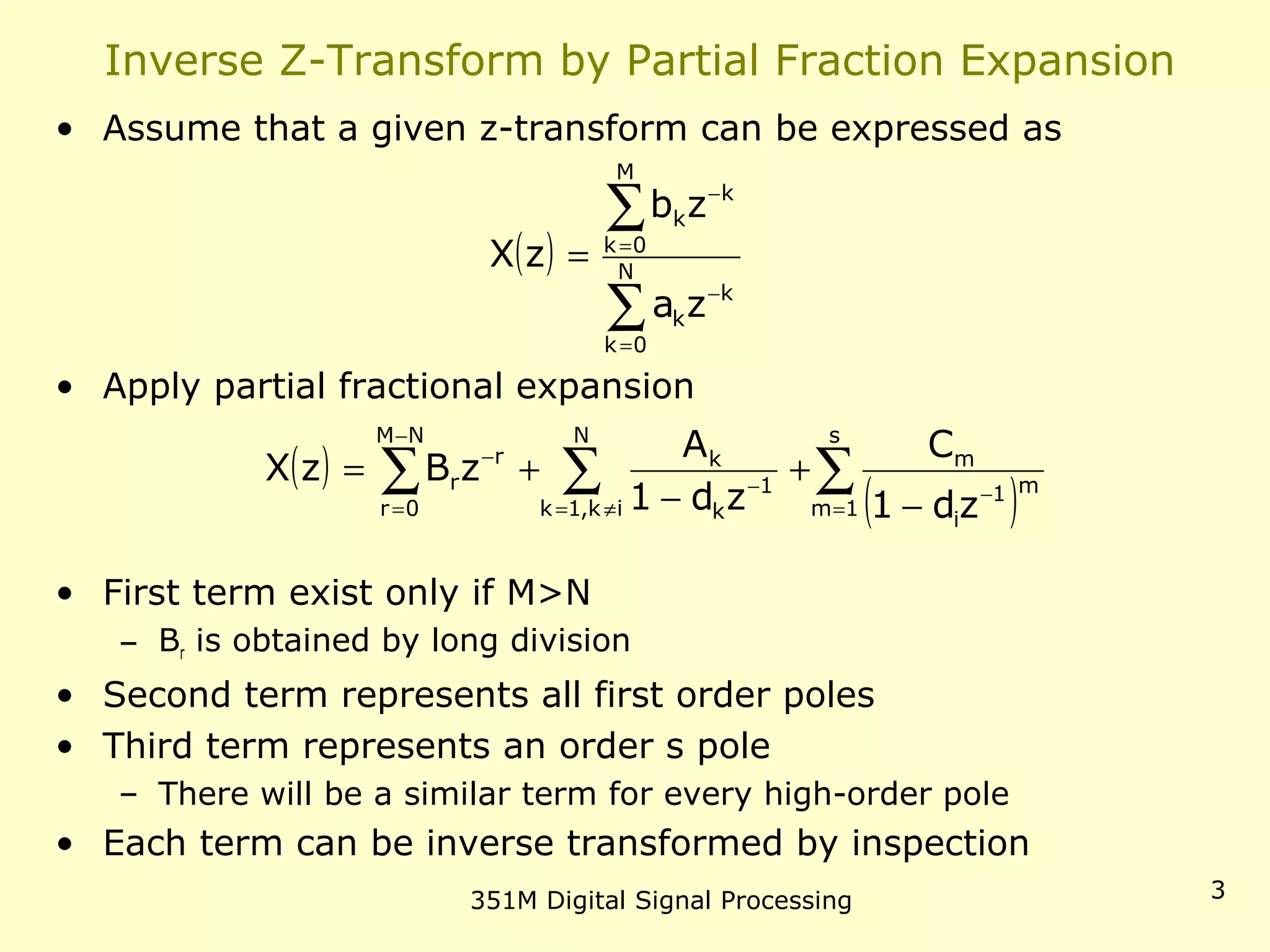
![351M Digital Signal Processing 4
Partial Fractional Expression
• Coefficients are given as
• Easier to understand with examples
( )
( )∑∑∑ =
−
≠=
−
−
=
−
−
+
−
+=
s
1m
m1
i
m
N
ik,1k
1
k
k
NM
0r
r
r
zd1
C
zd1
A
zBzX
( ) ( ) kdz
1
kk zXzd1A =
−
−=
( ) ( )
( ) ( )[ ] 1
idw
1s
ims
ms
ms
i
m wXwd1
dw
d
d!ms
1
C
−
=
−
−
−
−
−
−−
=](https://image.slidesharecdn.com/lecture9-150103095117-conversion-gate02/75/Z-TRANSFORM-PROPERTIES-AND-INVERSE-Z-TRANSFORM-4-2048.jpg)
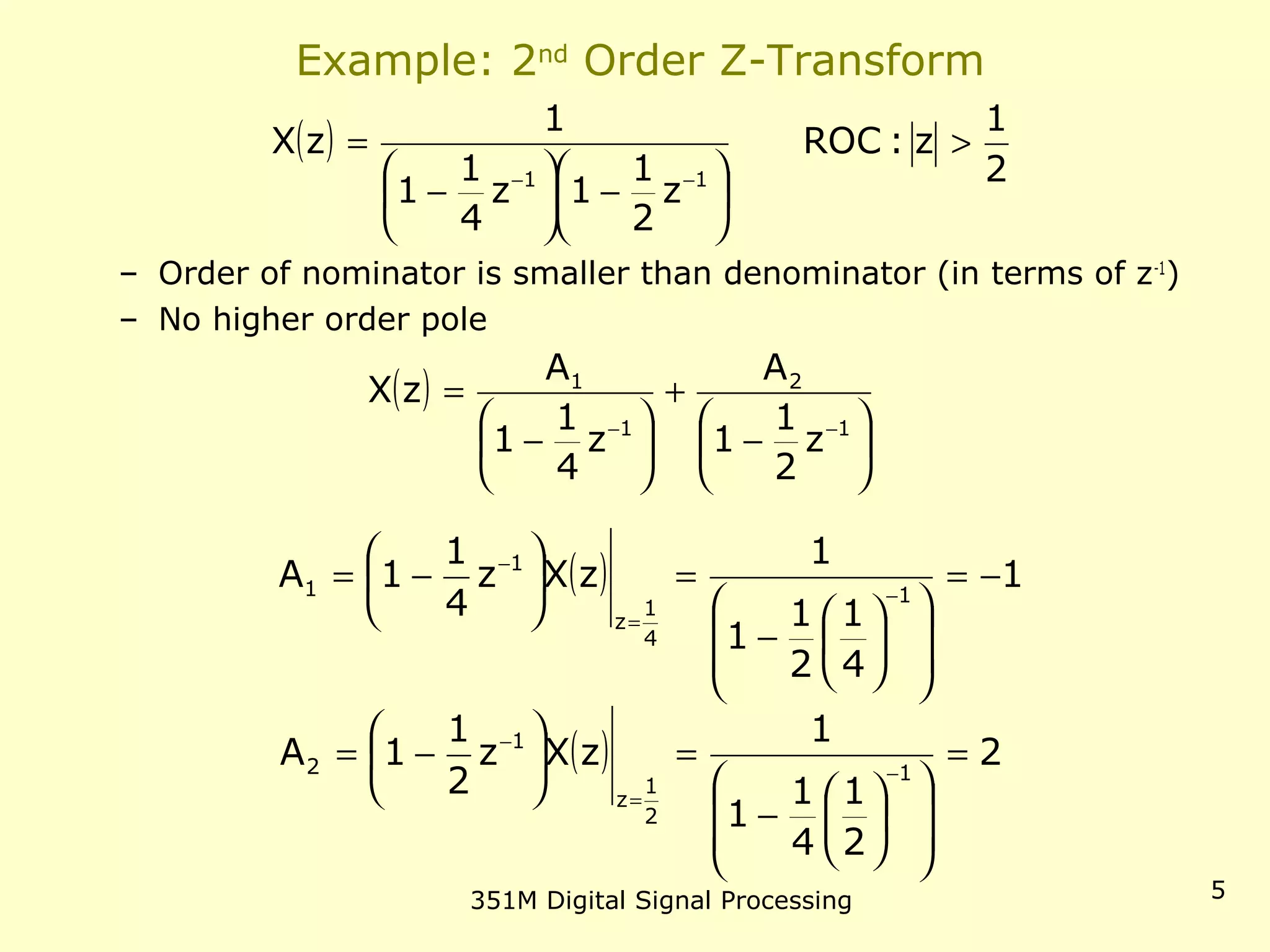
![351M Digital Signal Processing 6
Example Continued
• ROC extends to infinity
– Indicates right sided sequence
( )
2
1
z
z
2
1
1
2
z
4
1
1
1
zX
11
>
−
+
−
−
=
−−
[ ] [ ] [ ]nu
4
1
-nu
2
1
2nx
nn
=](https://image.slidesharecdn.com/lecture9-150103095117-conversion-gate02/75/Z-TRANSFORM-PROPERTIES-AND-INVERSE-Z-TRANSFORM-6-2048.jpg)
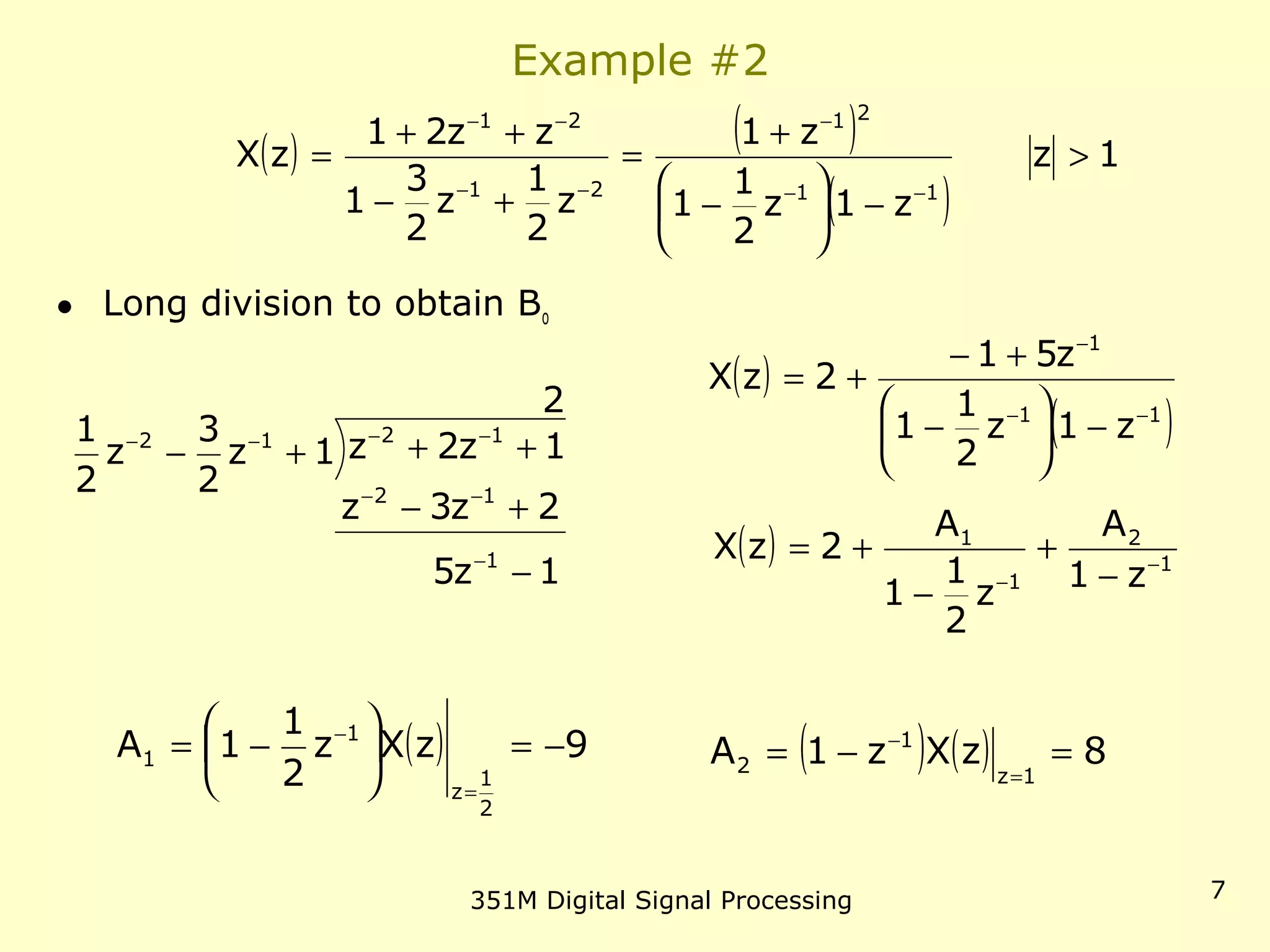
![351M Digital Signal Processing 8
Example #2 Continued
• ROC extends to infinity
– Indicates right-sides sequence
( ) 1z
z1
8
z
2
1
1
9
2zX 1
1
>
−
+
−
−= −
−
[ ] [ ] [ ] [ ]n8u-nu
2
1
9n2nx
n
−δ=](https://image.slidesharecdn.com/lecture9-150103095117-conversion-gate02/75/Z-TRANSFORM-PROPERTIES-AND-INVERSE-Z-TRANSFORM-8-2048.jpg)
![351M Digital Signal Processing 9
Inverse Z-Transform by Power Series Expansion
• The z-transform is power series
• In expanded form
• Z-transforms of this form can generally be inversed easily
• Especially useful for finite-length series
• Example
( ) [ ]∑
∞
−∞=
−
=
n
n
znxzX
( ) [ ] [ ] [ ] [ ] [ ] ++++−+−+= −− 2112
z2xz1x0xz1xz2xzX
( ) ( )( )
12
1112
z
2
1
1z
2
1
z
z1z1z
2
1
1zzX
−
−−−
+−−=
−+
−=
[ ] [ ] [ ] [ ] [ ]1n
2
1
n1n
2
1
2nnx −δ+δ−+δ−+δ=
[ ]
=
=
=−
−=−
−=
=
2n0
1n
2
1
0n1
1n
2
1
2n1
nx](https://image.slidesharecdn.com/lecture9-150103095117-conversion-gate02/75/Z-TRANSFORM-PROPERTIES-AND-INVERSE-Z-TRANSFORM-9-2048.jpg)
![351M Digital Signal Processing 10
Z-Transform Properties: Linearity
• Notation
• Linearity
– Note that the ROC of combined sequence may be larger than
either ROC
– This would happen if some pole/zero cancellation occurs
– Example:
• Both sequences are right-sided
• Both sequences have a pole z=a
• Both have a ROC defined as |z|>|a|
• In the combined sequence the pole at z=a cancels with a zero at z=a
• The combined ROC is the entire z plane except z=0
• We did make use of this property already, where?
[ ] ( ) x
Z
RROCzXnx = →←
[ ] [ ] ( ) ( ) 21 xx21
Z
21 RRROCzbXzaXnbxnax ∩=+ →←+
[ ] [ ] [ ]N-nua-nuanx nn
=](https://image.slidesharecdn.com/lecture9-150103095117-conversion-gate02/75/Z-TRANSFORM-PROPERTIES-AND-INVERSE-Z-TRANSFORM-10-2048.jpg)
![351M Digital Signal Processing 11
Z-Transform Properties: Time Shifting
• Here no is an integer
– If positive the sequence is shifted right
– If negative the sequence is shifted left
• The ROC can change the new term may
– Add or remove poles at z=0 or z=∞
• Example
[ ] ( ) x
nZ
o RROCzXznnx o
= →←− −
( )
4
1
z
z
4
1
1
1
zzX
1
1
>
−
=
−
−
[ ] [ ]1-nu
4
1
nx
1-n
=](https://image.slidesharecdn.com/lecture9-150103095117-conversion-gate02/75/Z-TRANSFORM-PROPERTIES-AND-INVERSE-Z-TRANSFORM-11-2048.jpg)
![351M Digital Signal Processing 12
Z-Transform Properties: Multiplication by Exponential
• ROC is scaled by |zo|
• All pole/zero locations are scaled
• If zo is a positive real number: z-plane shrinks or expands
• If zo is a complex number with unit magnitude it rotates
• Example: We know the z-transform pair
• Let’s find the z-transform of
[ ] ( ) xoo
Zn
o RzROCz/zXnxz = →←
[ ] 1z:ROC
z-1
1
nu 1-
Z
> →←
[ ] ( ) [ ] ( ) [ ] ( ) [ ]nure
2
1
nure
2
1
nuncosrnx
njnj
o
n oo ω−ω
+=ω=
( ) rz
zre1
2/1
zre1
2/1
zX 1j1j oo
>
−
+
−
= −ω−−ω](https://image.slidesharecdn.com/lecture9-150103095117-conversion-gate02/75/Z-TRANSFORM-PROPERTIES-AND-INVERSE-Z-TRANSFORM-12-2048.jpg)
![351M Digital Signal Processing 13
Z-Transform Properties: Differentiation
• Example: We want the inverse z-transform of
• Let’s differentiate to obtain rational expression
• Making use of z-transform properties and ROC
[ ] ( )
x
Z
RROC
dz
zdX
znnx =− →←
( ) ( ) azaz1logzX 1
>+= −
( ) ( )
1
1
1
2
az1
1
az
dz
zdX
z
az1
az
dz
zdX
−
−
−
−
+
=−⇒
+
−
=
[ ] ( ) [ ]1nuaannx
1n
−−=
−
[ ] ( ) [ ]1nu
n
a
1nx
n
1n
−−=
−](https://image.slidesharecdn.com/lecture9-150103095117-conversion-gate02/75/Z-TRANSFORM-PROPERTIES-AND-INVERSE-Z-TRANSFORM-13-2048.jpg)
![351M Digital Signal Processing 14
Z-Transform Properties: Conjugation
• Example
[ ] ( ) x
**Z*
RROCzXnx = →←
( ) [ ]
( ) [ ] [ ]
( ) [ ] ( ) [ ] [ ]{ }nxZznxznxzX
znxznxzX
znxzX
n
n
n
n
n
n
n
n
n
n
∗
∞
−∞=
−∗
∞
−∞=
∗∗∗∗
∞
−∞=
∗
∗
∞
−∞=
−∗
∞
−∞=
−
===
=
=
=
∑∑
∑∑
∑](https://image.slidesharecdn.com/lecture9-150103095117-conversion-gate02/75/Z-TRANSFORM-PROPERTIES-AND-INVERSE-Z-TRANSFORM-14-2048.jpg)
![351M Digital Signal Processing 15
Z-Transform Properties: Time Reversal
• ROC is inverted
• Example:
• Time reversed version of
[ ] ( )
x
Z
R
1
ROCz/1Xnx = →←−
[ ] [ ]nuanx n
−= −
[ ]nuan
( ) 1
11-
1-1
az
za-1
za-
az1
1
zX −
−
−
<=
−
=](https://image.slidesharecdn.com/lecture9-150103095117-conversion-gate02/75/Z-TRANSFORM-PROPERTIES-AND-INVERSE-Z-TRANSFORM-15-2048.jpg)
![351M Digital Signal Processing 16
Z-Transform Properties: Convolution
• Convolution in time domain is multiplication in z-domain
• Example:Let’s calculate the convolution of
• Multiplications of z-transforms is
• ROC: if |a|<1 ROC is |z|>1 if |a|>1 ROC is |z|>|a|
• Partial fractional expansion of Y(z)
[ ] [ ] ( ) ( ) 2x1x21
Z
21 RR:ROCzXzXnxnx ∩ →←∗
[ ] [ ] [ ] [ ]nunxandnuanx 2
n
1 ==
( ) az:ROC
az1
1
zX 11 >
−
= −
( ) 1z:ROC
z1
1
zX 12 >
−
= −
( ) ( ) ( )
( )( )1121
z1az1
1
zXzXzY −−
−−
==
( ) 1z:ROCasume
az1
1
z1
1
a1
1
zY 11
>
−
−
−−
= −−
[ ] [ ] [ ]( )nuanu
a1
1
ny 1n+
−
−
=](https://image.slidesharecdn.com/lecture9-150103095117-conversion-gate02/75/Z-TRANSFORM-PROPERTIES-AND-INVERSE-Z-TRANSFORM-16-2048.jpg)

The document discusses various methods for computing the inverse z-transform including inspection, partial fraction expansion, and power series expansion. It provides examples to illustrate each method. The inverse z-transform finds the original time domain sequence from its z-transform. Key properties like linearity, time shifting, and convolution are also covered.


![Digital Signal Processing[ECEG-3171]-Ch1_L03](https://cdn.slidesharecdn.com/ss_thumbnails/dspl3-180427094423-thumbnail.jpg?width=640&height=640&fit=bounds)
![Digital Signal Processing[ECEG-3171]-Ch1_L02](https://cdn.slidesharecdn.com/ss_thumbnails/dspl2-180427094423-thumbnail.jpg?width=640&height=640&fit=bounds)


