펄스 변조(Pulse Modulation)

조선대학교
정보통신공학과

디지털통신(Digital Comm.)
Contents
Sampling theory
Pulse Modulation
 PAM (Pulse Amplitude Modulation)
 PWM (Pulse Width Modulation)
 PPM (Pulse Position Modulation)

Multiplexing
 FDM
 TDM

디지털통신(Digital Comm.)

2
기저대역 시스템 (Baseband system)
Digital
information

Information
source

Character
information

•PAM
•PWM
•PPM

PCM

Analog
information

Sampling

Quantization

Encoding

Pulse
modulation

형식화(Formatting)

Analog
information

Information
sink

LPF

Decoding

TX

Channel

Demodulation
/detection

RX

Character
information
Digital
information

형식화(Formatting) 및 기저대역(baseband) 신호 전송
디지털통신(Digital Comm.)

3
Sampling

참고 : http://www.engr.usask.ca/classes/EE/352/virtual_labs.htm

 Sampling theory
 Ideal sampling(=impulse sampling)
analog signal x(t ) has a bandwidth

x (t ) 

fm



  (t  nT )

n  

Ts :sampling period

s

x s ( t )  x ( t ) x ( t ) 



 x ( nT

n  

1
X  ( f )  F [ x  ( t )] 
Ts

s

) ( t  nT s )



(f

n  

fs 

1
X s ( f )  X ( f )* X  ( f ) 
Ts
디지털통신(Digital Comm.)



 nf s )
1
: sampling frequency
Ts



n  

X ( f  nf s )
4
Sampling

analog signal x(t ) has a bandwidth f m

| X (f)|

x ( t )

t

0
x (t ) 





n  

1
X ( f ) 
Ts

 ( t  nT s )

…

…
-4Ts -2Ts

2Ts 4Ts

0

0

2Ts 4Ts



(f

n

t

-2fs

 nf s )

…

…
-fs

x s (t )  x (t ) x (t )

-4Ts -2Ts

f

-fm 0 fm

0

f

2fs

fs

| X (f)|

t

…

…
-2fs

-fs

0

fs

2fs

f

Impulse sampling
디지털통신(Digital Comm.)

5
Sampling
|Xs( f )|
Filter property to restore the original
signal from sampled signal

-2fs

-fs

-fm

0

fm

fs

2fs

f

(a)
|Xs( f )|

-2fs

-fs

Sampling theory

0

fs

2fs

fs  2 fm

f

(b)
(a)
디지털통신(Digital Comm.)

f s  2 f m (b)

fs  2 fm

aliasing
6
Sampling
 example
 음성신호가 3400Hz의 최대주파수를 가질때 Nyquist 표본화 정리에
의하면 원래의 신호로 완전하게 복원시키려면 최소한 초당 몇번을 표
본화해야 하는가?
f s  2 f max  2  3400  6800 Hz이상

 어떤 신호가 25KHz로 대역제한되어있다. Nyquist 율을 만족하는 최
소표본화주기를 구하라

f s  2 f max  2  25000  50 KHz이상
Ts 

1
1

 20  s
f s 50 KHz

 음성신호를 3KHz로 대역제한해서 Nyquist율로 표본화한 후, 각 표본
을 7bit로 A/D변환하여 전송하려고 할때 전송율은?

2  3000 sample/sec  7  42Kbps
디지털통신(Digital Comm.)

7
Sampling methods
~

~

Instantaneous sampling
Ideal sampling
(using impulse train)

F
 Ts (t )  s  s ( )


2 
 s 


Ts 


~

  s ( ) 



 (  k )
s

k  

PAM (t )  T (t )  p(t )
x
s

Realistic sampling
(using rectangular
pulse train)
■ sampling theory

디지털통신(Digital Comm.)

 s   max   max

 s  2 max
8
Baseband transmission
x(t )

t

PAM

t

PWM

t

PPM

t
디지털통신(Digital Comm.)

9
펄스진폭 변조(PAM)

자연 표본화
(Natural sampling)

평탄 표본화
(Flat-top sampling)

디지털통신(Digital Comm.)

10
펄스진폭 변조(PAM)
자연 표본화(Natural sampling)

 PAM (t )  x(t ) pTs (t )

p (t )  rect (t  )
  
P( )  sinc

 2 
~
pTs (t )  p(t )   Ts (t )
~

F [ pTs (t )]  F [ p(t )   Ts (t )]
~
 F [ p (t )]F [ Ts (t )]
~
  s P ( )  s ( ).
 
  ssinc
 2
  s

~
  s ( )




 k 
sinc s
 2
k  




 (  k s )






 c  (  k ).
k

s

k  

디지털통신(Digital Comm.)

11
펄스진폭 변조(PAM)


F [ pTs (t )] 

 c  (  k )
k

s

k  

 k  
ck   ssinc s .
 2 

x

*

 PAM (t )  x(t ) pTs (t )





 c  (  k )

k 

k

s

 PAM ( )
 F [ PAM (t )]  F [ x(t ) pTs (t )]


1
F [ x(t )]  F [ pTs (t )]
2




=

=



1
X ( ) 
ck  (  k s )
2
k  






ck
X (  k s ).
2
k  
시간상의 표본화는 주파수상에서
의 주기화를 일으킨다

디지털통신(Digital Comm.)

12
Natural sampling
 A 2 kHz sinusoid was sampled at 10 kHz while the sampling pulse duty cycle
was increased from 10% to 50%. The power increases with the duty cycle of the
sampling pulse.

Duty cycle

10%

20%

디지털통신(Digital Comm.)

13
Natural sampling

Duty cycle

33%

50%

디지털통신(Digital Comm.)

14
Natural sampling
 A 2 kHz sinusoid was sampled with a 25% duty cycle while the sampling
frequency was increased from 10 kHz to 25 kHz. The spectrum indicates that it
would be less difficult to filter out the 2 kHz sinusoid from the samples that are of
higher frequency.

Sampling freq.

10KHz

20KHz

디지털통신(Digital Comm.)

15KHz

25KHz

15
Natural sampling
 50% Natural Sampling of a Sinusoid
 This simulation shows time and frequency domain
representations of a naturally sampled sinusoid. To run the
simulation, matlab simulink file : natsamp1.mdl
"Mouse Over" the Spectrum Analyzer or Scope in the Simulink
model to see the output.

디지털통신(Digital Comm.)

16
펄스진폭 변조(PAM)
■ 자연 표본화(natural sampling)에서의 재구성(interpolation)

대역제한 내삽은 ideal
LPF 사용한다 : 구현 불
가능

디지털통신(Digital Comm.)

17
Sampling & Reconstruction
 A 2 kHz, 1.5 Vp-p sinusoid was
sampled at 10 kHz with a 33%
duty cycle. The filtered output is
displayed on the bottom trace of
the scope.

Sampling circuit
(a)

디지털통신(Digital Comm.)

18

(c)

(d)
펄스진폭 변조(PAM)
평탄 표본화(flat-top sampling)

PAM (t )  T (t )  p(t )
x
s

~
Ts (t )  x(t )Ts (t ) 
x



 x(kT ) (t  kT )

n  

s

s

 

PAM (t )  Ts (t )  p(t )  p(t )    x(kTs ) (t  kTs )
x

k  




 x(kT )[ p(t )   (t  kT )]   x(kT ) p(t  kT )

n  
디지털통신(Digital Comm.)



s

s

n  

s

s

19
펄스진폭 변조(PAM)

*

=

디지털통신(Digital Comm.)

X

=

20
펄스진폭 변조(PAM)
■ 평탄 표본화(flat-top sampling)에서의 재구성(interpolation)

Equalizer : P(w)의
영향을 보상해주기
위해 사용

 Flat-top sampling된 PAM signal를 복원하기 위해 LPF를 통과시키
면 신호의 왜곡 (signal distortion) 발생
[solution]
 1. sampling pulse duration(τ) << sampling period( Ts )
 2. LPF + equalizer (inverse transfer function of P(w))
equalizer : used to remove the distortion of band-limited pulse

디지털통신(Digital Comm.)

21
펄스진폭 변조(PAM)
표본/유지 회로(Sample & hold circuit)

Flat-top
sampling PAM
modulation

Flat-top
sampling PAM
demodulation

 Sample & hold circuit
 충전과 방전을 이용한 평탄 특성 생성
 Flat-top PAM 신호의 복조(demodulation)에도 이용
디지털통신(Digital Comm.)

22
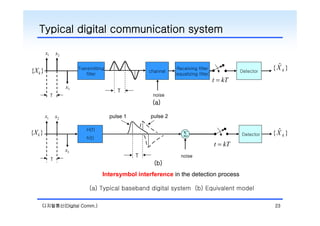
Typical digital communication system
x1

x2
Transmitting
filter

{X k }
x3

channel

T

T

Receiving filter
(equalizing filter)

Detector

ˆ
{X k }

t  kT

noise

(a)
x1

pulse 2

pulse 1

x2
H(f)

{X k }



h(t)

x3

ˆ
{X k}

t  kT
T

T

Detector

noise

(b)
Intersymbol interference in the detection process
(a) Typical baseband digital system (b) Equivalent model

디지털통신(Digital Comm.)

23
System transfer function
 Overall equivalent system transfer function

H ( f )  Ht ( f )H c ( f )H r ( f )
H ( f ) represents the composite system transfer function due
to all the filtering at various locations throughout the
transmitter/channel/receiver chain

여기서,

: transmitting filter

Hc ( f )

: filtering within the channel

Hr ( f )
디지털통신(Digital Comm.)

Ht ( f )

: receiving/equalizing filter

24
대역제한(filter)

Causal system → practical band-limited system

W 

W  j 

1



1  ( W ) 2


 ( )   tan 1 ( W )



디지털통신(Digital Comm.)

Non-causal system
-impractical

FT {e  at u (t ), a  0} 

1
a  jw

M ( )  H ( ) 

FT

25
ISI (intersymobl interference) & cross talk
Filter

Guard time
디지털통신(Digital Comm.)

26
ISI (intersymobl interference) & cross talk
B1, B2, B3 : cutoff-frequency

(a) Pulse train
(b) Interfered by high frequency limit
(c) Interfered by low frequency limit
디지털통신(Digital Comm.)

27
해상도(resolution)
LPF (band-limited
channel) impulse
response

ISI (intersymobl interference)

디지털통신(Digital Comm.)

28
최적의 펄스 형태(optimal pulse shape)
To reduce interference
• increase the channel BW
• band-limit the transmitted pulse BW
→ overlap sync pulses
Sampling time
in receiver
Frequency response of Ideal LPF

디지털통신(Digital Comm.)

29
ISI (intersymobl interference)
- Theoretical minimum system bandwidth needed in order to Rs
symbols/s, without ISI

W  1/ 2T  Rs / 2 (Hz)
h (t )

H ( f )

h (t  T )

T



1
2T

0
(a)

1
2T

f

t

0
T

T

(b)
Nyquist channels for zero ISI

(a) Rectangular system transfer function (b) Received pulse shape ht   sinc(t / T )
디지털통신(Digital Comm.)

30
ISI (intersymobl interference)
심볼률 패킹 (symbol-rate packing)
: maximum possible symbol transmission rate per hertz

Rs
Rs

2
W Rs / 2

(symbol/s/Hz) : zero ISI
W

※ R
s

: normalized bandwidth (Hz/symbol/s)

Problem)
• Zero ISI only when the sampling is performed at exactly the correct
sampling time
• When tails are large, small timing errors will result in ISI

디지털통신(Digital Comm.)

31
ISI (intersymobl interference)
 Pulse shaping to reduce ISI
 올림 코사인 필터 (raised cosine filter)
Commonly used filter of f(t)
이론적인 최소의 대역폭을 초과하는 대역폭 필요

T

T 
 

H ( )   1  sin 
(   W ) 
 2W

2 
0


디지털통신(Digital Comm.)

, 0    (1   )W
, (1   )W    (1   )W
,   (1   )W .

32
ISI (intersymobl interference)
상승 코사인(raised cosine) pulse

 sin Wt  cos Wt 
h(t )  

 1  (2Wt  ) 2 

 Wt 


디지털통신(Digital Comm.)

33
ISI (intersymobl interference)
- Excess bandwidth : w  W


W
W0  1 / 2T

 W0

: 절대 대역폭
: minimum nyquist bandwidth

- 롤오프 계수 (roll-off factor) :

 

(W  W 0 )  w

W0
W0

measure of the excess
bandwidth of the filter

 0

: case of minimum nyquist bandwidth

 1

: excess bandwidth = 100%
1 symbol/s/Hz의 심볼률 패킹을 얻음

-일반적인 관계

1
W  (1   ) Rs
2

; Baseband transmission

W  (1   ) Rs

;Bandpass transmission

디지털통신(Digital Comm.)

34
예) Digital Satellite Receiver




Fully DVB-S/MPEG-2 Compliant
• Highly Sensitive, Low Eb/No Tuner (920-2150MHz)
• QPSK Demodulator with Symbol Rate 2-50MS/s,SCPC and MCPC Compatible
• 10 Level LED Signal Strength Indicator
• Memory Space Capable of 1200 Channels
• Max.16 Satellite Input Support
• Automatic NTSC/PAL Detection
• Auto Searching Satellite Programs
• Auto Memorization of Frequency Deviation for Fast Program Searching
• Manual Edit Video, Audio, TTX and PCR PIDs etc
• Favorite Channels Support
• Parental Lock Function
• RF Modulator(CH 21-69)
• 32 Step Volume Control
• Compatible with CCIR/ITU-R Broadcast
• DiSEqC 1.0 LNB Control Protocol Support
• 0/12V, 13/18V, 22KHz for LNB Switching
• Software Upgradable Via RS-232
• Mechanical Polarizer Control(+5V Pulse GND)
GENERAL
- Colour OSD, Easy-to-Use Menu
- Operating Temp. -5° C to+50°C
- Power Supply Voltage...85 to 265V AC50/60Hz
- Main Power ON/OFF Switch
- Power Consumption Max, 30W .(Stand by 5W)
- Weight Approx. 2.8Kg
DEMODULATOR

http://www.digicomcatv.com/dsreceiver.php



-

Waveform QPSK
Symbol Rate 2-50MS/s
Roll off Factor 0.35
Outer Decoder Reed-Solomon (204,188,8)
Code Rate 1/2, 2/3, 3/4, 5/6, 7/8
SCPC and MCPC Compatible
Audio Decoder MPEG-1 Layer I and II
Audio Channel Mono, Dual Channels, Stereo
Volume Control 32 Steps Adjustable.

디지털통신(Digital Comm.)

35
Eye pattern
 아이 패턴 (eye pattern)
기저대역 신호에 대한 시스템의 응답을 측정하여 오실로스코프로 표
시
 최적의 표본화 시간은 최대의 눈 개방(eye opening)에 상응하며 잡음
으로부터 신호를 최대한 보호
 심볼 간 간섭이 증가할 수록 눈이 감겨지고, 심볼 간 간섭이 감소할 수
록 눈이 떠짐

송신부
디지털통신(Digital Comm.)

수신부
36
Eye pattern
최적 표본화 시간
시간 오류에
대한 민감도

심볼 간 간섭에
의한 왜곡

시간 지터
(timing jitter)의
측정값

잡음 마진
(noise margin)

심볼 간 간섭에 의한 아이 패턴

디지털통신(Digital Comm.)

37
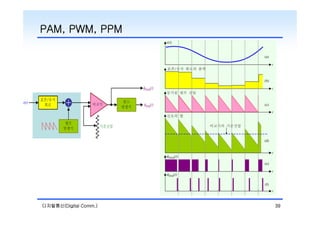
PAM, PWM, PPM



 t  nTs 
[ x(nTs )  C ]rect

 PAM (t ) 
  
n  


, C  x(t ) max






 t  nTs 
rect

 PWM (t ) 
  
n  


,   kW x(nTs )  C


, kW x(t ) max  C  Ts  kW x(t ) max .





 t  nTs  a 
rect

 PPM (t ) 



n  


, a  k P x(nTs )  C


, k P x(t ) max  C  Ts    k P x(t ) max .








디지털통신(Digital Comm.)

38
PAM, PWM, PPM

디지털통신(Digital Comm.)

39

디지털통신 7

  • 1.
  • 2.
    Contents Sampling theory Pulse Modulation PAM (Pulse Amplitude Modulation)  PWM (Pulse Width Modulation)  PPM (Pulse Position Modulation) Multiplexing  FDM  TDM 디지털통신(Digital Comm.) 2
  • 3.
    기저대역 시스템 (Basebandsystem) Digital information Information source Character information •PAM •PWM •PPM PCM Analog information Sampling Quantization Encoding Pulse modulation 형식화(Formatting) Analog information Information sink LPF Decoding TX Channel Demodulation /detection RX Character information Digital information 형식화(Formatting) 및 기저대역(baseband) 신호 전송 디지털통신(Digital Comm.) 3
  • 4.
    Sampling 참고 : http://www.engr.usask.ca/classes/EE/352/virtual_labs.htm Sampling theory  Ideal sampling(=impulse sampling) analog signal x(t ) has a bandwidth x (t )  fm    (t  nT ) n   Ts :sampling period s x s ( t )  x ( t ) x ( t )    x ( nT n   1 X  ( f )  F [ x  ( t )]  Ts s ) ( t  nT s )  (f n   fs  1 X s ( f )  X ( f )* X  ( f )  Ts 디지털통신(Digital Comm.)   nf s ) 1 : sampling frequency Ts  n   X ( f  nf s ) 4
  • 5.
    Sampling analog signal x(t) has a bandwidth f m | X (f)| x ( t ) t 0 x (t )    n   1 X ( f )  Ts  ( t  nT s ) … … -4Ts -2Ts 2Ts 4Ts 0 0 2Ts 4Ts  (f n t -2fs  nf s ) … … -fs x s (t )  x (t ) x (t ) -4Ts -2Ts f -fm 0 fm 0 f 2fs fs | X (f)| t … … -2fs -fs 0 fs 2fs f Impulse sampling 디지털통신(Digital Comm.) 5
  • 6.
    Sampling |Xs( f )| Filterproperty to restore the original signal from sampled signal -2fs -fs -fm 0 fm fs 2fs f (a) |Xs( f )| -2fs -fs Sampling theory 0 fs 2fs fs  2 fm f (b) (a) 디지털통신(Digital Comm.) f s  2 f m (b) fs  2 fm aliasing 6
  • 7.
    Sampling  example  음성신호가3400Hz의 최대주파수를 가질때 Nyquist 표본화 정리에 의하면 원래의 신호로 완전하게 복원시키려면 최소한 초당 몇번을 표 본화해야 하는가? f s  2 f max  2  3400  6800 Hz이상  어떤 신호가 25KHz로 대역제한되어있다. Nyquist 율을 만족하는 최 소표본화주기를 구하라 f s  2 f max  2  25000  50 KHz이상 Ts  1 1   20  s f s 50 KHz  음성신호를 3KHz로 대역제한해서 Nyquist율로 표본화한 후, 각 표본 을 7bit로 A/D변환하여 전송하려고 할때 전송율은? 2  3000 sample/sec  7  42Kbps 디지털통신(Digital Comm.) 7
  • 8.
    Sampling methods ~ ~ Instantaneous sampling Idealsampling (using impulse train) F  Ts (t )  s  s ( )  2   s    Ts    ~   s ( )    (  k ) s k   PAM (t )  T (t )  p(t ) x s Realistic sampling (using rectangular pulse train) ■ sampling theory 디지털통신(Digital Comm.)  s   max   max  s  2 max 8
  • 9.
  • 10.
    펄스진폭 변조(PAM) 자연 표본화 (Naturalsampling) 평탄 표본화 (Flat-top sampling) 디지털통신(Digital Comm.) 10
  • 11.
    펄스진폭 변조(PAM) 자연 표본화(Naturalsampling)  PAM (t )  x(t ) pTs (t ) p (t )  rect (t  )    P( )  sinc   2  ~ pTs (t )  p(t )   Ts (t ) ~ F [ pTs (t )]  F [ p(t )   Ts (t )] ~  F [ p (t )]F [ Ts (t )] ~   s P ( )  s ( ).     ssinc  2   s ~   s ( )    k  sinc s  2 k      (  k s )     c  (  k ). k s k   디지털통신(Digital Comm.) 11
  • 12.
    펄스진폭 변조(PAM)  F [pTs (t )]   c  (  k ) k s k    k   ck   ssinc s .  2  x *  PAM (t )  x(t ) pTs (t )    c  (  k ) k  k s  PAM ( )  F [ PAM (t )]  F [ x(t ) pTs (t )]  1 F [ x(t )]  F [ pTs (t )] 2   = =  1 X ( )  ck  (  k s ) 2 k      ck X (  k s ). 2 k   시간상의 표본화는 주파수상에서 의 주기화를 일으킨다 디지털통신(Digital Comm.) 12
  • 13.
    Natural sampling  A2 kHz sinusoid was sampled at 10 kHz while the sampling pulse duty cycle was increased from 10% to 50%. The power increases with the duty cycle of the sampling pulse. Duty cycle 10% 20% 디지털통신(Digital Comm.) 13
  • 14.
  • 15.
    Natural sampling  A2 kHz sinusoid was sampled with a 25% duty cycle while the sampling frequency was increased from 10 kHz to 25 kHz. The spectrum indicates that it would be less difficult to filter out the 2 kHz sinusoid from the samples that are of higher frequency. Sampling freq. 10KHz 20KHz 디지털통신(Digital Comm.) 15KHz 25KHz 15
  • 16.
    Natural sampling  50%Natural Sampling of a Sinusoid  This simulation shows time and frequency domain representations of a naturally sampled sinusoid. To run the simulation, matlab simulink file : natsamp1.mdl "Mouse Over" the Spectrum Analyzer or Scope in the Simulink model to see the output. 디지털통신(Digital Comm.) 16
  • 17.
    펄스진폭 변조(PAM) ■ 자연표본화(natural sampling)에서의 재구성(interpolation) 대역제한 내삽은 ideal LPF 사용한다 : 구현 불 가능 디지털통신(Digital Comm.) 17
  • 18.
    Sampling & Reconstruction A 2 kHz, 1.5 Vp-p sinusoid was sampled at 10 kHz with a 33% duty cycle. The filtered output is displayed on the bottom trace of the scope. Sampling circuit (a) 디지털통신(Digital Comm.) 18 (c) (d)
  • 19.
    펄스진폭 변조(PAM) 평탄 표본화(flat-topsampling) PAM (t )  T (t )  p(t ) x s ~ Ts (t )  x(t )Ts (t )  x   x(kT ) (t  kT ) n   s s    PAM (t )  Ts (t )  p(t )  p(t )    x(kTs ) (t  kTs ) x  k      x(kT )[ p(t )   (t  kT )]   x(kT ) p(t  kT ) n   디지털통신(Digital Comm.)  s s n   s s 19
  • 20.
  • 21.
    펄스진폭 변조(PAM) ■ 평탄표본화(flat-top sampling)에서의 재구성(interpolation) Equalizer : P(w)의 영향을 보상해주기 위해 사용  Flat-top sampling된 PAM signal를 복원하기 위해 LPF를 통과시키 면 신호의 왜곡 (signal distortion) 발생 [solution]  1. sampling pulse duration(τ) << sampling period( Ts )  2. LPF + equalizer (inverse transfer function of P(w)) equalizer : used to remove the distortion of band-limited pulse 디지털통신(Digital Comm.) 21
  • 22.
    펄스진폭 변조(PAM) 표본/유지 회로(Sample& hold circuit) Flat-top sampling PAM modulation Flat-top sampling PAM demodulation  Sample & hold circuit  충전과 방전을 이용한 평탄 특성 생성  Flat-top PAM 신호의 복조(demodulation)에도 이용 디지털통신(Digital Comm.) 22
  • 23.
    Typical digital communicationsystem x1 x2 Transmitting filter {X k } x3 channel T T Receiving filter (equalizing filter) Detector ˆ {X k } t  kT noise (a) x1 pulse 2 pulse 1 x2 H(f) {X k }  h(t) x3 ˆ {X k} t  kT T T Detector noise (b) Intersymbol interference in the detection process (a) Typical baseband digital system (b) Equivalent model 디지털통신(Digital Comm.) 23
  • 24.
    System transfer function Overall equivalent system transfer function H ( f )  Ht ( f )H c ( f )H r ( f ) H ( f ) represents the composite system transfer function due to all the filtering at various locations throughout the transmitter/channel/receiver chain 여기서, : transmitting filter Hc ( f ) : filtering within the channel Hr ( f ) 디지털통신(Digital Comm.) Ht ( f ) : receiving/equalizing filter 24
  • 25.
    대역제한(filter) Causal system →practical band-limited system W   W  j   1    1  ( W ) 2    ( )   tan 1 ( W )    디지털통신(Digital Comm.) Non-causal system -impractical FT {e  at u (t ), a  0}  1 a  jw M ( )  H ( )  FT 25
  • 26.
    ISI (intersymobl interference)& cross talk Filter Guard time 디지털통신(Digital Comm.) 26
  • 27.
    ISI (intersymobl interference)& cross talk B1, B2, B3 : cutoff-frequency (a) Pulse train (b) Interfered by high frequency limit (c) Interfered by low frequency limit 디지털통신(Digital Comm.) 27
  • 28.
    해상도(resolution) LPF (band-limited channel) impulse response ISI(intersymobl interference) 디지털통신(Digital Comm.) 28
  • 29.
    최적의 펄스 형태(optimalpulse shape) To reduce interference • increase the channel BW • band-limit the transmitted pulse BW → overlap sync pulses Sampling time in receiver Frequency response of Ideal LPF 디지털통신(Digital Comm.) 29
  • 30.
    ISI (intersymobl interference) -Theoretical minimum system bandwidth needed in order to Rs symbols/s, without ISI W  1/ 2T  Rs / 2 (Hz) h (t ) H ( f ) h (t  T ) T  1 2T 0 (a) 1 2T f t 0 T T (b) Nyquist channels for zero ISI (a) Rectangular system transfer function (b) Received pulse shape ht   sinc(t / T ) 디지털통신(Digital Comm.) 30
  • 31.
    ISI (intersymobl interference) 심볼률패킹 (symbol-rate packing) : maximum possible symbol transmission rate per hertz Rs Rs  2 W Rs / 2 (symbol/s/Hz) : zero ISI W ※ R s : normalized bandwidth (Hz/symbol/s) Problem) • Zero ISI only when the sampling is performed at exactly the correct sampling time • When tails are large, small timing errors will result in ISI 디지털통신(Digital Comm.) 31
  • 32.
    ISI (intersymobl interference) Pulse shaping to reduce ISI  올림 코사인 필터 (raised cosine filter) Commonly used filter of f(t) 이론적인 최소의 대역폭을 초과하는 대역폭 필요 T  T     H ( )   1  sin  (   W )   2W  2  0  디지털통신(Digital Comm.) , 0    (1   )W , (1   )W    (1   )W ,   (1   )W . 32
  • 33.
    ISI (intersymobl interference) 상승코사인(raised cosine) pulse  sin Wt  cos Wt  h(t )     1  (2Wt  ) 2    Wt   디지털통신(Digital Comm.) 33
  • 34.
    ISI (intersymobl interference) -Excess bandwidth : w  W  W W0  1 / 2T  W0 : 절대 대역폭 : minimum nyquist bandwidth - 롤오프 계수 (roll-off factor) :   (W  W 0 )  w  W0 W0 measure of the excess bandwidth of the filter  0 : case of minimum nyquist bandwidth  1 : excess bandwidth = 100% 1 symbol/s/Hz의 심볼률 패킹을 얻음 -일반적인 관계 1 W  (1   ) Rs 2 ; Baseband transmission W  (1   ) Rs ;Bandpass transmission 디지털통신(Digital Comm.) 34
  • 35.
    예) Digital SatelliteReceiver   Fully DVB-S/MPEG-2 Compliant • Highly Sensitive, Low Eb/No Tuner (920-2150MHz) • QPSK Demodulator with Symbol Rate 2-50MS/s,SCPC and MCPC Compatible • 10 Level LED Signal Strength Indicator • Memory Space Capable of 1200 Channels • Max.16 Satellite Input Support • Automatic NTSC/PAL Detection • Auto Searching Satellite Programs • Auto Memorization of Frequency Deviation for Fast Program Searching • Manual Edit Video, Audio, TTX and PCR PIDs etc • Favorite Channels Support • Parental Lock Function • RF Modulator(CH 21-69) • 32 Step Volume Control • Compatible with CCIR/ITU-R Broadcast • DiSEqC 1.0 LNB Control Protocol Support • 0/12V, 13/18V, 22KHz for LNB Switching • Software Upgradable Via RS-232 • Mechanical Polarizer Control(+5V Pulse GND) GENERAL - Colour OSD, Easy-to-Use Menu - Operating Temp. -5° C to+50°C - Power Supply Voltage...85 to 265V AC50/60Hz - Main Power ON/OFF Switch - Power Consumption Max, 30W .(Stand by 5W) - Weight Approx. 2.8Kg DEMODULATOR http://www.digicomcatv.com/dsreceiver.php  - Waveform QPSK Symbol Rate 2-50MS/s Roll off Factor 0.35 Outer Decoder Reed-Solomon (204,188,8) Code Rate 1/2, 2/3, 3/4, 5/6, 7/8 SCPC and MCPC Compatible Audio Decoder MPEG-1 Layer I and II Audio Channel Mono, Dual Channels, Stereo Volume Control 32 Steps Adjustable. 디지털통신(Digital Comm.) 35
  • 36.
    Eye pattern  아이패턴 (eye pattern) 기저대역 신호에 대한 시스템의 응답을 측정하여 오실로스코프로 표 시  최적의 표본화 시간은 최대의 눈 개방(eye opening)에 상응하며 잡음 으로부터 신호를 최대한 보호  심볼 간 간섭이 증가할 수록 눈이 감겨지고, 심볼 간 간섭이 감소할 수 록 눈이 떠짐 송신부 디지털통신(Digital Comm.) 수신부 36
  • 37.
    Eye pattern 최적 표본화시간 시간 오류에 대한 민감도 심볼 간 간섭에 의한 왜곡 시간 지터 (timing jitter)의 측정값 잡음 마진 (noise margin) 심볼 간 간섭에 의한 아이 패턴 디지털통신(Digital Comm.) 37
  • 38.
    PAM, PWM, PPM   t  nTs  [ x(nTs )  C ]rect   PAM (t )     n     , C  x(t ) max      t  nTs  rect   PWM (t )     n     ,   kW x(nTs )  C   , kW x(t ) max  C  Ts  kW x(t ) max .       t  nTs  a  rect   PPM (t )     n     , a  k P x(nTs )  C   , k P x(t ) max  C  Ts    k P x(t ) max .      디지털통신(Digital Comm.) 38
  • 39.